Key Takeaway
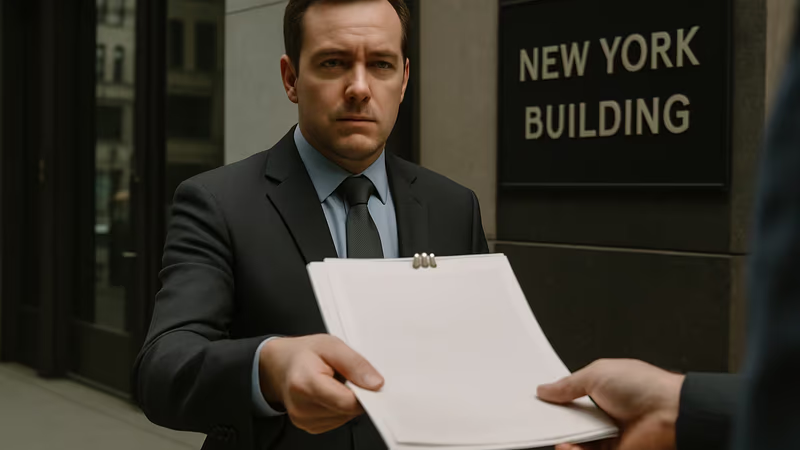
New York court ruling on e-filing deadlines and venue change motions.
This article is part of our ongoing procedural issues coverage, with 187 published articles analyzing procedural issues issues across New York State. Attorney Jason Tenenbaum brings 24+ years of hands-on experience to this analysis, drawing from his work on more than 1,000 appeals, over 100,000 no-fault cases, and recovery of over $100 million for clients throughout Nassau County, Suffolk County, Queens, Brooklyn, Manhattan, and the Bronx. For personalized legal advice about how these principles apply to your specific situation, contact our Long Island office at (516) 750-0595 for a free consultation.
Electronic filing has fundamentally transformed New York civil practice, replacing traditional paper filing and mail service with instantaneous digital submission. While e-filing offers numerous advantages—immediate confirmation of filing, elimination of courthouse trips, and streamlined case management—it also introduces new procedural pitfalls that can trap unwary practitioners. The transition from paper to electronic systems has created a hybrid period where attorneys must navigate both traditional and electronic filing rules, and misunderstanding which rules apply can result in dismissed motions, waived rights, and malpractice exposure.
The critical principle established in Woodward v Millbrook Ventures LLC is deceptively simple: when you consent to e-filing, electronic service controls your deadlines, regardless of whether you also serve papers through traditional means. This represents a fundamental departure from the familiar CPLR 2103(b)(2) rule that added extra days for mail service. Under the traditional rule, attorneys could serve papers by mail and gain additional time for responses based on the mailing date. But e-filing eliminates this cushion—the filing date becomes the service date, and deadlines run immediately.
The Woodward decision demonstrates how this principle operates in practice. CPLR 511 requires parties demanding a change of venue to bring their motion within fifteen days of serving the demand. Under the old paper system, defendants could have served the demand by mail and potentially argued for additional time based on mailing delays. But having consented to e-filing, the defendants triggered a strict fifteen-day deadline running from the electronic filing date. Their two-day delay proved fatal, and the First Department had no discretion to excuse the untimely motion.
Case Background
Defendants in Woodward v Millbrook Ventures LLC faced a lawsuit in New York County and sought to change venue to a different county. They consented to participate in the Supreme Court’s e-filing system, as required under Uniform Rules for Trial Courts § 202.5-b. On July 14, 2015, they electronically filed their answer together with a demand for change of venue. The defendants also served these documents via United States mail, perhaps hoping to preserve traditional mail service timing rules.
Free Consultation · No Fee Unless We Win
Does this apply to your situation?
Every case is different. Get a free, confidential case review from an experienced attorney who can tell you exactly where you stand.
CPLR 511 establishes a strict procedural requirement: after serving a demand for change of venue, the demanding party must bring their motion within fifteen days. The defendants’ electronic filing on July 14 triggered this deadline, requiring them to file their motion by July 29, 2015. However, they did not file the motion until July 31, 2015—two days late. The defendants argued their concurrent mail service should extend the deadline under CPLR 2103(b)(2), but the Supreme Court rejected this argument and denied the motion as untimely.
Jason Tenenbaum’s Analysis
Woodward v Millbrook Ventures LLC 2017 NY Slip Op 02522 (1st Dept. 2017)
“Supreme Court properly concluded that defendants’ motion was untimely. Having consented to electronic filing, defendants were required to serve their papers electronically (Uniform Rules for Trial Cts § 202.5-b), and indeed served their demand for change of venue, together with their answer, by e-filing the documents on July 14, 2015 (22 NYCRR 202.5-b). Having served their demand, defendants were required to bring their motion to change venue within 15 days, or by July 29, 2015 (CPLR 511). However, defendants did not bring their motion until July 31, 2015, rendering it untimely. That defendants also elected to serve their demand via United States mail did not extend the deadline for their motion under CPLR 2103(b)(2). Because they consented to participate in Supreme Court’s e-filing system, defendants were bound by the applicable rules governing service”
The e-filing world is the present and the future. At some point, OCA or the Legislature will mandate e-filing state-wide for all courts of record. I doubt village courts will ever become e-filing courts, but they are not courts of record and exist in their own sordid manner.
The point here is that unless you perform an act on the e-filing system, it never happened.
The Respondent in this case is a no-fault legend emeritus and someone I consider a friend, Amos Weinberg, Esq. While I did email you privately, I will publicly state you did a good job on this one Amos.
Legal Significance and Broader Implications
The Woodward decision establishes several important principles that extend beyond venue change motions. First, it confirms that consent to e-filing constitutes a binding election governing all procedural aspects of service. Parties cannot cherry-pick favorable aspects of both electronic and traditional filing systems. Once you consent to e-filing, you operate entirely within that framework, and traditional timing rules no longer provide safety nets.
Second, the decision demonstrates courts’ unwillingness to excuse technical violations of e-filing deadlines. The two-day delay might seem trivial, but the Appellate Division found no room for equitable consideration. Unlike some procedural rules that permit judicial discretion to excuse minor delays upon a showing of good cause, CPLR 511’s venue change deadline appears to be strictly enforced. This reflects broader judicial concern about maintaining predictable deadlines in an e-filing system where parties receive immediate notice.
Third, the case illustrates how e-filing systems create documentary proof of filing dates that eliminate factual disputes about when service occurred. In the paper filing era, parties could sometimes dispute mailing dates, postal delays, or receipt dates. E-filing systems generate timestamped confirmation of filing, creating irrefutable evidence of when documents were filed and served.
Practical Guidance for Practitioners
Attorneys practicing in New York’s e-filing courts must adopt new habits to avoid the Woodward trap. First, when calculating deadlines after e-filing service, use the filing date as the service date and do not add extra days for mail service. Create calendar reminders that account for the compressed timeline.
Second, do not rely on concurrent mail service to extend e-filing deadlines. While serving papers through multiple methods might seem prudent for ensuring actual notice, it provides no timing benefits in e-filing cases. The electronic filing controls, and mail service becomes legally irrelevant for deadline calculation purposes.
Third, understand that e-filing systems often require action earlier in the day than traditional filing. Courthouses typically accepted paper filings until 5:00 PM, but some e-filing systems impose earlier cutoff times or require time for county clerk review before documents are deemed filed. Attorneys should file motions and other time-sensitive documents well before midnight on the deadline date to avoid technical rejections or system failures that could render filings untimely.
Fourth, when handling venue change demands specifically, practitioners must move with particular speed. The fifteen-day CPLR 511 deadline leaves little margin for error. Attorneys should prepare motion papers before or simultaneously with serving the demand, enabling immediate filing once the demand is served.
Related Articles
- Understanding litigation delay tactics and procedural requirements in no-fault cases
- Single motion rule and statute of limitations procedural requirements
- How form defects can be corrected through proper reply procedures
- Second chances in motion practice when parties make procedural mistakes
- New York No-Fault Insurance Law
Legal Context
Why This Matters for Your Case
New York law is among the most complex and nuanced in the country, with distinct procedural rules, substantive doctrines, and court systems that differ significantly from other jurisdictions. The Civil Practice Law and Rules (CPLR) governs every stage of civil litigation, from service of process through trial and appeal. The Appellate Division, Appellate Term, and Court of Appeals create a rich and ever-evolving body of case law that practitioners must follow.
Attorney Jason Tenenbaum has practiced across these areas for over 24 years, writing more than 1,000 appellate briefs and publishing over 2,600 legal articles that attorneys and clients rely on for guidance. The analysis in this article reflects real courtroom experience — from motion practice in Civil Court and Supreme Court to oral arguments before the Appellate Division — and a deep understanding of how New York courts actually apply the law in practice.
About This Topic
Procedural Issues in New York Litigation
New York civil procedure governs every stage of litigation — from pleading requirements and service of process to motion practice, discovery deadlines, and trial procedures. The CPLR creates strict procedural rules that can make or break a case regardless of the underlying merits. These articles examine the procedural pitfalls, timing requirements, and strategic considerations that practitioners face in New York state courts, with a particular focus on no-fault insurance and personal injury practice.
187 published articles in Procedural Issues
Keep Reading
More Procedural Issues Analysis
How to Talk to a Judge in New York: What to Say, What to Avoid, and How to Present Yourself
Address the judge as 'Your Honor,' stand when you speak, wait to be recognized, and keep answers short and honest. A Long Island trial lawyer explains.
Feb 24, 2026
CPLR § 2106 Amendment Eliminates Affidavit Notarization Requirement: What This Means for New York Litigation
New York's CPLR 2106 permits affirmations in place of many sworn documents. See the 2024 and 2025 changes, exceptions, and historical case notes.
Feb 18, 2026
Can a Declaration of Non-Coverage that Arises from a Co-Defendant's Default be Considered Collateral Estoppel Against the Appearing and Answering Defendant?
Learn about collateral estoppel and privity in NY no-fault insurance cases. Expert analysis of State Farm v.
Nov 1, 2009
Defective notarization
Clarke v Scottsdale: a curable conformity omission differed from a defective notarial attestation. The insurer's motion remained denied.
Nov 16, 2014
CPLR § 2214 Motion Papers and Notice: The New York Practitioner's Guide
CPLR 2214 practitioner's guide: the 8/2 and 16/7/1 notice schedules, the good-cause gate of 2214(c), and when New York courts accept or reject late motion papers.
Apr 28, 2013
The trap called 2106
High Quality Medical applied the old CPLR 2106 rule, but also found an inadequate IME rebuttal. Learn what changed and why the evidence still matters.
Nov 14, 2010Was this article helpful?
Disclaimer: This article is published by the Law Office of Jason Tenenbaum, P.C. for informational and educational purposes only. It does not constitute legal advice, and no attorney-client relationship is formed by reading this content. The legal principles discussed may not apply to your specific situation, and the law may have changed since this article was last updated.
New York law varies by jurisdiction — court decisions in one Appellate Division department may not be followed in another, and local court rules in Nassau County Supreme Court differ from those in Suffolk County Supreme Court, Kings County Civil Court, or Queens County Supreme Court. The Appellate Division, Second Department (which covers Long Island, Brooklyn, Queens, and Staten Island) and the Appellate Term (which hears appeals from lower courts) each have distinct procedural requirements and precedents that affect litigation strategy.
If you need legal help with a procedural issues matter, contact our office at (516) 750-0595 for a free consultation. We serve clients throughout Long Island (Huntington, Babylon, Islip, Brookhaven, Smithtown, Riverhead, Southampton, East Hampton), Nassau County (Hempstead, Garden City, Mineola, Great Neck, Manhasset, Freeport, Long Beach, Rockville Centre, Valley Stream, Westbury, Hicksville, Massapequa), Suffolk County (Hauppauge, Deer Park, Bay Shore, Central Islip, Patchogue, Brentwood), Queens, Brooklyn, Manhattan, the Bronx, Staten Island, and Westchester County. Prior results do not guarantee a similar outcome.