Key Takeaway
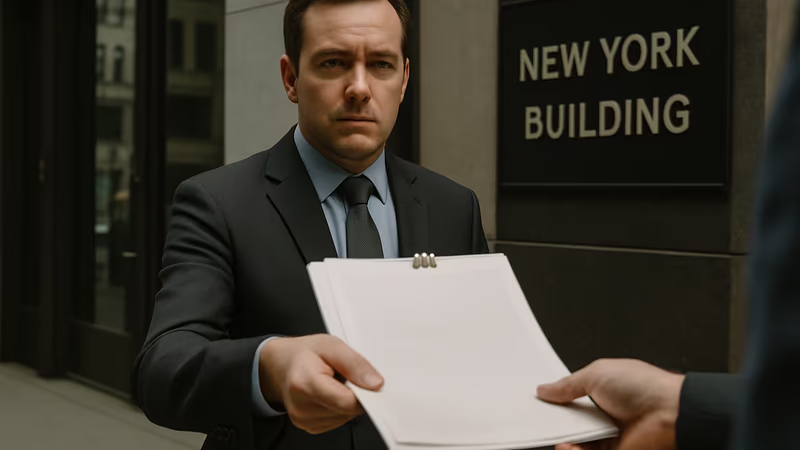
Appeals court vacates inappropriate default judgment in no-fault insurance case where trial court refused reasonable adjournment despite clear calendar confusion.
This article is part of our ongoing procedural issues coverage, with 187 published articles analyzing procedural issues issues across New York State. Attorney Jason Tenenbaum brings 24+ years of hands-on experience to this analysis, drawing from his work on more than 1,000 appeals, over 100,000 no-fault cases, and recovery of over $100 million for clients throughout Nassau County, Suffolk County, Queens, Brooklyn, Manhattan, and the Bronx. For personalized legal advice about how these principles apply to your specific situation, contact our Long Island office at (516) 750-0595 for a free consultation.
Atlantic Radiology Imaging, P.C. v Interboro Mut. Ins. Co., 2016 NY Slip Op 51031(U)(App. Term 2d Dept. 2016)
I admittedly find the extent that the judges and attorneys in the Civil Kings motion part 1) like to take defaults; and 2) refuse to vacate defaults to be alarming. There is no other Civil Court or District Court that I have practiced in where the court and judges look for reasons to default litigants.
This case and every other case I end up having to bring to the Appellate Term to vacate defaults just proves that insanity trumps reason, and not the Trump that is looking to Make America Great Again. Defendant moved for summary judgment and ancillary relief. Court found triable issue of medical necessity. Plaintiff moved for summary judgment after Defendant moved for summary judgment and received a later adjourn date. Attorney comes to court on plaintiff’s motion and told judge the issue was resolved in prior motion and there was a calendar issue so “formal” opposition was not interposed. Brief adjournment please? Clearly, nobody acted willfully or neglected the file. Plaintiff meant to make a cross-motion but made it returnable on another day. In the real world, the motions would have been heard together. In a surreal world, a one week adjournment would have been granted for a one line opposition with the order and motion papers from motion sequence number to be attached as an exhibit
Court defaulted defendant instead of adjourning the matter, which was inappropriate because the law of the case was that a triable issue of fact medical necessity. Again, do not expect anybody to go through a file and say that Plaintiff’s motion lacks merit. Defendant immediately moved to vacate and the presiding judge on the vacatur application denied the motion. No comment here. Off to the Appellate Term which vacated the order.
Free Consultation · No Fee Unless We Win
Does this apply to your situation?
Every case is different. Get a free, confidential case review from an experienced attorney who can tell you exactly where you stand.
This paradigm and variants of it represent normal behavior in the Civil Kings motion term.
A solution might be to assign cases to IAS parts, give shorter adjournments, allow 2-3 adjournments and allow greater judicial case management. The Civil Kings motion term is broken on so many levels.
Related Articles
Legal Context
Why This Matters for Your Case
New York law is among the most complex and nuanced in the country, with distinct procedural rules, substantive doctrines, and court systems that differ significantly from other jurisdictions. The Civil Practice Law and Rules (CPLR) governs every stage of civil litigation, from service of process through trial and appeal. The Appellate Division, Appellate Term, and Court of Appeals create a rich and ever-evolving body of case law that practitioners must follow.
Attorney Jason Tenenbaum has practiced across these areas for over 24 years, writing more than 1,000 appellate briefs and publishing over 2,600 legal articles that attorneys and clients rely on for guidance. The analysis in this article reflects real courtroom experience — from motion practice in Civil Court and Supreme Court to oral arguments before the Appellate Division — and a deep understanding of how New York courts actually apply the law in practice.
About This Topic
Procedural Issues in New York Litigation
New York civil procedure governs every stage of litigation — from pleading requirements and service of process to motion practice, discovery deadlines, and trial procedures. The CPLR creates strict procedural rules that can make or break a case regardless of the underlying merits. These articles examine the procedural pitfalls, timing requirements, and strategic considerations that practitioners face in New York state courts, with a particular focus on no-fault insurance and personal injury practice.
187 published articles in Procedural Issues
Keep Reading
More Procedural Issues Analysis
How to Talk to a Judge in New York: What to Say, What to Avoid, and How to Present Yourself
Address the judge as 'Your Honor,' stand when you speak, wait to be recognized, and keep answers short and honest. A Long Island trial lawyer explains.
Feb 24, 2026
CPLR § 2106 Amendment Eliminates Affidavit Notarization Requirement: What This Means for New York Litigation
New York's CPLR 2106 permits affirmations in place of many sworn documents. See the 2024 and 2025 changes, exceptions, and historical case notes.
Feb 18, 2026
Renewal and vacatur in interest of justice granted upon a release
Court decisions on renewal and vacatur motions in NY no-fault insurance cases, including releases that bar claims and late filing discretion.
May 6, 2017
CPLR 2004 allows an order to show cause to be served tardy – first holding for this proposition of law
Third Department rules CPLR 2004 allows courts to extend order to show cause service deadlines retroactively, establishing new precedent for tardy service extensions.
Jan 22, 2014
A Case and Reserves That Will Remain in Limbo: Understanding New York No-Fault Insurance Law
Learn how New York court calendar restoration rules create legal limbo for personal injury cases, keeping insurance reserves tied up indefinitely in Long Island and NYC.
Feb 3, 2012
It takes more than a mere allegation that a signature is not holographic in order to invoke the "stamped signature" rule. Also, a form defect can be fixed in reply.
Analysis of signature authenticity requirements and reply procedures in NY insurance litigation.
Feb 26, 2010Was this article helpful?
Disclaimer: This article is published by the Law Office of Jason Tenenbaum, P.C. for informational and educational purposes only. It does not constitute legal advice, and no attorney-client relationship is formed by reading this content. The legal principles discussed may not apply to your specific situation, and the law may have changed since this article was last updated.
New York law varies by jurisdiction — court decisions in one Appellate Division department may not be followed in another, and local court rules in Nassau County Supreme Court differ from those in Suffolk County Supreme Court, Kings County Civil Court, or Queens County Supreme Court. The Appellate Division, Second Department (which covers Long Island, Brooklyn, Queens, and Staten Island) and the Appellate Term (which hears appeals from lower courts) each have distinct procedural requirements and precedents that affect litigation strategy.
If you need legal help with a procedural issues matter, contact our office at (516) 750-0595 for a free consultation. We serve clients throughout Long Island (Huntington, Babylon, Islip, Brookhaven, Smithtown, Riverhead, Southampton, East Hampton), Nassau County (Hempstead, Garden City, Mineola, Great Neck, Manhasset, Freeport, Long Beach, Rockville Centre, Valley Stream, Westbury, Hicksville, Massapequa), Suffolk County (Hauppauge, Deer Park, Bay Shore, Central Islip, Patchogue, Brentwood), Queens, Brooklyn, Manhattan, the Bronx, Staten Island, and Westchester County. Prior results do not guarantee a similar outcome.