Key Takeaway
Court rules on certificate of conformity requirements for affidavits in default judgment motions, finding waiver of CPLR 2309(a) defects is permissible.
This article is part of our ongoing 2106 and 2309 coverage, with 31 published articles analyzing 2106 and 2309 issues across New York State. Attorney Jason Tenenbaum brings 24+ years of hands-on experience to this analysis, drawing from his work on more than 1,000 appeals, over 100,000 no-fault cases, and recovery of over $100 million for clients throughout Nassau County, Suffolk County, Queens, Brooklyn, Manhattan, and the Bronx. For personalized legal advice about how these principles apply to your specific situation, contact our Long Island office at (516) 750-0595 for a free consultation.
Todd v Green, 2014 NY Slip Op 08004 (2d Dept. 2014)
Law Office of Jason Tenenbaum, P.C, Garden City, N.Y., for appellant. (shameless self promotion)
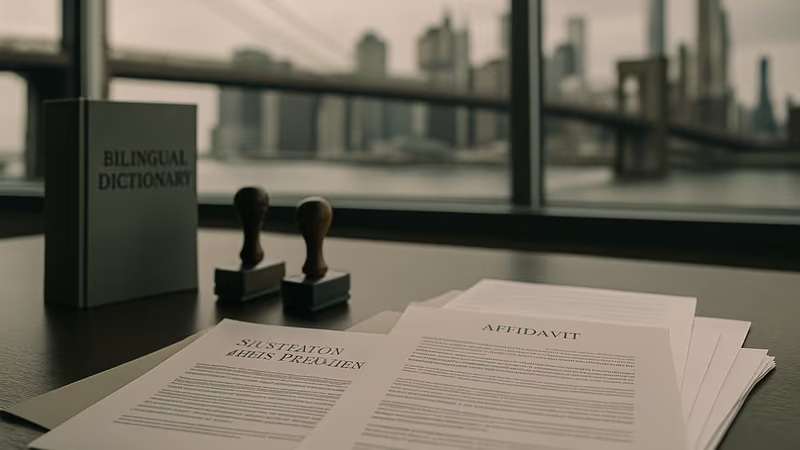
“The Supreme Court determined that the plaintiff’s affidavit of merit, notarized in Georgia, lacked a proper certificate of conformity as required by CPLR 2309(a), and denied the motion, with leave to renew upon the submission of a proper affidavit. The plaintiff appeals.”
” A party’s right to recover upon a defendant’s failure to appear or answer is governed by CPLR 3215′” (U.S. Bank, N.A. v Razon, 115 AD3d 739, 740, quoting Beaton v Transit Facility Corp., 14 AD3d 637, 637). Thus, a plaintiff moving for a default judgment against a defendant must submit proof of service of the summons and complaint, proof of the facts constituting the claim, and proof of the defaulting defendant’s failure to appear or answer (see CPLR 3215; U.S. Bank N.A. v Poku, 118 AD3d 980; U.S. Bank N.A. v Razon, 115 AD3d at 740; Dela Cruz v Keter Residence, LLC, 115 AD3d 700). Here, in support of his motion to enter a default judgment, the plaintiff met all of these requirements (see U.S. Bank N.A. v Poku, 118 AD3d 980). Although the Supreme Court found that the plaintiff’s affidavit lacked a proper certificate of conformity, it should have considered the affidavit since the absence of a certificate of conformity is not a fatal defect (see Midfirst Bank v Agho, 121 AD3d 349; Gonzalez v Perkan Concrete Corp., 110 AD3d 955, 960; Fredette v Town of Southampton, 95 AD3d 940, 942). Further, even if the subject certificate of conformity was inadequate, the defendant failed to answer or appear in opposition to the motion, and it was inappropriate for the Supreme Court to, sua sponte, raise the issue on the defendant’s behalf (see Midfirst Bank v Agho, 121 AD3d 349).
Free Consultation · No Fee Unless We Win
Does this apply to your situation?
Every case is different. Get a free, confidential case review from an experienced attorney who can tell you exactly where you stand.
The moral of the story is to take a stand when you think the Court is treating you like a no-fault defendant in Civil Kings, Special Term. The appellate courts sometimes get it right.
Related Articles
- CPLR 2309 Compliance: Navigating Notarization Requirements in New York Litigation
- CPLR 2309 Requirements: Understanding Affidavit Attestation Rules from the Appellate Division, Second Department
- Renewal Under Certain Circumstances May Be Granted to Correct an Improper Affirmation: A Comprehensive Guide to CPLR 2106 Requirements
- The Failure to Place Evidence in Proper Form Cannot Be Cured in a Supplemental Opposition
- New York No-Fault Insurance Law
Legal Update (February 2026): Since this 2014 post, CPLR 2309’s certificate of conformity requirements for out-of-state notarizations may have been subject to regulatory amendments or clarifications through subsequent court decisions and rule changes. Additionally, default judgment procedures under CPLR 3215 have been refined through ongoing appellate decisions. Practitioners should verify current provisions regarding out-of-state notarization requirements and default judgment motion standards.
Legal Context
Why This Matters for Your Case
New York law is among the most complex and nuanced in the country, with distinct procedural rules, substantive doctrines, and court systems that differ significantly from other jurisdictions. The Civil Practice Law and Rules (CPLR) governs every stage of civil litigation, from service of process through trial and appeal. The Appellate Division, Appellate Term, and Court of Appeals create a rich and ever-evolving body of case law that practitioners must follow.
Attorney Jason Tenenbaum has practiced across these areas for over 24 years, writing more than 1,000 appellate briefs and publishing over 2,600 legal articles that attorneys and clients rely on for guidance. The analysis in this article reflects real courtroom experience — from motion practice in Civil Court and Supreme Court to oral arguments before the Appellate Division — and a deep understanding of how New York courts actually apply the law in practice.
About This Topic
CPLR 2106 and 2309: Affirmation & Oath Requirements
CPLR 2106 governs who may submit an affirmation in lieu of an affidavit in New York courts, while CPLR 2309 addresses the requirements for oaths, affidavits, and the certification of out-of-state documents. These seemingly technical provisions have significant practical impact — an improperly executed affirmation or affidavit can render an entire summary judgment motion defective. These articles analyze the formal requirements, common defects, and court decisions that practitioners must navigate when preparing sworn statements.
31 published articles in 2106 and 2309
Keep Reading
More 2106 and 2309 Analysis
How to Talk to a Judge in New York: What to Say, What to Avoid, and How to Present Yourself
Address the judge as 'Your Honor,' stand when you speak, wait to be recognized, and keep answers short and honest. A Long Island trial lawyer explains.
Feb 24, 2026
CPLR § 2106 Amendment Eliminates Affidavit Notarization Requirement: What This Means for New York Litigation
New York's CPLR 2106 permits affirmations in place of many sworn documents. See the 2024 and 2025 changes, exceptions, and historical case notes.
Feb 18, 2026
An appeal from a judgment after a trial brings up for review a summary judgment motion that was not previously appealed
Understanding CPLR 5501(a)(1): How to challenge adverse summary judgment rulings on appeal from final judgment. Expert analysis of Bandler v Liberty case.
Mar 24, 2010
CPLR 2309 Certificate of Conformity: First Department Excuses the Defect Again
Donsimoni treated a missing conformity certificate as curable and rejected summary judgment. Read the actual ruling and the current affirmation alternative.
Oct 10, 2017
Declaratory judgment action given preclusive effect
Court ruling demonstrates how declaratory judgments can preclude subsequent no-fault insurance claims arising from the same accident, establishing binding legal precedent.
Mar 25, 2014
CPLR § 2221 Motions to Reargue, Renew, and Vacate: The New York Practitioner's Guide
CPLR 2221 practitioner's guide: motions to reargue under 2221(d), renew under 2221(e), and vacate sua sponte orders under 2221(a) — deadlines, leading New York cases, and practice...
Feb 17, 2012Was this article helpful?
Disclaimer: This article is published by the Law Office of Jason Tenenbaum, P.C. for informational and educational purposes only. It does not constitute legal advice, and no attorney-client relationship is formed by reading this content. The legal principles discussed may not apply to your specific situation, and the law may have changed since this article was last updated.
New York law varies by jurisdiction — court decisions in one Appellate Division department may not be followed in another, and local court rules in Nassau County Supreme Court differ from those in Suffolk County Supreme Court, Kings County Civil Court, or Queens County Supreme Court. The Appellate Division, Second Department (which covers Long Island, Brooklyn, Queens, and Staten Island) and the Appellate Term (which hears appeals from lower courts) each have distinct procedural requirements and precedents that affect litigation strategy.
If you need legal help with a 2106 and 2309 matter, contact our office at (516) 750-0595 for a free consultation. We serve clients throughout Long Island (Huntington, Babylon, Islip, Brookhaven, Smithtown, Riverhead, Southampton, East Hampton), Nassau County (Hempstead, Garden City, Mineola, Great Neck, Manhasset, Freeport, Long Beach, Rockville Centre, Valley Stream, Westbury, Hicksville, Massapequa), Suffolk County (Hauppauge, Deer Park, Bay Shore, Central Islip, Patchogue, Brentwood), Queens, Brooklyn, Manhattan, the Bronx, Staten Island, and Westchester County. Prior results do not guarantee a similar outcome.