
Key Takeaway
All-In-One awarded the provider judgment on stipulated medical records. Read the 2014 result alongside Jason's restored criticism of the trial ruling.
This article is part of our ongoing medical necessity coverage, with 170 published articles analyzing medical necessity issues across New York State. Attorney Jason Tenenbaum brings 24+ years of hands-on experience to this analysis, drawing from his work on more than 1,000 appeals, over 100,000 no-fault cases, and recovery of over $100 million for clients throughout Nassau County, Suffolk County, Queens, Brooklyn, Manhattan, and the Bronx. For personalized legal advice about how these principles apply to your specific situation, contact our Long Island office at (516) 750-0595 for a free consultation.
The provider won All-In-One despite calling no live rebuttal witness. Both parties had admitted their medical records on consent without objection. The Nassau District Court found the provider’s later treatment records sufficient to answer the insurer’s IME evidence.
Historical note: All-In-One (2014) is a Nassau District Court trial decision allowing recovery on stipulated post-IME records; Jason’s criticism below is not an appellate reversal or a current universal live-witness rule.
Last reviewed: September 2026.
All-In-One Medical Care v Government Employees, decided March 13, 2014, credited the insurer’s doctor and found an initial showing against continued therapy. The provider then supplied post-IME examination findings and treatment recommendations through the stipulated records.
Free Consultation · No Fee Unless We Win
Does this apply to your situation?
Every case is different. Get a free, confidential case review from an experienced attorney who can tell you exactly where you stand.
The court discussed Wilson v Bodian and Wagman v Bradshaw but did not choose between their approaches for a contested admission of these records. There was no such objection here. The stipulated opinions could be weighed with the other evidence.
The absent treating doctor supported only a limited adverse inference concerning the patient’s condition at the earlier IMEs. It did not defeat the otherwise sufficient proof about later treatment. Jason disagreed with parts of that reasoning. The archive should preserve his disagreement while making clear that the actual judgment favored the provider.
Jason’s original comment
These passages are restored from the version before the April 2026 expansion. Jason was criticizing the March 2014 result, not reporting a later reversal. His views on live testimony and missing-witness procedure, and his express speculation about testing, remain historical commentary. The cited case is Wilson v Bodian, despite the different spelling in the original.
This is what happens when we all stip to everything. Now, we end up in Court with the usual arbitration paradigm where a Plaintiff that provides contemporaneous treatment notes defeats the IME examination and testimony therein. This is reality.
First, at trial, Court finds Dr. Emmanuel’s testimony was sufficient to estblish a prima facie showing that further services lack medical appropriateness. Burden now shifts.
At this point, the Court discusses the fact that these notes would not come into evidence absent a proper foundation, and cites to Wilson v. Boden. The Court is correct on this score. But unobjected to hearsay is competent evidence, and I will cite to a certain Plaintiff attorney who in the middle to later 2000s reminded me of that when I used to hang out in Civil Court.
As to a missing witness instruction, this is inappropriate since the party for whom this charge will be sougth has to be on notice before he rests his case that this will be charged to the finder of fact. Defendant, presumably knowing Plaintiff’s witness list, did not put the Plaintiff known as soon as possible that it would seek a witness charge should Plaintiff not bring a witness to trial. Also, if you do not ask for a missing witness charge, you do not get it. On this record, the Court inappropriately went down a road that was never opened for traffic.
Can treatment notes at trial win the day for Plaintiff when the judge fully credited Defendant’s expert’s testimony? Probably not. This is identical to the line of cases where it was held that a peer report allowed into evidence is insufficient to satisfy a party’s prima facie showing of lack of medical appropriateness since medical necessity can only be discerned through live testimony.
But, I think if Defendant allowed these into evidence, then the Court (if not constrained by Appellate Term precedent that I think is wrong) had every right to consider these reports. Furthermore, since there was no objection to the reports coming into evidence nor was an adverse inference sought, the Court but for Appellate Term precedent to the contrary was justified in its findings of fact and conclusions of law.
However, given the state of law, Defendant should have won. Interestingly, these are the kinds of case that should be thrown into arbitration. Typed up monthly examination notes contemporaneous to the IME, along with (I am guessing) positive nerve tests and MRI’s to corroborate the functional and structural disabilities demonstrated on the clinical examination.
Connect to the Encyclopedia
Start with the medical-necessity and peer-review topic hub.
- Radiology Today: peer reports and live trial testimony
- Total Equipment: DME supplied after an IME cutoff
- Hernandez: the surgeon’s claims and summary judgment
- Mollo: competing MUA experts at trial
For review of a particular New York no-fault dispute, contact our office.
Legal Context
Why This Matters for Your Case
New York law is among the most complex and nuanced in the country, with distinct procedural rules, substantive doctrines, and court systems that differ significantly from other jurisdictions. The Civil Practice Law and Rules (CPLR) governs every stage of civil litigation, from service of process through trial and appeal. The Appellate Division, Appellate Term, and Court of Appeals create a rich and ever-evolving body of case law that practitioners must follow.
Attorney Jason Tenenbaum has practiced across these areas for over 24 years, writing more than 1,000 appellate briefs and publishing over 2,600 legal articles that attorneys and clients rely on for guidance. The analysis in this article reflects real courtroom experience — from motion practice in Civil Court and Supreme Court to oral arguments before the Appellate Division — and a deep understanding of how New York courts actually apply the law in practice.
About This Topic
Medical Necessity Disputes in No-Fault Insurance
Medical necessity is the most common basis for no-fault claim denials in New York. Insurers hire peer reviewers to opine that treatment was not medically necessary, shifting the burden to providers and claimants to demonstrate otherwise. The legal standards for establishing and rebutting medical necessity — including the sufficiency of peer review reports, the qualifications of reviewing physicians, and the evidentiary burdens at arbitration and trial — are the subject of extensive case law. These articles provide detailed analysis of medical necessity litigation strategies and court decisions.
170 published articles in Medical Necessity
Keep Reading
More Medical Necessity Analysis
MUA is dangerous
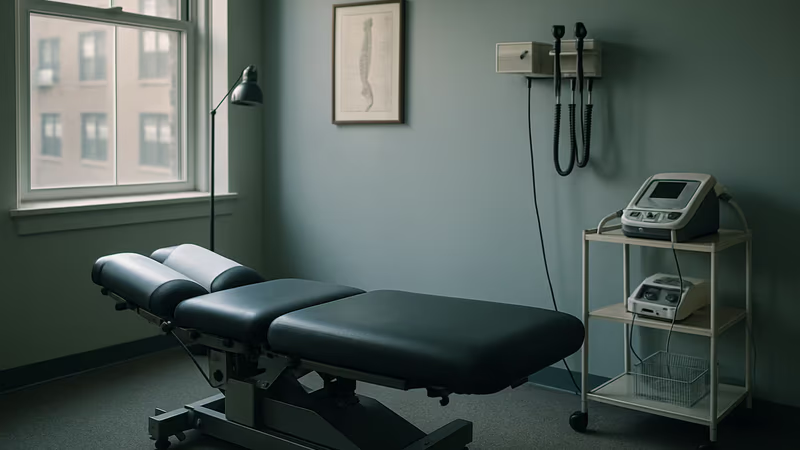
Mollo's 2020 MUA ruling turned on competing expert testimony. Read the actual trial result without treating an expert's safety concerns as a universal rule.
Mar 17, 2021
Another Medical Necessity?
DRD Medical defeated the insurer's motion in 2020. Compare the court's finding of a factual dispute with Jason's original criticism of the affidavit.
Apr 27, 2020
MUA with Straniere: Part 2
New Horizon Surgical v Allstate: Court analysis of MUA medical necessity burden of proof and expert witness testimony in New York no-fault insurance disputes.
Sep 16, 2016
A chiropractor may manipulate areas other than the vertebral column?
NY court ruling on chiropractor scope of practice beyond spinal manipulation in no-fault insurance cases.
Feb 8, 2014
First Presbyterian, then PSW – Maryland is at it again
PSW Chiropractic affirmed a provider's trial judgment in 2011. The majority deferred to credibility findings; the dissent read the evidence differently.
Sep 26, 2011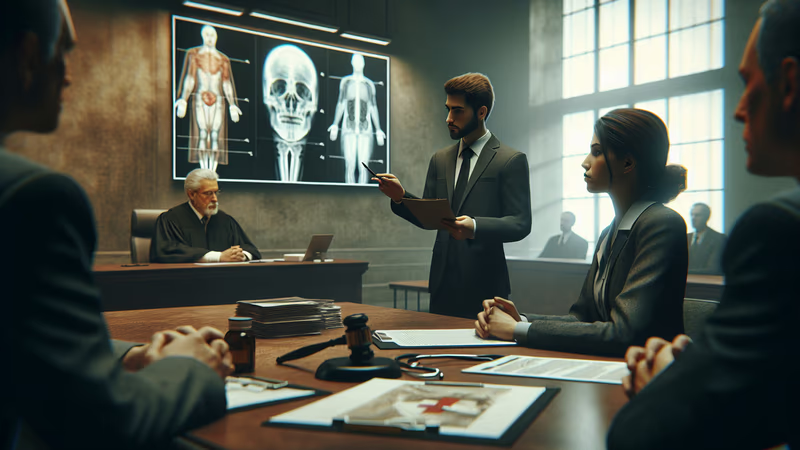
Understanding Medical Necessity Defense Failures in New York No-Fault Insurance Cases
Learn how medical necessity defenses fail in NY no-fault cases. Expert analysis of Progressive Med v Allstate reveals key evidentiary pitfalls & hearsay issues.
Feb 18, 2010Frequently Asked Questions
Common Questions About This Topic
4 answers from the firm's New York personal-injury and employment-law practice. Click any question to expand.
What happens when parties stipulate to everything in a no-fault trial?
Here, the parties limited the trial to medical necessity and admitted their respective medical records on consent without objection. That particular agreement allowed the court to consider the provider's post-IME records.
Can contemporaneous treatment notes alone defeat an IME doctor's testimony at trial?
Yes, that was the result in All-In-One. The provider called no witness, but its admitted post-IME records supplied a factual basis and medical rationale. The court found the limited adverse inference insufficient to defeat that evidence.
What is a missing witness instruction and when is it appropriate?
All-In-One drew a limited inference from the absent treating doctor about the patient's condition at the earlier IMEs. It did not treat that inference as dispositive of the later treatment records. Jason disagreed with the procedure; the opinion does not establish his account of when notice was given.
What is the burden-shifting framework in no-fault medical necessity disputes?
In this trial, the insurer's credited expert made the initial showing. The provider then met its burden with the stipulated post-IME records. The decision does not require a live rebuttal witness in every case or make an IME cutoff conclusive.
Was this article helpful?
Disclaimer: This article is published by the Law Office of Jason Tenenbaum, P.C. for informational and educational purposes only. It does not constitute legal advice, and no attorney-client relationship is formed by reading this content. The legal principles discussed may not apply to your specific situation, and the law may have changed since this article was last updated.
New York law varies by jurisdiction — court decisions in one Appellate Division department may not be followed in another, and local court rules in Nassau County Supreme Court differ from those in Suffolk County Supreme Court, Kings County Civil Court, or Queens County Supreme Court. The Appellate Division, Second Department (which covers Long Island, Brooklyn, Queens, and Staten Island) and the Appellate Term (which hears appeals from lower courts) each have distinct procedural requirements and precedents that affect litigation strategy.
If you need legal help with a medical necessity matter, contact our office at (516) 750-0595 for a free consultation. We serve clients throughout Long Island (Huntington, Babylon, Islip, Brookhaven, Smithtown, Riverhead, Southampton, East Hampton), Nassau County (Hempstead, Garden City, Mineola, Great Neck, Manhasset, Freeport, Long Beach, Rockville Centre, Valley Stream, Westbury, Hicksville, Massapequa), Suffolk County (Hauppauge, Deer Park, Bay Shore, Central Islip, Patchogue, Brentwood), Queens, Brooklyn, Manhattan, the Bronx, Staten Island, and Westchester County. Prior results do not guarantee a similar outcome.