Key Takeaway
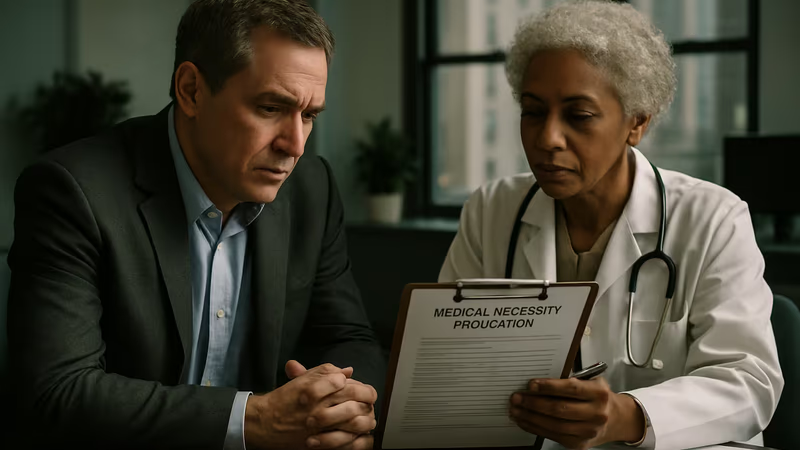
Mingmen rejected an affidavit that did not answer the IME. The opinion did not announce a two-to-three-month examination cutoff.
This article is part of our ongoing medical necessity coverage, with 170 published articles analyzing medical necessity issues across New York State. Attorney Jason Tenenbaum brings 24+ years of hands-on experience to this analysis, drawing from his work on more than 1,000 appeals, over 100,000 no-fault cases, and recovery of over $100 million for clients throughout Nassau County, Suffolk County, Queens, Brooklyn, Manhattan, and the Bronx. For personalized legal advice about how these principles apply to your specific situation, contact our Long Island office at (516) 750-0595 for a free consultation.
Mingmen is an Appellate Term decision, not an Appellate Division ruling. It rejected the affidavit submitted in that case; it did not announce that an examination automatically becomes too old after two or three months.
Last reviewed: September 2026.
Historical note: Mingmen is an Appellate Term ruling about the submitted affidavit, not a fixed examination-age rule. Read the 2018 decision.
What the opinion actually says
In Mingmen Acupuncture Services v Global Liberty, 2018 NY Slip Op 51358(U), decided September 26, 2018, the insurer established timely denials and a sworn IME explaining why further acupuncture was unnecessary. The provider’s principal submitted an affidavit that was not based on an examination and did not meaningfully rebut the examiner’s findings, including normal range-of-motion results. The Appellate Term granted dismissal.
Free Consultation · No Fee Unless We Win
Does this apply to your situation?
Every case is different. Get a free, confidential case review from an experienced attorney who can tell you exactly where you stand.
The short opinion does not describe ‘scribbled treatment notes,’ set an examination-age deadline or decide an arbitration evidentiary rule. Those subjects appear in Jason’s discussion, not in the reported holding.
Read alongside Arnica
Arnica Acupuncture v Interboard, 137 AD3d 421 (2016), is the Appellate Division authority Mingmen cites. It likewise addressed an affidavit not based on an examination and not answering objective testing. The linked Five Boro note supplies a contrasting record where medical opposition did raise a factual dispute.
Jason’s original 2018 note
Jason’s original 2018 observations follow. The timing, treatment-note descriptions and predictions about arbitration are his commentary, not a two-to-three-month cutoff adopted in the published opinion.
The test is whether there was an examination of the Assignor that did not have normal findings. The open question here is the time period of when this examination must take place. In this case, there was an examination that pre-dated the IME by 2-3 months. This was not sufficient. There was also scribbled treatment notes, but that will not carry the day. Also, do not mistake this case for the “contemporaneous” fallacy that has plagued AAA arbitrators when sizing up medical evidence.
My sense is when all the leaves on this issue are shaken out (there is more shaking going on than you are probably aware of), arbitrators may be stuck engaging in the painful task of looking at blocks of post IME treatment and determining whether they are appropriate once the presumption of medical necessity in the first instance is rebutted. That is, the Charles Sloan and Burt Feilich rule may very well be the correct statements of law.
Connect to the Encyclopedia
Start with the medical necessity and peer-review encyclopedia, then compare these records:
- Ji Sung Kim: answering an IME’s medical reasoning
- Five Boro: missing report pages and sufficient opposition
- Brooklyn Chiropractic: separate IME and peer-review claims
- Bronze Acupuncture: disagreement without supporting facts
For review of a particular no-fault dispute, contact the firm with the relevant reports and motion papers.
Legal Context
Why This Matters for Your Case
New York law is among the most complex and nuanced in the country, with distinct procedural rules, substantive doctrines, and court systems that differ significantly from other jurisdictions. The Civil Practice Law and Rules (CPLR) governs every stage of civil litigation, from service of process through trial and appeal. The Appellate Division, Appellate Term, and Court of Appeals create a rich and ever-evolving body of case law that practitioners must follow.
Attorney Jason Tenenbaum has practiced across these areas for over 24 years, writing more than 1,000 appellate briefs and publishing over 2,600 legal articles that attorneys and clients rely on for guidance. The analysis in this article reflects real courtroom experience — from motion practice in Civil Court and Supreme Court to oral arguments before the Appellate Division — and a deep understanding of how New York courts actually apply the law in practice.
About This Topic
Medical Necessity Disputes in No-Fault Insurance
Medical necessity is the most common basis for no-fault claim denials in New York. Insurers hire peer reviewers to opine that treatment was not medically necessary, shifting the burden to providers and claimants to demonstrate otherwise. The legal standards for establishing and rebutting medical necessity — including the sufficiency of peer review reports, the qualifications of reviewing physicians, and the evidentiary burdens at arbitration and trial — are the subject of extensive case law. These articles provide detailed analysis of medical necessity litigation strategies and court decisions.
170 published articles in Medical Necessity
Keep Reading
More Medical Necessity Analysis
MUA is dangerous
Mollo's 2020 MUA ruling turned on competing expert testimony. Read the actual trial result without treating an expert's safety concerns as a universal rule.
Mar 17, 2021
Another Medical Necessity?
DRD Medical defeated the insurer's motion in 2020. Compare the court's finding of a factual dispute with Jason's original criticism of the affidavit.
Apr 27, 2020
Prima facie entitlement to summary judgment was not established through an unsigned peer report
Court rules that unsigned peer review reports cannot establish prima facie entitlement to summary judgment in no-fault insurance medical necessity disputes.
Oct 8, 2010
NY Medical Necessity Challenges: Continental Medical Case Analysis
Analyzing NY no-fault medical necessity challenges from Continental Medical v.
Feb 26, 2009
Protection of the MRI facilities on medical necessity motions
Medical Arts upheld discovery during a medical-necessity motion. Read the CPLR 3214 stay exception and the limits of this 2015 MRI-provider decision.
Jul 21, 2015
A copy of a peer report is all that is needed
New York court clarifies that peer review reports need only be copies when requested by providers, and cannot be used as evidence to prove lack of medical necessity at trial.
Apr 1, 2013Was this article helpful?
Disclaimer: This article is published by the Law Office of Jason Tenenbaum, P.C. for informational and educational purposes only. It does not constitute legal advice, and no attorney-client relationship is formed by reading this content. The legal principles discussed may not apply to your specific situation, and the law may have changed since this article was last updated.
New York law varies by jurisdiction — court decisions in one Appellate Division department may not be followed in another, and local court rules in Nassau County Supreme Court differ from those in Suffolk County Supreme Court, Kings County Civil Court, or Queens County Supreme Court. The Appellate Division, Second Department (which covers Long Island, Brooklyn, Queens, and Staten Island) and the Appellate Term (which hears appeals from lower courts) each have distinct procedural requirements and precedents that affect litigation strategy.
If you need legal help with a medical necessity matter, contact our office at (516) 750-0595 for a free consultation. We serve clients throughout Long Island (Huntington, Babylon, Islip, Brookhaven, Smithtown, Riverhead, Southampton, East Hampton), Nassau County (Hempstead, Garden City, Mineola, Great Neck, Manhasset, Freeport, Long Beach, Rockville Centre, Valley Stream, Westbury, Hicksville, Massapequa), Suffolk County (Hauppauge, Deer Park, Bay Shore, Central Islip, Patchogue, Brentwood), Queens, Brooklyn, Manhattan, the Bronx, Staten Island, and Westchester County. Prior results do not guarantee a similar outcome.