Key Takeaway
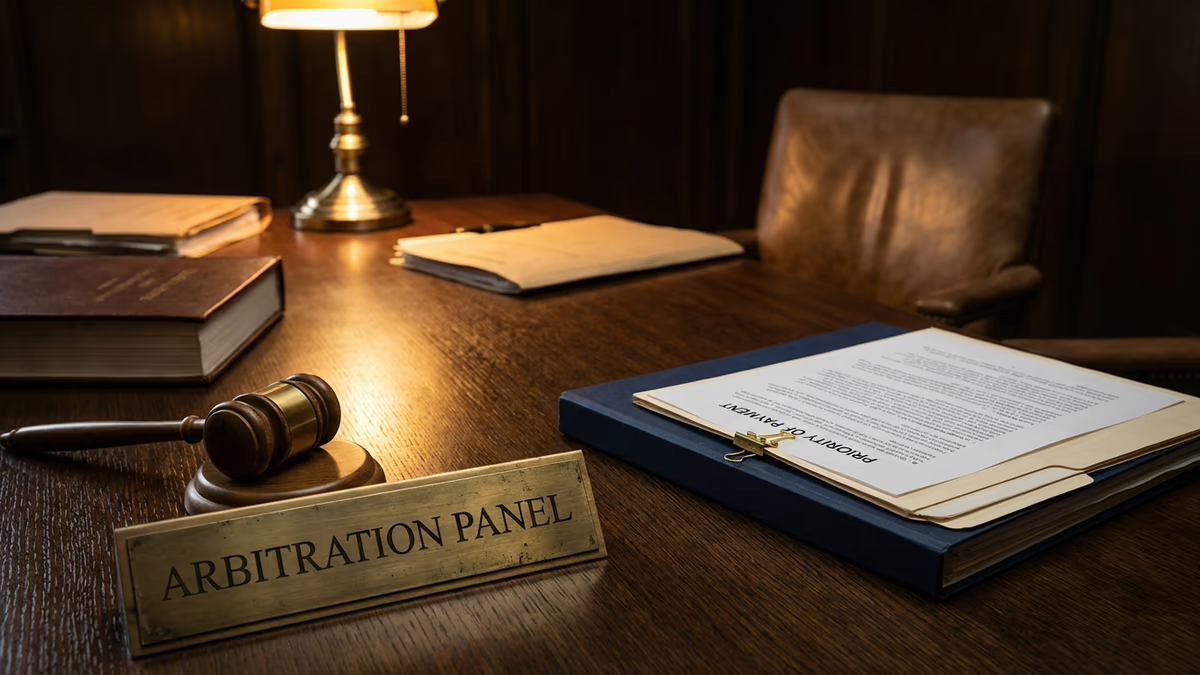
New York no-fault insurance case analysis examining peer review evidence requirements and stipulation breaches in medical necessity defenses.
This article is part of our ongoing no-fault coverage, with 271 published articles analyzing no-fault issues across New York State. Attorney Jason Tenenbaum brings 24+ years of hands-on experience to this analysis, drawing from his work on more than 1,000 appeals, over 100,000 no-fault cases, and recovery of over $100 million for clients throughout Nassau County, Suffolk County, Queens, Brooklyn, Manhattan, and the Bronx. For personalized legal advice about how these principles apply to your specific situation, contact our Long Island office at (516) 750-0595 for a free consultation.
A-Quality Med. Supply v Geico Gen. Ins. Co., 2010 NY Slip Op 20502 (Civ. Kings 2010) If you’re dealing with a no-fault insurance defense matter, an experienced attorney can help protect your rights.
So let me get this straight. The failure to produce an admissible peer review into evidence at trial precludes a party from raising a medical necessity defense? A party that stipulates to a denial being proper can still raise the issue regarding the impropriety of said denial post trial?
I am lost. Sorry.
To answer the first question, I tend to think that placing a peer report into evidence by its proponent constitutes improper bolstering and is a Trowbridge (People v Trowbridge, 305 NY 471) violation. The party opposing the peer review is free to place the peer report into evidence as an admission, although I think the better practice might be to mark it for identification and impeach the witness off of it. The signature of the peer review is relevant when it is used as an affidavit or affirmation during motion practice. Otherwise, it does not matter.
Free Consultation · No Fee Unless We Win
Does this apply to your situation?
Every case is different. Get a free, confidential case review from an experienced attorney who can tell you exactly where you stand.
Regarding the breach of the stipulation, and the court’s comment, “efendant has not provided, and the Court has not found, any authority to support the notion that plaintiff waived its ability to object to the denials during trial[,]” I would read Mid Atl. Med., P.C. v Electric Ins. Co., 26 Misc 3d 126(A)(App. Term 2d Dept. 2010) and begin writing my appeal. While I know some people have told me not to give free legal advice on here, I feel compelled to assist in the reversal of a decision that I think is just plain wrong. Also, despite the findings of the Civil Court, this case does not present any novel issues. What it does present is a perverse illustration in semantics.
Lastly, I just hope when this case gets reversed (and it should), the Appellate Term directs the entry of judgment in favor of Geico. Plaintiff played this charade and does not deserve a new trial.
Related Articles
- Understanding CPLR 3212(a): Critical Timing Rules for Summary Judgment Motions in New York
- The CPLR 3212(g) paradigm
- No-Fault Verification Requirements: When Partial Compliance Isn’t Enough
- Reasonable excuse satisfied despite claim of lack of personal jurisdiction
- New York No-Fault Insurance Law
Legal Update (February 2026): Since this 2010 analysis of peer review evidence requirements and medical necessity defense procedures, New York no-fault regulations and court interpretations regarding admissibility standards, stipulation effects, and trial procedure requirements may have been substantially modified through regulatory amendments or appellate decisions. Practitioners should verify current evidentiary rules and procedural requirements governing peer review submissions and stipulation enforcement in no-fault cases.
Legal Context
Why This Matters for Your Case
New York's no-fault insurance system, established under Insurance Law Article 51, is one of the most complex insurance frameworks in the country. Every motorist must carry Personal Injury Protection coverage that pays medical expenses and lost wages regardless of fault, up to $50,000 per person.
But insurers routinely deny valid claims using peer reviews, EUO scheduling tactics, fee schedule reductions, and coverage defenses. The Law Office of Jason Tenenbaum has handled over 100,000 no-fault cases since 2002 — from initial claim submissions through arbitration before the American Arbitration Association, trials in Civil Court and Supreme Court, and appeals to the Appellate Term and Appellate Division. Jason Tenenbaum is one of the few attorneys in the state who both writes his own appellate briefs and tries his own cases.
His 2,600+ published legal articles on no-fault practice are cited by attorneys throughout New York. Whether you are dealing with a medical necessity denial, an EUO no-show defense, a fee schedule dispute, or a coverage question, this article provides the kind of detailed case-law analysis that helps practitioners and claimants understand exactly where the law stands.
About This Topic
New York No-Fault Insurance Law
New York's no-fault insurance system requires every driver to carry Personal Injury Protection (PIP) coverage that pays medical expenses and lost wages regardless of who caused the accident. But insurers routinely deny, delay, and underpay valid claims — using peer reviews, IME no-shows, and fee schedule defenses to avoid paying providers and injured claimants. Attorney Jason Tenenbaum has litigated thousands of no-fault arbitrations and court cases since 2002.
271 published articles in No-Fault
Keep Reading
More No-Fault Analysis

Car Accident Recorded Statement in New York: Should You Give One?
The at-fault driver's adjuster wants a recorded statement within days of a New York car accident — and that call is designed to weaken your case.
Apr 5, 2026
Who Pays Car Accident Medical Bills in New York? A Step-by-Step Guide
New York no-fault PIP, primary health insurance, Medicaid/Medicare, and litigation liens — the full payment ladder for car-accident medical bills.
Apr 5, 2026
Reasonable Excuse and Law Office Failure in New York Practice
When does a busy law practice excuse a missed deadline? A look at reasonable excuse and law office failure in New York courts, plus a candid practice note.
Feb 1, 2016
The magic bus
Cuomo v Ferran upheld reargument in a Medicaid-recovery case involving dental buses. Read the procedural holding and distinguish it from no-fault law.
Oct 17, 2010
Mutual Rescheduling of EUOs and Disclaimer Timeliness in New York No-Fault Cases
Learn how mutual rescheduling of EUOs can impact disclaimer timeliness in NY no-fault cases.
Jul 13, 2022
Intention act on default
Surgicore: State Farm's evidence for a staged-accident default declaration, the separate pre-claim EUO issue, and why this was not summary judgment.
Jun 4, 2021Was this article helpful?
Disclaimer: This article is published by the Law Office of Jason Tenenbaum, P.C. for informational and educational purposes only. It does not constitute legal advice, and no attorney-client relationship is formed by reading this content. The legal principles discussed may not apply to your specific situation, and the law may have changed since this article was last updated.
New York law varies by jurisdiction — court decisions in one Appellate Division department may not be followed in another, and local court rules in Nassau County Supreme Court differ from those in Suffolk County Supreme Court, Kings County Civil Court, or Queens County Supreme Court. The Appellate Division, Second Department (which covers Long Island, Brooklyn, Queens, and Staten Island) and the Appellate Term (which hears appeals from lower courts) each have distinct procedural requirements and precedents that affect litigation strategy.
If you need legal help with a no-fault matter, contact our office at (516) 750-0595 for a free consultation. We serve clients throughout Long Island (Huntington, Babylon, Islip, Brookhaven, Smithtown, Riverhead, Southampton, East Hampton), Nassau County (Hempstead, Garden City, Mineola, Great Neck, Manhasset, Freeport, Long Beach, Rockville Centre, Valley Stream, Westbury, Hicksville, Massapequa), Suffolk County (Hauppauge, Deer Park, Bay Shore, Central Islip, Patchogue, Brentwood), Queens, Brooklyn, Manhattan, the Bronx, Staten Island, and Westchester County. Prior results do not guarantee a similar outcome.