Scenario Spoke · Catastrophic Crashes · FMCSA Regulation Deep-Dive
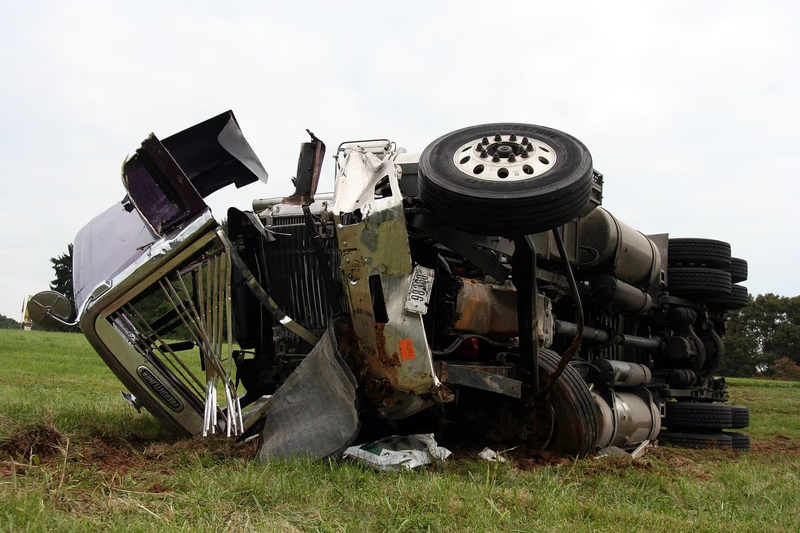
Jackknife & Rollover Truck Accident
Practitioner Guide & Litigation Framework
Jackknife and rollover crashes are the two highest-severity tractor-trailer crash modes. The mechanical, regulatory, and evidentiary framework — FMCSA cargo-securement (49 CFR Part 393), brake-maintenance (Part 396), Electronic Stability Control (FMVSS 136), and the reconstruction-engineering chain — determines whether the carrier settles within their primary policy or you reach the umbrella and reinsurance stack.
Bottom line
Jackknife and rollover crashes are catastrophic-severity events driven by a recurring set of causes: hard braking on low-friction pavement (jackknife), cargo-securement failures (rollover), Electronic Stability Control absence on pre-2017 tractors, brake-system maintenance failures, and excessive speed for conditions. The case is won or lost on the integration of ECM data, ELD logs, dashcam footage, DVIR records, FMCSA SMS scores, and reconstruction engineering. The regulatory framework — 49 CFR Part 393 Subpart I cargo securement, Part 396 inspection / maintenance, FMVSS 136 ESC — supports a negligence per se theory under New York law for every documented violation. Free consultation: (516) 750-0595.
This page covers the jackknife and rollover-specific details. It is part of our Long Island truck accident attorney practice, which explains the federal trucking rules, evidence, and liability framework that apply to every truck case we handle.
Last reviewed: May 22, 2026.
Quick Facts
Jackknife & Rollover Law — At a Glance
- Statute of limitations3 years — CPLR §214 (NY)
- Cargo securement49 CFR Part 393 Subpart I (§§393.100–393.136)
- Brake inspection/maintenance49 CFR Part 396 · DVIR §396.11 · Annual §396.17
- Electronic Stability ControlFMVSS 136 (49 CFR §571.136) — req'd on new tractors Aug 2017+
- Hours of service49 CFR Part 395 · ELD §395.8 · 11-hour driving · 14-hour duty
- Federal min. insurance$750K–$5M base · $5M–$25M+ umbrella · 49 CFR §387.9
- Crash mode frequencyRollover ≈ 4–5% of crashes · Jackknife ≈ 5–7% (FMCSA LTCCS)
- Settlement range$500K–$25M+ (catastrophic-severity weighting)
The Mechanical & Regulatory Framework
Jackknife physics and the regulatory chain
A jackknife occurs when the trailer of a tractor-trailer rotates around the fifth-wheel connection point until it forms an acute angle with the tractor. The mechanical cause is loss of traction at the tractor's drive axles combined with continued forward momentum at the trailer. The common precipitating factors are: hard braking on wet, icy, or oil-coated pavement; downhill grades exceeding tractor braking capacity; uneven brake adjustment between tractor and trailer (a Part 396 inspection failure); loss of trailer-brake response from frozen or contaminated air lines; high-speed lane-changes or evasive maneuvers; and the use of trailer brakes alone (hand valve / Johnson bar) without the tractor brakes — a driver-training failure that locks the trailer first. Jackknife crashes are largely preventable through proper braking technique, adequate following distance, and Federal Motor Vehicle Safety Standard No. 136 (Electronic Stability Control) mandated on new tractors since August 2017.
Rollover physics and the cargo-securement chain
A rollover occurs when the tractor or trailer's center of gravity moves outside its base of support, typically during a turn or evasive maneuver. The mechanical drivers are: high center of gravity (loaded tankers, dry vans with high-stacked freight, double trailers); unsecured or shifting cargo; excessive speed in turns (especially highway exit ramps designed for passenger-car speeds); aggressive evasive maneuvers; tire blowouts (particularly on trailer outboard tires); and roadway-edge pavement-drop contact. Cargo securement failures under 49 CFR Part 393, Subpart I (§§393.100–393.136) are a recurring rollover cause. Loads must be immobilized, firmly secured against shifting, and protected from falling. Specific tie-down counts depend on cargo length and weight under §393.106. Tanker rollovers — particularly with partially-loaded liquid tankers — involve unique 'liquid surge' physics where the liquid's lateral momentum continues after the tractor begins the turn, multiplying the rollover force.
FMVSS 136 Electronic Stability Control
Federal Motor Vehicle Safety Standard No. 136 (FMVSS 136), codified at 49 CFR §571.136, required Electronic Stability Control on all new truck tractors manufactured after August 1, 2017 (with three-axle tractors required to comply by that date and certain other configurations by August 2019). ESC reduces rollover risk by automatically applying selective brake force to individual wheels and reducing engine torque when the system detects an imminent rollover (roll stability control / RSC) or directional instability (yaw stability control / YSC). NHTSA estimated FMVSS 136 would prevent 40–56% of untripped rollover crashes annually. A pre-2017 tractor operating in a documented rollover-risk environment supports a theory of failure to upgrade safety-critical equipment.
Brake-system maintenance under Part 396
Air-brake-system maintenance is governed by 49 CFR Part 396. Drivers must complete a pre-trip inspection and prepare a Driver Vehicle Inspection Report (DVIR) under §396.11 documenting any defect or deficiency that would affect safe operation. The vehicle must receive an annual inspection under §396.17 by a qualified inspector. Brake-stroke measurements identify out-of-adjustment chambers under CVSA (Commercial Vehicle Safety Alliance) inspection standards. Brake-lining thickness, air-system leak testing, and ABS fault-code download from the ECM are routine inspection elements. The carrier's FMCSA Safety Measurement System (SMS) Vehicle Maintenance BASIC score is a public record showing the carrier's pattern of brake and maintenance violations — alert-status scores are particularly probative on negligent-supervision and negligent-entrustment theories.
Crash Cause Matrix
| Crash Mode | Primary Cause | Contributing FMCSA Rule | Liability Theory |
|---|---|---|---|
| Jackknife — wet pavement | Hard braking + low-friction surface | VTL §1180(a) reasonable speed; Part 392.14 hazardous conditions | Driver negligence + carrier dispatch decision |
| Jackknife — brake imbalance | Tractor/trailer brake-adjustment differential | Part 396.3 maintenance; CVSA brake-stroke | Negligence per se · carrier maintenance failure |
| Jackknife — downhill grade | Brake fade exceeding capacity | Part 392.14; carrier training records | Negligent training + driver error |
| Rollover — cargo shift | Inadequate tie-downs / WLL | Part 393.100–.136 cargo securement | Negligence per se · shipper + carrier joint |
| Rollover — tanker liquid surge | Partial load lateral surge | Part 393.106; tanker-baffle compliance | Negligent loading + driver speed selection |
| Rollover — exit-ramp speed | Excessive speed for radius | VTL §1180; FMVSS 136 ESC (if absent) | Driver negligence + equipment-upgrade failure |
| Rollover — tire blowout | Trailer outboard tire failure | Part 393.75 tire condition; Part 396 inspection | Negligence per se · maintenance failure |
| Both — driver fatigue | HOS exceeded · ELD violation | Part 395 hours of service; §395.8 ELD | Negligence per se · carrier dispatch pressure |
The Eight-Evidence Reconstruction Framework
1. ECM (Electronic Control Module)
Speed, throttle, brake application, RPM, and the final 15–30 seconds of pre-crash data. The single most important physical evidence source. Must be preserved through immediate spoliation letter.
2. ELD (Electronic Logging Device)
Hours-of-service logs under 49 CFR §395.8. Pre-crash driving hours, breaks, and rest periods. Detects HOS violations that support per-se theory.
3. Dashcam footage
Interior (driver-facing) and exterior (road-facing) cameras. Modern tractors increasingly carry both. Decisive on driver-attention and the immediate pre-crash sequence.
4. DVIR records (§396.11)
Pre-trip Driver Vehicle Inspection Reports. Documents any defect the driver identified before the trip. Annual inspection under §396.17.
5. Driver-qualification file
49 CFR §391.51. Driver training records, road-test records, prior-employer references, medical examinations, MVR (motor vehicle record).
6. FMCSA SMS scores
Carrier's public Safety Measurement System data: Unsafe Driving, HOS, Vehicle Maintenance, Crash Indicator, Hazmat, and Driver Fitness BASICs.
7. Cargo documents
Bill of Lading, loading documents, cargo-securement records. Critical in rollover cases for the per-se Part 393 Subpart I analysis.
8. Scene reconstruction
Photogrammetry, skid/yaw-mark analysis, position-at-rest evidence, cargo-displacement analysis. Performed by accident-reconstruction engineers.
Bonus: Brake-stroke gauge
CVSA-standard brake-stroke measurement of each chamber post-crash. Identifies out-of-adjustment defects under Part 396.
Jackknife & Rollover Truck Accident FAQ
Ten questions clients ask us most about catastrophic tractor-trailer crashes.
What is a jackknife and what causes it?
A jackknife occurs when the trailer of a tractor-trailer rotates around the connection point (the fifth wheel) until it forms a roughly 90-degree angle with the tractor — the trailer 'closes' on the cab like a folding pocketknife. The mechanical cause is loss of traction at the drive axles (typically the tractor's rear) combined with continued forward momentum at the trailer. Common precipitating factors: hard braking on wet, icy, or oil-coated pavement; downhill grades that exceed the tractor's braking capacity; uneven brake adjustment between the tractor and trailer (a common 49 CFR Part 396 inspection failure); loss of trailer-brake response from frozen or contaminated air lines; high-speed lane-changes or evasive maneuvers; and the use of the trailer brakes (hand valve / Johnson bar) without the tractor brakes — a common driver-training failure that locks the trailer first. Jackknife crashes are largely preventable through proper braking technique, adequate following distance, and electronic stability control (ESC) systems mandated for new tractors since 2017 under FMVSS No. 136.
What is a rollover and what causes it?
A truck rollover occurs when the tractor or trailer's center of gravity moves outside its base of support, typically during a turn or evasive maneuver. The mechanical drivers are: high center of gravity (loaded tankers, dry vans with high-stacked freight, double trailers); unsecured or shifting cargo (loads that slide laterally during turns shift the center of gravity); excessive speed in turns (especially on highway exit ramps designed for passenger-car speeds); aggressive evasive maneuvers; tire blowouts (particularly on the trailer's outboard tires); and roadway-side or shoulder-drop pavement edge contact where the wheel drops below the lane surface. Cargo securement failures under 49 CFR Part 393 (Subpart I) are a recurring cause — loads that exceed the required tie-down counts, loads on missing or damaged tie-down anchors, and improperly distributed loads that shift during transit. Tanker rollovers — particularly with partially-loaded liquid tankers — have a unique 'liquid surge' physics where the liquid's momentum continues laterally after the tractor begins the turn, multiplying the rollover force.
What FMCSA rules apply to cargo securement?
Cargo securement is governed by 49 CFR Part 393, Subpart I (§§393.100 through 393.136). The general rule (§393.100) requires that cargo be (a) immobilized during transit, (b) firmly secured against shifting, and (c) protected from falling off the vehicle. Specific minimum tie-down counts depend on cargo length and weight under §393.106 — for example, cargo less than or equal to 5 feet in length requires a minimum of one tie-down; cargo between 5 and 10 feet requires two; and so on. Specific commodities (logs, metal coils, paper rolls, concrete pipes, intermodal containers, vehicles, large boulders, flattened or crushed vehicles, roll-on/roll-off and hook lift containers) have additional category-specific rules in §§393.116 through §393.136. The Working Load Limit (WLL) of each tie-down must collectively equal at least half the weight of the cargo. Violation of any Part 393 cargo-securement rule that contributed to the crash supports a negligence per se theory against the carrier under New York law.
What electronic stability control rules apply to tractor-trailers?
Federal Motor Vehicle Safety Standard No. 136 (FMVSS 136), codified at 49 CFR §571.136, required Electronic Stability Control (ESC) on all new truck tractors manufactured after August 1, 2017 (with three-axle tractors required to comply by August 2017 and certain other configurations by August 2019). ESC reduces rollover risk by automatically applying selective brake force to individual wheels and reducing engine torque when the system detects an imminent rollover (roll stability control / RSC) or directional instability (yaw stability control / YSC). NHTSA estimated FMVSS 136 would prevent 40–56% of untripped rollover crashes. For pre-2017 tractors, ESC may have been installed as an optional aftermarket. A tractor without ESC operating in a documented rollover-risk environment (high-speed turns, downhill grades, cargo-shift conditions) supports a theory of failure to upgrade safety-critical equipment, especially when the carrier has had prior rollover events.
What is brake-system failure and how is it proven?
Air-brake-system failure in commercial vehicles is governed by 49 CFR Parts 393 (equipment) and 396 (inspection and maintenance). The proof framework involves: (1) post-crash brake inspection by a CDL-certified inspector — typically the responding NYS DOT Commercial Vehicle Enforcement Unit or NYSP Commercial Vehicle Inspection Unit; (2) the carrier's pre-crash inspection records (Driver Vehicle Inspection Reports / DVIRs required under §396.11 and §396.13, plus annual inspection under §396.17); (3) the brake-adjustment measurement using a brake-stroke gauge to identify out-of-adjustment chambers (per CVSA inspection standards); (4) the brake lining thickness inspection; (5) the air-system leak test; (6) ABS system fault-code download (most modern tractors store fault codes in the ECM); and (7) review of the carrier's FMCSA Safety Measurement System (SMS) Vehicle Maintenance BASIC score. A brake violation under Part 396 supports a negligence per se theory. The most aggressive defense theory — 'sudden brake failure' as an Act of God — is generally not available because brakes that suddenly fail nearly always reflect a documented inspection failure.
What weather factors contribute to jackknife and rollover crashes?
Weather is a contributing factor in the majority of weather-related jackknife crashes and a significant minority of rollovers. The specific risks: (1) Rain and wet pavement reduce coefficient of friction by approximately 30–50%, dramatically reducing braking traction and increasing jackknife risk on hard-braking events. (2) Ice and snow reduce friction by 70–90% in the worst conditions. (3) High crosswinds — gusts above 35–40 mph — affect high-profile loads (dry van trailers, tankers) and can initiate rollover on otherwise survivable lane departures. (4) Heavy rain or fog reduces visibility, increasing the likelihood of late-detection braking and the hard-brake jackknife sequence. (5) Black ice on bridges and overpasses creates the highest crash density per mile in winter conditions. The 'reasonable speed for conditions' standard under VTL §1180(a) means the driver bears the affirmative obligation to reduce speed below the posted limit when conditions warrant. Carriers' weather-event response plans and dispatch decisions on bad-weather routing are discoverable and frequently outcome-determinative.
What does the FMCSA crash data show about jackknife and rollover frequency?
FMCSA's Large Truck Crash Causation Study and annual Large Truck and Bus Crash Facts publications show: (1) Rollover crashes account for approximately 4–5% of large-truck crashes but a disproportionate share of fatal large-truck crashes (approximately 10–12%) — rollover is a high-severity crash type. (2) Jackknife crashes account for approximately 5–7% of large-truck crashes. (3) Driver-related factors (decisions, performance, recognition, non-performance) are coded as contributing in approximately 88% of large-truck crashes. (4) Vehicle-related factors (brakes, tires, cargo, lights) are coded as contributing in approximately 10% of large-truck crashes. (5) Environmental factors (weather, roadway, lighting) are coded as contributing in approximately 2–3%. The combination of driver-error + vehicle-defect + weather is most common in jackknife crashes; the combination of cargo-shift + speed + roadway geometry is most common in rollovers. The carrier's pre-crash conduct on driver training, dispatch routing, and equipment maintenance is the largest case-value lever.
What's the most important evidence in a jackknife or rollover case?
Eight categories of evidence are essential: (1) The truck's Electronic Control Module (ECM) data — speed, throttle, brake application, RPM, and the final 15–30 seconds of data before the crash. (2) The Electronic Logging Device (ELD) hours-of-service data under 49 CFR §395.8. (3) Dashcam footage — both interior (driver-facing) and exterior (road-facing). (4) The carrier's pre-crash Driver Vehicle Inspection Reports (DVIRs) under §396.11 and §396.13, and the annual inspection records under §396.17. (5) The carrier's driver-qualification file under §391.51 including the driver's training records, road-test records, and prior-employer references. (6) The carrier's FMCSA Safety Measurement System (SMS) scores. (7) For cargo cases, the Bill of Lading, the loading documents, and the cargo-securement records. (8) Reconstruction photogrammetry from the scene — the position of the tractor and trailer at rest, the orientation of skid and yaw marks, and the cargo-displacement evidence. The single biggest case-value driver is the integration of these eight evidence streams into a coherent reconstruction.
How much are jackknife and rollover cases worth?
Jackknife and rollover cases are typically high-severity, high-value cases because the kinetic-energy release is significantly higher than typical lower-speed truck crashes. Settlements range from $500,000 for severe but non-permanent injury cases up to $25,000,000+ for catastrophic-injury and wrongful-death cases. Case-value drivers: (1) injury severity — these cases produce disproportionately high rates of TBI, spinal cord, multi-system trauma, and death; (2) the FMCSA violation profile — documented brake-maintenance failures (49 CFR §396), cargo-securement violations (Part 393 Subpart I), hours-of-service violations (Part 395), ESC absence on pre-2017 tractors; (3) the carrier's safety-history pattern — prior similar crashes, FMCSA SMS scores in the warning or alert range, prior compliance reviews; (4) the insurance coverage stack (Class 8 carriers typically have $5M–$25M policies + reinsurance and umbrella). Use the firm's interactive settlement calculator for a preliminary estimate.
Why hire us for a jackknife or rollover case?
Jackknife and rollover litigation requires the deepest expertise in commercial-vehicle physics, FMCSA regulations, brake systems, electronic stability control, and cargo securement — combined with the trial-preparation discipline to take the case to verdict if the carrier refuses to settle. For 24 years we have prepared every truck-accident case as if it will be tried. We work with the same reconstruction engineers, brake-system specialists, biomechanics experts, and CDL-trained driver-error analysts that the carriers' defense teams retain — and we know how to neutralize their opinions through cross-examination. We litigate cases throughout New York and the region. We operate on contingency — no fee unless we win — and the initial consultation is free.
Free Consultation — Catastrophic Truck Crash
Jackknife · rollover · catastrophic injury. 24+ years of preparation discipline. $100M+ recovered. No fee unless we win.
← Return to the main Long Island Truck Accident Lawyer page · explore: Queens · Brooklyn · Nassau County · Melville · Babylon · Huntington · Suffolk County · 18-Wheeler · Amazon/FedEx/UPS