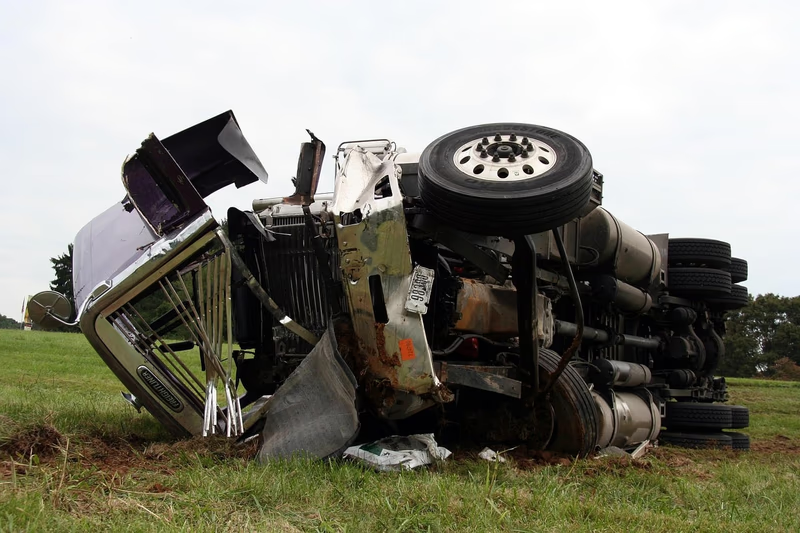
18-Wheeler · Tractor-Trailer · Semi-Truck · Class 8
Long Island 18-Wheeler & Tractor-Trailer Lawyer
FMCSA · ECM Black Box · ELD · Multi-Party Liability
Tractor-trailer crashes are the highest-value personal-injury cases in the firm — $500,000 to $10,000,000+ depending on injury severity, FMCSA regulation violations, and the insurance coverage stack. We litigate semi-truck cases in Suffolk County Supreme Court (Riverhead) and the U.S. District Court for the Eastern District of New York (Central Islip).
Bottom line
18-wheeler and tractor-trailer accidents are governed by the Federal Motor Carrier Safety Regulations (FMCSR) at 49 CFR Parts 380–399. The federal framework — driver qualification (Part 391), driving rules (Part 392), vehicle equipment (Part 393), hours-of-service (Part 395), maintenance (Part 396), and minimum insurance (Part 387) — drives every liability analysis. ECM black-box data and ELD hours-of-service logs are the decisive electronic evidence. The single most important post-crash action is a spoliation letter to preserve the ECM, ELD, dashcam footage, driver qualification file, and maintenance records before they're overwritten — often within 30 days. Free consultation: (516) 750-0595.
This page covers the 18-wheeler and tractor-trailer-specific details. It is part of our Long Island truck accident attorney practice, which explains the federal trucking rules, evidence, and liability framework that apply to every truck case we handle.
Last reviewed: May 22, 2026.
Quick Facts
18-Wheeler Accident Law — At a Glance
- Federal regulation49 CFR Parts 380–399 (FMCSR)
- Federal min. insurance$750K (general) / $5M (hazmat) — 49 CFR §387.9
- ELD requirementAll interstate carriers since Dec 2017 (49 CFR §395.8)
- Driving limit11 hours per day; 14-hour duty window; 30-min break after 8h
- Weight classClass 8 — over 33,000 lbs GVWR
- SOL3 years (CPLR §214); 2 years wrongful death (EPTL §5-4.1)
- ECM data retentionAs little as 30 days — preserve immediately
- Settlement range$500K–$10M+ depending on injury & coverage stack
Why 18-Wheeler Cases Demand Specialist Counsel
The kinetic-energy differential
A loaded Class 8 tractor-trailer at the legal Gross Vehicle Weight Rating of 80,000 pounds (40 tons) carries roughly 25 times the kinetic energy of a 3,500-pound passenger vehicle at the same speed — kinetic energy scales linearly with mass and quadratically with velocity. The injury-severity profile reflects this differential: tractor-trailer impacts that would be moderate-injury fender-benders between two passenger vehicles produce catastrophic injury or death when one party is in the smaller vehicle. The result is that even "moderate" speed differentials in tractor-trailer cases produce the spinal cord injuries, traumatic brain injuries, multi-system trauma, and wrongful-death claims that drive case values into seven and eight figures.
The federal-regulation framework is mandatory expertise
Federal regulations — the Federal Motor Carrier Safety Regulations at 49 CFR Parts 380–399 — apply to every interstate-commerce tractor-trailer on the road. Counsel without practitioner-level familiarity with the FMCSR routinely under-prepares cases: they fail to identify the per-se theories that bypass the defendant's reasonable-care defenses, they fail to extract the spoliation-letter targets, they fail to recognize the patterns in FMCSA Safety Measurement System (SMS) data, they fail to plead the joint-employer and negligent-entrustment theories that capture the full insurance stack. The FMCSR framework is a body of regulatory law as detailed as the IRC or the SEC rules — and the carriers' defense counsel are experts in it. Plaintiff's counsel without comparable expertise systematically under-recovers.
Multi-party defendant economics
A tractor-trailer crash typically has 5–9 potential defendants — driver, motor carrier (employer), vehicle owner (often a separate leasing entity), trailer owner (often a third separate entity), cargo loader/shipper, freight broker (under negligent-selection theory), maintenance contractor, tire/brake/component manufacturer (under product-liability strict liability), and any joint-employer entity (Amazon Logistics in DSP cases, FedEx Corp behind FedEx Ground ISP). Each defendant has its own insurance policy. Plaintiff's counsel who name only the driver and the operating carrier leave 60–80% of the available insurance on the table. Plaintiff's counsel who structure the complaint to capture the full defendant matrix reach $25M+ stacked coverage that supports a complete recovery on catastrophic-injury cases.
Electronic evidence is decisive — and time-limited
Modern tractor-trailer crashes are won or lost on electronic evidence: the truck's Electronic Control Module (ECM, the "black box") capturing speed, throttle, brake, and steering input for the 15–30 seconds before impact; the Electronic Logging Device (ELD) recording the driver's 7-day hours-of-service history; the dashcam capturing the road-facing and driver-facing video; the DVIR (Driver Vehicle Inspection Report) recording the carrier's pre-trip safety check; and the proprietary fleet-management telematics that operators like Amazon (Mentor app), UPS (DIAD/PAS), and FedEx use to monitor their drivers. Each data source has a different retention window — some as short as 30 days. The first action in a tractor-trailer case is a spoliation letter naming each data source specifically. Counsel who issue boilerplate preservation letters lose evidence; counsel who issue precise, regulation-specific demands preserve the case.
The $100K-vs-$10M case-value gap
The single biggest determinant of recovery in a tractor-trailer case is not injury severity (although that's a major factor). It's the depth of the FMCSR violation profile and the breadth of the captured insurance stack. Two clients with identical injuries can recover at radically different levels depending on counsel: the carrier's primary $1M policy if counsel pleads only respondeat superior — or the carrier's $25M+ stacked coverage when counsel pleads negligence per se on documented FMCSR violations, negligent entrustment on the carrier's prior-knowledge SMS data, negligent supervision on the dispatch-pressure pattern, and joint-employer liability on the corporate-defendant standing behind the operating carrier. This is the gap that distinguishes a generalist PI firm from a tractor-trailer specialist firm.
FMCSA Regulation Framework — What Each Part Covers
The Federal Motor Carrier Safety Regulations at 49 CFR Parts 380–399 govern every interstate-commerce tractor-trailer operating on a New York road. Each Part regulates a different aspect of motor-carrier operations, and violations of each support a distinct liability theory under New York law.
| FMCSR Part | What It Regulates | Liability Theory |
|---|---|---|
| 49 CFR Part 383 | Commercial Driver's License (CDL) — endorsements, testing, disqualifying violations | Negligent hiring; driver unfitness |
| 49 CFR Part 391 | Driver Qualification — medical certs, drug testing, criminal background, road test | Negligent hiring; negligent retention |
| 49 CFR Part 392 | Driving rules — texting, alcohol, drugs, fatigue, hazardous conditions, seatbelt use | Negligence per se on rule violation |
| 49 CFR Part 393 | Vehicle equipment — brakes, lights, tires, coupling devices, cargo securement, conspicuity | Negligence per se on equipment failure |
| 49 CFR Part 395 | Hours of Service — 11-hour driving / 14-hour duty / 30-min break / ELD logging (§395.8) | Negligence per se on falsified or excess logs |
| 49 CFR Part 396 | Inspection, Repair, Maintenance — pre-trip, periodic, post-trip defect reports (§396.11) | Negligent maintenance; pattern of safety violations |
| 49 CFR Part 397 | Hazardous materials transport — routing, parking, securement | Enhanced negligence on hazmat-related crashes |
| 49 CFR §387.9 | Minimum insurance — $750K (general property), $5M (hazmat), variants by cargo | Primary, excess, umbrella coverage stack |
| VTL §388 (NY) | Vicarious liability of vehicle owner — even if vehicle was leased to operator | Adds owner as defendant; deepens insurance stack |
The Five Most Dangerous 18-Wheeler Crash Patterns
1. Underride Collisions
When a passenger vehicle slides under the rear or side of a tractor-trailer, the trailer can shear off the passenger compartment roof. Often fatal. NHTSA-mandated rear-impact guards (the Mansfield bar) are required under FMVSS 223/224 but frequently fail on impact when the guard is improperly maintained, damaged in a prior incident, or not present. Side-underride guards remain optional under federal law despite years of safety-advocate lobbying. Underride cases typically involve catastrophic injury (decapitation, TBI, paralysis) or wrongful death — and produce the highest settlement values in our trucking practice.
2. Jackknife Crashes
When the tractor and trailer fold at the fifth wheel during emergency braking on wet or icy surfaces, the rig forms a "V" shape, often blocking multiple lanes and triggering multi-vehicle pileups. Jackknife crashes are typically the product of either inadequate brake maintenance (Part 396 violation) or inadequate driver training in wet-weather operation. New York's most jackknife-prone corridors are the LIE through Suffolk and the Northern State Parkway service road network during winter weather.
3. Rollover Crashes
When the tractor-trailer tips during a curve, sudden maneuver, or off-camber loading. The high center of gravity on a fully-loaded tractor-trailer (often above the truck's wheelbase) makes rollover inevitable when speed exceeds curve-design specifications. Cargo securement (Part 393.100–393.136) failures contribute — when cargo shifts during a maneuver, the load can cause the trailer to roll. Rollovers on Route 25A (North Shore) and the Sagtikos State Parkway are recurring fact patterns.
4. Head-On Collisions
When a fatigued or impaired driver crosses the center line. Federal hours-of-service rules (Part 395) exist precisely to prevent fatigue-related crashes — driver-fatigue head-on collisions on rural roads (Route 25A, Route 27A) are typically the result of ELD violations or falsified logs. Drug and alcohol testing under Part 382 documents impairment. Head-on collisions with 80,000-lb tractor-trailers are catastrophic — fatality and TBI are the dominant injury patterns.
5. Wide-Turn Crashes
When a tractor-trailer making a right turn swings left first to clear the turning radius, vehicles in the right lane (or pedestrians/cyclists on the right curb) get crushed against the curb or the trailer's right side. These are heavily-litigated cases in Long Island town-centers — Huntington Village, Patchogue, Babylon Village, and the New York Avenue / Jericho Turnpike intersection in Huntington. Wide-turn crashes typically result from driver-training failures (Part 391) or inadequate spotter use.
Federal Court (EDNY) vs. New York State Supreme Court
Most Long Island 18-wheeler cases can be filed in either Suffolk County Supreme Court (Riverhead and Central Islip) or, when diversity-of-citizenship jurisdiction is present, the U.S. District Court for the Eastern District of New York (EDNY) at Central Islip. The choice of forum drives procedural strategy, discovery scope, motion-practice calendar, and trial dynamics. The table below compares the two forums on the dimensions that matter to plaintiffs.
| Factor | Suffolk Co. Supreme Court | U.S. District Court — EDNY |
|---|---|---|
| Procedural rules | New York CPLR | Federal Rules of Civil Procedure (FRCP) |
| Jury right | Yes — 6 jurors (CPLR 4104) | Yes — 6–12 jurors (FRCP 48) |
| Discovery scope | Narrower — CPLR Art. 31 | Broader — Rule 26 mandatory disclosures |
| Interrogatories | Limited — CPLR 3130 (leave required in some cases) | 25 per side as of right — Rule 33 |
| Depositions | No durational limit by rule | 7 hours / 1 day default — Rule 30(d) |
| Motion practice | Returnable dates, motion calendar | Briefing schedule, magistrate-managed |
| Typical timeline | 2–4 years to verdict | 1.5–3 years to verdict (faster) |
| Jury pool geography | Suffolk County only | Suffolk + Nassau + Brooklyn + Queens + SI |
| Plaintiff favorability | Moderate | Moderate–High (Brooklyn factor) |
| Jurisdictional gate | Open to all parties | Diversity of citizenship + >$75K AIC (28 USC §1332) |
Trauma Centers & Major Hospitals for 18-Wheeler Crashes
Catastrophic 18-wheeler crashes typically require Level I trauma routing. The major Level I and Level II trauma centers across Long Island, Queens, Brooklyn, and the NYC metropolitan area handle the multi-system injuries that define tractor-trailer crash medicine — TBI requiring neurosurgical intervention, spinal cord injury, severe orthopedic trauma, internal-organ injury, and major burns.
Stony Brook University Hospital
101 Nicolls Rd, Stony Brook — Level I Trauma Center. SUNY academic medical center. East Suffolk dominant trauma destination.
Good Samaritan University Hospital
1000 Montauk Hwy, West Islip — Level I Trauma Center. Catholic Health system. Central / south Suffolk routing.
North Shore University Hospital
300 Community Dr, Manhasset — Level I Trauma Center. Northwell flagship. Nassau and east-Queens routing.
Long Island Jewish Medical Center
270-05 76th Ave, New Hyde Park — Level I Trauma. Northwell system. Nassau-Queens border.
NYU Langone Hospital — Long Island
259 First St, Mineola — Level I Trauma Center. Mineola Nassau routing.
Huntington Hospital (Northwell)
270 Park Ave, Huntington — Level II Trauma Center. North-Suffolk / LIE Exit 49 routing.
Elmhurst Hospital Center
79-01 Broadway, Queens — Level I Trauma. NYC Health + Hospitals. Central Queens / LIE routing.
Jamaica Hospital Medical Center
8900 Van Wyck Expwy, Jamaica — Level I Trauma. South Queens / JFK-area trauma.
Bellevue Hospital Center
462 First Ave, Manhattan — Level I Trauma. NYC Health + Hospitals. Manhattan and Manhattan-bridge routing.
18-Wheeler & Tractor-Trailer Accident FAQ
Twelve questions we hear most often from 18-wheeler accident clients.
What's the difference between an 18-wheeler, tractor-trailer, and semi-truck?
These terms are often used interchangeably but describe the same vehicle from different angles. A 'tractor' is the engine-cab portion of the rig; a 'trailer' is the cargo-hauling portion that detaches. A 'tractor-trailer' refers to the combined unit. '18-wheeler' refers to the standard 18-wheel configuration (10 wheels on the tractor — typically a steer axle with 2 wheels and 4 drive axles with 8 wheels — and 8 wheels on the trailer across 2 tandem axles). 'Semi-truck' is the most common informal term — short for semi-trailer truck, where the trailer rests partly on the tractor's fifth wheel. All are Class 8 vehicles subject to the same federal regulations under the Federal Motor Carrier Safety Administration (FMCSA) at 49 CFR Parts 380–399, including hours-of-service rules (Part 395), Commercial Driver's License requirements (Part 383), vehicle inspection mandates (Part 396), and minimum insurance coverage of $750,000 to $5 million under §387.9.
What FMCSA regulations apply to 18-wheeler accidents in New York?
The Federal Motor Carrier Safety Regulations (FMCSR) govern every interstate-commerce tractor-trailer operating on a New York road. The key Parts that drive liability analysis: 49 CFR Part 391 (Driver Qualification — CDL, medical certifications, drug testing, driving records, criminal background); Part 392 (Driving of Commercial Motor Vehicles — operating rules, prohibited practices, vehicle controls, weather-related driving restrictions); Part 393 (Parts and Accessories — brakes, lights, tires, coupling devices, cargo securement, conspicuity tape); Part 395 (Hours of Service — 11-hour daily driving limit, 14-hour duty window, 30-minute break requirement, 60/70-hour weekly limits, ELD logging requirements under §395.8); Part 396 (Inspection, Repair, and Maintenance — pre-trip inspections, periodic maintenance, post-trip defect reports under §396.11); Part 397 (Hazmat Transport — routing, parking, securement); and Part 387 (Minimum Insurance — $750,000 for general property, $5 million for hazmat, variants by cargo type). Violations of any of these regulations that caused the crash support a negligence per se theory under New York law.
Who can be liable in an 18-wheeler accident besides the driver?
Tractor-trailer accidents almost always involve multiple liable parties. Under New York law and the doctrine of respondeat superior, the trucking company (motor carrier) is vicariously liable for the driver's negligence during the course of employment. Beyond that: the vehicle owner (often a separate entity from the operating carrier — see Vehicle and Traffic Law §388 vicarious liability for any operator using the vehicle with permission); the cargo loader or shipper (if improper loading or securement caused the crash); the maintenance contractor (if inadequate maintenance caused mechanical failure); the broker (under the doctrine of negligent selection, if the broker hired an unsafe carrier with a documented out-of-service record); the tire or brake or component manufacturer (product-liability claims under New York's strict-liability standard); and the freight forwarder. Multi-party complaints capture the full insurance stack — federal minimum is $750,000 to $5 million under 49 CFR §387.9, but excess and umbrella coverage frequently raises total coverage to $10–25 million for major carriers.
What is ECM black box data and why is it critical in 18-wheeler crashes?
The Electronic Control Module (ECM) — informally called the truck's 'black box' — is a computer module on every modern tractor-trailer that records pre-crash and post-crash operational data. Manufacturers Detroit Diesel, Cummins, Caterpillar, Volvo, Mack, and Paccar all use ECM systems, though the specific data recorded varies by model and software version. The data typically includes: vehicle speed at impact and for the 30–90 seconds prior; brake application timing, pressure, and force; throttle position; steering input; engine RPM; cruise-control status; and crash-detection signatures triggered by sudden deceleration. The ECM data is the most powerful objective evidence in a tractor-trailer case — it shows the driver's actual conduct in the seconds before impact, not what the driver later remembers or claims. The retention window varies by manufacturer — some overwrite data in as little as 30 days. The first action we take in a tractor-trailer case is issuing a spoliation letter demanding immediate preservation of the ECM data, the ELD logs, the driver-qualification file, and all maintenance records.
What is ELD data and how does it interact with hours-of-service violations?
Since December 2017, every commercial motor vehicle operating in interstate commerce has been required to use an Electronic Logging Device (ELD) under 49 CFR §395.8. The ELD records driving time automatically, replacing the paper logbooks that were easily falsified. ELD data shows: driving status (on-duty driving / on-duty not driving / off-duty / sleeper-berth); cumulative driving hours within the 11-hour daily limit; cumulative duty time within the 14-hour duty window; the 60/70-hour weekly limits; and the mandatory 30-minute break required after 8 hours of driving. Tampering with or falsifying ELD data is a federal violation. In a tractor-trailer accident case, ELD data is critical because it directly establishes whether the driver was operating within the federal hours-of-service framework — and if not, the violation supports a negligence per se theory under New York law. ELD providers retain the data centrally; the trucking company cannot delete it locally, but they can attempt to alter it (which is itself a federal crime).
How much is an 18-wheeler accident case worth in New York?
Tractor-trailer accident cases are typically the highest-value personal-injury cases in the firm. Settlement ranges of $500,000 to $5,000,000+ are common, with catastrophic-injury cases (traumatic brain injury, spinal cord injury, multiple amputations, wrongful death) reaching $5–10 million or more. The drivers of the high case-value: (1) injury severity — the size and weight differential between an 80,000-pound tractor-trailer and a passenger vehicle produces catastrophic injuries even at low speeds; (2) FMCSA federal-regulation violations supporting negligence per se claims that bypass defendant's reasonable-care defenses; (3) deep insurance coverage — federal minimums of $750K to $5M under 49 CFR §387.9, plus excess and umbrella policies typically raising the total stack to $10–25 million for the largest motor carriers. Use the firm's interactive settlement calculator for a preliminary case-value estimate based on injury type, severity, and the carrier's coverage profile.
What are the most dangerous types of 18-wheeler crashes?
Five 18-wheeler crash patterns produce disproportionate catastrophic injury. (1) Underride collisions — when a passenger vehicle slides under the rear or side of a tractor-trailer; often fatal because the trailer can shear off the passenger compartment roof. (2) Jackknife crashes — when the tractor and trailer fold at the fifth wheel during emergency braking on wet or icy surfaces; produces multi-vehicle pileups. (3) Rollover crashes — when the tractor-trailer tips during a curve or sudden maneuver, often crushing adjacent vehicles or pedestrians. (4) Head-on collisions — when a fatigued or impaired driver crosses the center line. (5) Wide-turn crashes — when a tractor-trailer making a right turn swings left first, causing cars in the right lane (or pedestrians/cyclists) to be crushed against the curb. Each of these crash patterns has a distinct evidence-preservation profile and federal-regulation analysis. The firm has litigated cases involving every one of these crash patterns over the past 24 years.
What about hazmat truck accidents in New York?
Hazardous-materials trucking is governed by 49 CFR Part 397 (Routing) and Part 178/180 (containers and packaging), with additional requirements at 49 CFR §387.9 for $5 million minimum insurance coverage for hazmat carriers. Hazmat truck accidents — fuel tankers, chemical haulers, propane tankers, food-grade tankers — produce both immediate-trauma injury cases and exposure-injury claims (chemical burns, inhalation injury, contamination of property). The federal-regulation framework is stricter than ordinary commercial trucking. Hazmat carriers must follow specific routing requirements (avoiding tunnels, populated areas, and certain bridges), parking restrictions, and securement protocols. Violations support enhanced-negligence claims. We have handled hazmat-related truck accident cases under the higher federal-coverage minimums.
How does the firm handle interstate-carrier tractor-trailer cases?
Interstate-carrier cases — where the trucking company is incorporated outside New York — frequently get filed in federal court under diversity-of-citizenship jurisdiction (28 U.S.C. §1332) when the amount in controversy exceeds $75,000. We litigate these cases in the U.S. District Court for the Eastern District of New York (EDNY) at Central Islip, the Southern District (SDNY) at Foley Square or White Plains, and the District of New Jersey when the carrier is NJ-based. Federal-court practice is different from state-court — Federal Rules of Civil Procedure govern discovery (broader than CPLR), pretrial conferences are managed by magistrate judges, and the Rule 26 disclosure framework requires proactive production of insurance information and key witnesses. We have litigated against major interstate motor carriers (Schneider, Werner, J.B. Hunt, Crete Carrier, U.S. Xpress, others) in both state and federal court.
Why work with the firm for an 18-wheeler / tractor-trailer case?
Tractor-trailer cases are the most complex truck-accident cases — they involve federal-regulation expertise (49 CFR Parts 380–399), multi-party defendant analysis, electronic-evidence preservation, and an insurance coverage stack that requires understanding primary, excess, and umbrella policies. The Law Office of Jason Tenenbaum, P.C. has litigated 18-wheeler crash cases for 24 years. Managing Attorney Jason Tenenbaum has tried tractor-trailer cases to verdict in Suffolk County Supreme Court Riverhead and the U.S. District Court for the Eastern District of New York at Central Islip. We are not a settlement mill — we prepare every tractor-trailer case as if it will be tried, which is the single biggest driver of pre-trial settlement value. The firm has recovered more than $100 million for clients on contingency. The initial consultation is free.
What is the FMCSA Safety Measurement System (SMS) and why does it matter?
The FMCSA Safety Measurement System (SMS) is a public database that scores motor carriers in seven Behavior Analysis and Safety Improvement Categories (BASICs): Unsafe Driving, Hours-of-Service Compliance, Driver Fitness, Controlled Substances/Alcohol, Vehicle Maintenance, Hazardous Materials Compliance, and Crash Indicator. Each carrier is scored monthly using a 24-month history of roadside inspections, violations, and crashes. Carriers exceeding the FMCSA's intervention threshold in any BASIC are placed in 'alert' status. The SMS data is public and accessible through the FMCSA SMS website. In a truck-accident case, an alert-status SMS score is powerful evidence of carrier-level negligence: the carrier knew or should have known of the safety problem and failed to correct it. Negligent-supervision, negligent-entrustment, and punitive-damages theories all gain traction when SMS data shows a pattern of pre-crash violations.
What is the difference between Suffolk County Supreme Court and federal court (EDNY) for an 18-wheeler case?
Suffolk County Supreme Court (Riverhead and Central Islip) operates under the New York CPLR. Trial right is jury. Discovery is governed by CPLR Article 31 (narrower than federal discovery). Most procedural deadlines are longer than federal court. Suffolk County jurors are generally moderately plaintiff-favorable in serious-injury cases. The U.S. District Court for the Eastern District of New York at Central Islip operates under the Federal Rules of Civil Procedure. Discovery is broader (Rule 26 mandatory disclosures, Rule 30 deposition rules, Rule 33 interrogatories without leave). Pretrial conferences are managed by magistrate judges. Jury pools draw from a wider Long Island and Brooklyn geographic area. Federal-court practice is procedurally more aggressive and typically resolves on a faster timeline — but with stricter motion-practice expectations. Diversity-of-citizenship jurisdiction (28 USC §1332) requires the trucking company to be incorporated outside New York and the amount in controversy to exceed $75,000. We litigate Long Island truck-accident cases in both forums.
Free Consultation — 18-Wheeler & Tractor-Trailer Cases
FMCSA expertise. ECM & ELD evidence preservation. $100M+ recovered. 24+ years in practice. No fee unless we win.
← Return to the main Long Island Truck Accident Lawyer page · explore: Melville · Babylon · Huntington · Suffolk County · Nassau County · Queens · Brooklyn · Amazon/FedEx/UPS · Jackknife/Rollover