Key Takeaway
Work-zone crash on Sunrise Highway? Drivers, contractors, the State, and a 90-day clock.
This article is part of our ongoing personal injury coverage, with 181 published articles analyzing personal injury issues across New York State. Attorney Jason Tenenbaum brings 24+ years of hands-on experience to this analysis, drawing from his work on more than 1,000 appeals, over 100,000 no-fault cases, and recovery of over $100 million for clients throughout Nassau County, Suffolk County, Queens, Brooklyn, Manhattan, and the Bronx. For personalized legal advice about how these principles apply to your specific situation, contact our Long Island office at (516) 750-0595 for a free consultation.
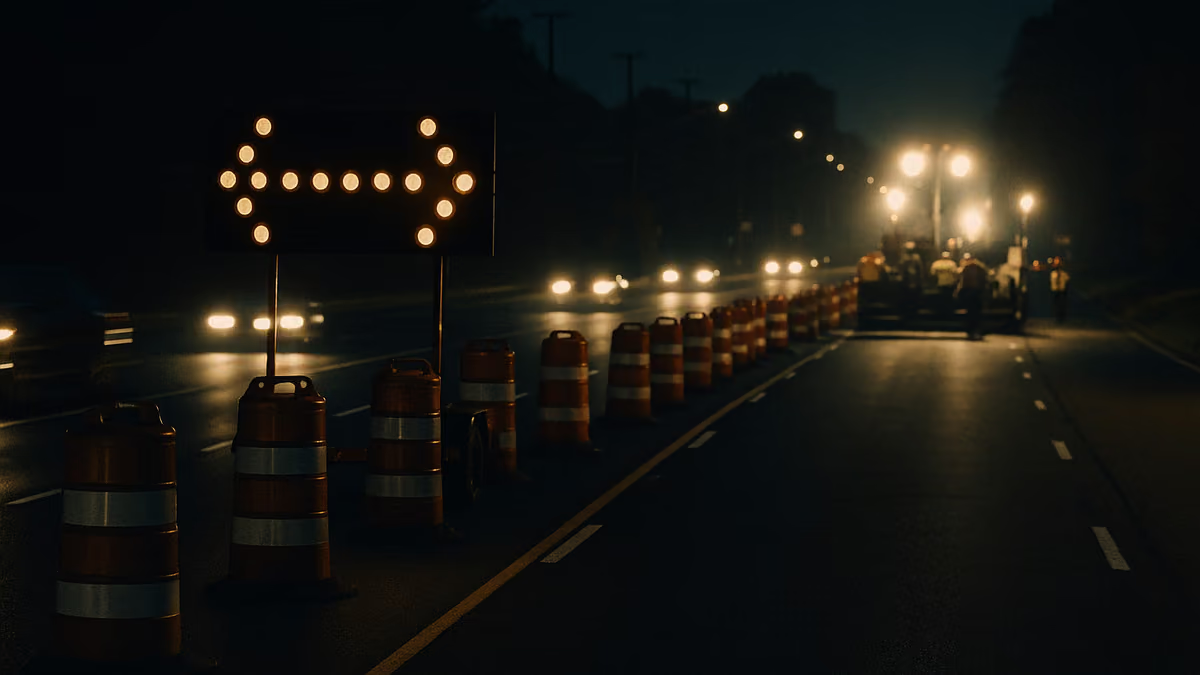
Starting the night of September 8, 2026, the New York State Department of Transportation is closing two westbound lanes of Sunrise Highway (Route 27) between County Line Road in Babylon and the Wantagh State Parkway in Hempstead, weeknights from 10 p.m. to 6 a.m., for about four weeks of pavement renewal. The advisory ends with the line NYSDOT puts on every one of these: “Lives are on the line; slow down and move over for highway workers!”
They mean the workers. But a nighttime lane drop on a six-lane arterial that carries commuters, delivery trucks and bar traffic through Nassau and western Suffolk is also one of the more dangerous places a driver can be, and when a crash happens inside a work zone the question of who pays is more complicated than in an ordinary rear-end collision. I handle car accident cases on Long Island. This is the liability map I walk clients through when the crash happened between the drums.
The short version
A work-zone crash can have three responsible parties, not one: the other driver, the contractor who set up the lane closure, and the State that owns the road. Each is sued differently, each has a different deadline, and the shortest one, 90 days for a claim against the State, starts the night of the crash. The evidence that decides these cases, camera footage and the contractor's traffic-control records, is gone within weeks unless someone asks for it.
Why work zones produce a different kind of crash
An ordinary Sunrise Highway crash is two drivers and one question: who was careless. A work-zone crash adds an engineered environment that was supposed to move traffic safely past the work and sometimes did not.
The rules for that environment are written down. New York uses the federal Manual on Uniform Traffic Control Devices with a state supplement, and Part 6 of the MUTCD governs temporary traffic control: how far in advance the first warning sign has to appear, how long the taper of drums that squeezes two lanes into one has to be, where the arrow board goes, how the work area is lit, how the buffer space between the taper and the crew is sized. On a road posted at 55 mph, a lane-closure taper is calculated from the lane width and the speed, and the advance warning signs sit hundreds of feet upstream of it. Those are not suggestions; they are the contract specifications NYSDOT writes into the paving contract, and the contractor keeps a daily traffic-control log showing it complied.
Free Consultation · No Fee Unless We Win
Does this apply to your situation?
Every case is different. Get a free, confidential case review from an experienced attorney who can tell you exactly where you stand.
When a taper is too short, a sign is missing, an arrow board is dark, or drums have been knocked into the open lane by an earlier vehicle and not reset, the driver who hits the closure at 55 mph in the dark is not the only person at fault.
The three potential defendants
The other driver. Most work-zone crashes are still driver-caused: someone speeding through the closure, drifting at the taper, rear-ending the car that slowed for the arrow board. New York doubles the fines for speeding in a work zone under Vehicle and Traffic Law 1180-f, and since 2023 the State has run automated speed cameras in active work zones on its highways. A camera ticket or a police citation for work-zone speeding is admissible evidence of negligence. The claim against the driver is an ordinary negligence claim under their auto policy, and it is where most of the recovery comes from.
The contractor. A paving contractor owes a duty to the public that uses the road while it is working, and the Court of Appeals set the framework in Espinal v Melville Snow Contractors in 2002: a contractor is liable to a third party when it launches an instrument of harm through its work, when the plaintiff relied on its performance, or when it displaced the owner’s duty to keep the premises safe. A contractor that set up a deficient lane closure has launched an instrument of harm. The claim is an ordinary negligence claim, with the ordinary three-year statute of limitations, against a company that carries a large liability policy precisely because of this exposure.
The State of New York. Sunrise Highway is a state road. The State owns it and NYSDOT designed and inspected the work zone. A claim against the State goes to the Court of Claims, not Supreme Court, and it comes with a deadline that surprises everyone: under Court of Claims Act 10(3), a claim or a notice of intention to file a claim has to be served on the Attorney General and filed within 90 days of the accident. Miss it and you are asking the court for permission to file late, which is discretionary and denied often. The State also has a qualified immunity for highway planning decisions that were the product of a deliberate study, so a claim that the work zone was badly designed is harder than a claim that it was badly maintained or that the contractor’s setup departed from the plan the State approved.
If a county or town vehicle was involved, or the crash was on a county road feeding into Sunrise, the municipal notice-of-claim rule applies instead: 90 days under General Municipal Law 50-e, and the lawsuit within a year and 90 days. Our page on accidents involving government vehicles covers that clock.
Who, where, and by when
| Defendant | Forum | First deadline | Lawsuit deadline |
|---|---|---|---|
| Other driver | Supreme Court, Nassau or Suffolk | No-fault application within 30 days (your own carrier) | 3 years |
| Paving contractor / traffic-control subcontractor | Supreme Court | Preservation letter immediately | 3 years |
| State of New York (NYSDOT) | Court of Claims | Claim or notice of intention within 90 days | 2 years with a timely notice of intention |
| County / town (if their road or vehicle) | Supreme Court after notice | Notice of claim within 90 days | 1 year and 90 days |
The evidence, and how fast it disappears
Work-zone cases are decided by what the closure looked like at the moment of impact, and almost none of that survives on its own.
NYSDOT’s cameras. The State’s 511NY system has traffic cameras along Sunrise Highway. The feeds are not archived for the public; they may be retained for a short period by the State or its vendor. A written demand, served fast, is the only way to find out.
The contractor’s records. Every NYSDOT paving contract requires a traffic-control plan, a daily work-zone inspection or diary, and often time-stamped photographs of the setup at the start and end of each shift. Those records show whether the drums, signs and arrow board were where the plan required them at 2 a.m. They are the contractor’s business records and they are discoverable, but only if the contractor is identified and put on notice before a routine retention period ends.
The police report. The MV-104A will name the contractor if the officer bothered to ask, describe the closure, and sometimes note whether the arrow board was operating. Get it the same week and read it against your memory.
Your car and your phone. The event data recorder in the airbag module logs speed and braking for the seconds before impact. A dashcam captures the taper as you approached it. Save the file the same day. And do not give the other driver’s insurer a recorded statement; since May 26, 2026, New York bars a car accident plaintiff who is found more at fault than the defendant from recovering anything, and the statement is where that argument gets built.
Witnesses and the work crew. The flagger and the crew saw the crash. They work for the contractor, and by the time a lawsuit is filed they may have moved to another job or another state. Names and phone numbers on the night are worth more than a subpoena a year later.
No-fault still comes first
Whoever was at fault, your own auto policy pays up to $50,000 in medical bills and lost wages under New York’s no-fault law, and the written application has to reach your carrier within 30 days. If you were a passenger, the car you were in pays; if you were the flagger or a worker struck in the zone, workers’ compensation is the first layer and a third-party claim against the driver is the second. The no-fault guide covers the application, the 30-day rule and what happens when a carrier denies.
For the lawsuit for pain and suffering, the serious-injury threshold applies as in any car case: a fracture, a documented limitation, or one of the other statutory categories. Work-zone crashes tend to produce the kinds of injuries that clear it, because the impact speeds are high and the vehicles are often hitting fixed objects.
What a work-zone claim is worth
The value drivers from an ordinary case apply, and one more. Where a contractor or the State shares fault, there is a second and sometimes third policy in the case, which matters most when the at-fault driver carries the state-minimum $25,000 and your injuries are worth a multiple of that. Our page on construction-zone accident settlements in New York walks through how those cases have resolved, and the highway accident and construction-zone accident pages cover the liability rules in more depth.
One caution on fault. The new rule under CPLR 1411(b) means that if you were speeding through the closure and the other driver drifted into you, the allocation of fault is no longer a discount on your recovery; it can be the end of it. The contractor’s records cut both ways: a properly set-up zone with a driver who blew through it is a bad plaintiff’s case, and a defective zone with a careful driver is a very good one.
The first week, in order
- Get treated the same night; work-zone impacts hide injuries behind adrenaline.
- Get the police report number and, if you can, the name of the contractor on the site signs.
- Save dashcam and phone photos to a second device that day.
- File the no-fault application with your own carrier within 30 days.
- Get preservation letters out to NYSDOT, the contractor and the other driver's insurer within days.
- If the State may share fault, get the Court of Claims notice of intention served inside 90 days. That is the deadline that ends cases.
Our Long Island personal injury practice handles work-zone crashes on Sunrise Highway, the Southern State and the LIE, including the Court of Claims side. If the crash happened in this closure, the four-week window NYSDOT gave the project is also roughly the window in which the evidence still exists.
Legal Context
Why This Matters for Your Case
Personal injury law in New York is governed by a complex web of statutes, case law, and procedural rules that differ from most other states. The statute of limitations for most personal injury claims is three years under CPLR 214(5), but claims against municipalities require a Notice of Claim within 90 days. Motor vehicle accident victims must meet the serious injury threshold under Insurance Law §5102(d) before they can recover pain and suffering damages.
The Law Office of Jason Tenenbaum has recovered over $100 million for injured clients across Long Island, Nassau County, Suffolk County, Queens, Brooklyn, Manhattan, and the Bronx. With 24+ years of trial and appellate experience, more than 1,000 appeals written, and 2,600+ published legal articles, Jason Tenenbaum provides the authoritative legal analysis that practitioners and injury victims need to understand their rights.
This article reflects real courtroom experience and a deep understanding of how New York courts actually evaluate personal injury claims — from the initial filing through discovery, summary judgment, trial, and appeal.
About This Topic
New York Personal Injury Law
When negligence causes serious injury, New York law entitles victims to compensation for medical bills, lost income, pain and suffering, and more. From car accidents and slip-and-falls to construction injuries and medical malpractice, the Law Office of Jason Tenenbaum has recovered over $100 million for injured Long Islanders and New Yorkers since 2002.
181 published articles in Personal Injury
Keep Reading
More Personal Injury Analysis
New York's Scaffold Law in the 2027 Budget: What Happens If Labor Law 240 Changes, and What Happens If It Doesn't
Labor Law 240 and the 2027 New York budget: what each side argues, the bills on file, and what each possible outcome would change.
Oct 19, 2026
Nassau Police Ordered to Pay $34,690.50 in FOIL Fees: What Meyer Means After a Crash
The Second Department raised a FOIL fee award against the Nassau County Police Department from $12,000 to $34,690.50. The statute, the math, and the FOIL clock.
Oct 8, 2026
Your Car Was Stolen and Caused an Accident in New York — Now What?
Your stolen car caused a crash in New York. Who pays? Owner liability under VTL 388, no-fault PIP, uninsured motorist claims, and MVAIC's strict deadlines.
Jul 16, 2026
Comparative Fault in New York Car Accident Cases: How Being Partly at Fault Affects Your Settlement
New York's pure comparative negligence rule (CPLR §1411) means you can still recover even when you're partly at fault.
Apr 5, 2026
Lost Wages After a Car Accident in New York: How to Claim What You're Owed
New York no-fault wage benefits, the $2,000/month PIP cap, and how to recover full lost earnings through a personal injury lawsuit after a car accident.
Apr 4, 2026
Hit and Run Car Accidents in NY & Long Island
Hit and run accidents in NY create unique challenges for victims. Learn your rights under no-fault insurance, uninsured motorist coverage, and recovery options.
May 12, 2025Frequently Asked Questions
Common Questions About This Topic
7 answers from the firm's New York personal-injury and employment-law practice. Click any question to expand.
Who is responsible for a crash in a highway work zone in New York?
Potentially three parties: the other driver (ordinary negligence), the contractor that set up the lane closure (liable under the *Espinal* framework if its setup created the hazard), and the State, which owns Sunrise Highway and approved the work zone (Court of Claims, with a 90-day notice deadline).
How long do I have to sue the State of New York for a road construction crash?
A claim or a notice of intention to file a claim must be served and filed within 90 days of the accident under Court of Claims Act 10(3). Late filing requires the court's permission and is not guaranteed.
Is a speeding ticket in a work zone evidence in a civil case?
Yes. A conviction or a work-zone camera violation for the other driver is evidence of negligence. Fines for work-zone speeding are doubled under Vehicle and Traffic Law 1180-f.
What if I was speeding too?
Since May 26, 2026, a plaintiff in a New York car accident case who is found more at fault than the defendant recovers nothing. Fault allocation now decides whether a case exists, which is why the contractor's setup records matter so much.
Does no-fault cover a work-zone crash?
Yes. Your own carrier pays up to $50,000 in medical bills and lost wages regardless of fault; the application is due within 30 days.
What evidence should I try to preserve?
Dashcam and phone footage, the police report, the contractor's name from the site, witness and crew contacts, and, through a lawyer, NYSDOT camera feeds and the contractor's traffic-control logs and setup photographs.
I was a flagger or worker hit in the zone. Is my claim different?
Workers' compensation pays first through your employer, and you keep a third-party claim against the driver who hit you. The contractor and State issues above may apply depending on who set up the zone and who employed you. --- A work zone is an engineered promise that traffic can get past the work safely. When the promise fails, the people who made it are answerable, but only to the person who asks in time. Call 516-750-0595 or request a free case review if you were hurt in a Sunrise Highway work-zone crash.
Was this article helpful?
Disclaimer: This article is published by the Law Office of Jason Tenenbaum, P.C. for informational and educational purposes only. It does not constitute legal advice, and no attorney-client relationship is formed by reading this content. The legal principles discussed may not apply to your specific situation, and the law may have changed since this article was last updated.
New York law varies by jurisdiction — court decisions in one Appellate Division department may not be followed in another, and local court rules in Nassau County Supreme Court differ from those in Suffolk County Supreme Court, Kings County Civil Court, or Queens County Supreme Court. The Appellate Division, Second Department (which covers Long Island, Brooklyn, Queens, and Staten Island) and the Appellate Term (which hears appeals from lower courts) each have distinct procedural requirements and precedents that affect litigation strategy.
If you need legal help with a personal injury matter, contact our office at (516) 750-0595 for a free consultation. We serve clients throughout Long Island (Huntington, Babylon, Islip, Brookhaven, Smithtown, Riverhead, Southampton, East Hampton), Nassau County (Hempstead, Garden City, Mineola, Great Neck, Manhasset, Freeport, Long Beach, Rockville Centre, Valley Stream, Westbury, Hicksville, Massapequa), Suffolk County (Hauppauge, Deer Park, Bay Shore, Central Islip, Patchogue, Brentwood), Queens, Brooklyn, Manhattan, the Bronx, Staten Island, and Westchester County. Prior results do not guarantee a similar outcome.