Key Takeaway
Sent home early or cancelled late on a New York construction job? The new Reporting Pay Act, effective December 8, 2026, sets four-hour and two-hour minimums.
This article is part of our ongoing employment law coverage, with 83 published articles analyzing employment law issues across New York State. Attorney Jason Tenenbaum brings 24+ years of hands-on experience to this analysis, drawing from his work on more than 1,000 appeals, over 100,000 no-fault cases, and recovery of over $100 million for clients throughout Nassau County, Suffolk County, Queens, Brooklyn, Manhattan, and the Bronx. For personalized legal advice about how these principles apply to your specific situation, contact our Long Island office at (516) 750-0595 for a free consultation.
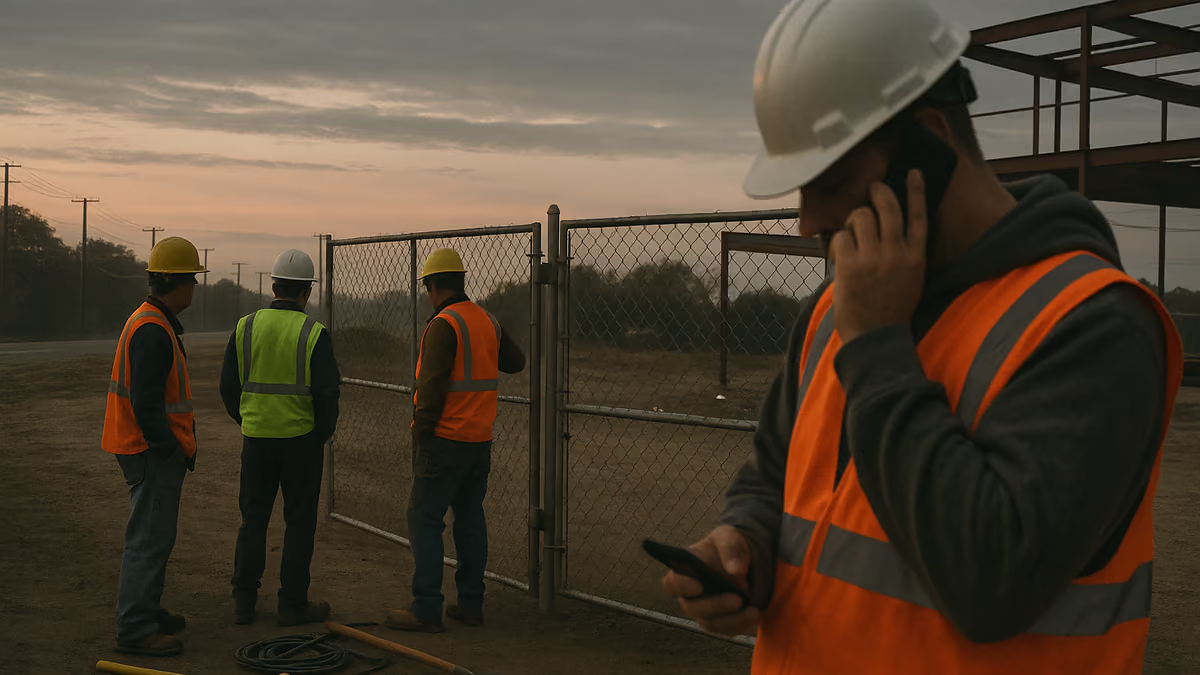
The truck did not come. The inspector pushed to Thursday. The general contractor re-sequenced the floors overnight and nobody told the subs. Whatever the reason, the foreman walks the gate at 7:30 and sends the crew home, and on most New York construction sites that half hour has paid a half hour, if it paid anything.
That changes on December 8, 2026. On September 9, 2026, the Governor signed the Construction Reporting Pay Act as Chapter 291 of the Laws of 2026. The bill was S.9843, sponsored by Senator Jessica Ramos, with A.6950 as its Assembly companion. The Assembly bill was substituted for the Senate bill and passed the Senate on June 4, 2026, by a vote of 50 to 10. It was delivered to the Governor on September 9, 2026 and signed the same day, at her Labor Appreciation Reception, alongside the personnel-file access law. The bill record shows an approval memo was filed with the signing; its text was not yet posted when this was written, and this post will be updated if it changes anything above. The act takes effect on the ninetieth day after signing, which is December 8, 2026.
I represent construction workers on Long Island in wage cases and injury cases, and the cancelled-shift call is one I get every spring. Until now the honest answer was disappointing. Here is what the new law does.
Why a new law was needed
New York already had a call-in pay rule. The Department of Labor’s Miscellaneous Wage Order gives an employee who reports for work at least four hours’ pay, or the scheduled shift if shorter, but at the basic minimum wage.
Free Consultation · No Fee Unless We Win
Does this apply to your situation?
Every case is different. Get a free, confidential case review from an experienced attorney who can tell you exactly where you stand.
The sponsor’s memo says the quiet part plainly: minimum wage is far below the prevailing and negotiated rates construction actually pays, so a contractor could cancel a crew, owe four hours at minimum wage, and still come out ahead. The memo calls the old rule an inadequate deterrent. The Legislature’s findings add that construction employees are entitled to the same scheduling reliability and predictability as workers in other fields.
The fix was to move the payment to the worker’s real rate and write it into the Labor Law itself, in two places.
The short version
From December 8, 2026, a New York construction worker who reports for work and is sent home is owed at least four hours (or the scheduled shift, if shorter, on a private job), and a shift cancelled on less than twelve hours' notice is owed two hours. Private jobs pay at your promised hourly wage; prevailing-wage jobs pay at the posted rate plus supplements. Screenshot the cancellation text.
Two sections, one rule
The act adds two sections to the Labor Law, and which one covers you depends on the job, not on your trade.
Labor Law § 196-e covers every employee engaged in construction as the Labor Law already defines it in § 861-b. That includes private jobs: the house in Dix Hills, the fit-out in Commack, the warehouse in Yaphank. If you report for work by request or permission of your employer, you must be paid for at least four hours, or for the number of hours in your regularly scheduled shift if that is less, at your promised hourly wage. If a scheduled shift is cancelled on less than twelve hours’ notice to you, you are owed two hours at your promised hourly wage.
The act says those payments are wages under Article 6 of the Labor Law, which means the ordinary wage-claim machinery applies. Unpaid wages under Article 6 generally carry liquidated damages and attorneys’ fees under Labor Law § 198.
Labor Law § 224-g covers public work and the other projects that New York’s prevailing-wage provisions reach. Each laborer, worker or mechanic employed by a contractor who reports for work by request or permission of the employer must be paid no less than four hours at the prevailing rate of wages, including supplements, for the employee’s regularly scheduled classification. A shift cancelled on less than twelve hours’ notice earns two hours at the same rate, including supplements.
One carve-out: if the posted prevailing rate already provides greater reporting pay wages or benefits, the posted schedule governs. These payments are deemed prevailing wages or supplements, so the prevailing-wage enforcement machinery applies.
Both sections open with “notwithstanding any law, rule or regulation to the contrary,” so the old minimum-wage call-in rule no longer sets the ceiling for construction. The act also authorizes the Department of Labor to issue rules before the effective date.
Private jobs vs. prevailing-wage jobs
| Issue | Private construction job (§ 196-e) | Prevailing-wage / public work (§ 224-g) |
|---|---|---|
| Who is covered | Every employee engaged in construction as the Labor Law defines it, on any job, union or not | Each laborer, worker or mechanic employed by a contractor on public work or another prevailing-wage project |
| Reported and sent home | At least four hours, or the regularly scheduled shift if shorter | No less than four hours, unless the posted prevailing rate already provides greater reporting pay |
| Shift cancelled with under 12 hours' notice | Two hours | Two hours |
| Rate used | Your promised hourly wage | The prevailing rate of wages, including supplements, for your regularly scheduled classification |
| How it is enforced | Deemed wages under Labor Law Article 6: DOL complaint or lawsuit; § 198 generally adds liquidated damages and attorneys' fees | Deemed prevailing wages or supplements: the prevailing-wage enforcement machinery applies |
| Effective date | December 8, 2026 | December 8, 2026 |
The three situations, with numbers
Take a laborer on a private job who was promised $32 an hour for an eight-hour shift.
Reported and sent home. He arrives at 7 am. At 7:30 the foreman says the concrete truck is not coming and sends everyone home. Under § 196-e he is owed four hours, because four is less than the eight-hour shift he was scheduled for. Four hours at $32 is $128, not the $16 for the half hour he stood at the gate. Under the old rule he would have been owed four hours at minimum wage, a fraction of that.
Cancelled with short notice. He gets a text at 9 pm cancelling tomorrow’s 6 am shift. Nine hours of notice is less than twelve. He is owed two hours at $32, which is $64, for a day he never left the house.
Cancelled with enough notice. Same text, same 6 am shift, but it lands at 5 pm the day before. That is thirteen hours of notice. Under this act, nothing is owed; the employer gave the notice the statute asks for.
On a prevailing-wage job the arithmetic is the same, with two differences. The rate is the posted prevailing rate for his classification plus supplements, not the number on his hiring paperwork. And the four-hour minimum under § 224-g is a flat four hours rather than “four or the shift, whichever is less.”
Two limits. If you work five hours and then get sent home, you are paid for five; the floor only matters when you worked less than four. And if your scheduled shift on a private job is shorter than four hours, § 196-e pays the shift.
What to write down
Reporting pay cases are won on timestamps. The employer will say you were told in time, or never actually reported. Your phone answers both.
- Screenshot the cancellation text, call log or crew-app message with its timestamp, and note when the shift was due to start.
- Note the time you arrived at the site and the time you were sent home, the same day, on your own phone.
- Keep whatever shows your promised rate: the offer text, the hiring paperwork, the pay app. On a prevailing-wage job, photograph the posted prevailing wage schedule for your classification.
- Keep every pay stub. Reporting pay that was never paid shows up as a day that is simply missing.
- Count the hours you are owed: four per sent-home day (or the shift, if shorter, on a private job) and two per late cancellation, at the right rate.
- Raise it in writing. A text to the foreman or an email to the office asking for the reporting pay, with the date, is enough, and it starts the record.
- Call a lawyer. Under § 198 the employer generally pays the attorneys' fees on a winning Article 6 claim, and prevailing-wage claims have their own route.
If a wage complaint gets you dropped from the crew, that is a separate claim; we wrote about what happens when an employer punishes a wage complaint. If the cancellations only ever land on one crew, or on the workers who speak up, our employment discrimination page covers that.
Our Long Island wage and hour practice handles these claims. Construction workers also get hurt on the same sites where they get shorted, and our personal injury practice, including our work on Labor Law 240 fall cases, is the other half of what we do for the trades.
For contractors
If you run a crew, the change is simple to state and expensive to ignore. From December 8, 2026, a worker who reports and is sent home is owed four hours (or the scheduled shift, if shorter, on a private job) at the rate you promised, and a cancellation on less than twelve hours’ notice costs two hours per worker. Build the twelve-hour rule into how your supers communicate. A cancellation texted at 5 pm for a 6 am start costs nothing; the same text at 9 pm costs two hours for every worker on the list.
On public work and other prevailing-wage projects the exposure is at the posted rate plus supplements, and because the act deems the payments prevailing wages, a shortfall is a prevailing-wage violation. If the posted schedule for a classification already carries greater reporting pay, the posted schedule governs.
Sources
- New York State Senate, S.9843 (Ramos), Construction Reporting Pay Act, bill record (text, sponsor memo, votes, chapter status): https://www.nysenate.gov/legislation/bills/2025/S9843
- New York Labor Law § 198 (remedies for unpaid wages under Article 6): https://www.nysenate.gov/legislation/laws/LAB/198
- Governor Hochul’s September 9, 2026 signing announcement (A.6950/S.9843 with A.2107/S.3460 and A.10835-A/S.9577-A): https://www.governor.ny.gov/news/governor-hochul-signs-legislation-improve-safety-and-prosperity-workers-new-york-state-during
The crew that gets sent home at 7:30 has always known what its morning was worth. As of December 8, 2026, the Labor Law agrees, and the number is four hours at the real rate.
Call 516-750-0595 or request a free case review if you were sent home from a New York construction site without reporting pay or had a shift cancelled on short notice.
Legal Context
Why This Matters for Your Case
Employment law in New York provides some of the strongest worker protections in the nation. The New York State Human Rights Law (Executive Law §296) prohibits discrimination based on race, sex, age, disability, sexual orientation, gender identity, and other protected characteristics. The New York City Human Rights Law goes even further, applying a broader standard and covering more employers.
Federal protections under Title VII, the ADA, the ADEA, and the FLSA provide additional layers of protection. The Law Office of Jason Tenenbaum represents employees facing workplace discrimination, wrongful termination, wage theft, hostile work environments, and employer retaliation throughout Long Island, Nassau County, Suffolk County, and the five boroughs of New York City.
Whether your case involves EEOC filings, NYS Division of Human Rights complaints, or direct court action under CPLR Article 78, this article provides the expert legal analysis that workers and practitioners need to understand their rights and develop effective litigation strategies under current New York employment law.
About This Topic
New York Employment Law
New York has some of the strongest worker protections in the nation — from the NYC Human Rights Law to state-level whistleblower statutes. Whether you're dealing with discrimination, wage theft, wrongful termination, or hostile work environments, understanding your rights is the first step. Attorney Jason Tenenbaum represents employees across Long Island and NYC in federal and state employment claims.
83 published articles in Employment Law
Keep Reading
More Employment Law Analysis

Laid Off After a Merger in New York? Severance, WARN and Discrimination Rights
A group layoff release must give 45 days, 7 days to revoke and a list of ages. What a missing list means, when WARN pays, and where age claims start.
Oct 22, 2026
No Small-Business Exemption: Which New York Employment Laws Cover a One-Employee Business
Title VII starts at 15 employees. New York's Human Rights Law starts at one. Which state laws reach the smallest employers, and where size still counts.
Oct 15, 2026
Where New York's 10-Day Personnel File Rule Came From: The Counseling Memo
Labor Law § 210-b gives every New York employee what teacher contracts have long given: notice of a write-up and a written answer in the file.
Oct 12, 2026
NYC's Deactivation Law Is Blocked: What Drivers Can Still Do
A federal judge blocked NYC's driver deactivation law days before it took effect. What Uber and Lyft drivers in New York can still do after a deactivation.
Aug 5, 2026
New York Employment Law Changes 2026: What Workers and Employers Need to Know About EEOC Developments
2026 New York employment law changes: $17.00 minimum wage, exempt salary thresholds, EEOC guidance rescission, NYC leave, credit-check ban, Trapped at Work Act.
May 4, 2026
How to File a Lawsuit Against Your Employer
Learn how to file a lawsuit against your employer with steps on rights, evidence, and legal help from expert attorneys.
Feb 21, 2025Frequently Asked Questions
Common Questions About This Topic
7 answers from the firm's New York personal-injury and employment-law practice. Click any question to expand.
Do I get paid if my construction shift is cancelled in New York?
Starting December 8, 2026, yes, if the notice was short. A scheduled shift cancelled on less than twelve hours' notice to you earns two hours' pay, at your promised hourly wage on a private job and at the prevailing rate plus supplements on a prevailing-wage job. A cancellation with twelve hours' notice or more owes nothing under this act.
How much reporting pay am I owed if I show up and get sent home?
On a private job, the lesser of four hours or your regularly scheduled shift, at your promised hourly wage. On a prevailing-wage job, four hours at the prevailing rate plus supplements for your classification, unless the posted schedule already gives you more. The four hours is a floor, not a bonus: work half an hour and get sent home, and you are paid four hours total.
What counts as twelve hours' notice?
The statute measures notice to the employee. Twelve hours before a 6 am start is 6 pm the evening before. The act does not define the form notice must take; the Department of Labor may address that in its rules. Until it does, treat the question as when the message reached you, and screenshot it with the time it arrived. A text sent at 9 pm is nine hours of notice for a 6 am shift.
Does this apply to non-union, private construction jobs?
Yes. § 196-e covers every employee engaged in construction, on any job, and it does not depend on a union, a public owner or a prevailing-wage schedule. The act sets a floor. If your collective bargaining agreement already gives you more show-up pay, the act does not take that away.
Does it apply to prevailing-wage and public work jobs?
Yes, through § 224-g, at the prevailing rate plus supplements. Because the act deems the payments prevailing wages, the prevailing-wage enforcement route applies; we covered how a worker shorted on a public job can sue earlier this year.
My boss says the weather cancelled the shift, so nobody gets paid. Is that right?
Not under the text of this act. There is no weather exception. The only question the statute asks is how much notice you got. A crew cancelled by a 5 am call because of rain, for a 6 am start, got one hour of notice, and two hours' pay is owed. Forecasts are public; a contractor who wants to avoid the payment can make the call the evening before.
I am paid by the day, not by the hour. Does the act apply to me?
The act is written in hourly terms, "promised hourly wage" on private jobs and "prevailing rate" on public ones, and it does not say how a day rate converts. That is a gap I expect the Department of Labor's rules to fill. Do not assume you are outside the law: keep the paperwork showing your day rate and scheduled hours, and get advice. A day rate divided by the scheduled shift is the obvious hourly figure, but nothing in the act says so yet.
Was this article helpful?
Disclaimer: This article is published by the Law Office of Jason Tenenbaum, P.C. for informational and educational purposes only. It does not constitute legal advice, and no attorney-client relationship is formed by reading this content. The legal principles discussed may not apply to your specific situation, and the law may have changed since this article was last updated.
New York law varies by jurisdiction — court decisions in one Appellate Division department may not be followed in another, and local court rules in Nassau County Supreme Court differ from those in Suffolk County Supreme Court, Kings County Civil Court, or Queens County Supreme Court. The Appellate Division, Second Department (which covers Long Island, Brooklyn, Queens, and Staten Island) and the Appellate Term (which hears appeals from lower courts) each have distinct procedural requirements and precedents that affect litigation strategy.
If you need legal help with a employment law matter, contact our office at (516) 750-0595 for a free consultation. We serve clients throughout Long Island (Huntington, Babylon, Islip, Brookhaven, Smithtown, Riverhead, Southampton, East Hampton), Nassau County (Hempstead, Garden City, Mineola, Great Neck, Manhasset, Freeport, Long Beach, Rockville Centre, Valley Stream, Westbury, Hicksville, Massapequa), Suffolk County (Hauppauge, Deer Park, Bay Shore, Central Islip, Patchogue, Brentwood), Queens, Brooklyn, Manhattan, the Bronx, Staten Island, and Westchester County. Prior results do not guarantee a similar outcome.