Key Takeaway
Workday spanned more than 10 hours in NY? Who is owed the extra hour at the 2026 minimum wage, how to calculate it, and six years of back pay.
This article is part of our ongoing employment law coverage, with 84 published articles analyzing employment law issues across New York State. Attorney Jason Tenenbaum brings 24+ years of hands-on experience to this analysis, drawing from his work on more than 1,000 appeals, over 100,000 no-fault cases, and recovery of over $100 million for clients throughout Nassau County, Suffolk County, Queens, Brooklyn, Manhattan, and the Bronx. For personalized legal advice about how these principles apply to your specific situation, contact our Long Island office at (516) 750-0595 for a free consultation.
This article was published February 20, 2025. Corrected October 23, 2026: the earlier text said the rule covers all industries and every employee, and it carried penalty ranges and business anecdotes we could not source. The Department of Labor reads the general wage order to protect only workers paid at or near the minimum wage; the hospitality order covers every restaurant and all-year hotel employee at any rate. The text below states the rule as verified.
Last reviewed: October 2026. Rates reflect Labor Law § 652(1-a) as in effect on January 1, 2026: $17.00 an hour in New York City, Nassau, Suffolk and Westchester, and $16.00 in the rest of the state.
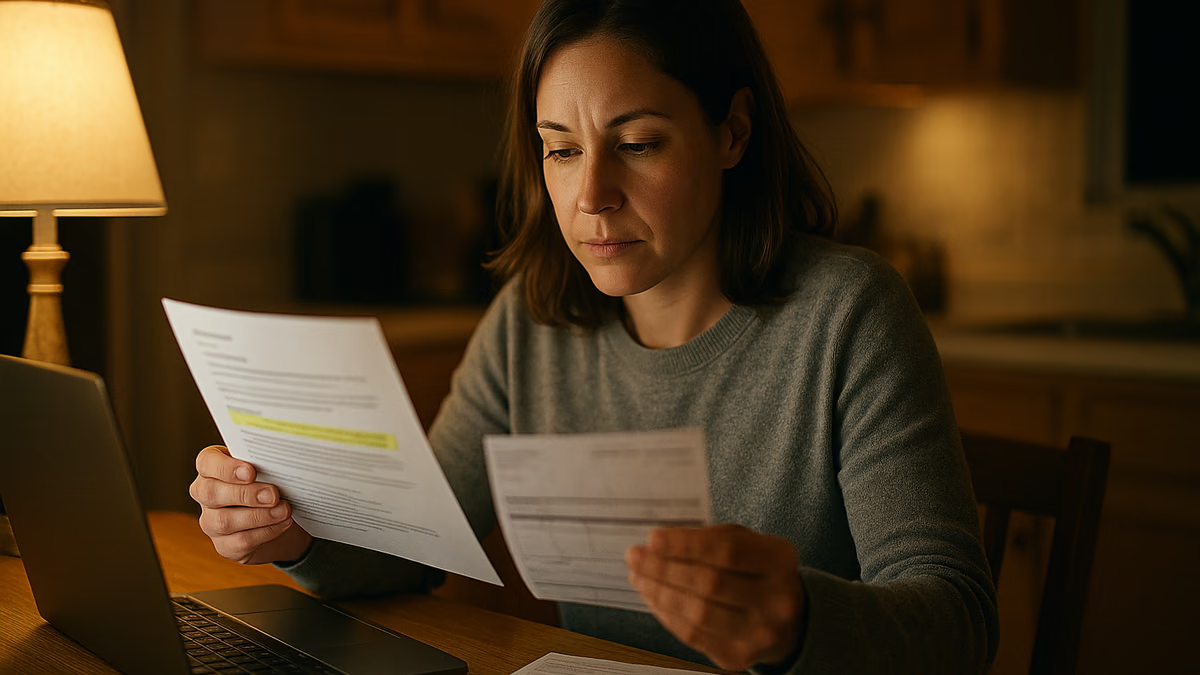
Take a hypothetical. A line cook at a diner in Hicksville works a split shift four days a week: in at 7:00 in the morning, off at 11:00, back at 3:00 in the afternoon, done at 9:00 at night. That is ten hours of work, but the workday runs fourteen hours from the first punch to the last. The cook earns $20.00 an hour and has never seen a line on the pay stub for “spread of hours.” Is something owed?
Yes. A diner is a restaurant under the hospitality wage order, which defines the term to include “any eating or drinking place that prepares and offers food or beverage for human consumption” (12 NYCRR 146-3.1(b)). Our Long Island wage and hour attorney page explains how we take these claims. This is general information, not advice about any one claim.
The short version
When the time from the start of your workday to the end of it is more than 10 hours, counting meal breaks and time off between shifts, New York's wage orders add one hour of pay at the basic minimum wage. On Long Island and in New York City that hour is worth $17.00 in 2026. If you work in a restaurant or an all-year hotel, you get it no matter how much you earn. Under the general wage order for miscellaneous industries and occupations, the Department of Labor reads it, and the Second Department agrees, to protect only workers whose pay for the week does not already cover the minimum wage, any overtime owed, and that extra hour. Unpaid spread-of-hours pay is a wage claim: you can file with the Department of Labor or sue, go back six years, and recover liquidated damages equal to the amount owed unless the employer proves good faith, plus interest and attorney's fees.
What “spread of hours” means
The spread of hours is not the number of hours you worked. It is the length of the day. The general wage order, 12 NYCRR 142-2.18, defines it as “the interval between the beginning and end of an employee’s workday,” and says it “includes working time plus time off for meals plus intervals off duty.” The hospitality order, 12 NYCRR 146-1.6, uses nearly the same words and gives two examples: “7 a.m. - 10 a.m., 7 p.m. - 10 p.m. = 6 hours worked but a 15 hour spread,” and “11:30 a.m. - 3 p.m., 4 p.m. - 10:00 p.m. = 9 1/2 hours worked but a 10 1/2 hour spread.”
Free Case Review
Tell us what happened at work — free case review
Employment claims have filing deadlines
Details received. The fastest next step is a call.
Don't wait for a callback. Call now and a real person takes your information: our office during business hours, and our intake line after hours and on weekends, answered 24/7.
Call (631) 823-7793 NowFree consultation · Nothing is filed or shared until you decide
Can't call right now? We'll reach out during business hours.
Your information is confidential. Submitting this form does not create an attorney-client relationship.
The trigger is a spread that “exceeds 10 hours,” so exactly ten is not enough. The cook’s 7:00 a.m. start and 9:00 p.m. finish make a fourteen-hour spread on each of those four days. The payment is one hour per day, however far past ten the day runs, and it is paid at the basic minimum wage for your region, not at your own rate: $17.00 for the cook in 2026, not $20.00.
The general order adds a second trigger. Under 12 NYCRR 142-2.4 the hour is also owed on a day when “there is a split shift,” which 142-2.17 defines as daily hours that “are not consecutive”; a meal period of one hour or less does not break them. One day earns one hour either way.
Every employer in New York has to have wage records and wage statements. That’s the basics under the labor law: a statement with every paycheck, and payroll records of the hours worked kept for six years. So if you believe that you were shortchanged on spread of hours, you don’t need your employer’s permission to prove it. In a lawsuit, you’d subpoena the ADP records, the time punches at the beginning and end of each shift, as well as the schedules. But keep your own record too. Write down when you started and finished work every day on your phone. Your pay stubs and your notes are where a case starts.
Am I owed spread-of-hours pay?
It depends on which wage order covers your job. The Department of Labor publishes separate orders for hospitality (including fast food), building service, farm workers, nonprofit institutions, and miscellaneous industries and occupations. This post covers the first and the last.
Restaurants and all-year hotels
12 NYCRR 146-1.6 provides that on “each day on which the spread of hours exceeds 10, an employee shall receive one additional hour of pay at the basic minimum hourly rate.” Subdivision (d) settles the question about high earners: the section “shall apply to all employees in restaurants and all-year hotels, regardless of a given employee’s regular rate of pay.” The hour “shall not be offset by any credits for meals or lodging.” For the Hicksville cook: four long days, four extra hours.
Other industries and occupations
The miscellaneous order says the extra hour is owed “in addition to the minimum wage required in this Part.” The Department of Labor reads that as a top-up for workers at or near the minimum. The courts have quoted its opinion-letter test: if the weekly wages actually paid “equal or exceed the total of: (i) 40 hours paid at the basic minimum wage rate; (ii) overtime paid at the particular employee’s overtime rate; and (iii) one hour’s basic minimum wage rate for each day the employee worked in excess of 10 hours, then no additional compensation is due.”
The Second Department, which hears appeals from Nassau and Suffolk, deferred to that reading in Seenaraine v Securitas Sec. Servs. USA, Inc., 37 AD3d 700 (2d Dept 2007), finding it “neither unreasonable nor irrational,” and federal courts have followed it (Almeida v Aguinaga, 500 F Supp 2d 366 [SD NY 2007]). Consequently, a worker paid well above $17.00 an hour under the general order usually has no claim, while a worker at or just above the minimum often does.
How to calculate it at the 2026 minimum wage
Count the days in the week whose spread was more than ten hours and multiply by the regional minimum wage. Under the general order, then compare the week’s actual pay with the floor the week required. Here is the cook’s week under both orders.
Worked example, 2026
Spread-of-hours pay, worked out at the Long Island minimum wage
- The schedule
- 7:00 a.m. to 11:00 a.m., then 3:00 p.m. to 9:00 p.m., four days a week. 10 hours worked a day, 40 a week, no overtime.
- The spread
- 7:00 a.m. to 9:00 p.m. is 14 hours, including the four hours off. It "exceeds 10," so each of the four days earns one extra hour (12 NYCRR 142-2.18; 146-1.6).
- The rate for the extra hour
- $17.00, the 2026 basic minimum wage in Nassau, Suffolk, Westchester and New York City; $16.00 elsewhere in the state (Labor Law § 652(1-a)). Not the worker's own rate.
Hospitality order, 12 NYCRR 146-1.6
Owed at any wage: $68 a week
- 4 long days x $17.00 = $68.00 for the week.
- Same answer at $17.00, $20.00 or $30.00 an hour: the order applies "regardless of a given employee's regular rate of pay."
- No meal or lodging credit can reduce it.
Miscellaneous order, 12 NYCRR 142-2.4
Owed only if the week falls short
- The week's floor: 40 x $17.00 = $680.00, plus 4 x $17.00 = $68.00, for $748.00.
- Paid $20.00 an hour: 40 x $20.00 = $800.00. That covers $748.00, so nothing more is owed.
- Paid $17.50 an hour: 40 x $17.50 = $700.00. That is $48.00 short, so $48.00 is owed for the week.
- Paid $17.00 an hour: $680.00, short by the full $68.00.
What a year of that week is worth in a lawsuit (hospitality, 50 weeks of 2026)
- Unpaid spread-of-hours pay: 200 long days x $17.00 = $3,400.00.
- Liquidated damages equal to 100 percent of the underpayment, unless the employer proves a good faith basis: $3,400.00 (Labor Law § 663(1)).
- Total before interest and fees: $6,800.00, plus prejudgment interest (9 percent a year under CPLR 5004) and the employee's reasonable attorney's fees.
- Earlier years are figured at the minimum wage in effect when the work was done. See the rate history below.
One caution: under the general order, a week with overtime adds the overtime owed at your own overtime rate to the floor.
What you can recover, and how far back
An unpaid spread-of-hours hour is an underpayment of the minimum wage, and Labor Law § 663 gives the employee a lawsuit for it. The worker “shall recover in a civil action the amount of any such underpayments, together with costs all reasonable attorney’s fees, prejudgment interest,” and, unless the employer proves a good faith basis for believing it complied, “liquidated damages equal to one hundred percent” of the underpayment. An agreement to work for less “shall be no defense.” Labor Law § 198(1-a) provides parallel remedies for wage claims.
The lookback is six years: an action “must be commenced within six years” (§§ 663(3), 198(3)), and the clock is tolled while a Department of Labor complaint is pending. A claim filed in October 2026 reaches work done since October 2020, each year priced at that year’s minimum wage.
What makes six years provable is the employer’s own paperwork. Labor Law § 195(4) requires “contemporaneous, true, and accurate payroll records” of the hours worked each week, kept for not less than six years.
Rates and clocks
The rate that prices the extra hour on Long Island, and the deadlines that govern the claim
- $13.0012/31/2019 Nassau, Suffolk, WestchesterLabor Law § 652(1)(b). Then $14.00 on December 31, 2020, and $15.00 on December 31, 2021, which held through 2023. New York City large employers reached $15.00 on December 31, 2018 (§ 652(1)(a)).
- $16.001/1/2024 New York City, Nassau, Suffolk, WestchesterLabor Law § 652(1-a), one rate for the whole downstate region regardless of employer size. Rest of state: $15.00.
- $16.501/1/2025 Same regionLabor Law § 652(1-a). Rest of state: $15.50.
- $17.001/1/2026 Same regionLabor Law § 652(1-a). Rest of state: $16.00. From January 1, 2027 the rate is indexed to inflation and set each year by the Commissioner, subject to economic off-ramps (§ 652(1-b)).
- 6years To sue for unpaid spread-of-hours payLabor Law §§ 663(3) and 198(3). Tolled from the filing of a Department of Labor complaint until its order to comply is final or the investigation is closed.
- 2years To sue for retaliationLabor Law § 215(2)(a) (notice to the Attorney General at or before filing, § 215(2)(b)) and Labor Law § 740(4)(a), each running from the retaliatory act.
A Department of Labor complaint or a lawsuit?
Spread-of-hours pay is a private right, not only an agency rule. The Department of Labor can enforce it, and so can you.
You have two doors. The Department of Labor has very broad powers to come in and do an audit after a complaint from someone who believes they are being paid improperly. The wage claim also has a private right of action. That means that you can go straight to court yourself without any government intervention, and the Department’s investigation is neither a prerequisite for nor a bar to going to court. And the first question is always, what are your damages? In terms of spread of hours, it’s very simple math: up to one hour at the minimum wage for every long day that you worked, up to six years, plus liquidated damages equal to one hundred percent unless the employer can prove good faith, plus interest and attorney’s fees.
The Department’s door starts with the Labor Standards Complaint Form (LS223). An investigator contacts the employer and may hold a compliance conference; if the employer does not pay what is found due, the Commissioner issues an order to comply, which the employer can challenge at a hearing. The Department also says it “cannot guarantee” it will collect.
The court door is the one with fee-shifting: a worker who prevails recovers “all reasonable attorney’s fees” from the employer (§ 663(1)), and a judgment still unpaid 90 days after it issues, or 90 days after the time to appeal runs out, whichever is later, grows by 15 percent (§ 663(4)). Consequently, for a few hundred dollars the Department, or small claims court, may be enough; for years of split shifts, or coworkers on the same schedule, a lawsuit is usually the stronger door. If you signed an arbitration agreement, read our note on forced arbitration first.
If you complain and your hours are cut
Labor Law § 215 bars an employer from firing, threatening or penalizing an employee who complained “to his or her employer, or to the commissioner” about conduct the employee “reasonably and in good faith, believes violates any provision of this chapter, or any order issued by the commissioner.” The wage orders are orders of the Commissioner, and the complaint “need not make explicit reference to any section.”
Labor Law § 740 also protects an employee who discloses to a supervisor a practice the employee “reasonably believes is in violation of law, rule or regulation.” The remedies differ, which is why both belong in the case: § 215 caps liquidated damages at $20,000 and adds lost compensation, front pay and fees; § 740 adds “a jury trial,” a civil penalty of up to $10,000, and punitive damages “if the violation was willful, malicious or wanton.” See our Long Island employer retaliation attorney page and our post on wage theft retaliation lawsuits.
And then the other thing is retaliation. So an employer who isn’t happy that their employee is exercising their rights can be on the butt end of a lawsuit for retaliation. That’s your retaliation hook. If you complain about your wages and they cut your hours or they fire you, that’s Labor Law section 215. And complaining to a supervisor that your boss is breaking the labor law is also a disclosure under the whistleblower statute, Labor Law section 740, where you get a jury. You have two years to sue under either one.
What to bring to the first call
Bring as many of these as you have:
- Your pay stubs for the period, which show the rate and whether any “spread of hours” line was ever paid.
- Your schedules, or screenshots of the scheduling app, showing first and last shifts on the long days.
- Your own log of start and finish times, even an informal one in your phone.
- Your offer letter or hiring notice, which states your rate and your regular payday.
- Any text or email where you asked about the long days, and what happened to your hours afterward.
Back to the cook in Hicksville: $68 a week in 2026 spread-of-hours pay, owed even at $20.00 an hour, and $6,800 for 50 such weeks once liquidated damages are added, before interest and fees, reaching back six years at each year’s rate. For the rest of the wage picture, see our guides to New York wage and hour laws and the tip credit rules for Long Island restaurants.
If your workdays regularly ran past ten hours from first punch to last and your pay stubs never show the extra hour, contact us or call (516) 750-0595, and have your last few pay stubs and your schedule in front of you when you call.
Sources
- 12 NYCRR 142-2.4, additional rate for split shift and spread of hours
- 12 NYCRR 142-2.17, split shift
- 12 NYCRR 142-2.18, spread of hours
- 12 NYCRR 146-1.6, spread of hours greater than 10 in restaurants and all-year hotels
- 12 NYCRR 146-3.1, hospitality industry, restaurant and hotel defined
- Labor Law § 652, minimum wage
- Labor Law § 663, civil action
- Labor Law § 198, costs and remedies
- Labor Law § 195, notice and recordkeeping
- Labor Law § 215, prohibited retaliation
- Labor Law § 740, retaliatory action by employers
- CPLR 5004, rate of interest
- Seenaraine v Securitas Sec. Servs. USA, Inc., 37 AD3d 700 (2d Dept 2007)
- Almeida v Aguinaga, 500 F Supp 2d 366 (SD NY 2007)
- NYS Department of Labor, minimum wage
- NYS Department of Labor, wage orders
- NYS Department of Labor, the labor standards complaint process
Legal Context
Why This Matters for Your Case
Employment law in New York provides some of the strongest worker protections in the nation. The New York State Human Rights Law (Executive Law §296) prohibits discrimination based on race, sex, age, disability, sexual orientation, gender identity, and other protected characteristics. The New York City Human Rights Law goes even further, applying a broader standard and covering more employers.
Federal protections under Title VII, the ADA, the ADEA, and the FLSA provide additional layers of protection. The Law Office of Jason Tenenbaum represents employees facing workplace discrimination, wrongful termination, wage theft, hostile work environments, and employer retaliation throughout Long Island, Nassau County, Suffolk County, and the five boroughs of New York City.
Whether your case involves EEOC filings, NYS Division of Human Rights complaints, or direct court action under CPLR Article 78, this article provides the expert legal analysis that workers and practitioners need to understand their rights and develop effective litigation strategies under current New York employment law.
About This Topic
New York Employment Law
New York has some of the strongest worker protections in the nation — from the NYC Human Rights Law to state-level whistleblower statutes. Whether you're dealing with discrimination, wage theft, wrongful termination, or hostile work environments, understanding your rights is the first step. Attorney Jason Tenenbaum represents employees across Long Island and NYC in federal and state employment claims.
84 published articles in Employment Law
Keep Reading
More Employment Law Analysis

Can Your Employer Force You onto Medical Leave Instead of Accommodating You in New York?
Sent home on leave when a workable change would keep you on the job? New York's accommodation rules, the cooperative dialogue, forced FMLA, and retaliation.
Oct 26, 2026
Laid Off After a Merger in New York? Severance, WARN and Discrimination Rights
A group layoff release must give 45 days, 7 days to revoke and a list of ages. What a missing list means, when WARN pays, and where age claims start.
Oct 22, 2026
Forced Arbitration: Challenges in Discrimination Claims
Explores forced arbitration in discrimination claims, examining laws with the 2021 EFAA, impacting employee rights and employer policies.
Feb 11, 2025
No Small-Business Exemption: Which New York Employment Laws Cover a One-Employee Business
Title VII starts at 15 employees. New York's Human Rights Law starts at one. Which state laws reach the smallest employers, and where size still counts.
Oct 15, 2026
Injured in New York? Here's What Actually Pays While You Recover — and How Your Family Can Get Paid Leave to Care for You
NY Paid Family Leave does not cover your own injury. Here is what actually pays while you recover — DBL, workers' comp, no-fault — and how a family member.
Aug 10, 2026
The Two-Front War: How New York Employers Got Caught Between Trump's EEOC and Albany's Pro-Worker Backlash
New York employers in 2026 face a structural conflict: the Trump EEOC is treating DEI programs as unlawful discrimination while Albany has codified.
May 12, 2026Frequently Asked Questions
Common Questions About This Topic
4 answers from the firm's New York personal-injury and employment-law practice. Click any question to expand.
What is spread of hours pay in NY?
Spread-of-hours pay is one extra hour at the basic minimum wage for any day on which your workday, counting meal breaks and time off between shifts, runs more than 10 hours from start to finish. It comes from New York's wage orders: 12 NYCRR 146-1.6 for restaurants and all-year hotels, and 142-2.4 for miscellaneous industries. In 2026 the hour is worth $17.00 on Long Island and in New York City, and $16.00 elsewhere.
How is spread of hours calculated?
Measure from your first start to your last finish on the same day; if that exceeds 10 hours, you are owed one hour at the regional minimum wage. A 7:00 a.m. to 9:00 p.m. day with four hours off is a 14-hour spread and earns $17.00 on Long Island in 2026. Under the general order, compare the week's pay with the minimum for your hours plus those extra hours; if your pay already covers it, nothing more is owed.
Do you get spread of hours if you make more than minimum wage?
In a restaurant or all-year hotel, yes: 12 NYCRR 146-1.6(d) applies "regardless of a given employee's regular rate of pay," and that includes servers and bartenders. Under the general order, usually not; the Second Department deferred to the Department of Labor's narrower reading in Seenaraine v Securitas, 37 AD3d 700 (2007).
How far back can I claim unpaid spread of hours pay on Long Island?
Six years. An employee in Nassau, Suffolk or anywhere in New York has six years to sue for unpaid spread-of-hours pay, with liquidated damages equal to the unpaid amount unless the employer proves good faith, plus prejudgment interest and attorney's fees (Labor Law §§ 663, 198). Each year is priced at the minimum wage in effect then.
Was this article helpful?
Disclaimer: This article is published by the Law Office of Jason Tenenbaum, P.C. for informational and educational purposes only. It does not constitute legal advice, and no attorney-client relationship is formed by reading this content. The legal principles discussed may not apply to your specific situation, and the law may have changed since this article was last updated.
New York law varies by jurisdiction — court decisions in one Appellate Division department may not be followed in another, and local court rules in Nassau County Supreme Court differ from those in Suffolk County Supreme Court, Kings County Civil Court, or Queens County Supreme Court. The Appellate Division, Second Department (which covers Long Island, Brooklyn, Queens, and Staten Island) and the Appellate Term (which hears appeals from lower courts) each have distinct procedural requirements and precedents that affect litigation strategy.
If you need legal help with a employment law matter, contact our office at (516) 750-0595 for a free consultation. We serve clients throughout Long Island (Huntington, Babylon, Islip, Brookhaven, Smithtown, Riverhead, Southampton, East Hampton), Nassau County (Hempstead, Garden City, Mineola, Great Neck, Manhasset, Freeport, Long Beach, Rockville Centre, Valley Stream, Westbury, Hicksville, Massapequa), Suffolk County (Hauppauge, Deer Park, Bay Shore, Central Islip, Patchogue, Brentwood), Queens, Brooklyn, Manhattan, the Bronx, Staten Island, and Westchester County. Prior results do not guarantee a similar outcome.