Key Takeaway
Learn how to prove causation in NY personal injury cases. Expert analysis of Parisien v Allstate case and causation challenges. Call 516-750-0595.
This article is part of our ongoing causation coverage, with 51 published articles analyzing causation issues across New York State. Attorney Jason Tenenbaum brings 24+ years of hands-on experience to this analysis, drawing from his work on more than 1,000 appeals, over 100,000 no-fault cases, and recovery of over $100 million for clients throughout Nassau County, Suffolk County, Queens, Brooklyn, Manhattan, and the Bronx. For personalized legal advice about how these principles apply to your specific situation, contact our Long Island office at (516) 750-0595 for a free consultation.
Understanding Causation Requirements in New York Personal Injury Cases
Causation remains one of the most critical elements in New York personal injury litigation. The recent Appellate Term decision in Parisien v Allstate Ins. Co., 2019 NY Slip Op 51249(U)(App. Term 2d Dept. 2019), demonstrates how insurance carriers can successfully defeat personal injury claims by challenging the basic causation element.
The Parisien Case: A Critical Analysis
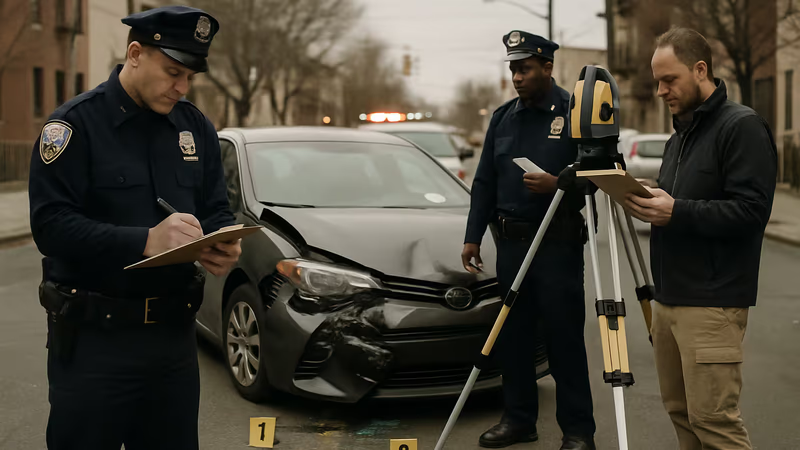
This Appellate Term decision provides a stark reminder of how fundamental factual disputes can undermine even seemingly straightforward personal injury claims. The case involves a pedestrian allegedly struck by an insured vehicle, but the underlying facts tell a different story.
Key Facts and Insurance Company Defense
In Parisien v Allstate, the insurance carrier presented compelling evidence challenging the occurrence of any accident at all. The decision states:
“In support of its motion, defendant submitted the transcript of the examination under oath (EUO) of its insured, in which she testified that she had been parking her vehicle at the time of the alleged accident, that no accident had occurred and that plaintiff’s assignor, a pedestrian, had not been struck by her vehicle. In a supporting affidavit, the insured attested to the same facts. The EUO testimony and the affidavit are sufficient to demonstrate, prima facie, that ‘the alleged injury not arise out of an insured incident’”
Collateral Estoppel Implications
This decision carries significant implications beyond the immediate No-Fault claim. As noted in the original case analysis, this ruling establishes collateral estoppel against the assignor under Lobel v Allstate Ins. Co., 269 AD2d 502 (2000). This means the injured party is now bound by this determination in any subsequent bodily injury litigation.
Legal Standards for Causation in New York
New York personal injury law requires plaintiffs to establish both factual and legal causation. Understanding these requirements is essential for successful litigation outcomes.
Factual Causation (“But For” Test)
Plaintiffs must prove that “but for” the defendant’s conduct, the injury would not have occurred. This requires establishing:
- Actual occurrence of the incident – The alleged accident must have actually happened
- Defendant’s involvement – The defendant must have been a factual cause of the incident
- Direct causal relationship – The incident must have directly caused the claimed injuries
- No intervening causes – No independent causes broke the causal chain
Legal Causation (Proximate Cause)
Even with factual causation established, plaintiffs must prove legal causation, showing the defendant’s conduct was a “substantial factor” in bringing about the injury and that the harm was foreseeable.
Common Causation Challenges in Personal Injury Cases
Insurance carriers and defense attorneys frequently challenge causation through various strategic approaches.
Accident Occurrence Disputes
As demonstrated in Parisien, carriers may challenge whether any accident occurred at all. Common scenarios include:
- Staged accident allegations
- Disputed timeline of events
- Lack of property damage evidence
- Inconsistent witness statements
- Missing police reports
Pre-Existing Condition Arguments
Defense teams often argue that claimed injuries result from pre-existing conditions rather than the alleged incident. Effective responses include:
- Medical records demonstrating symptom onset timing
- Expert testimony on injury causation
- Documentation of functional limitations post-accident
- Comparative diagnostic imaging
Strategic Implications for Personal Injury Practice
The Parisien decision offers important lessons for both plaintiff and defense counsel in personal injury litigation.
For Plaintiff’s Counsel
Attorneys representing injured parties must carefully investigate causation from case inception:
- Thorough fact investigation – Gather all available evidence supporting accident occurrence
- Witness preservation – Secure sworn statements from witnesses early in the process
- Medical documentation – Ensure comprehensive medical records link injuries to the incident
- Expert retention – Consider early expert evaluation for complex causation issues
- Discovery strategy – Use depositions and document requests to establish causal links
For Defense Counsel
Insurance defense attorneys should systematically examine causation defenses:
- EUO utilization – Conduct thorough examinations under oath of all relevant parties
- Medical record analysis – Review pre-accident medical history for alternative causation theories
- Investigative resources – Deploy investigators to gather contradictory evidence
- Expert testimony – Retain causation experts for complex medical and technical issues
- Discovery focus – Target depositions and document requests toward causation gaps
Related Personal Injury Legal Issues
Causation disputes frequently intersect with other aspects of personal injury law, including motor vehicle accidents, premises liability cases, and medical malpractice claims. Understanding these connections is essential for comprehensive case preparation.
The Intersection of No-Fault and Bodily Injury Claims
The Parisien case illustrates the critical intersection between No-Fault insurance claims and potential bodily injury litigation. Decisions in No-Fault proceedings can have preclusive effects on subsequent personal injury lawsuits.
Collateral Estoppel Considerations
Under New York law, determinations in No-Fault arbitrations or litigation may bind parties in subsequent proceedings. Key factors include:
- Identity of issues – The same factual or legal issue must be involved
- Actual litigation – The issue must have been actually litigated and decided
- Necessity of decision – The determination must have been necessary to the judgment
- Finality – The prior proceeding must have resulted in a final judgment
Legal Malpractice Implications
The Parisien case raises important questions about potential legal malpractice exposure for attorneys handling personal injury cases. The original analysis noted: “For the legal malpractice attorneys out there, does this constitute legal malpractice? Is there a duty from counsel to the medical provider to the EIP when this type of action is arbitrated or litigated?”
Duty to Coordinate Defense
Attorneys must consider their duties when representing clients in related proceedings:
- Coordination between No-Fault and bodily injury counsel
- Disclosure of potential conflicts between proceedings
- Strategic planning to avoid adverse determinations
- Communication with all affected parties
Frequently Asked Questions About Causation in Personal Injury Cases
What evidence is needed to prove causation in a New York personal injury case?
Plaintiffs must provide evidence establishing that the defendant’s conduct was both a factual and legal cause of their injuries. This typically includes witness testimony, medical records, expert opinions, and physical evidence demonstrating the causal connection between the incident and claimed damages.
Can insurance companies challenge whether an accident occurred at all?
Yes. As demonstrated in Parisien, insurance carriers can present evidence through examinations under oath, affidavits, and other discovery tools to challenge the basic occurrence of alleged incidents. Success requires competent evidence supporting their position.
How do pre-existing conditions affect causation arguments?
Pre-existing conditions don’t automatically defeat personal injury claims, but they can complicate causation analysis. Plaintiffs must show how the incident worsened or aggravated existing conditions, while defendants may argue injuries result from prior conditions rather than the alleged accident.
What is collateral estoppel and how does it apply to personal injury cases?
Collateral estoppel prevents re-litigation of issues already decided in prior proceedings. In personal injury contexts, determinations in No-Fault arbitrations or insurance coverage disputes may bind parties in subsequent bodily injury lawsuits involving the same factual issues.
Can attorneys be liable for malpractice if they don’t coordinate related proceedings?
Potentially. Attorneys have duties to consider how determinations in related proceedings might affect their clients’ interests. Failure to coordinate defense strategies or advise clients of potential adverse consequences may constitute malpractice depending on the specific circumstances.
Best Practices for Causation Evidence
Successful personal injury practice requires systematic attention to causation evidence throughout the litigation process.
Early Case Development
- Immediate scene investigation and photography
- Prompt witness interviews and statement preservation
- Comprehensive medical documentation from initial treatment
- Expert consultation for complex causation issues
Ongoing Case Management
- Regular medical follow-up documentation
- Functional capacity evaluations when appropriate
- Coordination between treating physicians and legal team
- Anticipation and preparation for causation challenges
Conclusion: Lessons from Parisien v Allstate
The Appellate Term’s decision in Parisien v Allstate serves as a crucial reminder that even basic factual elements like accident occurrence cannot be taken for granted in personal injury litigation. Insurance carriers possess significant resources and strategic advantages when challenging causation, and successful outcomes require meticulous preparation and evidence development.
For practitioners, this case underscores the importance of thorough investigation, careful coordination between related proceedings, and systematic attention to causation evidence throughout the litigation process.
If you’re dealing with a personal injury case involving causation disputes or insurance coverage challenges, experienced legal representation is essential. Call 516-750-0595 for a free consultation with attorneys who understand New York’s complex causation requirements and can effectively advocate for your interests throughout the litigation process.
The Law Office of Jason Tenenbaum provides comprehensive representation in all aspects of personal injury litigation, from initial case evaluation through trial and appeal. Our experienced team understands the nuances of causation law and works diligently to build compelling cases that withstand insurance company challenges.
Legal Context
Why This Matters for Your Case
New York law is among the most complex and nuanced in the country, with distinct procedural rules, substantive doctrines, and court systems that differ significantly from other jurisdictions. The Civil Practice Law and Rules (CPLR) governs every stage of civil litigation, from service of process through trial and appeal. The Appellate Division, Appellate Term, and Court of Appeals create a rich and ever-evolving body of case law that practitioners must follow.
Attorney Jason Tenenbaum has practiced across these areas for over 24 years, writing more than 1,000 appellate briefs and publishing over 2,353 legal articles that attorneys and clients rely on for guidance. The analysis in this article reflects real courtroom experience — from motion practice in Civil Court and Supreme Court to oral arguments before the Appellate Division — and a deep understanding of how New York courts actually apply the law in practice.
About This Topic
Causation in New York Personal Injury & No-Fault Law
Causation — proving that the defendant's negligence or the accident caused the plaintiff's injuries — is an essential element of every personal injury and no-fault claim. New York courts distinguish between proximate cause, intervening causes, and pre-existing conditions that may have been aggravated by an accident. The legal standards for establishing causation through medical evidence and the defenses available to challenge causal connection are analyzed in depth across these articles.
51 published articles in Causation
Keep Reading
More Causation Analysis

Collateral Estoppel?
Explore collateral estoppel: why default judgments don't preclude later suits & when courts can depart from other departments' rulings.
Sep 28, 2020
Understanding Causal Relationship in New York Personal Injury Cases: Legal Guide
Learn how to prove causal relationship in New York personal injury cases. Expert legal guidance on causation challenges, medical evidence, and winning strategies. Call...
Jul 24, 2019
Causation not proved
Court dismisses personal injury case where plaintiff failed to prove causation between car accident and cervical injuries, distinguishing new trauma from preexisting neck...
Oct 27, 2016
Absence of a business record entry = no motor vehicle accident
Expert analysis of Jesa Med. Supply v NYC Transit Authority and business records evidence. Learn how absent records affect personal injury cases in NY.
Feb 15, 2013
Affirmed, Reversed, and Modified on Summary Judgment: Key Causation Lessons
Learn how New York courts evaluate medical evidence in personal injury cases through key appellate decisions on causation, expert testimony, and preexisting conditions.
Jan 25, 2009
Degeneration from the App Div
Court dismisses personal injury case where plaintiff failed to prove spinal injuries caused by accident rather than degeneration, highlighting critical causation requirements.
May 22, 2018Was this article helpful?

About the Author
Jason Tenenbaum, Esq.
Jason Tenenbaum is the founding attorney of the Law Office of Jason Tenenbaum, P.C., headquartered at 326 Walt Whitman Road, Suite C, Huntington Station, New York 11746. With over 24 years of experience since founding the firm in 2002, Jason has written more than 1,000 appeals, handled over 100,000 no-fault insurance cases, and recovered over $100 million for clients across Long Island, Nassau County, Suffolk County, Queens, Brooklyn, Manhattan, the Bronx, and Staten Island. He is one of the few attorneys in the state who both writes his own appellate briefs and tries his own cases.
Jason is admitted to practice in New York, New Jersey, Florida, Texas, Georgia, and Michigan state courts, as well as multiple federal courts. His 2,353+ published legal articles analyzing New York case law, procedural developments, and litigation strategy make him one of the most prolific legal commentators in the state. He earned his Juris Doctor from Syracuse University College of Law.
Disclaimer: This article is published by the Law Office of Jason Tenenbaum, P.C. for informational and educational purposes only. It does not constitute legal advice, and no attorney-client relationship is formed by reading this content. The legal principles discussed may not apply to your specific situation, and the law may have changed since this article was last updated.
New York law varies by jurisdiction — court decisions in one Appellate Division department may not be followed in another, and local court rules in Nassau County Supreme Court differ from those in Suffolk County Supreme Court, Kings County Civil Court, or Queens County Supreme Court. The Appellate Division, Second Department (which covers Long Island, Brooklyn, Queens, and Staten Island) and the Appellate Term (which hears appeals from lower courts) each have distinct procedural requirements and precedents that affect litigation strategy.
If you need legal help with a causation matter, contact our office at (516) 750-0595 for a free consultation. We serve clients throughout Long Island (Huntington, Babylon, Islip, Brookhaven, Smithtown, Riverhead, Southampton, East Hampton), Nassau County (Hempstead, Garden City, Mineola, Great Neck, Manhasset, Freeport, Long Beach, Rockville Centre, Valley Stream, Westbury, Hicksville, Massapequa), Suffolk County (Hauppauge, Deer Park, Bay Shore, Central Islip, Patchogue, Brentwood), Queens, Brooklyn, Manhattan, the Bronx, Staten Island, and Westchester County. Prior results do not guarantee a similar outcome.