Key Takeaway
Imran ordered a new trial after a poorly founded biomechanical opinion. The 2018 ruling concerns the crash-test evidence, not a ban on biomechanics.
This article is part of our ongoing causation coverage, with 52 published articles analyzing causation issues across New York State. Attorney Jason Tenenbaum brings 24+ years of hands-on experience to this analysis, drawing from his work on more than 1,000 appeals, over 100,000 no-fault cases, and recovery of over $100 million for clients throughout Nassau County, Suffolk County, Queens, Brooklyn, Manhattan, and the Bronx. For personalized legal advice about how these principles apply to your specific situation, contact our Long Island office at (516) 750-0595 for a free consultation.
The problem in Imran v R. Barany Monuments, Inc., 167 AD3d 992 (2018) was the foundation for one expert’s opinion. The Second Department upheld an order setting aside a defense damages verdict and granting a new trial. It did not ban biomechanical evidence.
Legal Update (September 2026): Chapter 58 of 2026, Part EE §§ 1 and 4 removed the 90/180-day serious-injury category for actions and proceedings commenced on or after May 26, 2026; the historical decision discussed here predates that amendment.
Last reviewed: September 2026.
A reconstruction that did not fit the crash
The accident involved four vehicles. The defense engineer calculated a 5.7-mph change in velocity, then used other crash tests to conclude that the collision could not have caused the claimed lumbar and knee injuries. He had not calculated the force from all four vehicles. The selected crash test differed materially from the actual collision, and the simulations used dummies whose weights were unlike the plaintiff’s.
Free Consultation · No Fee Unless We Win
Does this apply to your situation?
Every case is different. Get a free, confidential case review from an experienced attorney who can tell you exactly where you stand.
Those shortcomings left the causation opinion without a proper foundation. Relief came through CPLR 4404(a), after the jury found no qualifying serious injury. The result was a new trial on damages, not a finding that causation or a damages award had been proved.
The Johnson note below compares low-impact studies with and without patient-specific medical information. The expert’s inputs and reasoning need examination; the label “biomechanics” does not settle admissibility.
Jason’s original 2018 commentary
Jason’s December 2018 reaction is preserved below as opinion. His description of this as the first real pushback is not presented as a verified history of all biomechanical-evidence decisions.
Biomechanical engineers are dangerous because, as seen above, they can use alternative facts to come to conclusions that spell disaster on causation claims. I have to give the trial judge credit for reflecting after the proverbial “**** storm” hit and setting aside the verdict. It was a brave move on his part. Not a good case to appeal for the carrier, and definitely the first real push back we have seem from the Appellate Division in a long time on this issue.
Connect to the Encyclopedia
Start with the pre-existing injuries and causation topic hub.
- Donoso: missing causal proof at trial, distinguished from stipulated no-fault records
- Johnson: causal proof on a default-judgment application
- Cariddi: the basis of an expert opinion and missing records
- Khanfour: reconcile earlier and later range-of-motion findings
For review of a particular dispute, contact the firm.
Legal Context
Why This Matters for Your Case
New York law is among the most complex and nuanced in the country, with distinct procedural rules, substantive doctrines, and court systems that differ significantly from other jurisdictions. The Civil Practice Law and Rules (CPLR) governs every stage of civil litigation, from service of process through trial and appeal. The Appellate Division, Appellate Term, and Court of Appeals create a rich and ever-evolving body of case law that practitioners must follow.
Attorney Jason Tenenbaum has practiced across these areas for over 24 years, writing more than 1,000 appellate briefs and publishing over 2,600 legal articles that attorneys and clients rely on for guidance. The analysis in this article reflects real courtroom experience — from motion practice in Civil Court and Supreme Court to oral arguments before the Appellate Division — and a deep understanding of how New York courts actually apply the law in practice.
About This Topic
Causation in New York Personal Injury & No-Fault Law
Causation — proving that the defendant's negligence or the accident caused the plaintiff's injuries — is an essential element of every personal injury and no-fault claim. New York courts distinguish between proximate cause, intervening causes, and pre-existing conditions that may have been aggravated by an accident. The legal standards for establishing causation through medical evidence and the defenses available to challenge causal connection are analyzed in depth across these articles.
52 published articles in Causation
Keep Reading
More Causation Analysis

Defense Engineer Says Your Injury Is Degenerative? Bonilla-Acosta v Max Services (2026)
A NY appeals court held a defense engineer was qualified on crash force but not shown qualified to call spine injuries degenerative. What it means for you.
Oct 23, 2026
Collateral Estoppel?
Explore collateral estoppel: why default judgments don't preclude later suits & when courts can depart from other departments' rulings.
Sep 28, 2020
Cessation of treatment/Pre-existing injuries/Commentary
Latus and Vila: treatment gaps, contradictory explanations and pre-existing conditions, with Jason's historical commentary kept separate.
Mar 7, 2018
Contemporaneous medical records sufficient
Court ruling demonstrates how contemporaneous medical records can establish causation between accidents and injuries, with implications for no-fault insurance claims.
Dec 11, 2014
A 2007 causation case – affidavit insufficient
Selective's insurer submitted the deficient affidavit; the hospital won. A corrected account of the 2007 no-fault causation and payment ruling.
Apr 27, 2011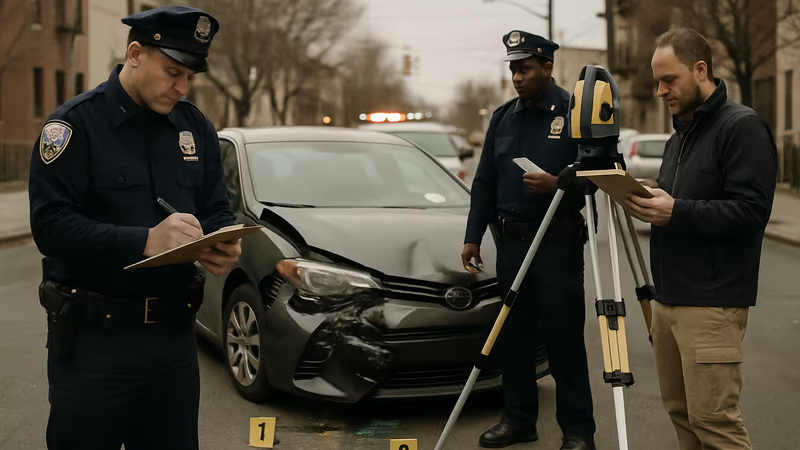
New York Personal Injury Law: Proving Causation in Accident Cases
Learn how to prove causation in NY personal injury cases. Expert analysis of Parisien v Allstate case and causation challenges. Call 516-750-0595.
Aug 10, 2019Was this article helpful?
Disclaimer: This article is published by the Law Office of Jason Tenenbaum, P.C. for informational and educational purposes only. It does not constitute legal advice, and no attorney-client relationship is formed by reading this content. The legal principles discussed may not apply to your specific situation, and the law may have changed since this article was last updated.
New York law varies by jurisdiction — court decisions in one Appellate Division department may not be followed in another, and local court rules in Nassau County Supreme Court differ from those in Suffolk County Supreme Court, Kings County Civil Court, or Queens County Supreme Court. The Appellate Division, Second Department (which covers Long Island, Brooklyn, Queens, and Staten Island) and the Appellate Term (which hears appeals from lower courts) each have distinct procedural requirements and precedents that affect litigation strategy.
If you need legal help with a causation matter, contact our office at (516) 750-0595 for a free consultation. We serve clients throughout Long Island (Huntington, Babylon, Islip, Brookhaven, Smithtown, Riverhead, Southampton, East Hampton), Nassau County (Hempstead, Garden City, Mineola, Great Neck, Manhasset, Freeport, Long Beach, Rockville Centre, Valley Stream, Westbury, Hicksville, Massapequa), Suffolk County (Hauppauge, Deer Park, Bay Shore, Central Islip, Patchogue, Brentwood), Queens, Brooklyn, Manhattan, the Bronx, Staten Island, and Westchester County. Prior results do not guarantee a similar outcome.