Key Takeaway
V.S. Medical v Allstate: a hearing to prove compliance with a funeral-related adjournment condition, with limited review despite a default.
This article is part of our ongoing adjournments coverage, with 10 published articles analyzing adjournments issues across New York State. Attorney Jason Tenenbaum brings 24+ years of hands-on experience to this analysis, drawing from his work on more than 1,000 appeals, over 100,000 no-fault cases, and recovery of over $100 million for clients throughout Nassau County, Suffolk County, Queens, Brooklyn, Manhattan, and the Bronx. For personalized legal advice about how these principles apply to your specific situation, contact our Long Island office at (516) 750-0595 for a free consultation.
Last reviewed: September 2026
A court can require proof of the excuse offered for a trial adjournment. In V.S. Medical Services v Allstate, the error was refusing to let the witness testify to try to supply that proof. The provider received a hearing, not a ruling that the funeral excuse had already been established or that its bills had to be paid.
Historical note: V.S. Medical Services, P.C. v Allstate Insurance Co., 60 Misc 3d 138(A), 2018 NY Slip Op 51124(U) (App Term, 2d Dept, July 13, 2018) reversed only insofar as reviewed and remitted for a hearing on compliance with the adjournment condition. The extensions and adjournments hub places this narrow ruling alongside the other archive cases.
The condition the provider had to satisfy
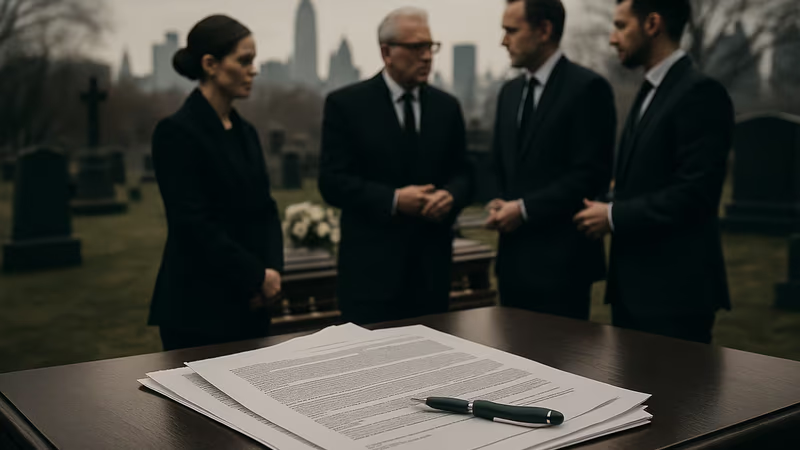
The provider sued for assigned first-party no-fault benefits. Its counsel said a witness had been attending a funeral on the scheduled trial date. Kings Civil Court conditioned the adjournment on proof of that funeral.
Free Consultation · No Fee Unless We Win
Does this apply to your situation?
Every case is different. Get a free, confidential case review from an experienced attorney who can tell you exactly where you stand.
The court later determined that the provider had not satisfied the condition and dismissed the complaint on default. The Appellate Term held that requiring proof was within the trial court’s discretion. But the witness should have been allowed to testify in an attempt to provide it.
The matter returned for a hearing and a new determination of whether the proof satisfied the court. That disposition left the factual issue open. It did not remove the condition, accept the excuse as true or adjudicate entitlement to the underlying no-fault benefits.
Jason’s original July 2018 comment
The original observation connects this procedural dispute to the proof still needed on the insurance claim:
Here’s a first. A plaintiff could not prove its prima facie case because its biller failed to present proof (s)he had a funeral on the date of the trial. Should Plaintiff prove its case, can Allstate prove they mailed the documents?
The question about mailing was Jason’s commentary. The appellate opinion did not decide an insurer’s mailing proof or the merits of the provider’s claim.
Why the appeal was limited
CPLR 5511 generally excludes an appeal by a party from a judgment or order entered on that party’s default. The decision applied a narrower principle permitting review of matters actually contested below. Here, that was the determination that the provider failed to comply with the condition for the adjournment.
That distinction explains both parts of the disposition: dismissal of the appeal except as to the contested determination, and reversal within that limited scope. An appeal from a default judgment is not an invitation to raise every defense or merits argument that was never presented.
For a current default, counsel should identify what the court actually decided after a contest and what went unopposed. Relief under CPLR 5015 is a separate route with specified grounds and requirements. This note does not determine which route is available on another record, and filing one kind of application should not be assumed to preserve a different deadline.
Turn an excuse into an evidentiary showing
The useful question is what the condition requires the party to establish. Start with the actual order or transcript. Was the condition proof of the event, proof of the witness’s attendance, or another stated fact? Do not replace the court’s words with counsel’s impression of what would probably be enough.
Next, identify who has firsthand knowledge and what documents are available. A witness may be able to explain the relevant event and absence. Documents may support that explanation. Neither an attorney’s assertion nor the title of a document establishes facts that it does not actually address.
Finally, offer the proof through the procedure the court permits. In this case, the witness was not given the opportunity the appellate court held was required. That does not mean testimony must be accepted as credible, or that a particular document will always suffice.
These are practical preparation questions. The decision did not prescribe a universal list of funeral documents, require disclosure of unrelated private information or create a rule that bereavement excuses every missed appearance.
Preserve the request to present proof
If the dispute is whether a condition was met, make clear that the witness is being offered to address that condition. Identify the subject of the proposed testimony. Ask for a ruling on the request to present it, and keep that ruling distinct from any later assessment of credibility.
A useful record should let a reviewer understand what was offered, why it mattered and why the court accepted or rejected the proposed procedure. An unexplained statement that counsel had “proof” may leave those points uncertain.
Keep copies of the relevant calendar directions and prior rulings with your hearing materials. If there was an oral direction given at a prior appearance, consult the transcript rather than assuming that the next judge will have the same understanding of what occurred. This is record keeping, not a substitute for satisfying the condition itself.
How this differs from other adjournment problems
In Middle Village Chiropractic, the central weakness was the absence of a showing of diligence in obtaining experts for trial. In Brooklyn Chiropractic, the court had been told about a specific witness restriction and a way to accommodate it. This case adds the proof stage: what happens when an adjournment was conditioned on substantiating the explanation.
There is also a useful comparison with Counsel Financial Services. Showing up on an adjourned return date did not erase a missed deadline for written opposition there. Here, the unresolved condition concerned the excuse for missing trial. In both situations, the question is what the prior direction required, not merely whether a party eventually appeared.
The claim still needs its own proof
A successful procedural challenge can restore an opportunity without resolving the case. The provider’s proof of its claim and any insurer defenses remained separate from whether the witness had supplied a satisfactory adjournment excuse.
That is the useful connection behind Jason’s closing question. Winning the argument about the hearing does not supply missing insurance evidence. When reviewing a file, keep a calendar and procedural-history section separate from the documents and testimony needed on the merits.
For help assessing a no-fault litigation record, see the firm’s no-fault defense practice or contact the office. Have the judgment, adjournment directions and relevant transcript available; the title of a reported case alone cannot show which remedy fits.
Connect to the Encyclopedia
The CPLR 2004 topic hub links the full adjournment cohort.
Legal Context
Why This Matters for Your Case
New York law is among the most complex and nuanced in the country, with distinct procedural rules, substantive doctrines, and court systems that differ significantly from other jurisdictions. The Civil Practice Law and Rules (CPLR) governs every stage of civil litigation, from service of process through trial and appeal. The Appellate Division, Appellate Term, and Court of Appeals create a rich and ever-evolving body of case law that practitioners must follow.
Attorney Jason Tenenbaum has practiced across these areas for over 24 years, writing more than 1,000 appellate briefs and publishing over 2,600 legal articles that attorneys and clients rely on for guidance. The analysis in this article reflects real courtroom experience — from motion practice in Civil Court and Supreme Court to oral arguments before the Appellate Division — and a deep understanding of how New York courts actually apply the law in practice.
Keep Reading
More Adjournments Analysis

Improvidently Granted: What 'Improvident' Means When Courts Accept Late Papers
What 'improvidently granted' means in New York law: a vague law office failure excuse cannot justify late opposition papers, per Elusma v Jackson.
Sep 25, 2020
Who is the attorney?
Civil Kings court case on attorney representation requirements and default judgment appeals in no-fault insurance litigation.
Feb 1, 2020
Adjournments not granted as a matter of course
New York courts have discretion to deny adjournments when attorneys lack due diligence. Learn about court adjournment standards and legal requirements.
Dec 15, 2016
Motion Return Date Adjournments in New York Courts – Expert Legal Guidance
Counsel Financial explains a denied second adjournment, missed opposition under CPLR 3213 and the limits of appealing a contested ruling after default.
Nov 26, 2009
Understanding Foundation Requirements in Medical Malpractice Expert Testimony
New York medical malpractice expert testimony foundation requirements.
Dec 28, 2008
New trial ordered due to physician unavailability
Normandin v Bell explains a brief trial continuance for an unavailable medical expert. The new trial was not an automatic right or a merits ruling.
Jun 11, 2018Was this article helpful?
Disclaimer: This article is published by the Law Office of Jason Tenenbaum, P.C. for informational and educational purposes only. It does not constitute legal advice, and no attorney-client relationship is formed by reading this content. The legal principles discussed may not apply to your specific situation, and the law may have changed since this article was last updated.
New York law varies by jurisdiction — court decisions in one Appellate Division department may not be followed in another, and local court rules in Nassau County Supreme Court differ from those in Suffolk County Supreme Court, Kings County Civil Court, or Queens County Supreme Court. The Appellate Division, Second Department (which covers Long Island, Brooklyn, Queens, and Staten Island) and the Appellate Term (which hears appeals from lower courts) each have distinct procedural requirements and precedents that affect litigation strategy.
If you need legal help with a adjournments matter, contact our office at (516) 750-0595 for a free consultation. We serve clients throughout Long Island (Huntington, Babylon, Islip, Brookhaven, Smithtown, Riverhead, Southampton, East Hampton), Nassau County (Hempstead, Garden City, Mineola, Great Neck, Manhasset, Freeport, Long Beach, Rockville Centre, Valley Stream, Westbury, Hicksville, Massapequa), Suffolk County (Hauppauge, Deer Park, Bay Shore, Central Islip, Patchogue, Brentwood), Queens, Brooklyn, Manhattan, the Bronx, Staten Island, and Westchester County. Prior results do not guarantee a similar outcome.