Key Takeaway
New York court ruling on missing witness charges in civil trials - when courts should instruct juries to draw adverse inferences from a party's failure to call expected witnesses.
This article is part of our ongoing no-fault coverage, with 271 published articles analyzing no-fault issues across New York State. Attorney Jason Tenenbaum brings 24+ years of hands-on experience to this analysis, drawing from his work on more than 1,000 appeals, over 100,000 no-fault cases, and recovery of over $100 million for clients throughout Nassau County, Suffolk County, Queens, Brooklyn, Manhattan, and the Bronx. For personalized legal advice about how these principles apply to your specific situation, contact our Long Island office at (516) 750-0595 for a free consultation.
Alli v Full Serv. Auto Repair, LLC, 2015 NY Slip Op 03308 (2d Dept. 2015) If you’re dealing with a no-fault insurance defense matter, an experienced attorney can help protect your rights.
The missing witness charge
“The plaintiff requested that the Supreme Court deliver a missing witness charge because of the failure of the defense to call Chinsamy as a witness. This request was refused and no such charge was given. The jury returned a verdict in favor of the defendants.
A missing witness charge “instructs a jury that it may draw an adverse inference based on the failure of a party to call a witness who would normally be expected to support that party’s version of events… The preconditions for this charge, applicable to both criminal and civil trials, may be set out as follows: (1) the witness’s knowledge is material to the trial; (2) the witness is expected to give noncumulative testimony; (3) the witness is under the control’ of the party against whom the charge is sought, so that the witness would be expected to testify in that party’s favor; and (4) the witness is available to that party” (DeVito v Feliciano, 22 NY3d 159, 165-166 ).
Free Consultation · No Fee Unless We Win
Does this apply to your situation?
Every case is different. Get a free, confidential case review from an experienced attorney who can tell you exactly where you stand.
Under the circumstances, and considering Chinsamy’s unexplained failure to appear and testify at trial, the Supreme Court should have granted the plaintiff’s request for a missing witness charge (see Katz v Gangemi, 60 AD3d 819; Brown v City of New York, 50 AD3d 937; Crowder v Wells & Wells Equip., Inc., 11 AD3d 360; Farrell v Labarbera, 181 AD2d 715). In this regard, we note that the plaintiff’s use of Chinsamy’s deposition testimony does not constitute a waiver of her right to request a missing witness charge (see Webber v K-Mart Corp., 266 AD2d 534; Farrell v Labarbera, 181 AD2d 715). In light of the evidence presented, the error cannot be deemed harmless (see Crowder v Wells & Wells Equip., Inc., 11 AD3d at 362)”
Related Articles
Legal Context
Why This Matters for Your Case
New York's no-fault insurance system, established under Insurance Law Article 51, is one of the most complex insurance frameworks in the country. Every motorist must carry Personal Injury Protection coverage that pays medical expenses and lost wages regardless of fault, up to $50,000 per person.
But insurers routinely deny valid claims using peer reviews, EUO scheduling tactics, fee schedule reductions, and coverage defenses. The Law Office of Jason Tenenbaum has handled over 100,000 no-fault cases since 2002 — from initial claim submissions through arbitration before the American Arbitration Association, trials in Civil Court and Supreme Court, and appeals to the Appellate Term and Appellate Division. Jason Tenenbaum is one of the few attorneys in the state who both writes his own appellate briefs and tries his own cases.
His 2,600+ published legal articles on no-fault practice are cited by attorneys throughout New York. Whether you are dealing with a medical necessity denial, an EUO no-show defense, a fee schedule dispute, or a coverage question, this article provides the kind of detailed case-law analysis that helps practitioners and claimants understand exactly where the law stands.
About This Topic
New York No-Fault Insurance Law
New York's no-fault insurance system requires every driver to carry Personal Injury Protection (PIP) coverage that pays medical expenses and lost wages regardless of who caused the accident. But insurers routinely deny, delay, and underpay valid claims — using peer reviews, IME no-shows, and fee schedule defenses to avoid paying providers and injured claimants. Attorney Jason Tenenbaum has litigated thousands of no-fault arbitrations and court cases since 2002.
271 published articles in No-Fault
Keep Reading
More No-Fault Analysis

Car Accident Recorded Statement in New York: Should You Give One?
The at-fault driver's adjuster wants a recorded statement within days of a New York car accident — and that call is designed to weaken your case.
Apr 5, 2026
Who Pays Car Accident Medical Bills in New York? A Step-by-Step Guide
New York no-fault PIP, primary health insurance, Medicaid/Medicare, and litigation liens — the full payment ladder for car-accident medical bills.
Apr 5, 2026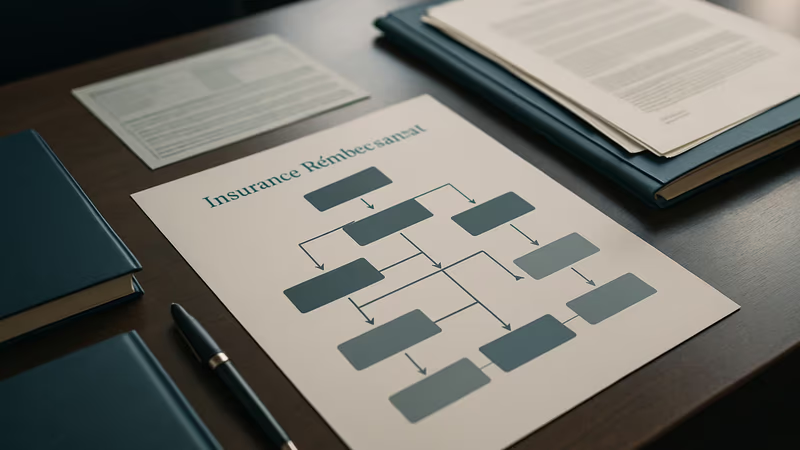
Fee Schedule vs. Reasonable and Customary Charges: Avenues of Reimbursement in No-Fault Insurance
Court validates hybrid approach to no-fault reimbursement using both fee schedules and reasonable charges. New York and Long Island no-fault defense analysis.
Jul 30, 2022
Respond at your own peril
Court ruling on whether emails satisfy CPLR 2104 writing requirements in settlement agreements, analyzing Forcelli precedent and signature standards.
Jul 12, 2021
Corporate Representative's Right to Remain in Courtroom During NY Trial
NY appellate court holds defendant's employee representative can remain in courtroom and communicate with defense counsel during trial. Perry v Kone analysis.
Feb 23, 2017
Response to Sun's comment last week
Response to Sun's comment on blanket denials in New York no-fault insurance law, discussing DOI requirements and A&S Medical case interpretation.
Jun 3, 2011Was this article helpful?
Disclaimer: This article is published by the Law Office of Jason Tenenbaum, P.C. for informational and educational purposes only. It does not constitute legal advice, and no attorney-client relationship is formed by reading this content. The legal principles discussed may not apply to your specific situation, and the law may have changed since this article was last updated.
New York law varies by jurisdiction — court decisions in one Appellate Division department may not be followed in another, and local court rules in Nassau County Supreme Court differ from those in Suffolk County Supreme Court, Kings County Civil Court, or Queens County Supreme Court. The Appellate Division, Second Department (which covers Long Island, Brooklyn, Queens, and Staten Island) and the Appellate Term (which hears appeals from lower courts) each have distinct procedural requirements and precedents that affect litigation strategy.
If you need legal help with a no-fault matter, contact our office at (516) 750-0595 for a free consultation. We serve clients throughout Long Island (Huntington, Babylon, Islip, Brookhaven, Smithtown, Riverhead, Southampton, East Hampton), Nassau County (Hempstead, Garden City, Mineola, Great Neck, Manhasset, Freeport, Long Beach, Rockville Centre, Valley Stream, Westbury, Hicksville, Massapequa), Suffolk County (Hauppauge, Deer Park, Bay Shore, Central Islip, Patchogue, Brentwood), Queens, Brooklyn, Manhattan, the Bronx, Staten Island, and Westchester County. Prior results do not guarantee a similar outcome.