Why Trust This Analysis
This article is part of our ongoing procedural issues coverage, with 187 published articles analyzing procedural issues issues across New York State. Attorney Jason Tenenbaum brings 24+ years of hands-on experience to this analysis, drawing from his work on more than 1,000 appeals, over 100,000 no-fault cases, and recovery of over $100 million for clients throughout Nassau County, Suffolk County, Queens, Brooklyn, Manhattan, and the Bronx. For personalized legal advice about how these principles apply to your specific situation, contact our Long Island office at (516) 750-0595 for a free consultation.
Looking for the complete rule? This post analyzes one traverse-hearing decision. For the full practitioner’s guide to CPLR § 308 — service methods, leading cases, and practice pointers — see CPLR § 308 Service of Process: The New York Practitioner’s Guide.
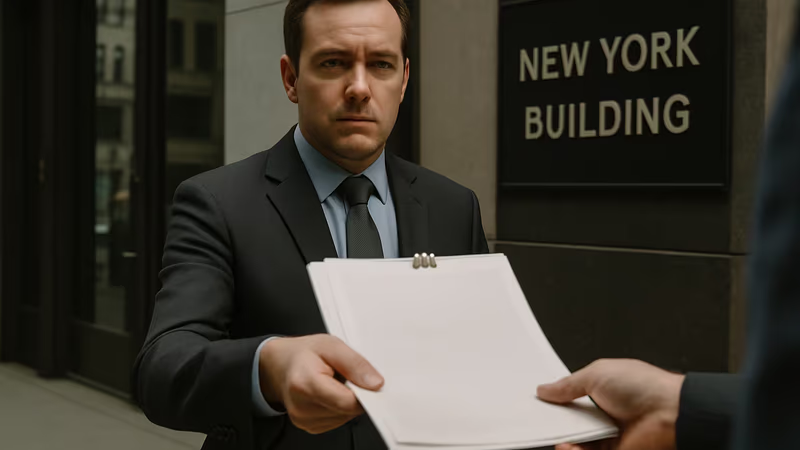
Proper service of legal documents is a fundamental requirement in civil litigation. When defendants claim they were never properly served with court papers — a situation sometimes referred to as “sewer service” — courts must carefully examine the evidence to determine whether valid service actually occurred. This case from the Second Department demonstrates how appellate courts scrutinize service issues and apply the legal principle that false testimony from one witness can undermine their entire credibility.
The dispute centered on whether the defendant was properly served with process. While trial courts typically have the advantage of observing witness credibility firsthand, appellate courts will overturn those findings when the evidence clearly demonstrates that a witness provided false testimony. This reflects the broader challenges in service of process procedures where conflicting testimony about service attempts can create credibility battles.
Case Background
In Bank v. Holt, the plaintiff initiated litigation against the defendant and attempted to establish jurisdiction through service of process. The defendant filed a traverse challenging the validity of service, asserting that he was never properly served with the summons and complaint. A hearing was conducted before the Supreme Court to resolve the factual dispute regarding whether service had been properly effectuated.
Free Consultation · No Fee Unless We Win
Does this apply to your situation?
Every case is different. Get a free, confidential case review from an experienced attorney who can tell you exactly where you stand.
At the hearing, the process server testified about the circumstances of the alleged service. However, upon close examination, the Second Department found significant problems with this testimony. The process server provided testimony about certain facts that was demonstrably false based on other evidence in the record. This created a credibility crisis that ultimately proved fatal to the plaintiff’s case, as the appellate court determined it could not rely on any portion of the process server’s testimony once part of it had been proven false.
Jason Tenenbaum’s Analysis
Bank v Holt, 2014 NY Slip Op 00344 (2d Dept. 2014)
Traverse sustained on appeal and complaint dismissed.
“Although, as a general matter, we do not lightly disturb findings that are based upon conflicting evidence and implicate the credibility of witnesses, the evidence adduced at the hearing warrants a reversal of the Supreme Court’s determination that process was properly effected upon Holt …. Where a witness has given testimony that is demonstrably false, we may, in accordance with the maxim falsus in uno falsus in omnibus, choose to discredit or disbelieve other testimony given by that witness (see DiPalma v State of New York, 90 AD3d 1659, 1660; Accardi v City of New York, 121 AD2d 489, 490-491; see generally People v Becker, 215 NY 126, 144)“
Legal Significance
The Bank v. Holt decision illustrates the application of the ancient evidentiary principle falsus in uno, falsus in omnibus—literally “false in one thing, false in everything.” This maxim allows courts to reject all testimony from a witness who has been proven to have lied about any material fact, even if other portions of their testimony appear credible. While not an absolute rule that courts must apply in every case, it provides a powerful tool for appellate review when witnesses provide demonstrably false testimony.
The Second Department’s willingness to reverse the trial court’s credibility determination reflects the seriousness with which New York courts treat service of process issues. Valid service is a jurisdictional prerequisite, and courts will not permit judgments to stand against defendants who were never properly brought before the court. When the only evidence of proper service comes from a witness whose testimony has been proven false in material respects, the fundamental requirement of jurisdiction cannot be satisfied.
This decision also serves as a warning to process servers and the attorneys who rely on their testimony. Process servers must provide truthful, accurate testimony about every aspect of their service attempts. Even a single false statement—whether about timing, location, description of the person served, or any other material detail—can undermine the validity of service and result in dismissal of the entire action.
Practical Implications
For plaintiffs and their counsel, this case emphasizes the critical importance of ensuring that process servers maintain accurate contemporaneous records of all service attempts. Process servers should document the date, time, location, physical description of the person served, and all other relevant details immediately after service is completed. These contemporaneous notes become crucial if service is later challenged, as they help ensure the process server can provide consistent, accurate testimony that will withstand scrutiny.
Attorneys should carefully vet process servers before retaining them, selecting professionals with established track records of accurate documentation and truthful testimony. When service is challenged, counsel must thoroughly prepare process servers for testimony, reviewing their affidavits and contemporaneous records to identify any potential inconsistencies or areas of vulnerability before the hearing.
For defendants challenging service, this decision provides a roadmap for successful traverses. Defense counsel should conduct thorough discovery regarding the circumstances of alleged service, including deposing process servers and obtaining their contemporaneous records. Any inconsistencies between the affidavit of service, contemporaneous notes, and hearing testimony should be highlighted and pressed vigorously, as even minor falsehoods can provide grounds for finding the entire testimony incredible.
Key Takeaway
The Second Department applied the Latin maxim “falsus in uno falsus in omnibus” (false in one thing, false in everything) to overturn a trial court’s service determination. When a witness provides demonstrably false testimony on one point, courts may choose to disbelieve their entire testimony, even in procedural matters where credibility is crucial.
Related Articles
Legal Context
Why This Matters for Your Case
New York law is among the most complex and nuanced in the country, with distinct procedural rules, substantive doctrines, and court systems that differ significantly from other jurisdictions. The Civil Practice Law and Rules (CPLR) governs every stage of civil litigation, from service of process through trial and appeal. The Appellate Division, Appellate Term, and Court of Appeals create a rich and ever-evolving body of case law that practitioners must follow.
Attorney Jason Tenenbaum has practiced across these areas for over 24 years, writing more than 1,000 appellate briefs and publishing over 2,600 legal articles that attorneys and clients rely on for guidance. The analysis in this article reflects real courtroom experience — from motion practice in Civil Court and Supreme Court to oral arguments before the Appellate Division — and a deep understanding of how New York courts actually apply the law in practice.
About This Topic
Procedural Issues in New York Litigation
New York civil procedure governs every stage of litigation — from pleading requirements and service of process to motion practice, discovery deadlines, and trial procedures. The CPLR creates strict procedural rules that can make or break a case regardless of the underlying merits. These articles examine the procedural pitfalls, timing requirements, and strategic considerations that practitioners face in New York state courts, with a particular focus on no-fault insurance and personal injury practice.
187 published articles in Procedural Issues
Keep Reading
More Procedural Issues Analysis
How to Talk to a Judge in New York: What to Say, What to Avoid, and How to Present Yourself
Address the judge as 'Your Honor,' stand when you speak, wait to be recognized, and keep answers short and honest. A Long Island trial lawyer explains.
Feb 24, 2026
CPLR § 2106 Amendment Eliminates Affidavit Notarization Requirement: What This Means for New York Litigation
New York's CPLR 2106 permits affirmations in place of many sworn documents. See the 2024 and 2025 changes, exceptions, and historical case notes.
Feb 18, 2026
Court Takes Judicial Notice of Supreme Court Declaratory Judgment — Res Judicata in No-Fault Cases
How a default declaratory judgment in New York Supreme Court can have res judicata effect to end a no-fault Civil Court claim — key Long Island no-fault defense strategy.
Sep 9, 2013
More on defective denials
Learn how defective insurance claim denials can be challenged in New York no-fault cases.
Mar 12, 2011
CPLR 2309 Requirements: Understanding Affidavit Attestation Rules from the Appellate Division, Second Department
Learn about CPLR 2309 affidavit attestation requirements and when technical violations may be excused under CPLR 2001.
Jan 10, 2010
The 120-day requirement does not apply to pro-se actions in the lower courts
New York courts rule that 120-day summary judgment deadlines don't apply to pro-se actions in lower courts without proper trial scheduling procedures.
Feb 11, 2015Was this article helpful?
Disclaimer: This article is published by the Law Office of Jason Tenenbaum, P.C. for informational and educational purposes only. It does not constitute legal advice, and no attorney-client relationship is formed by reading this content. The legal principles discussed may not apply to your specific situation, and the law may have changed since this article was last updated.
New York law varies by jurisdiction — court decisions in one Appellate Division department may not be followed in another, and local court rules in Nassau County Supreme Court differ from those in Suffolk County Supreme Court, Kings County Civil Court, or Queens County Supreme Court. The Appellate Division, Second Department (which covers Long Island, Brooklyn, Queens, and Staten Island) and the Appellate Term (which hears appeals from lower courts) each have distinct procedural requirements and precedents that affect litigation strategy.
If you need legal help with a procedural issues matter, contact our office at (516) 750-0595 for a free consultation. We serve clients throughout Long Island (Huntington, Babylon, Islip, Brookhaven, Smithtown, Riverhead, Southampton, East Hampton), Nassau County (Hempstead, Garden City, Mineola, Great Neck, Manhasset, Freeport, Long Beach, Rockville Centre, Valley Stream, Westbury, Hicksville, Massapequa), Suffolk County (Hauppauge, Deer Park, Bay Shore, Central Islip, Patchogue, Brentwood), Queens, Brooklyn, Manhattan, the Bronx, Staten Island, and Westchester County. Prior results do not guarantee a similar outcome.