Why Trust This Analysis
This article is part of our ongoing 2106 and 2309 coverage, with 31 published articles analyzing 2106 and 2309 issues across New York State. Attorney Jason Tenenbaum brings 24+ years of hands-on experience to this analysis, drawing from his work on more than 1,000 appeals, over 100,000 no-fault cases, and recovery of over $100 million for clients throughout Nassau County, Suffolk County, Queens, Brooklyn, Manhattan, and the Bronx. For personalized legal advice about how these principles apply to your specific situation, contact our Long Island office at (516) 750-0595 for a free consultation.
Understanding CPLR 2309(c) Authentication Requirements
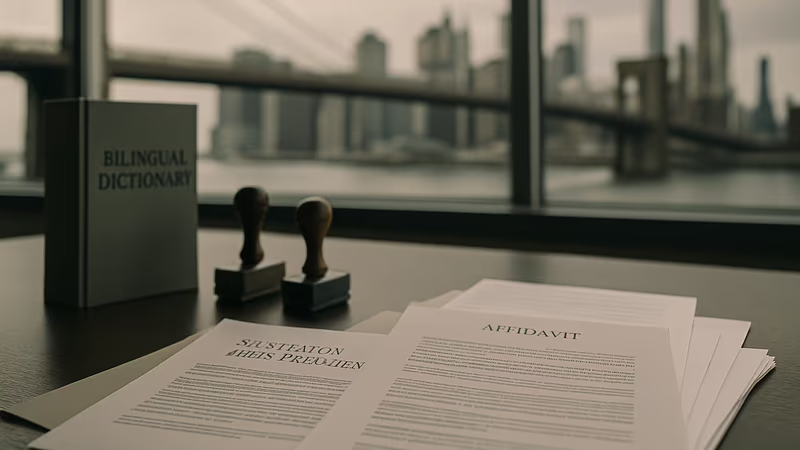
New York’s Civil Practice Law and Rules (CPLR) Section 2309(c) requires specific authentication when affidavits are notarized outside of New York State. Typically, such documents must include certificates that authenticate the authority of the out-of-state notary who administered the oath. This requirement ensures the validity and authenticity of sworn statements used in New York litigation.
However, procedural defects in legal documents don’t always result in automatic dismissal. Courts have discretionary power under CPLR 2001 to overlook technical deficiencies, particularly when the opposing party fails to object in a timely manner. This principle prevents parties from strategically waiting to raise procedural objections until it becomes advantageous to do so.
The interplay between strict procedural requirements and judicial discretion creates an important balance in civil litigation. While courts maintain standards for document authentication, they also recognize that minor procedural errors shouldn’t derail otherwise meritorious cases.
The authentication requirement under CPLR 2309(c) serves a legitimate purpose in verifying the credentials of out-of-state notaries whose authority New York courts cannot independently verify. Unlike New York notaries whose commissions are registered with the Secretary of State, out-of-state notaries operate under different jurisdictional frameworks. The authentication certificate, typically issued by the clerk of the court in the notary’s jurisdiction, provides the necessary chain of verification establishing that the person who administered the oath was indeed authorized to do so. This procedural safeguard protects against fraudulent affidavits and ensures that sworn statements submitted to New York courts meet minimum standards of reliability.
Free Consultation · No Fee Unless We Win
Does this apply to your situation?
Every case is different. Get a free, confidential case review from an experienced attorney who can tell you exactly where you stand.
Nevertheless, the courts have recognized that not every procedural defect warrants the draconian remedy of excluding otherwise reliable evidence. The Second Department has consistently held that CPLR 2001, which grants courts broad discretion to disregard errors and defects not affecting substantial rights, provides an appropriate safety valve. This curative statute embodies the fundamental principle that technical compliance should not trump substantive justice when the opposing party suffers no actual prejudice from the procedural irregularity. The waiver doctrine further reinforces this approach by preventing parties from sandbagging their opponents by raising known defects only when strategically advantageous.
Case Background
In Gonzalez v Perkan Concrete Corp., the defendants submitted expert affidavits supporting their summary judgment motion in a personal injury case. These affidavits were notarized outside New York State but lacked the authentication certificates required by CPLR 2309(c) to verify the out-of-state notaries’ authority. The plaintiff opposed the motion but failed to raise any objection to the missing authentication certificates at the trial court level.
Despite the technical defect in the defendants’ submissions, the trial court granted summary judgment in defendants’ favor. The plaintiff then appealed to the Second Department, arguing for the first time on appeal that the expert affidavits should have been disregarded due to the absence of proper authentication. The appellate court was thus presented with the question of whether a party can raise CPLR 2309(c) authentication defects for the first time on appeal, or whether such objections must be timely raised at the trial court level to preserve the issue.
The procedural posture was significant because it implicated both the waiver doctrine and the appellate court’s discretion under CPLR 2001. The Second Department had to balance the legitimate policy interests underlying authentication requirements against the fundamental fairness concerns raised when a party strategically delays raising procedural objections.
Jason Tenenbaum’s Analysis:
Gonzalez v Perkan Concrete Corp., 2013 NY Slip Op 06835 (2d Dept. 2013)
“Finally, although the affidavits of the defendants’ expert, which were notarized outside of New York, were not accompanied by certificates authenticating the authority of the notaries who administered the oaths (see CPLR 2309), this omission was not a fatal defect (see CPLR 2001; Matter of Recovery of Judgment, LLC v Warren, 91 AD3d 656, 657; Betz v Daniel Conti, Inc., 69 AD3d 545, 545; Smith v Allstate Ins. Co., 38 AD3d 522, 523).
Legal Significance
The Second Department’s decision in Gonzalez reinforces a well-established line of authority holding that CPLR 2309(c) defects are curable under CPLR 2001’s discretionary provisions. The court’s citation to Matter of Recovery of Judgment, LLC v Warren, Betz v Daniel Conti, Inc., and Smith v Allstate Ins. Co. demonstrates a consistent appellate approach spanning multiple years and factual contexts. This jurisprudential pattern signals to practitioners that authentication defects, while technically improper, will rarely prove dispositive when raised belatedly or when no actual prejudice results from the omission.
The court’s analysis implicitly incorporates waiver principles even though the decision does not expressly invoke waiver doctrine. By characterizing the omission as “not a fatal defect” rather than addressing whether the plaintiff preserved the objection, the Second Department suggests that CPLR 2001’s curative authority operates independently of traditional preservation requirements. This approach provides trial courts with flexibility to address authentication defects on a case-by-case basis, considering factors such as the timing of any objection, the reliability of the underlying affidavit, and whether the opposing party has suffered actual prejudice from the technical non-compliance.
The decision also reflects broader judicial efficiency concerns. Requiring strict compliance with authentication formalities in every instance would needlessly prolong litigation and reward strategic gamesmanship over substantive merit. When expert affidavits are facially reliable and the opposing party has had full opportunity to challenge their content through counter-affidavits or deposition, the absence of a formal authentication certificate becomes a distinction without meaningful difference.
Practical Implications
Defense practitioners should take careful note that while Gonzalez provides a safety net for authentication defects, reliance on CPLR 2001’s curative provisions remains inherently risky. Courts retain discretion to deny summary judgment when authentication is absent, particularly if the opposing party timely objects. Best practice dictates obtaining proper authentication certificates for all out-of-state affidavits before filing motions. The authentication process is neither burdensome nor time-consuming, typically requiring only a request to the county clerk where the notary is commissioned.
Plaintiff’s counsel, conversely, must recognize that authentication objections carry limited strategic value unless raised promptly at the trial court level. Waiting until appeal to raise CPLR 2309(c) defects will almost certainly prove futile given the Second Department’s consistent application of CPLR 2001. If authentication defects exist in opposing papers, they should be identified in opposition papers or through a pre-motion objection, accompanied by specific argument regarding prejudice or unreliability.
The decision underscores the importance of understanding procedural preservation requirements. Technical defects in motion papers create opportunities for opposition, but only when counsel acts promptly to raise objections before the trial court. Appellate courts will not rescue parties who fail to alert trial judges to correctable deficiencies in their opponents’ submissions.
Key Takeaway
The Gonzalez decision demonstrates that procedural defects under CPLR 2309(c) can be waived when not timely raised by the opposing party. Courts will apply CPLR 2001’s discretionary authority to overlook technical authentication omissions, preventing parties from gaining unfair strategic advantages through delayed procedural objections. This ruling reinforces the principle that substantive justice should prevail over minor procedural technicalities.
Legal Update (February 2026): Since this 2013 post, CPLR procedural requirements and judicial interpretations regarding authentication defects and waiver under sections 2309(c) and 2001 may have evolved through subsequent court decisions and potential rule amendments. Practitioners should verify current authentication requirements for out-of-state notarized affidavits and recent appellate guidance on waiver of procedural defects before relying on the specific precedents discussed.
Related Articles
Legal Context
Why This Matters for Your Case
New York law is among the most complex and nuanced in the country, with distinct procedural rules, substantive doctrines, and court systems that differ significantly from other jurisdictions. The Civil Practice Law and Rules (CPLR) governs every stage of civil litigation, from service of process through trial and appeal. The Appellate Division, Appellate Term, and Court of Appeals create a rich and ever-evolving body of case law that practitioners must follow.
Attorney Jason Tenenbaum has practiced across these areas for over 24 years, writing more than 1,000 appellate briefs and publishing over 2,600 legal articles that attorneys and clients rely on for guidance. The analysis in this article reflects real courtroom experience — from motion practice in Civil Court and Supreme Court to oral arguments before the Appellate Division — and a deep understanding of how New York courts actually apply the law in practice.
About This Topic
CPLR 2106 and 2309: Affirmation & Oath Requirements
CPLR 2106 governs who may submit an affirmation in lieu of an affidavit in New York courts, while CPLR 2309 addresses the requirements for oaths, affidavits, and the certification of out-of-state documents. These seemingly technical provisions have significant practical impact — an improperly executed affirmation or affidavit can render an entire summary judgment motion defective. These articles analyze the formal requirements, common defects, and court decisions that practitioners must navigate when preparing sworn statements.
31 published articles in 2106 and 2309
Keep Reading
More 2106 and 2309 Analysis
How to Talk to a Judge in New York: What to Say, What to Avoid, and How to Present Yourself
Address the judge as 'Your Honor,' stand when you speak, wait to be recognized, and keep answers short and honest. A Long Island trial lawyer explains.
Feb 24, 2026
CPLR § 2106 Amendment Eliminates Affidavit Notarization Requirement: What This Means for New York Litigation
New York's CPLR 2106 permits affirmations in place of many sworn documents. See the 2024 and 2025 changes, exceptions, and historical case notes.
Feb 18, 2026
Another arbitrator and master arbitrator get shamed for not following the law
Court vacates master arbitration award for failing to consider IME report despite electronic signature, highlighting CPLR 2106 flexibility in no-fault cases.
Oct 4, 2016
Existence of insurance coverage does not defeat summary judgment motion
New York court ruling confirms insurance coverage existence doesn't defeat summary judgment motions in medical debt cases, establishing patient liability principles.
Feb 11, 2014
A Case and Reserves That Will Remain in Limbo: Understanding New York No-Fault Insurance Law
Learn how New York court calendar restoration rules create legal limbo for personal injury cases, keeping insurance reserves tied up indefinitely in Long Island and NYC.
Feb 3, 2012
Read the stipulation….
Learn about summary jury trials and legal stipulations in NY personal injury cases. Experienced Long Island attorneys explain the Grochowski v Fudella decision.
Feb 16, 2010Was this article helpful?
Disclaimer: This article is published by the Law Office of Jason Tenenbaum, P.C. for informational and educational purposes only. It does not constitute legal advice, and no attorney-client relationship is formed by reading this content. The legal principles discussed may not apply to your specific situation, and the law may have changed since this article was last updated.
New York law varies by jurisdiction — court decisions in one Appellate Division department may not be followed in another, and local court rules in Nassau County Supreme Court differ from those in Suffolk County Supreme Court, Kings County Civil Court, or Queens County Supreme Court. The Appellate Division, Second Department (which covers Long Island, Brooklyn, Queens, and Staten Island) and the Appellate Term (which hears appeals from lower courts) each have distinct procedural requirements and precedents that affect litigation strategy.
If you need legal help with a 2106 and 2309 matter, contact our office at (516) 750-0595 for a free consultation. We serve clients throughout Long Island (Huntington, Babylon, Islip, Brookhaven, Smithtown, Riverhead, Southampton, East Hampton), Nassau County (Hempstead, Garden City, Mineola, Great Neck, Manhasset, Freeport, Long Beach, Rockville Centre, Valley Stream, Westbury, Hicksville, Massapequa), Suffolk County (Hauppauge, Deer Park, Bay Shore, Central Islip, Patchogue, Brentwood), Queens, Brooklyn, Manhattan, the Bronx, Staten Island, and Westchester County. Prior results do not guarantee a similar outcome.