
Key Takeaway
Park Slope ordered a new trial in 2012. Read the substitute-expert holding, Golia's concurrence and later clarification of the trial burden of proof.
This article is part of our ongoing medical necessity coverage, with 170 published articles analyzing medical necessity issues across New York State. Attorney Jason Tenenbaum brings 24+ years of hands-on experience to this analysis, drawing from his work on more than 1,000 appeals, over 100,000 no-fault cases, and recovery of over $100 million for clients throughout Nassau County, Suffolk County, Queens, Brooklyn, Manhattan, and the Bronx. For personalized legal advice about how these principles apply to your specific situation, contact our Long Island office at (516) 750-0595 for a free consultation.
The separate opinion was a concurrence, not a dissent. In Park Slope Medical & Surgical Supply v Progressive Insurance Co., decided February 21, 2012, all three judges agreed to reverse the provider’s judgment and send the case back for a new trial. Justice Golia wrote separately about expert testimony and the burden of proving medical necessity.
The majority held that the substitute medical expert should have been permitted to testify, within the original peer review’s basis for denial. It did not adopt every proposition in Golia’s separate memorandum.
Read the majority and concurrence separately
Golia questioned an unduly narrow reading of the restriction on expert testimony. He also proposed that, after the competing summary-judgment submissions had left medical necessity for trial, the provider should have to establish necessity. That discussion must be attributed to his concurrence.
Later authority supplies a more precise trial-burden statement. Dayan v Allstate (2015) describes the insurer’s initial burden to rebut the presumption of medical necessity and the provider’s ultimate burden once the insurer succeeds. It ordered a new trial because the Civil Court had put the ultimate burden on the insurer.
Free Consultation · No Fee Unless We Win
Does this apply to your situation?
Every case is different. Get a free, confidential case review from an experienced attorney who can tell you exactly where you stand.
The 2017 Radiology Today decision repeats that distinction and cites this Park Slope decision on the scope of expert testimony. It does not support treating the mere denial of competing motions as proof that the insurer has satisfied its trial burden.
Jason’s original comment
Jason’s March 2012 comment is preserved as originally written. Its references to a “dissent” describe Golia’s concurrence, and its burden-shifting argument is a historical position, not the majority holding or a statement of the later Dayan rule.
I do not buy into the presumption of medical necessity. I never did.
Interestingly, Central General forced the presumption of causation on us. After this, the Appellate Term in Fogel and All County forced the presumption of medical necessity upon us.
Notwithstanding the above, this dissent is so on the money. If a court finds that dueling affidavits create an issue of fact, then it would appear that the issue of medical necessity, at trial, should fall on the provider since its presumption has evaporated.
The above being said, I know that the Appellate Division, if forced to grapple with this issue, would never buy into it the dissent.
One last thought. If nobody ever introduced the doctrine of the presumption of medical necessity, then this portion of the dissent would have no meaning since medical necessity would be assumed to always be an affirmative defense. However, those who have cheered about the “presumption of medical necessity” can now see what the side effect of this great presumption can become, when rebutted during motion practice, of course.
Legal Update: Dayan v Allstate (2015) distinguishes the insurer’s initial trial burden from the provider’s ultimate burden after that showing; it should replace reliance on this 2012 note’s prediction that competing motion papers automatically eliminate the presumption. Last reviewed: September 2026.
Connect to the Encyclopedia
- Medical necessity: opinions, claim timing and related cases
- Excluding a substitute expert led to a new trial: Radiology Today (2011)
- Independent expert testimony supported dismissal: All Borough
- A provider’s MUA win after competing testimony: Westcan
- Unopposed and inadequately opposed motions: two Nassau appeals
For review of a particular denial or litigation record, contact the firm or see the no-fault defense practice.
Legal Context
Why This Matters for Your Case
New York law is among the most complex and nuanced in the country, with distinct procedural rules, substantive doctrines, and court systems that differ significantly from other jurisdictions. The Civil Practice Law and Rules (CPLR) governs every stage of civil litigation, from service of process through trial and appeal. The Appellate Division, Appellate Term, and Court of Appeals create a rich and ever-evolving body of case law that practitioners must follow.
Attorney Jason Tenenbaum has practiced across these areas for over 24 years, writing more than 1,000 appellate briefs and publishing over 2,600 legal articles that attorneys and clients rely on for guidance. The analysis in this article reflects real courtroom experience — from motion practice in Civil Court and Supreme Court to oral arguments before the Appellate Division — and a deep understanding of how New York courts actually apply the law in practice.
About This Topic
Medical Necessity Disputes in No-Fault Insurance
Medical necessity is the most common basis for no-fault claim denials in New York. Insurers hire peer reviewers to opine that treatment was not medically necessary, shifting the burden to providers and claimants to demonstrate otherwise. The legal standards for establishing and rebutting medical necessity — including the sufficiency of peer review reports, the qualifications of reviewing physicians, and the evidentiary burdens at arbitration and trial — are the subject of extensive case law. These articles provide detailed analysis of medical necessity litigation strategies and court decisions.
170 published articles in Medical Necessity
Keep Reading
More Medical Necessity Analysis
MUA is dangerous
Mollo's 2020 MUA ruling turned on competing expert testimony. Read the actual trial result without treating an expert's safety concerns as a universal rule.
Mar 17, 2021
Another Medical Necessity?
DRD Medical defeated the insurer's motion in 2020. Compare the court's finding of a factual dispute with Jason's original criticism of the affidavit.
Apr 27, 2020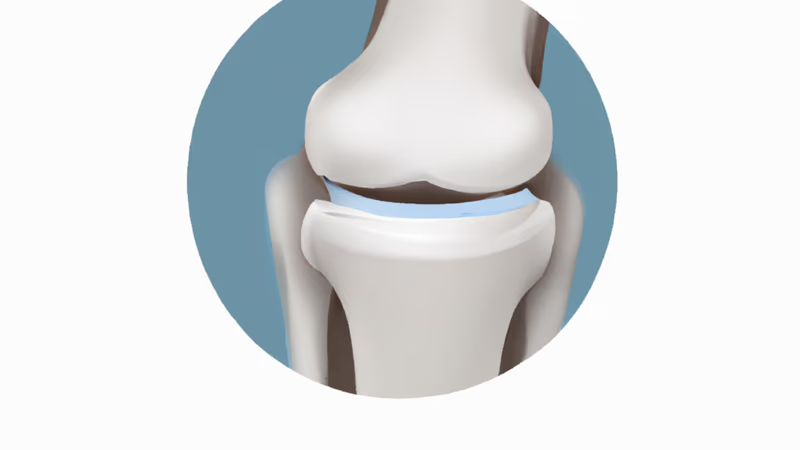
Knee Surgery for ACL and Meniscus Tears: Understanding the Serious Injury Threshold in New York Personal Injury Cases
Learn why knee surgery for ACL and meniscus tears may not automatically meet NY serious injury threshold.
Mar 5, 2010
5102(d) litigation: Plaintiff’s own records non-suit him
Khanfour distinguished cervical degeneration from unexplained later lumbar restrictions. Read the 2017 ruling and Jason's comparison with Huntington.
Mar 13, 2017
Peer review testimony is admissible and sufficient
All Borough upheld a no-fault defense based on expert testimony in 2014. Separate the report-admission objection from the doctor's independent record review.
Apr 2, 2014
Understanding Medical Necessity and Peer Review Requirements in New York No-Fault Cases
Ortho-Med and three January 2012 decisions: supporting records, medical rebuttal, IME versus peer review, and the limits of a discovery request.
Feb 3, 2012Was this article helpful?
Disclaimer: This article is published by the Law Office of Jason Tenenbaum, P.C. for informational and educational purposes only. It does not constitute legal advice, and no attorney-client relationship is formed by reading this content. The legal principles discussed may not apply to your specific situation, and the law may have changed since this article was last updated.
New York law varies by jurisdiction — court decisions in one Appellate Division department may not be followed in another, and local court rules in Nassau County Supreme Court differ from those in Suffolk County Supreme Court, Kings County Civil Court, or Queens County Supreme Court. The Appellate Division, Second Department (which covers Long Island, Brooklyn, Queens, and Staten Island) and the Appellate Term (which hears appeals from lower courts) each have distinct procedural requirements and precedents that affect litigation strategy.
If you need legal help with a medical necessity matter, contact our office at (516) 750-0595 for a free consultation. We serve clients throughout Long Island (Huntington, Babylon, Islip, Brookhaven, Smithtown, Riverhead, Southampton, East Hampton), Nassau County (Hempstead, Garden City, Mineola, Great Neck, Manhasset, Freeport, Long Beach, Rockville Centre, Valley Stream, Westbury, Hicksville, Massapequa), Suffolk County (Hauppauge, Deer Park, Bay Shore, Central Islip, Patchogue, Brentwood), Queens, Brooklyn, Manhattan, the Bronx, Staten Island, and Westchester County. Prior results do not guarantee a similar outcome.