Key Takeaway
Learn why knee surgery for ACL and meniscus tears may not automatically meet NY serious injury threshold.
This article is part of our ongoing 5102(d) issues coverage, with 90 published articles analyzing 5102(d) issues issues across New York State. Attorney Jason Tenenbaum brings 24+ years of hands-on experience to this analysis, drawing from his work on more than 1,000 appeals, over 100,000 no-fault cases, and recovery of over $100 million for clients throughout Nassau County, Suffolk County, Queens, Brooklyn, Manhattan, and the Bronx. For personalized legal advice about how these principles apply to your specific situation, contact our Long Island office at (516) 750-0595 for a free consultation.
When you’ve been injured in a motor vehicle accident on Long Island or in New York City, understanding whether your injuries meet the “serious injury threshold” can mean the difference between receiving compensation for your pain and suffering or being limited to no-fault benefits alone. This complex legal standard has evolved significantly over the years, and recent court decisions have shown that even surgical procedures may not automatically guarantee your case meets the threshold requirements.
The Evolving Landscape of New York’s Serious Injury Threshold
In New York State, the Insurance Law requires that personal injury claims arising from motor vehicle accidents demonstrate a “serious injury” as defined by statute before a plaintiff can step outside the no-fault system and pursue a tort claim for pain and suffering damages. This threshold has become increasingly challenging to meet, with insurance companies and defense attorneys scrutinizing every aspect of medical evidence.
Understanding the Current Standard
The buzz on the street over the last few years is that “surgery” is necessary to breach the serious injury threshold. On the no-fault side, this has translated into insurance carriers seeing many more surgery cases than in years past. It seems that surgery might not even save the threshold case as seen below:
Rodriguez v Grant, 2010 NY Slip Op 01780 (2d Dept. 2010)
Free Consultation · No Fee Unless We Win
Does this apply to your situation?
Every case is different. Get a free, confidential case review from an experienced attorney who can tell you exactly where you stand.
“The affirmed magnetic resonance imaging report of Dr. Raymond Rizzuti merely revealed the existence of a tear of the anterior cruciate ligament and medial meniscus in the plaintiff’s left knee. A tear in tendons, as well as a tear in a ligament, is not evidence of a serious injury in the absence of objective evidence of the extent of the alleged physical limitations resulting from the injury and its duration.”
So does this relate to a service lacking medical reasonableness based upon the absence of objective evidence of the nature and extent of the underlying injury? This raises a really interesting question about what this means for certain no-fault medical necessity surgery cases.
The Medical Reality of ACL and Meniscus Injuries
Understanding ACL Tears
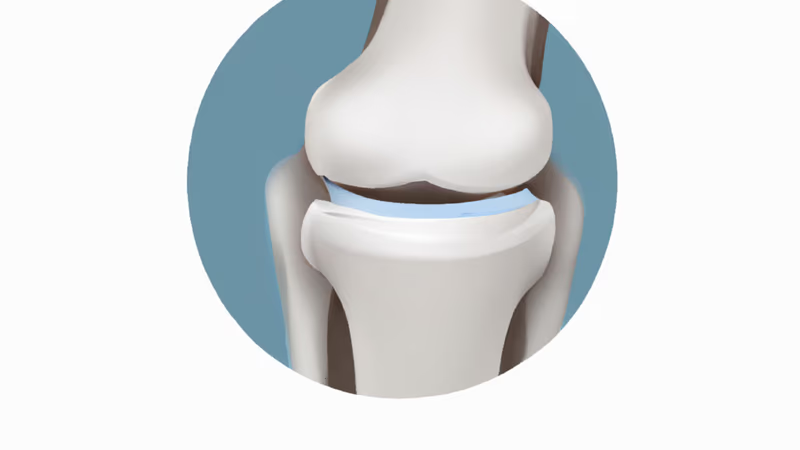
The anterior cruciate ligament (ACL) is one of four major ligaments in the knee that connect the femur to the tibia. ACL tears are among the most common and serious knee injuries, particularly for individuals who participate in sports or experience trauma from motor vehicle accidents. In New York’s bustling metropolitan areas, from Manhattan to Nassau County, emergency rooms see hundreds of these injuries annually from car accidents alone.
ACL tears are typically classified into three grades:
- Grade 1: Minor stretching with small tears in the ligament fibers
- Grade 2: Partial tear of the ACL with moderate stretching
- Grade 3: Complete tear or rupture of the ACL
Meniscus Tear Complications
The meniscus acts as a cushion between your thighbone and shinbone, consisting of two wedge-shaped pieces of cartilage. When torn in conjunction with an ACL injury, the complexity of the knee damage increases significantly. Meniscus tears can be:
- Traumatic tears: Resulting from acute injury like a car accident
- Degenerative tears: Related to aging and wear
- Complex tears: Involving multiple areas or types of damage
Why Surgery Alone May Not Be Enough for Serious Injury Cases
The Rodriguez decision highlighted a critical issue facing personal injury attorneys and their clients throughout Long Island and New York City: the mere existence of structural damage and subsequent surgical intervention does not automatically establish serious injury under New York law.
The Objective Evidence Requirement
New York courts require objective evidence of both the extent and duration of physical limitations. This means plaintiffs must demonstrate:
- Measurable functional limitations: Range of motion restrictions, strength deficits, or gait abnormalities
- Duration of limitations: Evidence that restrictions persisted for a significant period
- Causal relationship: Clear connection between the accident and the ongoing limitations
- Professional documentation: Consistent medical records from treating physicians
Related Articles
- IME doctor explanations for restricted range of motion findings
- How significant knee surgery can still fail to meet serious injury threshold
- Strategic timing of MRI evidence in personal injury cases
- Building strong opposition to conclusory medical affidavits
- Personal Injury
Legal Update (February 2026): Since this post’s publication in 2010, New York courts have continued to refine the serious injury threshold standards, particularly regarding surgical procedures and ACL/meniscus injuries. The legal landscape surrounding Insurance Law § 5102(d) has evolved through subsequent appellate decisions that may have modified how courts evaluate the sufficiency of medical evidence for knee surgeries. Practitioners should verify current case law and threshold requirements, as judicial interpretations of what constitutes adequate proof of serious injury have continued to develop over the past sixteen years.
Legal Context
Why This Matters for Your Case
New York law is among the most complex and nuanced in the country, with distinct procedural rules, substantive doctrines, and court systems that differ significantly from other jurisdictions. The Civil Practice Law and Rules (CPLR) governs every stage of civil litigation, from service of process through trial and appeal. The Appellate Division, Appellate Term, and Court of Appeals create a rich and ever-evolving body of case law that practitioners must follow.
Attorney Jason Tenenbaum has practiced across these areas for over 24 years, writing more than 1,000 appellate briefs and publishing over 2,600 legal articles that attorneys and clients rely on for guidance. The analysis in this article reflects real courtroom experience — from motion practice in Civil Court and Supreme Court to oral arguments before the Appellate Division — and a deep understanding of how New York courts actually apply the law in practice.
About This Topic
Serious Injury Threshold Under Insurance Law 5102(d)
New York Insurance Law 5102(d) defines the categories of serious injury that a plaintiff must prove to recover non-economic damages in a motor vehicle accident case. The statute lists specific categories — significant disfigurement, fracture, loss of a fetus, permanent consequential limitation, significant limitation of use, and the 90/180-day rule. Courts apply these categories strictly, and the sufficiency of medical evidence supporting a serious injury claim is one of the most frequently litigated issues in New York personal injury law.
90 published articles in 5102(d) issues
Keep Reading
More 5102(d) issues Analysis

Defense Engineer Says Your Injury Is Degenerative? Bonilla-Acosta v Max Services (2026)
A NY appeals court held a defense engineer was qualified on crash force but not shown qualified to call spine injuries degenerative. What it means for you.
Oct 23, 2026
Significant limitation v. permanent consequential, again
New York court ruling creates apparent contradiction in no-fault threshold requirements for significant limitation vs. permanent consequential limitation cases.
May 22, 2021
No-Fault Insurance Medical Necessity: Understanding the Praetorian Standard
Darlington rejected an unsupported medical affidavit in 2012. Read the actual peer-review holding alongside Jason's original comments about Praetorian.
Feb 17, 2012
Proof That Physician Was Internist Sufficient for Expert Medical Testimony in NY Personal Injury Cases
Learn how internist qualifications meet NY expert witness standards for personal injury cases. Nassau & Suffolk County medical malpractice lawyer insights.
Jan 7, 2010
Functional ATIC/ medial necessity and fee schedule defense susbstantiated
New York court decision on medical necessity and fee schedule defenses in no-fault insurance cases, featuring expert affidavit requirements and proper coding analysis.
Jul 31, 2017
Stipulated to Defeat — How Trial Stipulations Shape No-Fault Medical Necessity Outcomes
All-In-One awarded the provider judgment on stipulated medical records. Read the 2014 result alongside Jason's restored criticism of the trial ruling.
Apr 14, 2014Was this article helpful?
Disclaimer: This article is published by the Law Office of Jason Tenenbaum, P.C. for informational and educational purposes only. It does not constitute legal advice, and no attorney-client relationship is formed by reading this content. The legal principles discussed may not apply to your specific situation, and the law may have changed since this article was last updated.
New York law varies by jurisdiction — court decisions in one Appellate Division department may not be followed in another, and local court rules in Nassau County Supreme Court differ from those in Suffolk County Supreme Court, Kings County Civil Court, or Queens County Supreme Court. The Appellate Division, Second Department (which covers Long Island, Brooklyn, Queens, and Staten Island) and the Appellate Term (which hears appeals from lower courts) each have distinct procedural requirements and precedents that affect litigation strategy.
If you need legal help with a 5102(d) issues matter, contact our office at (516) 750-0595 for a free consultation. We serve clients throughout Long Island (Huntington, Babylon, Islip, Brookhaven, Smithtown, Riverhead, Southampton, East Hampton), Nassau County (Hempstead, Garden City, Mineola, Great Neck, Manhasset, Freeport, Long Beach, Rockville Centre, Valley Stream, Westbury, Hicksville, Massapequa), Suffolk County (Hauppauge, Deer Park, Bay Shore, Central Islip, Patchogue, Brentwood), Queens, Brooklyn, Manhattan, the Bronx, Staten Island, and Westchester County. Prior results do not guarantee a similar outcome.