Key Takeaway
Involved in a staged car accident? Learn how insurance fraud affects coverage and your rights as an innocent victim. Call 516-750-0595 for legal help.
This article is part of our ongoing no-fault coverage, with 271 published articles analyzing no-fault issues across New York State. Attorney Jason Tenenbaum brings 24+ years of hands-on experience to this analysis, drawing from his work on more than 1,000 appeals, over 100,000 no-fault cases, and recovery of over $100 million for clients throughout Nassau County, Suffolk County, Queens, Brooklyn, Manhattan, and the Bronx. For personalized legal advice about how these principles apply to your specific situation, contact our Long Island office at (516) 750-0595 for a free consultation.
Understanding Staged Accidents and Insurance Fraud
Car accident insurance fraud is a serious problem in New York. Innocent drivers often become unwitting victims of staged collisions. If you’ve been involved in what seems like a suspicious accident, understanding how intentional acts affect insurance coverage is crucial. Knowing your rights as an innocent victim can help protect you both legally and financially.
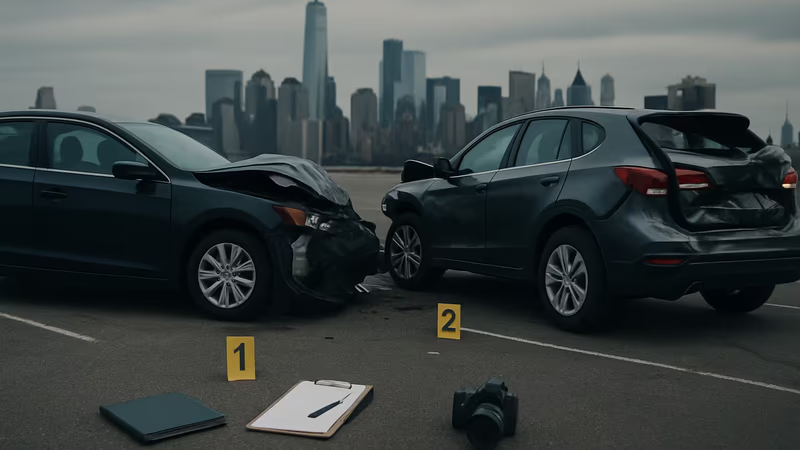
A staged accident occurs when someone deliberately causes or orchestrates a vehicular collision for the purpose of filing fraudulent insurance claims. These schemes can range from simple “swoop and squat” maneuvers to complex multi-vehicle operations involving multiple participants.
The recent case of Adirondack Ins. Exch. v Rodriguez, 2023 NY Slip Op 02095 (2d Dept. 2023), shows how New York courts handle these cases. It also clarifies what evidence is needed to prove insurance fraud involving intentionally staged accidents.
The Legal Standard: Intentional Acts Void Insurance Coverage
Core Legal Principle
New York law is clear about intentionally caused accidents: “An intentionally caused or staged vehicular collision is not a covered accident under an insurance policy” (National Gen. Ins. Online, Inc. v Blasco, 210 AD3d 786 ).
When a collision is intentionally caused, insurance companies have no obligation to provide coverage. This applies even to innocent third parties who had no knowledge of or participation in the fraud.
Impact on All Parties
The harsh reality: when courts determine an accident was staged, insurance coverage can be denied for everyone involved. That includes:
- Innocent drivers who happened to be struck by fraudulent actors
- Passengers who had no knowledge of the scheme
- Legitimate medical providers who treated real injuries
This creates serious challenges for victims who suffer real injuries in staged accidents. They can lose insurance coverage entirely because of the fraudulent nature of the incident.
Red Flags: How Courts Identify Staged Accidents
The Rodriguez case provides insight into the patterns courts look for when evaluating whether accidents were intentionally staged. The insurance company successfully demonstrated fraud by showing:
Suspicious Policy Procurement
- The insured individuals obtained their insurance policies fraudulently
- False information was provided during the application process
- Policies were purchased shortly before the accidents occurred
Pattern of Similar Circumstances
- Both collisions occurred under nearly identical circumstances
- The insured individuals were not actually in their vehicles when the accidents happened
- Both accidents involved the insured vehicles striking UPS trucks while exiting parking spaces
- All individuals involved in the collisions were closely interrelated
Coordinated Medical Treatment
- All allegedly injured parties sought treatment from the same healthcare providers
- Treatment patterns suggested coordination rather than independent medical decisions
- Medical billing and treatment appeared to follow suspicious patterns
What This Means For You
If You’re an Innocent Victim
Being involved in a staged accident as an innocent party creates complex legal challenges:
Coverage Denials: Even though you did nothing wrong, your insurance coverage may be denied if the court determines the accident was staged. This can leave you personally responsible for medical bills, vehicle repairs, and other damages.
Legal Complications: Proving your innocence and lack of participation in the fraud scheme requires substantial legal evidence and experienced representation.
Financial Exposure: Without insurance coverage, you may face significant out-of-pocket expenses for injuries and damages that weren’t your fault.
If You’re Accused of Participation
Being accused of involvement in a staged accident—whether true or not—creates serious legal and financial consequences:
Criminal Liability: Insurance fraud is a serious criminal offense in New York, potentially resulting in felony charges, fines, and imprisonment.
Civil Liability: You may be sued for damages by other parties involved in the accident, including innocent victims.
Insurance Consequences: Your current and future insurance coverage may be affected, including potential policy cancellations and difficulty obtaining coverage.
How Insurance Companies Prove Staging
Investigative Methods
Insurance companies use sophisticated techniques to identify staged accidents:
Special Investigation Units (SIUs): Most major insurers have dedicated fraud investigation teams that analyze suspicious claims.
Data Analysis: Companies compare accident patterns, treatment histories, and relationships between parties involved in claims.
Surveillance: Private investigators may conduct surveillance of claimants to verify injury claims and identify fraudulent behavior.
Medical Record Analysis: Detailed review of treatment records to identify suspicious patterns or unnecessary procedures.
Evidence Required for Summary Judgment
To win a case like Rodriguez on summary judgment, insurance companies must present clear evidence that:
- The accidents were intentionally caused rather than accidental
- The parties involved coordinated their actions
- False information was provided to obtain insurance coverage
- The collision patterns demonstrate deliberate planning
The Discovery Process and Timing Issues
The Rodriguez case addressed an important procedural issue: when should courts grant summary judgment in staged accident cases without allowing more discovery?
The court ruled that defendants cannot simply hope more discovery will produce favorable evidence. They must show that specific evidence essential to their defense exists and that the plaintiff exclusively controls it.
Protecting Yourself from Staged Accident Schemes
Prevention Strategies
Defensive Driving: Be aware of common staging techniques, such as vehicles that suddenly brake without reason or cars that position themselves to cause collisions.
Documentation: If you’re in any accident, thoroughly document the scene, take photos, and obtain contact information for all parties and witnesses.
Quick Reporting: Report accidents to police and your insurance company immediately, before other parties can coordinate their stories.
Medical Awareness: Seek medical attention from reputable providers of your choice rather than accepting referrals from other accident participants.
Red Flags to Watch For
Be suspicious if other accident participants:
- Immediately suggest specific medical providers or attorneys
- Seem unusually calm or prepared for the accident
- Have multiple passengers who all claim similar injuries
- Push for quick settlements without proper medical evaluation
- Provide inconsistent information about how the accident occurred
Common Staged Accident Schemes
“Swoop and Squat”
- A car “swoops” in front of your vehicle
- The car suddenly brakes, causing you to rear-end them
- Multiple occupants claim soft-tissue injuries
“Drive Down”
- You’re waved into traffic by another driver
- Once you enter, they accelerate and hit you
- They deny waving you forward
“Sideswipe”
- At multi-lane intersections, fraudsters wait for you to drift slightly
- They accelerate and sideswipe your vehicle
- They claim you changed lanes unsafely
Working with Legal Representation
Staged accident cases involve complex interactions between criminal and civil law, insurance regulations, and fraud investigation procedures. Whether you’re an innocent victim or facing fraud allegations, experienced legal representation is essential.
Frequently Asked Questions
Q: What should I do if I suspect I was involved in a staged accident?
A: Contact an experienced attorney immediately, document everything about the incident, seek independent medical care if needed, and cooperate fully with law enforcement and insurance investigations. Don’t communicate with other parties involved without legal representation.
Q: Can my insurance company deny my claim if other parties staged the accident but I was innocent?
A: Unfortunately, yes. When courts determine an accident was staged, coverage can be denied for all parties involved, including innocent victims. However, you may have other legal options for recovering damages.
Q: How can I prove I wasn’t involved in staging an accident?
A: Evidence of innocence might include: no prior relationship with other parties, immediate and consistent reporting to police and insurance, independent medical treatment, absence from suspicious communications, and a clean driving record.
Q: What are the criminal penalties for staged accident fraud in New York?
A: Insurance fraud in New York can be charged as a felony, with penalties including significant fines and imprisonment. The specific charges depend on the amount of fraud involved and your role in the scheme.
Q: Should I accept medical referrals from other parties in an accident?
A: No. Always seek medical care from providers you choose independently. Accepting referrals from other accident participants can make you appear complicit in fraudulent schemes, even if you’re innocent.
Moving Forward After a Staged Accident
The Rodriguez case demonstrates that New York courts take insurance fraud seriously and have established clear standards for proving staged accidents. Whether you’re an innocent victim caught in someone else’s scheme or facing allegations of participation, understanding these legal standards is crucial to protecting your rights.
The key takeaway is that prevention and proper legal representation are your best defenses against the complex legal issues surrounding staged accidents. If you suspect you’ve been involved in a staged accident or are facing fraud allegations, don’t try to handle the situation alone.
Call 516-750-0595 for a free consultation with our experienced attorneys. We understand the complex intersection of personal injury law, insurance fraud, and criminal defense. Whether you’re an innocent victim seeking compensation or someone facing fraud allegations, we can help you navigate these challenging legal waters and protect your rights throughout the process.
Related Articles
Legal Context
Why This Matters for Your Case
New York's no-fault insurance system, established under Insurance Law Article 51, is one of the most complex insurance frameworks in the country. Every motorist must carry Personal Injury Protection coverage that pays medical expenses and lost wages regardless of fault, up to $50,000 per person.
But insurers routinely deny valid claims using peer reviews, EUO scheduling tactics, fee schedule reductions, and coverage defenses. The Law Office of Jason Tenenbaum has handled over 100,000 no-fault cases since 2002 — from initial claim submissions through arbitration before the American Arbitration Association, trials in Civil Court and Supreme Court, and appeals to the Appellate Term and Appellate Division. Jason Tenenbaum is one of the few attorneys in the state who both writes his own appellate briefs and tries his own cases.
His 2,353+ published legal articles on no-fault practice are cited by attorneys throughout New York. Whether you are dealing with a medical necessity denial, an EUO no-show defense, a fee schedule dispute, or a coverage question, this article provides the kind of detailed case-law analysis that helps practitioners and claimants understand exactly where the law stands.
About This Topic
New York No-Fault Insurance Law
New York's no-fault insurance system requires every driver to carry Personal Injury Protection (PIP) coverage that pays medical expenses and lost wages regardless of who caused the accident. But insurers routinely deny, delay, and underpay valid claims — using peer reviews, IME no-shows, and fee schedule defenses to avoid paying providers and injured claimants. Attorney Jason Tenenbaum has litigated thousands of no-fault arbitrations and court cases since 2002.
271 published articles in No-Fault
Keep Reading
More No-Fault Analysis
Priority of Payment Regulation Has No Force in Arbitration: First and Second Departments Agree
Both the First and Second Departments have held that the priority of payment regulation under 11 NYCRR 65-3.15 is of no force or effect in no-fault arbitration proceedings....
Feb 25, 2026
How Insurance Companies Use Colossus Software to Undervalue Your Injury Claim
Insurance companies use Colossus software to lowball your injury claim. Learn how this system works and how a Long Island attorney can fight back. Call 516-750-0595.
Feb 18, 2026
Unitrin and Lincoln General again
Island Life Chiropractic v 21st Century case review: EUO failure, 30-day denial deadlines, and Unitrin defense preclusion in New York no-fault insurance claims.
Dec 18, 2021
Understanding Trial Bifurcation in New York Personal Injury Cases: Liability vs. Damages
Learn about trial bifurcation strategies in New York personal injury litigation. Expert legal guidance. Call 516-750-0595.
Sep 13, 2019
Summary judgment granted as to negligence yet “sole proximate cause” and comparative negligence left as open questions
Court grants summary judgment on negligence but leaves causation questions open, demonstrating how complex liability cases can be divided into discrete legal issues.
Oct 7, 2013
What is NY de Novo?
Learn what "de novo" means in NY personal injury and no-fault cases. Understand how de novo review provides a fresh start when arbitration awards or court rulings seem unfair.
May 2, 2025Was this article helpful?

About the Author
Jason Tenenbaum, Esq.
Jason Tenenbaum is the founding attorney of the Law Office of Jason Tenenbaum, P.C., headquartered at 326 Walt Whitman Road, Suite C, Huntington Station, New York 11746. With over 24 years of experience since founding the firm in 2002, Jason has written more than 1,000 appeals, handled over 100,000 no-fault insurance cases, and recovered over $100 million for clients across Long Island, Nassau County, Suffolk County, Queens, Brooklyn, Manhattan, the Bronx, and Staten Island. He is one of the few attorneys in the state who both writes his own appellate briefs and tries his own cases.
Jason is admitted to practice in New York, New Jersey, Florida, Texas, Georgia, and Michigan state courts, as well as multiple federal courts. His 2,353+ published legal articles analyzing New York case law, procedural developments, and litigation strategy make him one of the most prolific legal commentators in the state. He earned his Juris Doctor from Syracuse University College of Law.
Disclaimer: This article is published by the Law Office of Jason Tenenbaum, P.C. for informational and educational purposes only. It does not constitute legal advice, and no attorney-client relationship is formed by reading this content. The legal principles discussed may not apply to your specific situation, and the law may have changed since this article was last updated.
New York law varies by jurisdiction — court decisions in one Appellate Division department may not be followed in another, and local court rules in Nassau County Supreme Court differ from those in Suffolk County Supreme Court, Kings County Civil Court, or Queens County Supreme Court. The Appellate Division, Second Department (which covers Long Island, Brooklyn, Queens, and Staten Island) and the Appellate Term (which hears appeals from lower courts) each have distinct procedural requirements and precedents that affect litigation strategy.
If you need legal help with a no-fault matter, contact our office at (516) 750-0595 for a free consultation. We serve clients throughout Long Island (Huntington, Babylon, Islip, Brookhaven, Smithtown, Riverhead, Southampton, East Hampton), Nassau County (Hempstead, Garden City, Mineola, Great Neck, Manhasset, Freeport, Long Beach, Rockville Centre, Valley Stream, Westbury, Hicksville, Massapequa), Suffolk County (Hauppauge, Deer Park, Bay Shore, Central Islip, Patchogue, Brentwood), Queens, Brooklyn, Manhattan, the Bronx, Staten Island, and Westchester County. Prior results do not guarantee a similar outcome.