Key Takeaway
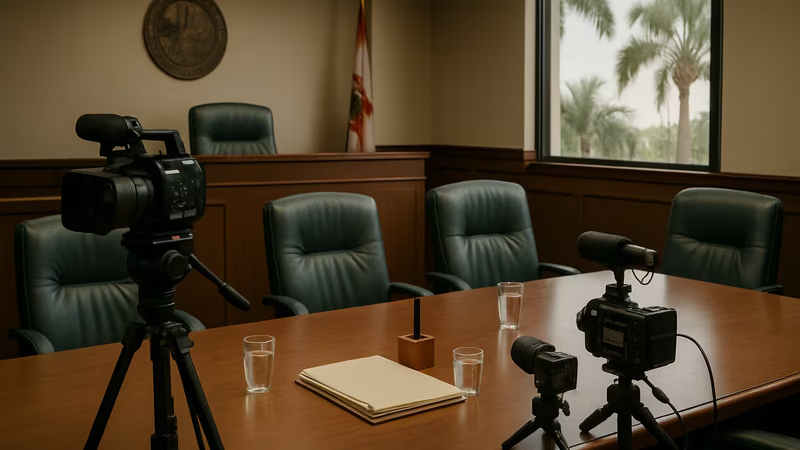
Florida court upholds EUO as condition precedent in no-fault case, rejecting provider's argument that overdue bills discharge insured's duty to appear.
This article is part of our ongoing no-fault coverage, with 271 published articles analyzing no-fault issues across New York State. Attorney Jason Tenenbaum brings 24+ years of hands-on experience to this analysis, drawing from his work on more than 1,000 appeals, over 100,000 no-fault cases, and recovery of over $100 million for clients throughout Nassau County, Suffolk County, Queens, Brooklyn, Manhattan, and the Bronx. For personalized legal advice about how these principles apply to your specific situation, contact our Long Island office at (516) 750-0595 for a free consultation.
MIRACLE HEALTH SERVICES, INC., A/A/O KIRENIA TAMAYO, vs PROGRESSIVE SELECT INSURANCE COMPANY, No. 3D21-14
I really find the analysis here telling and quite biting.
(1) “Miracle Health sent Progressive four sets of bills for Tamayo’s treatment, which Progressive received on May 21, 2014, June 2, 2014, June 23, 2014 and July 18, 2014, respectively. On June 23, 2014, Progressive sent Tamayo a notice to appear for an EUO, scheduled on July 31, 2014. Tamayo failed to appear for the first and then a second subsequently scheduled EUO. Pursuant to the policy provision requiring the insured to submit to an EUO before receiving PIP benefits, Progressive denied payment of benefits.”
(2) “Progressive answered alleging Miracle Health was not entitled to receive benefits because the insured failed to comply with the condition precedent to receiving benefits under the terms of the policy and section 627.736(6)(g), Florida Statutes (2013). Progressive filed a motion for summary judgment with accompanying affidavit establishing that Tamayo failed to appear for the scheduled EUOs. Miracle Health argued that because three sets of bills were overdue prior to the first scheduled EUO, Tamayo was discharged of her statutory and contractual duty to submit to an EUO.”
(3) “The trial court entered summary judgment in favor of Progressive.”
(4) “Despite this direct legislative response, Miracle Health argues that the policy’s condition precedent is actually a condition subsequent because it is an obligation which arises after the formation of the contract.”
(5)(a) “This argument ignores the basic principle that: “nder well established contract law, a condition precedent is a condition which calls for the performance of an act after a contract is entered into, upon the performance or happening of which its obligation to perform is made to depend.” Univ. Hous. by Dayco Corp. v. Foch, 221 So. 3d 701, 704 (Fla. 3d DCA 2017) (quoting Racing Props., L.P. v. Baldwin, 885 So. 2d 881, 882–83 (Fla. 3d DCA 2004)).
(5)(b) “A condition may be either a condition precedent to the formation of a contract or a condition precedent to performance under an existing contract.”
(5)(c) “Conditions precedent to an obligation to perform are those acts or events, which occur subsequently to the making of a contract, that must occur before there is a right to immediate performance and before there is a reach of contractual duty.”
(6)(a) “Our holding in Amador was limited. In determining whether the insured’s failure to submit to an EUO was a bar to filing suit, “we that, because of the special nature of, and protection afforded by, the PIP statute, upon expiration of the 30-day period, the insurer is itself in breach of the contract and may therefore, not deny an insured the right to access the courts for purposes of enforcing the PIP statute.” Amador,748 So. 2d at 309.
(6)(b) “We cannot, and do not, read Amador for the proposition that an insurer’s failure to pay PIP benefits within thirty days thwarts its ability to investigate the claim or discover facts by discharging the insured’s statutory obligation to comply with conditions precedent to receiving benefit.”
I think this is a good citation to buttress Unitrin.
Related Articles
- Understanding IME No-Shows in New York No-Fault Insurance: Rights, Consequences, and Strategic Considerations
- No-Fault Verification Requirements: When Partial Compliance Isn’t Enough
- Reasonable excuse satisfied despite claim of lack of personal jurisdiction
- Understanding CPLR 3212(a): Critical Timing Rules for Summary Judgment Motions in New York
- New York No-Fault Insurance Law
Legal Context
Why This Matters for Your Case
New York's no-fault insurance system, established under Insurance Law Article 51, is one of the most complex insurance frameworks in the country. Every motorist must carry Personal Injury Protection coverage that pays medical expenses and lost wages regardless of fault, up to $50,000 per person.
But insurers routinely deny valid claims using peer reviews, EUO scheduling tactics, fee schedule reductions, and coverage defenses. The Law Office of Jason Tenenbaum has handled over 100,000 no-fault cases since 2002 — from initial claim submissions through arbitration before the American Arbitration Association, trials in Civil Court and Supreme Court, and appeals to the Appellate Term and Appellate Division. Jason Tenenbaum is one of the few attorneys in the state who both writes his own appellate briefs and tries his own cases.
His 2,353+ published legal articles on no-fault practice are cited by attorneys throughout New York. Whether you are dealing with a medical necessity denial, an EUO no-show defense, a fee schedule dispute, or a coverage question, this article provides the kind of detailed case-law analysis that helps practitioners and claimants understand exactly where the law stands.
About This Topic
New York No-Fault Insurance Law
New York's no-fault insurance system requires every driver to carry Personal Injury Protection (PIP) coverage that pays medical expenses and lost wages regardless of who caused the accident. But insurers routinely deny, delay, and underpay valid claims — using peer reviews, IME no-shows, and fee schedule defenses to avoid paying providers and injured claimants. Attorney Jason Tenenbaum has litigated thousands of no-fault arbitrations and court cases since 2002.
271 published articles in No-Fault
Keep Reading
More No-Fault Analysis
Priority of Payment Regulation Has No Force in Arbitration: First and Second Departments Agree
Both the First and Second Departments have held that the priority of payment regulation under 11 NYCRR 65-3.15 is of no force or effect in no-fault arbitration proceedings....
Feb 25, 2026
How Insurance Companies Use Colossus Software to Undervalue Your Injury Claim
Insurance companies use Colossus software to lowball your injury claim. Learn how this system works and how a Long Island attorney can fight back. Call 516-750-0595.
Feb 18, 2026
Conditional order of preclusion absolves a willfulness inquiry
Court ruling clarifies that conditional discovery orders eliminate the need to prove willful conduct when imposing sanctions for non-compliance.
Mar 23, 2022
A declaration later became an affidavit
New York appellate court allows correction of defective declaration to proper affidavit form in summary judgment motion, demonstrating courts' flexibility with technical procedural...
Jul 23, 2020
Cost of doctor for aborted trial not reimbursable
New York court rules that trial costs and expert witness cancellation fees are not reimbursable when defense attorney becomes ill, reversing $6,900 award.
Apr 14, 2015
Reasonable excuse satisfied despite claim of lack of personal jurisdiction
Understanding reasonable excuse requirements for opening default judgments in New York courts. Expert legal guidance on CPLR procedure. Call (516) 750-0595.
Jan 26, 2010Common Questions
Frequently Asked Questions
What is New York's no-fault insurance system?
New York's no-fault insurance system, codified in Insurance Law Article 51, requires all drivers to carry Personal Injury Protection (PIP) coverage. This pays for medical expenses, lost wages (up to $2,000/month), and other basic economic loss regardless of who caused the accident, up to $50,000 per person. However, to sue for pain and suffering, you must meet the 'serious injury' threshold under Insurance Law §5102(d).
How do I fight a no-fault insurance claim denial?
When a no-fault claim is denied, you can challenge it through mandatory arbitration under the American Arbitration Association's no-fault rules, or by filing a lawsuit in court. Common defenses to denials include challenging the timeliness of the denial, the adequacy of the peer review report, or the insurer's compliance with regulatory requirements. An experienced no-fault attorney can evaluate which strategy gives you the best chance of overturning the denial.
What is the deadline to file a no-fault claim in New York?
Under 11 NYCRR §65-1.1, you must submit a no-fault application (NF-2 form) within 30 days of the accident. Medical providers must submit claims within 45 days of treatment. Missing these deadlines can result in claim denial, though there are limited exceptions for late notice if the claimant can demonstrate a reasonable justification.
What no-fault benefits am I entitled to after a car accident in New York?
Under Insurance Law §5102(b), no-fault PIP covers necessary medical expenses, 80% of lost earnings up to $2,000/month, up to $25/day for other reasonable expenses, and a $2,000 death benefit. These benefits are available regardless of fault, up to the $50,000 policy limit. Claims are paid by your own insurer — not the at-fault driver's.
Can I choose my own doctor for no-fault treatment in New York?
Yes. Under New York's no-fault regulations, you have the right to choose your own physician, chiropractor, physical therapist, or other licensed healthcare provider. The insurer cannot dictate which providers you see. However, the insurer can request an IME with their chosen doctor and may challenge the medical necessity of your treatment through peer review.
Was this article helpful?

About the Author
Jason Tenenbaum, Esq.
Jason Tenenbaum is the founding attorney of the Law Office of Jason Tenenbaum, P.C., headquartered at 326 Walt Whitman Road, Suite C, Huntington Station, New York 11746. With over 24 years of experience since founding the firm in 2002, Jason has written more than 1,000 appeals, handled over 100,000 no-fault insurance cases, and recovered over $100 million for clients across Long Island, Nassau County, Suffolk County, Queens, Brooklyn, Manhattan, the Bronx, and Staten Island. He is one of the few attorneys in the state who both writes his own appellate briefs and tries his own cases.
Jason is admitted to practice in New York, New Jersey, Florida, Texas, Georgia, and Michigan state courts, as well as multiple federal courts. His 2,353+ published legal articles analyzing New York case law, procedural developments, and litigation strategy make him one of the most prolific legal commentators in the state. He earned his Juris Doctor from Syracuse University College of Law.
Disclaimer: This article is published by the Law Office of Jason Tenenbaum, P.C. for informational and educational purposes only. It does not constitute legal advice, and no attorney-client relationship is formed by reading this content. The legal principles discussed may not apply to your specific situation, and the law may have changed since this article was last updated.
New York law varies by jurisdiction — court decisions in one Appellate Division department may not be followed in another, and local court rules in Nassau County Supreme Court differ from those in Suffolk County Supreme Court, Kings County Civil Court, or Queens County Supreme Court. The Appellate Division, Second Department (which covers Long Island, Brooklyn, Queens, and Staten Island) and the Appellate Term (which hears appeals from lower courts) each have distinct procedural requirements and precedents that affect litigation strategy.
If you need legal help with a no-fault matter, contact our office at (516) 750-0595 for a free consultation. We serve clients throughout Long Island (Huntington, Babylon, Islip, Brookhaven, Smithtown, Riverhead, Southampton, East Hampton), Nassau County (Hempstead, Garden City, Mineola, Great Neck, Manhasset, Freeport, Long Beach, Rockville Centre, Valley Stream, Westbury, Hicksville, Massapequa), Suffolk County (Hauppauge, Deer Park, Bay Shore, Central Islip, Patchogue, Brentwood), Queens, Brooklyn, Manhattan, the Bronx, Staten Island, and Westchester County. Prior results do not guarantee a similar outcome.