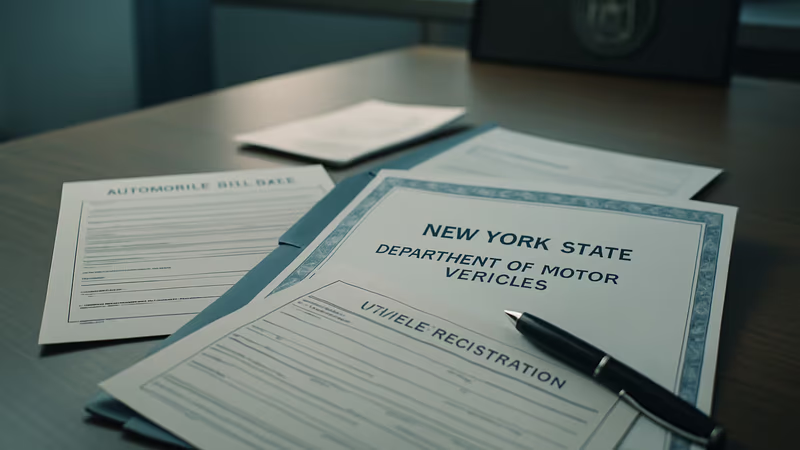
Key Takeaway
Global Liberty v Ho Suk Shin distinguishes replacing an insured vehicle from terminating a policy. Jason’s original 2020 commentary is preserved.
This article is part of our ongoing coverage coverage, with 150 published articles analyzing coverage issues across New York State. Attorney Jason Tenenbaum brings 24+ years of hands-on experience to this analysis, drawing from his work on more than 1,000 appeals, over 100,000 no-fault cases, and recovery of over $100 million for clients throughout Nassau County, Suffolk County, Queens, Brooklyn, Manhattan, and the Bronx. For personalized legal advice about how these principles apply to your specific situation, contact our Long Island office at (516) 750-0595 for a free consultation.
The policy-transfer question
Matter of Global Liberty Insurance Co. v Ho Suk Shin, 182 AD3d 597, 2020 NY Slip Op 02469, was decided April 29, 2020, by the Second Department.
The issue was whether State Farm had terminated a policy or continued the same coverage on a replacement vehicle. That distinction controlled the DMV-notice argument.
Jason Tenenbaum’s original May 2020 commentary
The insured removed his vehicle from the policy. A dmv notice was not sent. The insured replaced the vehicle with a commercial vehicle. The carrier changes the policy number to accommodate the new vehicle.
Now, the removed vehicle is involved in an accident. Is there coverage? The Appellate Division said no.
Not a terribly logical decision, but to make the right the decision, the floodgates of hell would be opened on every removed car case.
What the court decided
Global Liberty sought to stay its insured’s uninsured-motorist arbitration. It argued that State Farm’s failure to notify DMV left coverage in place on the other vehicle.
Free Consultation · No Fee Unless We Win
Does this apply to your situation?
Every case is different. Get a free, confidential case review from an experienced attorney who can tell you exactly where you stand.
After a framed-issue hearing, the court found that the policy continued: a Ford replaced a Chevrolet, and commercial use explained the new policy number. The Second Department affirmed denial of the permanent stay.
The opinion distinguishes Matter of Progressive Northeastern Insurance Co. v Barnes, 30 AD3d 523 (2006), and Matter of Chubb Group of Insurance Cos. v Williams, 14 AD3d 561 (2005).
It also explains why Matter of Eveready Insurance Co. v Wilson, 180 AD2d 796 (1992), addressing pre-1983 statutory language, did not decide this dispute.
This was not a general exemption from reporting actual policy terminations.
Jason’s reaction to the result
Sorry – I am not convinced. I do not mind losing when I should but if you saw the oral argument, they agreed with our position. As Rivera once told me on another case “Floodgates”.
That remains Jason’s contemporaneous reaction. The reported holding, rather than an inference about the panel’s motives, supplies the legal rule.
Practical distinction: vehicle substitution or policy termination?
VTL § 313(2)(a) describes reporting termination of a policy, as opposed to individual vehicles insured under it. Subsection (3) addresses effectiveness against third parties.
To evaluate a similar dispute, compare the policy and endorsements before and after the change. Identify which vehicle was removed, which was substituted, and whether coverage continued under the same contract.
A changed policy number is a fact to investigate, not a substitute for that comparison. Preserve the insurer’s change records and the evidence establishing the accident date.
For the contrasting cancellation problem, read VTL 313 in action, where the insurer proved policy cancellation and DMV filing.
Related resources
This is a historical case note, not a determination of coverage under another policy. Current statutory text and later case treatment require a separate check.
Legal Context
Why This Matters for Your Case
New York law is among the most complex and nuanced in the country, with distinct procedural rules, substantive doctrines, and court systems that differ significantly from other jurisdictions. The Civil Practice Law and Rules (CPLR) governs every stage of civil litigation, from service of process through trial and appeal. The Appellate Division, Appellate Term, and Court of Appeals create a rich and ever-evolving body of case law that practitioners must follow.
Attorney Jason Tenenbaum has practiced across these areas for over 24 years, writing more than 1,000 appellate briefs and publishing over 2,600 legal articles that attorneys and clients rely on for guidance. The analysis in this article reflects real courtroom experience — from motion practice in Civil Court and Supreme Court to oral arguments before the Appellate Division — and a deep understanding of how New York courts actually apply the law in practice.
About This Topic
Insurance Coverage Issues in New York
Coverage disputes determine whether an insurance policy provides benefits for a particular claim. In the no-fault context, coverage questions involve policy inception, named insured status, vehicle registration requirements, priority of coverage among multiple insurers, and the applicability of exclusions. These articles examine how New York courts resolve coverage disputes, the burden of proof on coverage defenses, and the interplay between regulatory requirements and policy language.
150 published articles in Coverage
Keep Reading
More Coverage Analysis

IME no-show is a policy defense triggering the hourly attorney fee provision
Learn how IME no-show defenses trigger hourly attorney fee provisions in NY no-fault insurance. Court rules failure to attend IME is policy defense.
May 22, 2021
Contractual deemer
New York courts examine when out-of-state insurers can avoid no-fault coverage obligations through contractual deemer provisions and policy language analysis.
Apr 24, 2021
Neurologist’s Insufficient Affirmation: Understanding Causal Connection in Personal Injury Cases
Frias v James: the defense neurologist's unexplained degeneration opinion failed on limitation claims. Jason's radiology comment was not the court's.
Jan 14, 2010
Alleviation v Allstate Goes to the Appellate Division: Leave Granted in the Policy Exhaustion Fight
Allstate wins leave to appeal Alleviation Medical Services to the Appellate Division, teeing up the no-fault policy exhaustion and priority of payment question.
Dec 27, 2017
A good causation case
Jones v MTA Bus Co. dismissed injury claims on its medical record. The 2014 First Department ruling did not create a universal five-month rule.
Dec 25, 2014
MVAIC failed to disprove that the accident was the cause of the injuries
MVAIC fails to prove motor vehicle accident didn't cause injuries using inadmissible hearsay police report, resulting in summary judgment loss in NY court.
Apr 8, 2012Was this article helpful?
Disclaimer: This article is published by the Law Office of Jason Tenenbaum, P.C. for informational and educational purposes only. It does not constitute legal advice, and no attorney-client relationship is formed by reading this content. The legal principles discussed may not apply to your specific situation, and the law may have changed since this article was last updated.
New York law varies by jurisdiction — court decisions in one Appellate Division department may not be followed in another, and local court rules in Nassau County Supreme Court differ from those in Suffolk County Supreme Court, Kings County Civil Court, or Queens County Supreme Court. The Appellate Division, Second Department (which covers Long Island, Brooklyn, Queens, and Staten Island) and the Appellate Term (which hears appeals from lower courts) each have distinct procedural requirements and precedents that affect litigation strategy.
If you need legal help with a coverage matter, contact our office at (516) 750-0595 for a free consultation. We serve clients throughout Long Island (Huntington, Babylon, Islip, Brookhaven, Smithtown, Riverhead, Southampton, East Hampton), Nassau County (Hempstead, Garden City, Mineola, Great Neck, Manhasset, Freeport, Long Beach, Rockville Centre, Valley Stream, Westbury, Hicksville, Massapequa), Suffolk County (Hauppauge, Deer Park, Bay Shore, Central Islip, Patchogue, Brentwood), Queens, Brooklyn, Manhattan, the Bronx, Staten Island, and Westchester County. Prior results do not guarantee a similar outcome.