
Key Takeaway
Learn why surgery peer review alone isnt enough for NY no-fault medical necessity denials. Expert legal analysis from experienced Long Island attorneys. Call 516-750-0595.
This article is part of our ongoing medical necessity coverage, with 170 published articles analyzing medical necessity issues across New York State. Attorney Jason Tenenbaum brings 24+ years of hands-on experience to this analysis, drawing from his work on more than 1,000 appeals, over 100,000 no-fault cases, and recovery of over $100 million for clients throughout Nassau County, Suffolk County, Queens, Brooklyn, Manhattan, and the Bronx. For personalized legal advice about how these principles apply to your specific situation, contact our Long Island office at (516) 750-0595 for a free consultation.
Understanding No-Fault Insurance Medical Necessity Claims in New York
In the complex world of New York’s no-fault insurance system, determining medical necessity for surgical procedures requires more than just a simple peer review. The recent case of Allstate Ins. Co. v Buffalo Neurosurgery Group, 2019 NY Slip Op 03749 (2d Dept. 2019), highlights the critical standards insurance companies must meet when challenging the medical necessity of surgical treatments.
This case demonstrates why understanding the burden of proof in medical necessity determinations is crucial for both healthcare providers and patients navigating the no-fault insurance system.
The Facts Behind the Case
The case arose from a motor vehicle accident that occurred on February 6, 2013. Christopher Krull allegedly was injured in the accident and subsequently underwent spinal fusion surgery performed by P. Jeffrey Lewis of the defendant, Buffalo Neurosurgery Group.
Following the surgery, Allstate Insurance Company sought a determination that it was not obligated to pay no-fault benefits for Krull’s surgery, claiming the procedure was not medically necessary. The insurance company submitted peer review reports to support their position, believing these reports would be sufficient to establish their case.
The Court’s Analysis: Why Peer Review Reports Fell Short
The Second Department’s decision was clear: “Here, we agree with the Supreme Court’s denial of that branch of the plaintiff’s motion which was for summary judgment on so much of the complaint as, in effect, sought a determination that it was not obligated to pay the defendant no-fault benefits relating to Krull’s surgery, since the surgery was not medically necessary. The peer review reports submitted in support of that branch of the motion failed to demonstrate, prima facie, that the surgery performed on Krull was not medically necessary.”
This ruling underscores a fundamental principle in New York no-fault law: insurance companies bear the burden of proving that a treatment was not medically necessary, and they must do so with sufficient evidence that goes beyond conclusory statements.
Standards for Establishing Medical Necessity Claims
Under New York Insurance Law § 5106(c), insurance companies seeking to deny claims based on lack of medical necessity must provide substantial evidence supporting their position. The court’s decision in this case reinforces that peer review reports alone, without proper foundation and detailed analysis, are insufficient to meet this burden.
For a peer review report to be effective in challenging medical necessity, it must:
- Provide specific medical reasoning for why the treatment was unnecessary
- Address the patient’s particular medical condition and circumstances
- Compare alternative treatment options that would have been appropriate
- Demonstrate understanding of the treating physician’s rationale
The Broader Implications for No-Fault Insurance
This decision has significant implications for how medical necessity determinations are handled in New York’s no-fault insurance system. It serves as a reminder that the system is designed to ensure injured parties receive necessary medical care while preventing frivolous claims.
Impact on Healthcare Providers
For healthcare providers, this case provides important guidance on defending their treatment decisions. When facing challenges to medical necessity, providers should ensure their medical records clearly document:
- The patient’s presenting symptoms and examination findings
- Diagnostic test results and their interpretation
- Conservative treatment attempts, if applicable
- The medical reasoning for recommending surgery
- How the proposed treatment addresses the patient’s specific condition
Significance for Insurance Companies
Insurance companies must understand that successfully challenging medical necessity requires comprehensive evidence. Simply obtaining a peer review opinion that disagrees with the treating physician is not sufficient. The reviewing physician must provide detailed analysis explaining why the treatment was unnecessary based on the specific facts of the case.
Common Challenges in Medical Necessity Disputes
Medical necessity disputes often arise in cases involving:
- Complex spinal surgeries
- Multiple treatment modalities
- Pre-existing conditions that may have been aggravated by the accident
- Experimental or newer treatment techniques
- Extended rehabilitation programs
In each of these scenarios, the key is ensuring that any challenge to medical necessity is based on solid medical evidence and reasoning, not merely disagreement with the treating physician’s approach.
Legal Standards and Precedent
The Allstate v Buffalo Neurosurgery Group case builds upon established New York precedent regarding the standards for medical necessity determinations. Courts have consistently held that insurance companies seeking to deny coverage must present clear and convincing evidence that the treatment in question was not medically necessary.
This standard recognizes the expertise of treating physicians who have examined the patient and have access to the complete medical history, while also allowing for legitimate challenges when treatments are clearly inappropriate or excessive.
Related cases that have established similar principles include various personal injury cases where medical necessity has been challenged, and no-fault insurance disputes that have helped define the standards for coverage determinations.
Frequently Asked Questions About Medical Necessity in No-Fault Cases
What constitutes “medical necessity” under New York no-fault law?
Medical necessity generally means that the treatment is appropriate for the condition, consistent with accepted medical standards, and reasonable in scope and duration. The treatment should be the most appropriate level of care for the patient’s condition.
Can an insurance company deny coverage based solely on a peer review report?
No. As this case demonstrates, peer review reports must provide detailed medical reasoning and analysis. Conclusory opinions without proper foundation are insufficient to establish that treatment was not medically necessary.
What should I do if my no-fault insurance claim is denied for lack of medical necessity?
You should immediately consult with an experienced no-fault attorney who can review the denial, assess the strength of the insurance company’s evidence, and help you challenge the denial through the appropriate legal channels.
How long do insurance companies have to make medical necessity determinations?
Insurance companies must make coverage determinations within specific timeframes established by New York regulations. Delays in making determinations can impact the validity of denials.
What types of evidence strengthen a medical necessity claim?
Strong medical necessity claims are supported by comprehensive medical records, diagnostic test results, documentation of conservative treatment attempts where appropriate, and clear medical reasoning from the treating physician explaining why the treatment was necessary.
Protecting Your Rights in Medical Necessity Disputes
If you’re involved in a dispute over medical necessity in a no-fault insurance claim, it’s essential to understand your rights and options. The legal system provides several avenues for challenging inappropriate denials and ensuring you receive the coverage you’re entitled to under the law.
Working with experienced legal counsel can make a significant difference in the outcome of your case. An attorney familiar with no-fault insurance law can help you address the complex regulatory requirements and build a strong case for coverage.
Conclusion: The Importance of Thorough Medical Analysis
The Allstate v Buffalo Neurosurgery Group case serves as an important reminder that medical necessity determinations in New York’s no-fault insurance system require thorough, evidence-based analysis. Insurance companies cannot simply rely on conclusory peer review reports to deny coverage for surgical procedures.
This decision protects the integrity of the no-fault system while ensuring that legitimate medical treatments receive appropriate coverage. For patients, healthcare providers, and insurance companies alike, understanding these standards is crucial for navigating the complex world of no-fault insurance claims.
If you’re facing a medical necessity dispute or have questions about your no-fault insurance coverage, don’t hesitate to seek professional legal guidance. The stakes are often high, and having experienced representation can make all the difference in achieving a favorable outcome.
Call 516-750-0595 for a free consultation with an experienced New York no-fault insurance attorney who can help protect your rights and ensure you receive the coverage you deserve.
Legal Update (February 2026): Since this post’s publication in 2019, New York’s no-fault insurance regulations under Insurance Law § 5106 may have been subject to amendments affecting medical necessity determination standards and peer review procedures. Additionally, case law developments and regulatory guidance from the Department of Financial Services may have further refined the evidentiary requirements for challenging surgical medical necessity. Practitioners should verify current statutory provisions and recent appellate decisions when handling medical necessity disputes.
Related Articles
How New York Medical Necessity & Peer Review Law Has Evolved
Verified February 2026This topic has been shaped by appellate rulings over many years. Explore the timeline below.
- Medical Necessity Denials: Escaping the Four Corners Rule
Early analysis of how courts evaluate medical necessity denials under the four corners doctrine in PIP claims.
- A Common Sense Approach to Defeating Medical Necessity Motions
Practical strategy for challenging peer review–based medical necessity denials on Long Island.
- Expert Opinion Beyond the Peer or IME Report
Key question arises: may an insurer's expert offer opinions beyond the confines of the written peer or IME report?
- A Landmark Ruling in No-Fault Medical Necessity Litigation
Significant ruling establishes new standards for how courts evaluate medical necessity determinations.
- Understanding Medical Necessity Defense Failures
Analysis of why insurer medical necessity defenses routinely fail — conclusory peer reviews prove insufficient.
- Understanding Peer Review Requirements in No-Fault Cases
Comprehensive early synthesis of the evolving standards peer reviewers must meet to support medical necessity denials.
- Peer Review
Court continues to refine what constitutes a sufficient peer review — treatment-specific rationale required.
- Why Surgery Peer Review Alone Is Not Enough
Definitive hub article: courts now require peer reviewers to address each specific treatment and provide an adequate rationale — surgery peer review alone is insufficient.
Legal Context
Why This Matters for Your Case
New York law is among the most complex and nuanced in the country, with distinct procedural rules, substantive doctrines, and court systems that differ significantly from other jurisdictions. The Civil Practice Law and Rules (CPLR) governs every stage of civil litigation, from service of process through trial and appeal. The Appellate Division, Appellate Term, and Court of Appeals create a rich and ever-evolving body of case law that practitioners must follow.
Attorney Jason Tenenbaum has practiced across these areas for over 24 years, writing more than 1,000 appellate briefs and publishing over 2,353 legal articles that attorneys and clients rely on for guidance. The analysis in this article reflects real courtroom experience — from motion practice in Civil Court and Supreme Court to oral arguments before the Appellate Division — and a deep understanding of how New York courts actually apply the law in practice.
About This Topic
Medical Necessity Disputes in No-Fault Insurance
Medical necessity is the most common basis for no-fault claim denials in New York. Insurers hire peer reviewers to opine that treatment was not medically necessary, shifting the burden to providers and claimants to demonstrate otherwise. The legal standards for establishing and rebutting medical necessity — including the sufficiency of peer review reports, the qualifications of reviewing physicians, and the evidentiary burdens at arbitration and trial — are the subject of extensive case law. These articles provide detailed analysis of medical necessity litigation strategies and court decisions.
170 published articles in Medical Necessity
Keep Reading
More Medical Necessity Analysis
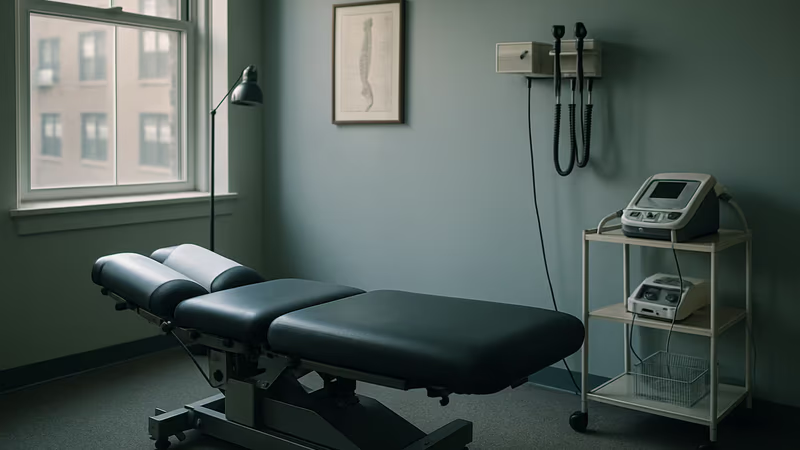
MUA is dangerous
Court finds MUA treatment too aggressive without proper foundation. Expert testimony on medical necessity prevails in no-fault insurance dispute.
Mar 17, 2021
Another Medical Necessity?
New York court finds conflicting medical opinions create triable issue on physical therapy necessity, despite provider's weak affidavit of merit in no-fault insurance case.
Apr 27, 2020
The inability to recall which shoulder was hurt damages the plaintiff’s case
In Fludd v Pena, a plaintiff's inability to recall which shoulder was injured and failure to complain about shoulder pain at IME severely damaged their case.
Nov 14, 2014
Peer review
Court ruling emphasizes that peer review reports must provide clear medical rationale and factual basis to successfully challenge medical necessity claims in no-fault cases.
Jun 18, 2012
A Plaintiff's own hospital records defeated his own threshold summary judgment motion
Court examines how plaintiff's own hospital records contradicted expert testimony in no-fault threshold case, creating triable issues of fact.
Jun 5, 2010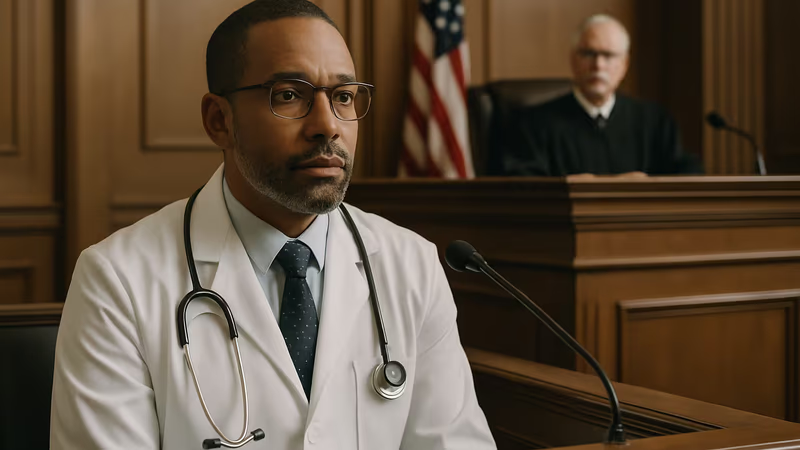
Witness Credibility in Personal Injury Cases: Standards for Medical and Expert Testimony in New York
Understanding witness credibility standards in NY personal injury law. Expert analysis of medical testimony, expert witnesses & courtroom credibility. Call 516-750-0595.
Apr 10, 2019Was this article helpful?

About the Author
Jason Tenenbaum, Esq.
Jason Tenenbaum is the founding attorney of the Law Office of Jason Tenenbaum, P.C., headquartered at 326 Walt Whitman Road, Suite C, Huntington Station, New York 11746. With over 24 years of experience since founding the firm in 2002, Jason has written more than 1,000 appeals, handled over 100,000 no-fault insurance cases, and recovered over $100 million for clients across Long Island, Nassau County, Suffolk County, Queens, Brooklyn, Manhattan, the Bronx, and Staten Island. He is one of the few attorneys in the state who both writes his own appellate briefs and tries his own cases.
Jason is admitted to practice in New York, New Jersey, Florida, Texas, Georgia, and Michigan state courts, as well as multiple federal courts. His 2,353+ published legal articles analyzing New York case law, procedural developments, and litigation strategy make him one of the most prolific legal commentators in the state. He earned his Juris Doctor from Syracuse University College of Law.
Disclaimer: This article is published by the Law Office of Jason Tenenbaum, P.C. for informational and educational purposes only. It does not constitute legal advice, and no attorney-client relationship is formed by reading this content. The legal principles discussed may not apply to your specific situation, and the law may have changed since this article was last updated.
New York law varies by jurisdiction — court decisions in one Appellate Division department may not be followed in another, and local court rules in Nassau County Supreme Court differ from those in Suffolk County Supreme Court, Kings County Civil Court, or Queens County Supreme Court. The Appellate Division, Second Department (which covers Long Island, Brooklyn, Queens, and Staten Island) and the Appellate Term (which hears appeals from lower courts) each have distinct procedural requirements and precedents that affect litigation strategy.
If you need legal help with a medical necessity matter, contact our office at (516) 750-0595 for a free consultation. We serve clients throughout Long Island (Huntington, Babylon, Islip, Brookhaven, Smithtown, Riverhead, Southampton, East Hampton), Nassau County (Hempstead, Garden City, Mineola, Great Neck, Manhasset, Freeport, Long Beach, Rockville Centre, Valley Stream, Westbury, Hicksville, Massapequa), Suffolk County (Hauppauge, Deer Park, Bay Shore, Central Islip, Patchogue, Brentwood), Queens, Brooklyn, Manhattan, the Bronx, Staten Island, and Westchester County. Prior results do not guarantee a similar outcome.