Why Trust This Analysis
This article is part of our ongoing 5102(d) issues coverage, with 90 published articles analyzing 5102(d) issues issues across New York State. Attorney Jason Tenenbaum brings 24+ years of hands-on experience to this analysis, drawing from his work on more than 1,000 appeals, over 100,000 no-fault cases, and recovery of over $100 million for clients throughout Nassau County, Suffolk County, Queens, Brooklyn, Manhattan, and the Bronx. For personalized legal advice about how these principles apply to your specific situation, contact our Long Island office at (516) 750-0595 for a free consultation.
Understanding New York’s Serious Injury Threshold in Personal Injury Cases
In New York’s no-fault insurance system, accident victims must demonstrate they sustained a “serious injury” to pursue a lawsuit against the at-fault driver for pain and suffering damages. This threshold requirement, codified under Insurance Law § 5102(d), often becomes the battleground where cases are won or lost. The definition of serious injury includes various categories, but proving you meet the threshold can be challenging without proper medical documentation.
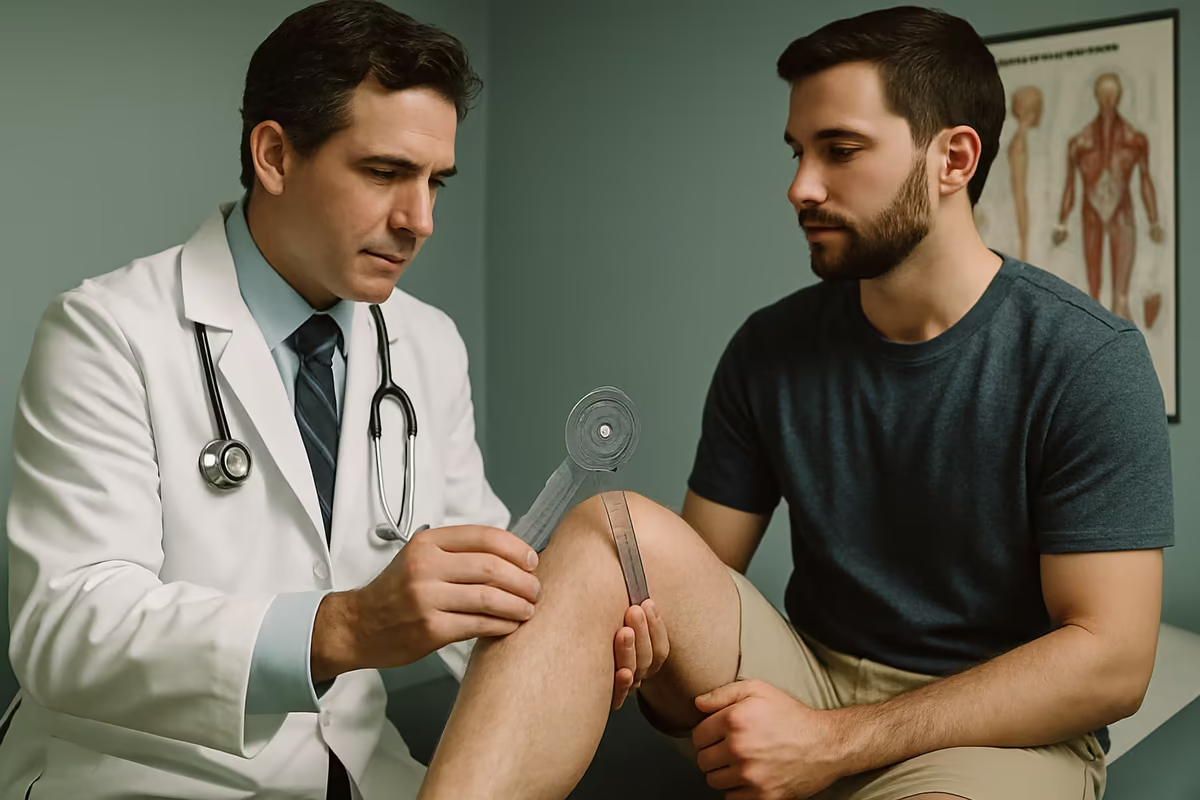
One crucial category within the serious injury threshold involves demonstrating a significant limitation of use of a body function or system. Medical professionals typically measure this through range of motion testing, comparing a patient’s current mobility to normal standards. Personal injury attorneys frequently rely on these objective measurements to establish their clients meet the statutory requirements.
The question of what percentage of limitation constitutes “significant” has been litigated extensively. While some defendants argue that only substantial deficits qualify, courts have recognized that even seemingly modest percentage losses can represent serious impairments, particularly when they affect daily activities and quality of life.
Jason Tenenbaum’s Analysis:
Free Consultation · No Fee Unless We Win
Does this apply to your situation?
Every case is different. Get a free, confidential case review from an experienced attorney who can tell you exactly where you stand.
Kholdarov v Hyman, 2018 NY Slip Op 07111 (2d Dept. 2018)
“In opposition, the plaintiff submitted the affirmed report of a neurologist who examined the plaintiff on March 16, 2016. The neurologist measured the range of motion of the cervical region of the plaintiff’s spine and compared his results to what would be considered normal range of motion. The neurologist found a 20 percent deficit in the flexion of the plaintiff’s cervical spine, but otherwise found the results to be normal”
Key Takeaway
This case demonstrates that a 20% deficit in cervical spine flexion can satisfy New York’s serious injury threshold. The court’s acceptance of this relatively modest percentage deficit reinforces that plaintiffs don’t need catastrophic limitations to meet the statutory requirements. Objective medical evidence showing measurable deficits in range of motion remains crucial for overcoming summary judgment motions, as hospital records and medical documentation can make or break a case.
Legal Update (February 2026): Since this post’s 2018 publication, New York courts have continued to develop jurisprudence regarding serious injury thresholds under Insurance Law § 5102(d), particularly concerning what percentage limitations constitute “significant” impairment. Practitioners should verify current case law interpretations and any potential legislative or regulatory modifications to the serious injury threshold requirements that may have occurred in the intervening years.
Related Articles
Legal Context
Why This Matters for Your Case
New York law is among the most complex and nuanced in the country, with distinct procedural rules, substantive doctrines, and court systems that differ significantly from other jurisdictions. The Civil Practice Law and Rules (CPLR) governs every stage of civil litigation, from service of process through trial and appeal. The Appellate Division, Appellate Term, and Court of Appeals create a rich and ever-evolving body of case law that practitioners must follow.
Attorney Jason Tenenbaum has practiced across these areas for over 24 years, writing more than 1,000 appellate briefs and publishing over 2,600 legal articles that attorneys and clients rely on for guidance. The analysis in this article reflects real courtroom experience — from motion practice in Civil Court and Supreme Court to oral arguments before the Appellate Division — and a deep understanding of how New York courts actually apply the law in practice.
About This Topic
Serious Injury Threshold Under Insurance Law 5102(d)
New York Insurance Law 5102(d) defines the categories of serious injury that a plaintiff must prove to recover non-economic damages in a motor vehicle accident case. The statute lists specific categories — significant disfigurement, fracture, loss of a fetus, permanent consequential limitation, significant limitation of use, and the 90/180-day rule. Courts apply these categories strictly, and the sufficiency of medical evidence supporting a serious injury claim is one of the most frequently litigated issues in New York personal injury law.
90 published articles in 5102(d) issues
Keep Reading
More 5102(d) issues Analysis

Defense Engineer Says Your Injury Is Degenerative? Bonilla-Acosta v Max Services (2026)
A NY appeals court held a defense engineer was qualified on crash force but not shown qualified to call spine injuries degenerative. What it means for you.
Oct 23, 2026
Significant limitation v. permanent consequential, again
New York court ruling creates apparent contradiction in no-fault threshold requirements for significant limitation vs. permanent consequential limitation cases.
May 22, 2021
90/180 discussion – interpretation of Perl.
Crawford-Reese v Woodard case analysis: 90/180 threshold motion requirements, medical evidence standards, and Perl interpretation for NY serious injury law.
May 5, 2012
NY Serious Injury Threshold: When Suboptimal Effort Derails Personal Injury Cases
Learn how NY's serious injury threshold works and why suboptimal effort can destroy your personal injury case. Expert Long Island attorney guidance.
Nov 25, 2019
Femur Fracture and New York's Serious Injury Threshold: When Causation Becomes a Question of Fact
In Peterson v Ward, a plaintiff who walked unassisted after a crash raised fact issues on whether a femur fracture met New York's serious injury threshold.
Dec 26, 2017
The missing EMG/NCV undermined the expert’s analysis
Expert testimony undermined in 5102(d) serious injury case when EMG/NCV study missing critical conclusion page showing radiculopathy - Fourth Department analysis
Jan 7, 2015Was this article helpful?
Disclaimer: This article is published by the Law Office of Jason Tenenbaum, P.C. for informational and educational purposes only. It does not constitute legal advice, and no attorney-client relationship is formed by reading this content. The legal principles discussed may not apply to your specific situation, and the law may have changed since this article was last updated.
New York law varies by jurisdiction — court decisions in one Appellate Division department may not be followed in another, and local court rules in Nassau County Supreme Court differ from those in Suffolk County Supreme Court, Kings County Civil Court, or Queens County Supreme Court. The Appellate Division, Second Department (which covers Long Island, Brooklyn, Queens, and Staten Island) and the Appellate Term (which hears appeals from lower courts) each have distinct procedural requirements and precedents that affect litigation strategy.
If you need legal help with a 5102(d) issues matter, contact our office at (516) 750-0595 for a free consultation. We serve clients throughout Long Island (Huntington, Babylon, Islip, Brookhaven, Smithtown, Riverhead, Southampton, East Hampton), Nassau County (Hempstead, Garden City, Mineola, Great Neck, Manhasset, Freeport, Long Beach, Rockville Centre, Valley Stream, Westbury, Hicksville, Massapequa), Suffolk County (Hauppauge, Deer Park, Bay Shore, Central Islip, Patchogue, Brentwood), Queens, Brooklyn, Manhattan, the Bronx, Staten Island, and Westchester County. Prior results do not guarantee a similar outcome.