
Why Trust This Analysis
This article is part of our ongoing discovery coverage, with 100 published articles analyzing discovery issues across New York State. Attorney Jason Tenenbaum brings 24+ years of hands-on experience to this analysis, drawing from his work on more than 1,000 appeals, over 100,000 no-fault cases, and recovery of over $100 million for clients throughout Nassau County, Suffolk County, Queens, Brooklyn, Manhattan, and the Bronx. For personalized legal advice about how these principles apply to your specific situation, contact our Long Island office at (516) 750-0595 for a free consultation.
Understanding Discovery Orders and the Law of the Case Doctrine
In civil litigation, discovery orders play a crucial role in ensuring parties exchange relevant information before trial. However, questions often arise about whether courts can revisit or modify previous discovery rulings. The law of the case doctrine typically prevents courts from reconsidering issues already decided in the same case, but its application to discovery matters has important limitations.
The distinction between substantive legal rulings and procedural discovery orders becomes critical when parties seek to modify court directives or when circumstances change during litigation. This flexibility in discovery proceedings allows courts to adapt their orders based on new information or changed circumstances, unlike final determinations on legal issues.
Understanding these nuances helps attorneys navigate complex litigation scenarios where discovery disputes may require multiple court interventions or modifications to existing orders.
Jason Tenenbaum’s Analysis:
Free Consultation · No Fee Unless We Win
Does this apply to your situation?
Every case is different. Get a free, confidential case review from an experienced attorney who can tell you exactly where you stand.
Terra Chiropractic, P.C. v Hertz Claim Mgt. Corp., 2010 NY Slip Op 51722(U)(App. Term 2d Dept. 2010)
“Doctrine of law of the case…does not apply to prior discovery orders” I found that line to be interesting. Factually, this case involved a plaintiff who could not seem to get his act together, and a court that gave him more chances than you would find in a standard civil action.
Legal Significance: Distinguishing Procedural from Substantive Rulings
The Terra Chiropractic decision’s statement that law of the case doesn’t apply to discovery orders reflects an important distinction between procedural case management and substantive legal determinations. The law of the case doctrine prevents parties from relitigating issues already decided in the same case, promoting finality and judicial efficiency. However, this doctrine primarily applies to determinations on legal issues or merits questions, not to procedural discovery management.
Discovery orders are inherently provisional and responsive to evolving circumstances. As cases proceed, new information emerges, parties’ needs change, and cooperation levels fluctuate. Courts retain discretion to modify discovery orders based on changed circumstances, non-compliance, or recognition that prior orders proved inadequate or inappropriate. Applying law of the case strictly to discovery would prevent courts from adapting their management of cases, leading to inefficient or unfair outcomes.
This flexibility serves important purposes. When parties fail to comply with initial discovery orders, courts need authority to impose more stringent requirements or sanctions. When initial discovery proves insufficient to resolve disputed issues, courts must be able to order additional disclosure. When parties raise new issues requiring discovery, courts can order supplemental disclosure even if prior orders were deemed complete. This adaptive approach allows discovery to serve its purpose of ensuring parties have access to relevant evidence before trial.
However, this flexibility has limits. Courts won’t simply allow parties to relitigate discovery disputes without changed circumstances or valid reasons. The Terra Chiropractic plaintiff apparently sought multiple extensions or modifications of discovery obligations, testing the court’s patience. Eventually, courts will determine that enough chances have been provided and enforce compliance through sanctions or dismissal. The decision’s comment about giving the plaintiff “more chances than you would find in a standard civil action” suggests the court’s flexibility was approaching its limit.
Practical Implications for Discovery Practice
For litigants, the non-application of law of the case to discovery orders means both opportunity and risk. Parties who receive unfavorable discovery rulings aren’t necessarily bound by them permanently. If circumstances change, new issues arise, or cooperation improves, parties can seek modification of prior orders. This provides flexibility when initial discovery plans prove inadequate.
However, this flexibility also means opponents can seek more stringent discovery orders when parties fail to comply with initial directives. The Terra Chiropractic plaintiff’s repeated non-compliance led to increasingly strict court intervention. Rather than being protected by prior lenient orders under law of the case, the plaintiff faced escalating consequences for continued failures. Parties cannot rely on initial favorable discovery rulings to shield them from consequences of subsequent non-compliance.
Key Takeaway
This ruling provides important clarity for litigation strategy: courts retain discretion to modify discovery orders even after previous rulings on similar issues. This flexibility allows for adaptation when parties fail to comply with initial orders or when new circumstances arise, though courts may be less patient with repeated non-compliance as demonstrated in this case.
Related Articles
Legal Context
Why This Matters for Your Case
New York law is among the most complex and nuanced in the country, with distinct procedural rules, substantive doctrines, and court systems that differ significantly from other jurisdictions. The Civil Practice Law and Rules (CPLR) governs every stage of civil litigation, from service of process through trial and appeal. The Appellate Division, Appellate Term, and Court of Appeals create a rich and ever-evolving body of case law that practitioners must follow.
Attorney Jason Tenenbaum has practiced across these areas for over 24 years, writing more than 1,000 appellate briefs and publishing over 2,600 legal articles that attorneys and clients rely on for guidance. The analysis in this article reflects real courtroom experience — from motion practice in Civil Court and Supreme Court to oral arguments before the Appellate Division — and a deep understanding of how New York courts actually apply the law in practice.
About This Topic
Discovery Practice in New York Courts
Discovery is the pre-trial process through which parties exchange information relevant to the dispute. In New York, discovery practice is governed by CPLR Article 31 and involves depositions, interrogatories, document demands, and physical examinations. Disputes over the scope of discovery, compliance with demands, and sanctions for noncompliance are frequent in both no-fault and personal injury cases. These articles analyze discovery rules, court decisions on discovery disputes, and strategies for effective discovery practice.
100 published articles in Discovery
Keep Reading
More Discovery Analysis
Nassau Police Ordered to Pay $34,690.50 in FOIL Fees: What Meyer Means After a Crash
The Second Department raised a FOIL fee award against the Nassau County Police Department from $12,000 to $34,690.50. The statute, the math, and the FOIL clock.
Oct 8, 2026
FOIL and the Court System's Memos to Judges: NYCLU v OCA (1st Dept 2026)
On September 29, 2026 the First Department upheld an order to release 22 OCA memos to judges under FOIL. What the ruling holds, and what it leaves open.
Oct 3, 2026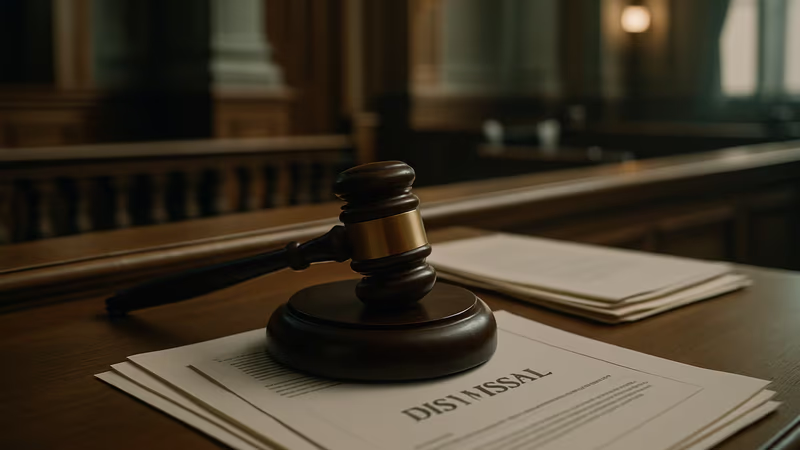
The conditional order of dismissal
New York's First Department issued a conditional order of dismissal for discovery noncompliance, but the two-step process raises doctrinal concerns about court consistency.
Mar 28, 2020
Depositions granted – First department precedent eschewed
Second Department Appellate Term grants depositions in no-fault cases, overruling district court precedent on discovery timing and procedural requirements.
Dec 28, 2015
Tax records denied in Mallela based disclosure matter
Court denies insurance company's request for tax records in no-fault case, reinforcing that tax returns require special circumstances to be discoverable in litigation.
Oct 27, 2013
Brutal discovery decision from the Appellate Term First Department
Appellate Term First Department issues harsh discovery sanctions ruling, striking defendant's answer for failure to respond to disclosure requests in no-fault case.
Nov 7, 2010Was this article helpful?
Disclaimer: This article is published by the Law Office of Jason Tenenbaum, P.C. for informational and educational purposes only. It does not constitute legal advice, and no attorney-client relationship is formed by reading this content. The legal principles discussed may not apply to your specific situation, and the law may have changed since this article was last updated.
New York law varies by jurisdiction — court decisions in one Appellate Division department may not be followed in another, and local court rules in Nassau County Supreme Court differ from those in Suffolk County Supreme Court, Kings County Civil Court, or Queens County Supreme Court. The Appellate Division, Second Department (which covers Long Island, Brooklyn, Queens, and Staten Island) and the Appellate Term (which hears appeals from lower courts) each have distinct procedural requirements and precedents that affect litigation strategy.
If you need legal help with a discovery matter, contact our office at (516) 750-0595 for a free consultation. We serve clients throughout Long Island (Huntington, Babylon, Islip, Brookhaven, Smithtown, Riverhead, Southampton, East Hampton), Nassau County (Hempstead, Garden City, Mineola, Great Neck, Manhasset, Freeport, Long Beach, Rockville Centre, Valley Stream, Westbury, Hicksville, Massapequa), Suffolk County (Hauppauge, Deer Park, Bay Shore, Central Islip, Patchogue, Brentwood), Queens, Brooklyn, Manhattan, the Bronx, Staten Island, and Westchester County. Prior results do not guarantee a similar outcome.