
Key Takeaway
New York employers increasingly use AI tools to screen job applicants. Learn how automated hiring bias could violate your rights under NYC and NY State law.
This article is part of our ongoing employment law coverage, with 82 published articles analyzing employment law issues across New York State. Attorney Jason Tenenbaum brings 24+ years of hands-on experience to this analysis, drawing from his work on more than 1,000 appeals, over 100,000 no-fault cases, and recovery of over $100 million for clients throughout Nassau County, Suffolk County, Queens, Brooklyn, Manhattan, and the Bronx. For personalized legal advice about how these principles apply to your specific situation, contact our Long Island office at (516) 750-0595 for a free consultation.
You submitted your resume, checked every box in the job listing, maybe even had a phone screen — and then silence. Or a generic rejection email generated the same second you clicked “submit.”
You weren’t screened by a human. You were screened by a machine.
Artificial intelligence tools that filter, rank, and reject job applicants are now used by the majority of large employers in the United States. Résumé-screening algorithms, AI-powered video interview analyzers, automated scoring systems, and predictive hiring tools are reshaping who gets called for interviews — and who gets quietly eliminated before any human ever reads their name.
The problem? These systems are demonstrably discriminatory. Study after study has shown that AI hiring tools can perpetuate and amplify bias against women, older workers, people of color, and people with disabilities. And until recently, most workers had no idea they were being scored — or rejected — by software.
Free Consultation · No Fee Unless We Win
Does this apply to your situation?
Every case is different. Get a free, confidential case review from an experienced attorney who can tell you exactly where you stand.
New York has stepped up with some of the strongest AI hiring protections in the country. If you live or work in New York City or New York State, here’s what you need to know about your rights.
What Are Automated Employment Decision Tools (AEDTs)?
An Automated Employment Decision Tool (AEDT) is any computational process — including machine learning, statistical modeling, artificial intelligence, or data analytics — that an employer uses to make or substantially assist a decision about hiring, promotion, or similar employment actions.
AEDTs in common use include:
- Résumé screening software that scores candidates on keywords, career trajectory, and other factors without human review
- Video interview analysis platforms that score candidates based on facial expressions, eye movements, tone of voice, and word choice
- Skills and personality assessments administered online and automatically scored
- Predictive hiring scores that rank candidates by likelihood of success using historical workforce data
- Applicant tracking systems (ATS) with automated filtering that eliminates candidates before a recruiter sees them
These tools are marketed to employers as efficiency solutions. The problem is that the data they’re trained on often reflects historical patterns of discrimination — and training AI on biased data produces biased results.
NYC Local Law 144: The First Major AEDT Regulation in the U.S.
In 2021, New York City enacted Local Law 144, one of the first laws in the world to directly regulate AI hiring tools. The law applies to employers and employment agencies that use AEDTs in hiring or promotion decisions affecting NYC workers. It has been in effect since 2023 and enforcement has been ramping up significantly.
Under Local Law 144, employers who use AEDTs must:
1. Conduct a Bias Audit
Before deploying an AEDT, employers must commission an independent bias audit — a technical evaluation of the tool’s impact on candidates across race, ethnicity, and sex categories. The audit must be conducted by a qualified independent auditor, not the company that made the software.
2. Publish the Audit Results
The results of the bias audit must be published publicly on the employer’s website, including the date of the most recent audit, a summary of the results, and the distribution date of the tool being audited.
3. Notify Candidates
Employers must notify job candidates residing in New York City that an AEDT is being used to evaluate them. This notice must be provided:
- At least ten business days before the use of the AEDT
- Via the job posting, website, or direct communication to the candidate
4. Provide an Accommodation Option
Candidates who live in NYC must be given the opportunity to request an alternative selection process or request additional consideration if they prefer not to be evaluated by an AEDT.
Violations of Local Law 144 are subject to civil penalties. More importantly for individual workers, violations are increasingly being used as evidence in broader employment discrimination claims.
New York State Human Rights Law and Federal Protections
Beyond Local Law 144, AI hiring discrimination may violate multiple layers of anti-discrimination law:
New York State Human Rights Law (NYSHRL)
The NYSHRL prohibits employment discrimination based on race, color, national origin, sex, age, disability, religion, sexual orientation, gender identity, and other protected characteristics. Critically, the NYSHRL applies statewide — including Nassau and Suffolk Counties and all of Long Island — not just New York City.
Under a disparate impact theory, you don’t need to prove an employer intended to discriminate. If a hiring tool disproportionately filters out candidates in a protected class — even if unintentionally — that may constitute unlawful discrimination.
Title VII of the Civil Rights Act (Federal)
Title VII, enforced by the EEOC, prohibits employment discrimination on the basis of race, color, religion, sex, and national origin. The EEOC has issued guidance making clear that employers cannot escape Title VII liability simply because a discriminatory decision was made by an algorithm rather than a human. The employer is responsible for the tools it uses.
In recent years, the EEOC has actively pursued enforcement actions involving AI hiring discrimination. The agency’s 2023 guidance on AI and algorithmic fairness reinforced that disparate impact analysis applies fully to automated tools.
Age Discrimination in Employment Act (ADEA)
Workers 40 and older have federal protection against age discrimination in hiring. AI hiring tools have been found to systematically disadvantage older workers — particularly when they use proxy variables correlated with age, like graduation year, chronological resume gaps, or familiarity with older technology platforms.
Americans with Disabilities Act (ADA)
AI video interview platforms that score facial expressions and vocal tone may unlawfully screen out candidates with certain disabilities — including autism spectrum disorder, cerebral palsy, hearing impairments, or conditions that affect speech and expression. The ADA requires employers to provide reasonable accommodations in the hiring process, which may include alternatives to AI-scored assessments.
Signs You May Have Been Discriminated Against by an AI Hiring System
It can be difficult to know for certain that an algorithm contributed to your rejection, but warning signs include:
- You were rejected almost immediately after applying — too fast for a human to have reviewed your materials
- You were rejected automatically after completing an online assessment or video interview
- You never received any personalized communication from a recruiter or hiring manager
- You are a member of a protected class (race, age, sex, disability) and were rejected despite clearly meeting the qualifications
- You applied to the same employer multiple times with different outcomes you can’t explain
- Friends or colleagues who are similarly qualified had different outcomes on the same application process
If you suspect AI discrimination, document everything: save the job posting, your application, any automated communications you received, and any assessments you completed. This documentation may become important if you decide to pursue a claim.
What You Can Do: Your Options Under New York Law
File a Complaint with the NYC Commission on Human Rights
If you work or applied for a job in New York City, you can file a complaint with the NYC Commission on Human Rights (NYCCHR). The NYCCHR has jurisdiction to investigate violations of the NYC Human Rights Law, which is among the broadest in the country. The agency can investigate employer practices, compel disclosure of algorithmic tools, and award damages including lost wages, emotional distress, and punitive damages.
File with the New York State Division of Human Rights
For Long Island residents and applicants for jobs outside NYC, the New York State Division of Human Rights (DHR) handles complaints under the NYSHRL. You have one year from the discriminatory act to file a complaint with the DHR.
File with the EEOC
Federal claims — under Title VII, the ADEA, or the ADA — begin with a charge filed with the Equal Employment Opportunity Commission (EEOC). You generally have 300 days from the discriminatory act to file a charge in New York. Receiving a “right to sue” letter from the EEOC is a prerequisite to filing a federal court lawsuit.
Private Lawsuit
In many cases, the most effective path is filing a private lawsuit directly in court. An experienced New York employment discrimination attorney can evaluate your case, determine which laws apply, and advise on the best forum and strategy for your specific situation.
What Damages Are Available in an AI Hiring Discrimination Case?
If your claim is successful, you may be entitled to:
- Back pay — wages you would have earned had you not been discriminated against
- Front pay — future lost earnings if you cannot be reinstated to the position
- Compensatory damages — for emotional distress, humiliation, and harm to your professional reputation
- Punitive damages — in cases of particularly egregious conduct, to punish the employer
- Attorney’s fees — New York law and most federal employment statutes allow successful plaintiffs to recover their legal fees from the employer
- Injunctive relief — a court order requiring the employer to change its hiring practices
Contact Us
If you believe you were unfairly screened out of a job opportunity by an AI hiring tool — or if you’ve experienced discrimination in any stage of the hiring process — the Law Offices of Jason Tenenbaum wants to hear from you.
Our employment law team represents workers throughout Long Island, Nassau County, Suffolk County, and all five boroughs of New York City. We handle employment discrimination claims on a contingency fee basis, meaning you pay nothing unless we recover for you.
Call us at 516-750-0595 for a free consultation. We will review your situation, explain your options, and fight to hold employers accountable — whether the discriminator was a person or an algorithm.
Learn more about our employment law practice and how we handle workplace discrimination claims.
Related Practice Areas
For a deeper dive into the firm’s coverage of related topics:
Authoritative External Resources
- U.S. Equal Employment Opportunity Commission (EEOC) — federal anti-discrimination enforcement
- U.S. Department of Labor — Fair Labor Standards Act — federal wage-and-hour rules
- New York Division of Human Rights — state anti-discrimination charges
- New York Department of Labor — Wage and Hour Laws — NYLL framework and Wage Theft Prevention Act
Free Consultation — Talk to a New York Attorney
The Law Office of Jason Tenenbaum, P.C. has recovered more than $100 million for clients across personal injury, employment, and no-fault matters since 2002. We work on contingency — no fee unless we win — and the initial consultation is free.
- Call (516) 750-0595 (Mon–Fri 9am–5pm; 24/7 emergency line)
- Use the secure online contact form
The firm is licensed in New York State only. Nothing in this article constitutes legal advice; everything is provided for informational purposes.
Last reviewed: 2026-07-06.
Legal Context
Why This Matters for Your Case
Employment law in New York provides some of the strongest worker protections in the nation. The New York State Human Rights Law (Executive Law §296) prohibits discrimination based on race, sex, age, disability, sexual orientation, gender identity, and other protected characteristics. The New York City Human Rights Law goes even further, applying a broader standard and covering more employers.
Federal protections under Title VII, the ADA, the ADEA, and the FLSA provide additional layers of protection. The Law Office of Jason Tenenbaum represents employees facing workplace discrimination, wrongful termination, wage theft, hostile work environments, and employer retaliation throughout Long Island, Nassau County, Suffolk County, and the five boroughs of New York City.
Whether your case involves EEOC filings, NYS Division of Human Rights complaints, or direct court action under CPLR Article 78, this article provides the expert legal analysis that workers and practitioners need to understand their rights and develop effective litigation strategies under current New York employment law.
About This Topic
New York Employment Law
New York has some of the strongest worker protections in the nation — from the NYC Human Rights Law to state-level whistleblower statutes. Whether you're dealing with discrimination, wage theft, wrongful termination, or hostile work environments, understanding your rights is the first step. Attorney Jason Tenenbaum represents employees across Long Island and NYC in federal and state employment claims.
82 published articles in Employment Law
Keep Reading
More Employment Law Analysis

No Small-Business Exemption: Which New York Employment Laws Cover a One-Employee Business
Title VII starts at 15 employees. New York's Human Rights Law starts at one. Which state laws reach the smallest employers, and where size still counts.
Oct 15, 2026
Religious Accommodation at Work After Bergin: The "Motivating Factor" Test in New York
The Second Circuit replaced its old religious-accommodation test with Abercrombie's motivating-factor test. What changed, what New York law adds, what to keep.
Oct 14, 2026
Uber and Lyft Sue NYC Over the Deactivation Law
Uber and Lyft sued to block NYC Local Law 52's just-cause driver deactivation rules before July 28, 2026. What drivers and injured passengers need to know.
Jun 12, 2026
Major Employment Law Changes in 2026: What the Gig Worker Rule Rollback Means for New York Workers
The Trump administration is rolling back the Biden-era independent contractor rule, dramatically impacting gig workers, rideshare drivers, and employment.
Feb 27, 2026
A Legal Guide to Remote Work Employment Law
Comprehensive guide to remote work employment law: regulations, contracts, safety, data security, discrimination & tax implications for employers.
Jan 6, 2025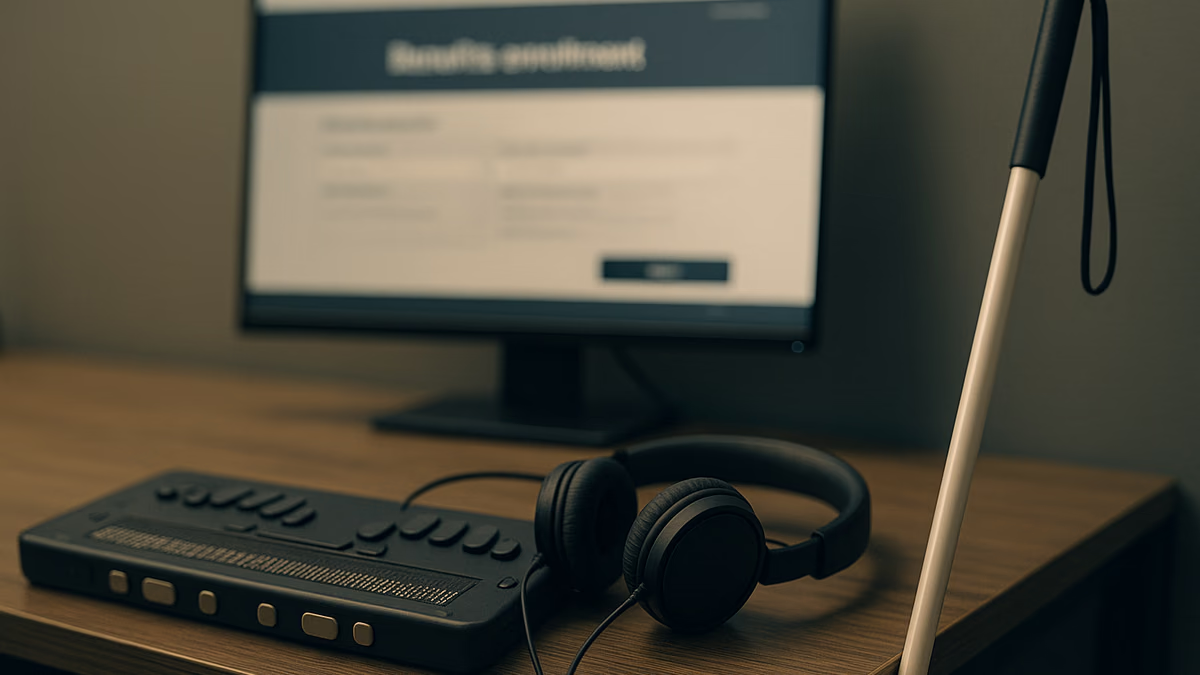
Inaccessible HR Portals and Blind Employees' Rights
Pearson Education paid $150,000 to settle EEOC claims that its benefits and training portals shut out blind employees. What the ADA and New York law require.
Sep 26, 2026Frequently Asked Questions
Common Questions About This Topic
6 answers from the firm's New York personal-injury and employment-law practice. Click any question to expand.
Does Local Law 144 apply to employers based outside of New York City?
Local Law 144 applies when an employer uses an AEDT to evaluate candidates for positions based in New York City, regardless of where the employer itself is headquartered. If you applied for a NYC-based job, the employer must comply.
What if I live on Long Island and applied for a job in New York City?
If you applied for a position located in New York City, Local Law 144 may apply to your situation. Additionally, New York State Human Rights Law protections apply statewide, regardless of where the employer or the job opening is located.
Do I need to prove the employer intended to discriminate against me?
No. Under disparate impact theory, you can prevail by showing that a hiring practice disproportionately harmed a protected group, even without evidence of intentional bias. This is particularly important for AI discrimination claims, where the employer may genuinely not know their software has a discriminatory effect.
Can I request a copy of how I was scored by an AEDT?
Under Local Law 144, employers must notify you that an AEDT is being used — but there is currently no automatic right to your individual score. However, in litigation, your attorney can seek this information through discovery. Some advocates are pushing for stronger individual disclosure rights; this area of law is evolving quickly.
How long do I have to file a claim?
It depends on which law you're pursuing. For the EEOC, you generally have 300 days. For the New York State DHR, one year. For the NYC Commission, three years. Because deadlines vary, consulting with an attorney as soon as possible is critical.
Is hiring AI discrimination a new area of law? Will courts take it seriously?
Courts and regulators are taking this seriously — and quickly. The EEOC has issued enforcement guidance, the FTC has weighed in on AI bias, and New York City has already enacted and begun enforcing Local Law 144. Litigation in this area is increasing, and courts are applying established anti-discrimination frameworks to these new technologies. It is not a fringe legal theory; it is mainstream employment law applied to modern tools. ---
Was this article helpful?
Disclaimer: This article is published by the Law Office of Jason Tenenbaum, P.C. for informational and educational purposes only. It does not constitute legal advice, and no attorney-client relationship is formed by reading this content. The legal principles discussed may not apply to your specific situation, and the law may have changed since this article was last updated.
New York law varies by jurisdiction — court decisions in one Appellate Division department may not be followed in another, and local court rules in Nassau County Supreme Court differ from those in Suffolk County Supreme Court, Kings County Civil Court, or Queens County Supreme Court. The Appellate Division, Second Department (which covers Long Island, Brooklyn, Queens, and Staten Island) and the Appellate Term (which hears appeals from lower courts) each have distinct procedural requirements and precedents that affect litigation strategy.
If you need legal help with a employment law matter, contact our office at (516) 750-0595 for a free consultation. We serve clients throughout Long Island (Huntington, Babylon, Islip, Brookhaven, Smithtown, Riverhead, Southampton, East Hampton), Nassau County (Hempstead, Garden City, Mineola, Great Neck, Manhasset, Freeport, Long Beach, Rockville Centre, Valley Stream, Westbury, Hicksville, Massapequa), Suffolk County (Hauppauge, Deer Park, Bay Shore, Central Islip, Patchogue, Brentwood), Queens, Brooklyn, Manhattan, the Bronx, Staten Island, and Westchester County. Prior results do not guarantee a similar outcome.