Key Takeaway
PTSD after a car accident may qualify as a serious injury under New York law. Learn what the First Department held in Ravi v. Gyebi and what evidence matters most.
This article is part of our ongoing personal injury coverage, with 84 published articles analyzing personal injury issues across New York State. Attorney Jason Tenenbaum brings 24+ years of hands-on experience to this analysis, drawing from his work on more than 1,000 appeals, over 100,000 no-fault cases, and recovery of over $100 million for clients throughout Nassau County, Suffolk County, Queens, Brooklyn, Manhattan, and the Bronx. For personalized legal advice about how these principles apply to your specific situation, contact our Long Island office at (516) 750-0595 for a free consultation.
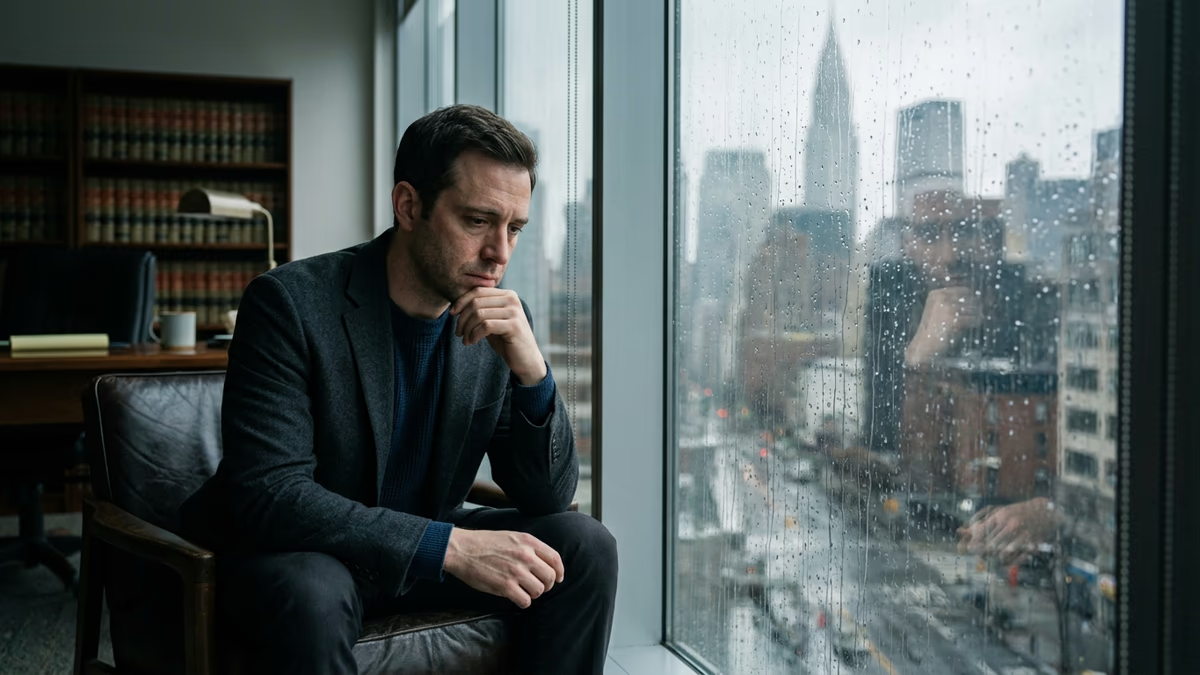
You survived the crash. The cuts healed. The bruises faded. But you still cannot sleep, you panic in traffic, and the sound of screeching brakes sends your heart racing.
Can that kind of trauma count as a “serious injury” under New York law?
In a new appellate decision, Ravi S.A. v. Gyebi, the First Department confirmed that post-traumatic stress disorder can support a serious-injury claim under the right facts. That matters for anyone pursuing a Long Island car accident lawyer case where the worst injuries are not only physical, but psychological.
This decision is especially significant because Jason Tenenbaum represented the appellants. He knows the record, the evidentiary fights, and exactly why the court drew the line where it did.
The No-Fault Threshold Still Controls
New York is a no-fault state. After a car accident, your own insurer typically pays basic medical expenses and a portion of lost wages. But if you want to sue for pain and suffering, you must first prove a “serious injury” under Insurance Law section 5102(d).
Most people think of fractures, disc injuries, surgeries, or permanent limitations. Those are the familiar threshold fights. But psychological injuries can be just as disabling. The problem is that insurance companies often try to dismiss them as subjective, temporary, or impossible to measure.
That is why this ruling matters. It confirms that emotional trauma is not automatically outside the statute. But it also shows that these claims rise or fall on the quality of the proof.
If you are trying to understand how the broader threshold works in a personal injury case, this case is a reminder that the law focuses on evidence and functional impact, not just labels.
What the Court Actually Held in Ravi v. Gyebi
The First Department split the issue into two different serious-injury theories.
The permanent consequential limitation claim failed
That part of the case was dismissed.
Why? Because the record showed a gap in treatment that neither expert adequately explained. The child had been recommended for continued therapy, but her mother stopped formal treatment and tried to manage things at home. Under New York law, unexplained gaps in treatment can destroy a permanent-injury theory. Courts regularly cite Pommells v. Perez for that point, and this case followed that pattern.
In plain English: if you are going to argue that psychological injury is permanent, you cannot ignore a treatment gap. You need a medically grounded explanation for why therapy stopped and why the symptoms still remain.
The significant limitation claim survived
This was the important win.
The defendants did not submit their own expert proof establishing that the PTSD claim failed as a matter of law. Worse for them, the evidence they did submit included deposition testimony showing a child still suffering meaningful trauma tied to the crash.
That was enough for the First Department to say a jury should decide the issue.
So the court did not hold that every PTSD diagnosis automatically meets the threshold. It held something narrower and more useful:
- PTSD can qualify under the significant-limitation category.
- Defendants still have to meet their prima facie burden if they want dismissal.
- Real evidence of ongoing trauma affecting daily life creates a triable issue.
The plaintiff still did not win outright
The plaintiffs also moved for partial summary judgment and lost.
That matters because it shows the other half of the rule: just having experts is not always enough to win as a matter of law. The court noted that the psychologists found only one or two mild clinically significant findings on the testing instruments they used. That was not strong enough for the plaintiffs to take the issue away from the jury.
So the decision is balanced. It helps plaintiffs with legitimate PTSD claims, but it does not lower the evidentiary bar into nothing.
What Makes a PTSD Claim Strong in New York
The cases say psychological injuries must be serious, verifiable, and supported by objective medical evidence. PTSD is not always proven the same way a fracture is proven, but courts still want more than a bare complaint of anxiety or fear.
The strongest claims usually have several things working together:
- A prompt evaluation by a licensed therapist, psychologist, or psychiatrist.
- Consistent treatment over time.
- Documented symptoms like flashbacks, nightmares, avoidance, panic, sleep disruption, or school/work impairment.
- Standardized testing or other objective assessment tools.
- A clear explanation of how the condition affects ordinary life.
What weakens a claim?
- Long unexplained gaps in therapy.
- Minimal findings on testing.
- Sparse records that list a diagnosis but do not describe functional impact.
- Experts who fail to connect the trauma to the accident in a detailed way.
This is the same basic lesson courts apply in many threshold cases: diagnosis alone is not enough. The records must show real limitation.
Why Insurance Companies Fight PTSD Claims So Hard
Carriers are comfortable attacking psychological injuries because they assume juries will see them as less concrete than orthopedic injuries. That is why they often argue:
- the symptoms are mild,
- the treatment was too short,
- the claimant had prior emotional issues, or
- the trauma does not meaningfully limit daily activity.
That is also why the right documentation matters. If your provider only notes “anxiety” or “stress,” the defense will try to trivialize it. If your records explain that you cannot ride in cars, cannot sleep, cannot concentrate at work, or cannot function in school the way you did before, the case becomes much harder to dismiss.
For clients who also have no-fault insurance disputes, the issue becomes even more complicated because treatment records, IME reviews, and causation fights can overlap. Psychological injuries often sit at the intersection of threshold law, insurance procedure, and credibility.
Practical Takeaways for Accident Victims
If you are experiencing trauma after a crash, treat it seriously from day one.
1. Get evaluated
Do not assume the symptoms will just disappear. Nightmares, flashbacks, hypervigilance, and panic while driving are not minor issues when they interfere with daily life.
2. Stay in treatment unless your provider says otherwise
If therapy stops, the record should explain why. Improvement, discharge, insurance issues, relocation, or a provider-directed pause should be documented. Silence on that point gives the defense room to argue that the condition was not serious.
3. Make sure the records describe function, not just diagnosis
The most persuasive records explain how PTSD affects:
- driving
- work
- school
- sleep
- concentration
- relationships
- ordinary routines
4. Use objective tools when appropriate
Psychological claims are stronger when supported by recognized testing and careful clinical findings. Mild findings may keep the claim alive, but stronger findings make it harder for the defense to minimize the injury.
5. Talk to a lawyer early
PTSD serious-injury claims are not impossible, but they are not self-proving either. You need a legal strategy that understands both the no-fault threshold and the way appellate courts evaluate emotional-injury evidence.
What This Means for Long Island and NYC Cases
This ruling will matter well beyond the First Department.
Defense lawyers across New York routinely argue that psychological trauma should not get past summary judgment. Plaintiffs’ lawyers can now point to a fresh appellate decision recognizing that PTSD may present a jury question under the significant-limitation category.
That does not mean every county will treat these claims identically. But it does mean the argument is no longer theoretical. There is now clearer appellate support for the idea that emotional trauma after a crash can satisfy the threshold when the facts are strong enough.
For people injured on Long Island or in New York City, the lesson is simple: if the crash changed the way you function psychologically, the law may recognize that injury. But the proof has to be built correctly.
Frequently Asked Questions
Can PTSD qualify as a serious injury in New York?
Yes. PTSD can qualify under New York’s serious-injury threshold, especially under the “significant limitation of use” category, if the evidence shows a serious, verifiable condition with meaningful life impact.
What evidence do I need to prove PTSD from a car accident?
Strong records from a therapist, psychologist, or psychiatrist help most. Objective testing, consistent treatment, and documentation of how the trauma affects work, school, sleep, or daily life make the claim much stronger.
Does stopping therapy hurt my PTSD injury claim?
It can. An unexplained gap in treatment is one of the easiest ways for the defense to attack a serious-injury claim, especially if you are arguing permanent limitation.
Can children bring PTSD claims after a crash?
Yes. Ravi v. Gyebi itself involved a child claimant. But the same evidentiary rules apply: the records still need to show serious and lasting functional impact.
How long do I have to file a PTSD injury lawsuit in New York?
Most personal injury actions in New York must be filed within three years. Claims against public entities can have much shorter deadlines, including a 90-day notice-of-claim requirement. The sooner you get advice, the safer your position.
The Bottom Line
PTSD is not automatically enough to satisfy New York’s serious-injury threshold. But it is not automatically excluded either.
That is the real importance of Ravi v. Gyebi. The court recognized that psychological trauma from a car accident can be serious enough to send the issue to a jury, while also reminding everyone that weak proof and unexplained treatment gaps can still sink the case.
If you are dealing with flashbacks, panic, avoidance, or trauma after a crash, do not assume the law will ignore it. Get it documented. Stay in treatment. And make sure your case is built by someone who understands the threshold fights that decide whether serious-injury cases survive.
If you want to talk through your options after a New York car accident, call the Law Office of Jason Tenenbaum, P.C. at 516-750-0595 or use our free consultation form.
Legal Context
Why This Matters for Your Case
Personal injury law in New York is governed by a complex web of statutes, case law, and procedural rules that differ from most other states. The statute of limitations for most personal injury claims is three years under CPLR 214(5), but claims against municipalities require a Notice of Claim within 90 days. Motor vehicle accident victims must meet the serious injury threshold under Insurance Law §5102(d) before they can recover pain and suffering damages.
The Law Office of Jason Tenenbaum has recovered over $100 million for injured clients across Long Island, Nassau County, Suffolk County, Queens, Brooklyn, Manhattan, and the Bronx. With 24+ years of trial and appellate experience, more than 1,000 appeals written, and 2,353+ published legal articles, Jason Tenenbaum provides the authoritative legal analysis that practitioners and injury victims need to understand their rights.
This article reflects real courtroom experience and a deep understanding of how New York courts actually evaluate personal injury claims — from the initial filing through discovery, summary judgment, trial, and appeal.
About This Topic
New York Personal Injury Law
When negligence causes serious injury, New York law entitles victims to compensation for medical bills, lost income, pain and suffering, and more. From car accidents and slip-and-falls to construction injuries and medical malpractice, the Law Office of Jason Tenenbaum has recovered over $100 million for injured Long Islanders and New Yorkers since 2002.
84 published articles in Personal Injury
Keep Reading
More Personal Injury Analysis

Social Media Addiction Lawsuits in New York: What Families Need to Know in 2026
Over 2,407 social media addiction cases are consolidated in MDL 3047. Learn what New York families need to know about filing claims against Meta, TikTok, and Snapchat in 2026.
Mar 27, 2026
$5 Million Verdict Affirmed for Childhood Sexual Abuse Survivor Under NY Survivors Act
NY appellate court affirms $5M verdict for childhood sexual abuse survivor under the Survivors Act. Learn your rights. Call 516-750-0595 for a free consultation.
Feb 18, 2026
NYC Boat Accidents
NYC boat accident lawyers explain maritime law complexities, federal vs state jurisdiction, safety violations, and legal deadlines for injury claims in New York waters.
May 9, 2025
COVID Vaccine Injury Claims: Are You Eligible?
Explore vaccine injury claims: compensation, legal options, and challenges for those affected by rare complications
Feb 19, 2025
Cómo tratar con las aseguradoras después de un accidente
Guía completa sobre cómo tratar con aseguradoras tras un accidente. Estrategias, derechos y pasos esenciales para proteger sus intereses legales.
May 12, 2024
Sig Sauer’s $11 Million Misfire: What Gun Owners Need to Know
Sig Sauer P320 owners: after an $11 million verdict for a pistol firing without trigger pull, learn if you qualify for a product liability lawsuit. Free case review from Long...
Jul 30, 2025Was this article helpful?

About the Author
Jason Tenenbaum, Esq.
Jason Tenenbaum is the founding attorney of the Law Office of Jason Tenenbaum, P.C., headquartered at 326 Walt Whitman Road, Suite C, Huntington Station, New York 11746. With over 24 years of experience since founding the firm in 2002, Jason has written more than 1,000 appeals, handled over 100,000 no-fault insurance cases, and recovered over $100 million for clients across Long Island, Nassau County, Suffolk County, Queens, Brooklyn, Manhattan, the Bronx, and Staten Island. He is one of the few attorneys in the state who both writes his own appellate briefs and tries his own cases.
Jason is admitted to practice in New York, New Jersey, Florida, Texas, Georgia, and Michigan state courts, as well as multiple federal courts. His 2,353+ published legal articles analyzing New York case law, procedural developments, and litigation strategy make him one of the most prolific legal commentators in the state. He earned his Juris Doctor from Syracuse University College of Law.
Disclaimer: This article is published by the Law Office of Jason Tenenbaum, P.C. for informational and educational purposes only. It does not constitute legal advice, and no attorney-client relationship is formed by reading this content. The legal principles discussed may not apply to your specific situation, and the law may have changed since this article was last updated.
New York law varies by jurisdiction — court decisions in one Appellate Division department may not be followed in another, and local court rules in Nassau County Supreme Court differ from those in Suffolk County Supreme Court, Kings County Civil Court, or Queens County Supreme Court. The Appellate Division, Second Department (which covers Long Island, Brooklyn, Queens, and Staten Island) and the Appellate Term (which hears appeals from lower courts) each have distinct procedural requirements and precedents that affect litigation strategy.
If you need legal help with a personal injury matter, contact our office at (516) 750-0595 for a free consultation. We serve clients throughout Long Island (Huntington, Babylon, Islip, Brookhaven, Smithtown, Riverhead, Southampton, East Hampton), Nassau County (Hempstead, Garden City, Mineola, Great Neck, Manhasset, Freeport, Long Beach, Rockville Centre, Valley Stream, Westbury, Hicksville, Massapequa), Suffolk County (Hauppauge, Deer Park, Bay Shore, Central Islip, Patchogue, Brentwood), Queens, Brooklyn, Manhattan, the Bronx, Staten Island, and Westchester County. Prior results do not guarantee a similar outcome.