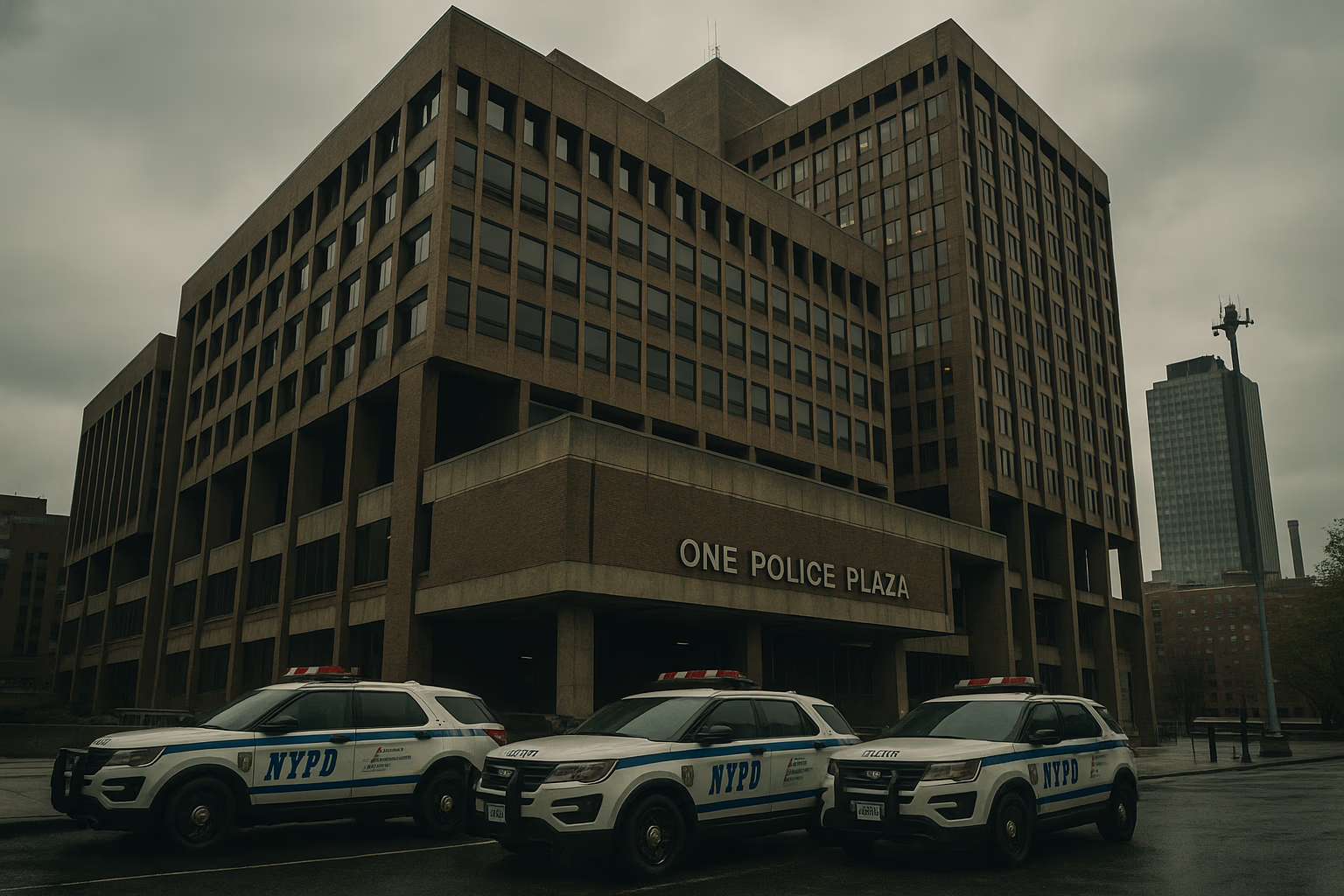
NYC Paid $117M in Police Misconduct Settlements in 2025
NYC paid $117M to settle 1,044 police misconduct lawsuits in 2025. Learn your rights and how to file a claim.
NYC Paid $117M in Police Misconduct Settlements in 2025 — Read More →14 articles published in 2026
This archive contains every legal article published by Attorney Jason Tenenbaum and his team during 2026. Each article provides detailed analysis of New York court decisions, statutory developments, and procedural issues across personal injury, no-fault insurance, employment law, and related practice areas. The articles below are organized by month and draw on real case holdings from Nassau County District Court, Suffolk County courts, New York City Civil Court, and appellate courts throughout the state.
Attorney Tenenbaum has maintained this legal blog since 2008 as a public resource for attorneys, insurance professionals, and individuals seeking to understand how New York courts resolve specific legal disputes. Topics covered range from the prima facie case standard in no-fault litigation to workplace discrimination claims under the New York State Human Rights Law. Whether you are researching a procedural issue or evaluating the merits of a potential case, these articles provide the kind of substantive legal analysis that generic legal websites cannot offer.
The firm's blog has grown into one of the most comprehensive public archives of New York insurance and personal injury case law commentary. With over 2,353 published articles analyzing decisions from the Appellate Term, Appellate Division (Second Department), and Court of Appeals, this resource reflects more than 24 years of hands-on litigation experience. Attorney Tenenbaum has written over 1,000 appellate briefs, handled more than 100,000 no-fault insurance disputes, and recovered over $100 million in verdicts and settlements for clients throughout Nassau County, Suffolk County, Queens, Brooklyn, Manhattan, the Bronx, and Staten Island.
NYC paid $117M to settle 1,044 police misconduct lawsuits in 2025. Learn your rights and how to file a claim.
NYC Paid $117M in Police Misconduct Settlements in 2025 — Read More →
The Trump administration is rolling back the Biden-era independent contractor rule, dramatically impacting gig workers, rideshare drivers, and employment law in New York. Learn how these changes affect your rights and what steps to take.
Major Employment Law Changes in 2026: What the Gig Worker Rule Rollback Means for New York Workers — Read More →
Appellate Term reverses Civil Court, holding that an attorney's affirmation attesting to plaintiff's failure to appear at EUOs was sufficient despite a 'significant lapse in time.' Analysis of GC Chiropractic v State Farm.
EUO No-Show: Attorney Affirmation Sufficient Despite Time Lapse Between No-Shows and Execution — Read More →
Both the First and Second Departments have held that the priority of payment regulation under 11 NYCRR 65-3.15 is of no force or effect in no-fault arbitration proceedings. Analysis of Lam Quan v GEICO and Fill Rx v LM General.
Priority of Payment Regulation Has No Force in Arbitration: First and Second Departments Agree — Read More →
Appellate Division holds insurers need not issue a denial when a medical provider or injured person fails to respond to verification demands within 120 days. Analysis of Chapa Prods. v MVAIC (2026).
No Denial Required When Provider Fails to Respond to Verification Within 120 Days — Read More →
Practical guide on how to talk to a judge in New York courts. Proper forms of address, courtroom behavior, and tips from Long Island attorney Jason Tenenbaum. Call 516-750-0595.
How to Talk to a Judge in New York: What to Say, What to Avoid, and How to Present Yourself — Read More →
A 2026 NY Appellate Division ruling warns homeowners: signing loan modifications after the 6-year foreclosure statute expires can revive lenders' rights. Call 516-750-0595
WARNING: Don’t Sign That Loan Modification if Your Mortgage Foreclosure Statute of Limitations Has Expired — Read More →
NY appellate court affirms $5M verdict for childhood sexual abuse survivor under the Survivors Act. Learn your rights. Call 516-750-0595 for a free consultation.
$5 Million Verdict Affirmed for Childhood Sexual Abuse Survivor Under NY Survivors Act — Read More →
NY CPLR 2106 amendment eliminates notarized affidavits and certificates of conformity. Learn how this changes litigation practice. Call 516-750-0595.
CPLR § 2106 Amendment Eliminates Affidavit Notarization Requirement: What This Means for New York Litigation — Read More →
Insurance companies use Colossus software to lowball your injury claim. Learn how this system works and how a Long Island attorney can fight back. Call 516-750-0595.
How Insurance Companies Use Colossus Software to Undervalue Your Injury Claim — Read More →Showing 10 of 14 articles from 2026
Browse All ArticlesThe Law Office of Jason Tenenbaum has been publishing legal analysis on New York personal injury, no-fault insurance, and employment law since 2008. With over 2,353 articles spanning nearly two decades, this blog represents one of the most extensive public archives of New York insurance and personal injury case law commentary available anywhere online. Every article is written by practicing attorneys who handle these issues in court on a daily basis.
Frequently covered topics include the 30-day preclusion rule under Insurance Regulation 192, IME and EUO scheduling requirements, summary judgment motions under CPLR 3212, default judgment practice under CPLR 3215, fee schedule disputes, verification procedures, the serious injury threshold under Insurance Law Section 5102(d), causation defenses, and employment claims under Executive Law Section 296. The firm also covers developments in workers compensation subrogation, declaratory judgment actions, and appellate practice.
The firm serves clients throughout Long Island, including Nassau County, Suffolk County, Queens, Brooklyn, the Bronx, Manhattan, and Staten Island. If any article raises questions about your own legal situation, contact the office at (516) 750-0595 for a free, confidential case evaluation. No fee is charged unless the firm recovers compensation on your behalf.
New York operates one of the most complex court systems in the United States, and understanding its structure is essential for anyone involved in a legal dispute. The trial-level courts are divided by subject matter and monetary jurisdiction. The Supreme Court has unlimited monetary jurisdiction and hears most personal injury cases, commercial disputes, and equity matters. Despite its name, it is not the state's highest court — that role belongs to the Court of Appeals. The Civil Court of the City of New York handles claims up to $25,000 in the five boroughs, while the District Courts in Nassau and Suffolk Counties handle similar matters on Long Island. Small Claims Court provides an informal forum for claims under $10,000 in Civil Court and $5,000 in the Justice Courts.
The appellate structure adds additional layers of complexity. The Appellate Term hears appeals from lower courts, and its decisions on no-fault insurance and procedural issues are binding precedent for Civil Court and District Court judges across its jurisdiction. The Appellate Division, divided into four departments, hears appeals from Supreme Court and serves as the state's intermediate appellate court. The Second Department — which covers Long Island (Nassau and Suffolk Counties), Brooklyn (Kings County), Queens, Staten Island (Richmond County), Dutchess, Orange, Putnam, Rockland, and Westchester Counties — is particularly important for the topics covered in these articles. Its decisions on personal injury thresholds, insurance coverage, and procedural matters define the legal landscape for millions of New Yorkers.
No-fault insurance cases follow their own procedural track. Under Insurance Law Article 51 and its implementing regulations (11 NYCRR Part 65), insurers must pay or deny first-party benefits within 30 days of receiving proof of claim and all demanded verification. When disputes arise, they are typically resolved through mandatory arbitration before the American Arbitration Association under 11 NYCRR 65-4.2. Master arbitration provides a layer of appellate review, and either party can seek judicial review in court through an Article 75 proceeding. Attorney Tenenbaum has handled over 100,000 no-fault matters through arbitration and court proceedings, and his articles on this blog analyze the specific case holdings that shape day-to-day practice in this area.
Timing is everything in New York litigation. The general statute of limitations for personal injury is three years under CPLR 214(5), but exceptions abound. Medical malpractice claims must be filed within two years and six months under CPLR 214-a, with a discovery rule that may extend the deadline for foreign objects left in the body. Claims against municipalities and government entities require a Notice of Claim within 90 days of the incident under General Municipal Law Section 50-e, followed by a one-year-and-ninety-day statute of limitations. Workers' compensation claims must be filed within two years of the accident or last payment of compensation. Employment discrimination claims under the New York State Human Rights Law must generally be filed within three years, while federal claims under Title VII require an EEOC charge within 300 days.
In no-fault insurance practice, the deadlines are even more compressed. The eligible injured person must file an Application for Motor Vehicle No-Fault Benefits (NF-2) within 30 days of the accident. Health care providers must submit proof of claim within 45 days of the date services are rendered. Insurers must request verification within 15 business days of receiving a claim and must pay or deny within 30 days of receiving all verification. Failure to comply with these deadlines can have severe consequences: a provider who submits a late claim may be barred from recovery, while an insurer who fails to timely deny may be precluded from asserting most coverage defenses.
The articles in this 2026 archive examine how courts applied these rules in specific cases, providing practitioners and claimants with real-world guidance on how to navigate New York's procedural requirements. Each article cites actual court decisions and analyzes the reasoning behind the rulings, making this archive an invaluable resource for anyone involved in New York personal injury, insurance, or employment litigation. For case-specific advice, contact the Law Office of Jason Tenenbaum at (516) 750-0595 for a free consultation.
The Law Office of Jason Tenenbaum, P.C. is headquartered at 326 Walt Whitman Road, Suite C, Huntington Station, New York 11746, conveniently located in the heart of Long Island. The firm represents injured individuals and workers throughout Nassau County — including Hempstead, Garden City, Mineola, Great Neck, Manhasset, Freeport, Long Beach, Rockville Centre, Valley Stream, Westbury, Hicksville, Massapequa, and Levittown — and Suffolk County — including Babylon, Islip, Brookhaven, Smithtown, Riverhead, Southampton, East Hampton, and Huntington. Attorney Tenenbaum also represents clients in all five boroughs of New York City, regularly appearing in Nassau County Supreme Court, Suffolk County Supreme Court, the New York City Civil Court, and American Arbitration Association hearing facilities throughout the greater metropolitan area. Every consultation is free and confidential, and no attorney fees are charged unless the firm recovers compensation on your behalf.
Injured? Don't Wait.
Get Your Free Case Evaluation Today
No fees unless we win — available 24/7 for emergencies.