Key Takeaway
Discover the 5 most common premises liability claims in NYC. From slip and falls to security issues, learn what property owners must know in 2025.
This article is part of our ongoing premises liability coverage, with 8 published articles analyzing premises liability issues across New York State. Attorney Jason Tenenbaum brings 24+ years of hands-on experience to this analysis, drawing from his work on more than 1,000 appeals, over 100,000 no-fault cases, and recovery of over $100 million for clients throughout Nassau County, Suffolk County, Queens, Brooklyn, Manhattan, and the Bronx. For personalized legal advice about how these principles apply to your specific situation, contact our Long Island office at (516) 750-0595 for a free consultation.
 Introduction
Slips, trips, and falls send over 1 million people to emergency rooms annually in New York. Premises liability—a property owner’s legal responsibility for injuries occurring on their property—extends far beyond legal jargon. It’s about accountability. Whether you’re a landlord, business owner, or visitor, understanding these claims could prevent devastating financial consequences. The Law Office of Jason Tenenbaum, P.C. has handled hundreds of premises liability cases across NYC. Here are the five most common claims we encounter.
The Legal Landscape in New York
New York’s premises liability laws center on one core principle: reasonable care. Property owners must maintain safe conditions for invitees (like customers) and licensees (social guests), though protections for trespassers remain limited. Plaintiffs must prove:
- A dangerous condition existed
- The owner knew or should have known about it
- The hazard directly caused injury
New York’s comparative negligence rule can reduce your compensation if you’re partially at fault. Miss a “Wet Floor” sign? That might shrink your settlement. More information on comparative negligence can be found on the New York Courts website.
#1 Slip and Fall Accidents (35% of Our Cases)
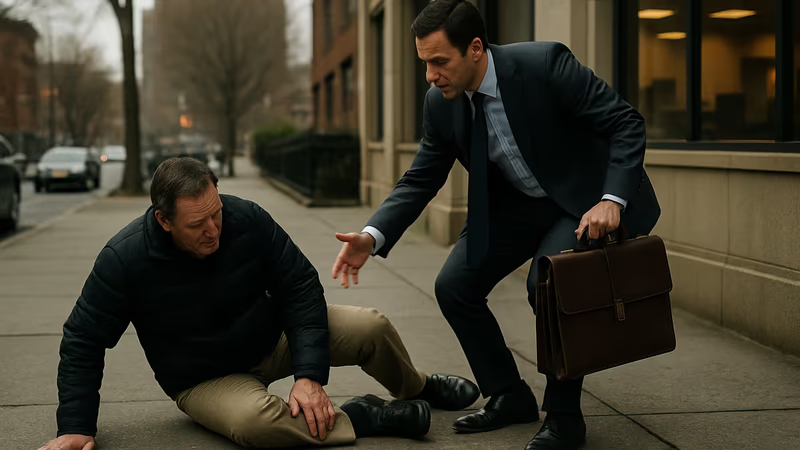
The classic icy sidewalk or grocery store puddle claim dominates NYC court dockets. Last winter alone, seven clients suffered injuries on uncleared Queens walkways. Key triggers include:
- Wet floors without signage
- Uneven pavement (those notorious NYC potholes!)
- Dimly lit stairwells
One client slipped on an unmarked spill in a Bronx bodega—her $145k settlement shows why prompt evidence collection matters. Property owners should document maintenance logs religiously. Resources from the National Safety Council highlight slip and fall prevention strategies.
#2 Inadequate Security (Rising in Urban Areas)
A Manhattan parking garage assault made headlines last month, highlighting a troubling trend. Property owners must provide reasonable security in high-crime zones. We typically see:
- Poorly lit apartment complex hallways
- Broken lobby locks in Brooklyn buildings
- Absent security in nightclubs
A recent client won $500k after an attack in a Queens building with three prior police reports. The owner ignored foreseeable risks completely.
#3 Defective Stairs and Handrails (The Silent Hazard)
Something as simple as a handrail can become lethal. NYC building codes mandate strict stair safety, yet violations persist:
- Wobbly or missing handrails
- Steps with inconsistent heights
- Decaying wooden stairs in brownstones
We handled a case where a tenant fell down rotted steps owned by a negligent landlord. The jury awarded $220k. Landlords must inspect those staircases quarterly!
#4 Falling Objects & Structural Collapses (Unexpected Dangers)
Ceiling tiles crashing down represents a legitimate concern. Claims spike after heavy snow or in aging buildings. Common scenarios include:
- Collapsing store shelving units
- Construction debris from overhead work
- Ceiling cave-ins in neglected apartments
A Williamsburg café paid $90k last year when faulty ductwork fell on a patron. Regular inspections aren’t optional.
#5 Elevator/Escalator Malfunctions (Mechanical Nightmares)
Elevator accidents in high-rises prove particularly terrifying. NYC requires monthly inspections, yet failures persist due to:
- Misleveling elevator cars
- Sudden escalator jerks and stops
- Entrapment incidents“`html
We represented a doorman trapped for hours in a faulty elevator—the case settled for $175k. Property owners shouldn’t skip maintenance contracts! The Department of Buildings provides guidelines for elevator safety.
Building Your Case: Practical Steps
If you suffer an injury:
- Document everything—photos, witness contacts, incident reports.
- Seek medical care immediately (records prove injury severity).
- Report to property owners—this creates a paper trail.
- Don’t delay! NY’s statute of limitations gives just 3 years to file.
Why Legal Help Matters
Insurance companies routinely lowball victims. A major retailer offered one client $15k for a fractured hip, but we fought for $200k. Experts like engineers or security consultants often make the difference between winning and losing.
Conclusion
Safe properties don’t happen by accident—they result from diligent ownership. If you’ve suffered an injury due to negligence, remember: You don’t pay unless we win your case. The Law Office of Jason Tenenbaum, P.C. combines 20+ years of NYC premises liability experience with personalized advocacy.
Act Now: Injured in NYC? Call (516)-750-0595 for a free consultation. Let our expertise guide your recovery.
Related Articles
Legal Context
Why This Matters for Your Case
New York law is among the most complex and nuanced in the country, with distinct procedural rules, substantive doctrines, and court systems that differ significantly from other jurisdictions. The Civil Practice Law and Rules (CPLR) governs every stage of civil litigation, from service of process through trial and appeal. The Appellate Division, Appellate Term, and Court of Appeals create a rich and ever-evolving body of case law that practitioners must follow.
Attorney Jason Tenenbaum has practiced across these areas for over 24 years, writing more than 1,000 appellate briefs and publishing over 2,353 legal articles that attorneys and clients rely on for guidance. The analysis in this article reflects real courtroom experience — from motion practice in Civil Court and Supreme Court to oral arguments before the Appellate Division — and a deep understanding of how New York courts actually apply the law in practice.
Keep Reading
More Premises Liability Analysis
What to Do After a Winter Slip and Fall Accident in NYC & Long Island
Injured in a winter slip and fall in NYC or Long Island? Learn what to do, who is liable, and how a personal injury lawyer can help. Call 516-750-0595.
Feb 14, 2026
Averting Premises Liability Traps in New York
Learn essential strategies to avoid costly premises liability traps in New York. Discover legal frameworks, maintenance tips, and prevention methods for property owners.
Aug 28, 2025
Trip and Fall in NY: What’s Your Case Really Worth?
Learn what trip and fall cases are worth in NY. Real settlement data, factors affecting compensation, and how to evaluate your premises liability claim.
Aug 22, 2025
Long Island Elevator Laws
Nassau and Suffolk County elevator safety laws, inspection requirements, and liability rules for Long Island property owners and injury victims.
Aug 11, 2025
NYC Elevator Accidents: Who Pays When Cables Snap?
Learn who's liable when NYC elevator cables snap, from building owners to maintenance companies. Understanding your rights after elevator accidents in New York.
Aug 7, 2025
Premises Liability: Property Owners’ Hidden Responsibilities
Premises liability laws establish property owners' responsibility to maintain safe conditions or warn of hazards.
Feb 3, 2025Common Questions
Frequently Asked Questions
What must I prove in a premises liability case in New York?
You must prove the property owner had actual or constructive notice of a dangerous condition, failed to take reasonable steps to fix it, and that the condition caused your injury. Constructive notice exists when the condition was visible, apparent, and existed for a sufficient length of time that the owner should have discovered it.
What is the "open and obvious" doctrine in New York premises liability?
In New York, the open and obvious nature of a hazard does not automatically absolve the property owner. Unlike some states, New York treats the obviousness of a condition as a factor in comparative negligence, not as a complete defense. The property owner still has a duty to maintain safe premises.
What is the deadline to sue for a slip and fall in New York?
The statute of limitations for a premises liability lawsuit is 3 years from the date of injury (CPLR §214). For claims against municipalities, you must file a notice of claim within 90 days under GML §50-e. Acting quickly to document conditions and preserve evidence is critical.
Was this article helpful?

About the Author
Jason Tenenbaum, Esq.
Jason Tenenbaum is the founding attorney of the Law Office of Jason Tenenbaum, P.C., headquartered at 326 Walt Whitman Road, Suite C, Huntington Station, New York 11746. With over 24 years of experience since founding the firm in 2002, Jason has written more than 1,000 appeals, handled over 100,000 no-fault insurance cases, and recovered over $100 million for clients across Long Island, Nassau County, Suffolk County, Queens, Brooklyn, Manhattan, the Bronx, and Staten Island. He is one of the few attorneys in the state who both writes his own appellate briefs and tries his own cases.
Jason is admitted to practice in New York, New Jersey, Florida, Texas, Georgia, and Michigan state courts, as well as multiple federal courts. His 2,353+ published legal articles analyzing New York case law, procedural developments, and litigation strategy make him one of the most prolific legal commentators in the state. He earned his Juris Doctor from Syracuse University College of Law.
Disclaimer: This article is published by the Law Office of Jason Tenenbaum, P.C. for informational and educational purposes only. It does not constitute legal advice, and no attorney-client relationship is formed by reading this content. The legal principles discussed may not apply to your specific situation, and the law may have changed since this article was last updated.
New York law varies by jurisdiction — court decisions in one Appellate Division department may not be followed in another, and local court rules in Nassau County Supreme Court differ from those in Suffolk County Supreme Court, Kings County Civil Court, or Queens County Supreme Court. The Appellate Division, Second Department (which covers Long Island, Brooklyn, Queens, and Staten Island) and the Appellate Term (which hears appeals from lower courts) each have distinct procedural requirements and precedents that affect litigation strategy.
If you need legal help with a premises liability matter, contact our office at (516) 750-0595 for a free consultation. We serve clients throughout Long Island (Huntington, Babylon, Islip, Brookhaven, Smithtown, Riverhead, Southampton, East Hampton), Nassau County (Hempstead, Garden City, Mineola, Great Neck, Manhasset, Freeport, Long Beach, Rockville Centre, Valley Stream, Westbury, Hicksville, Massapequa), Suffolk County (Hauppauge, Deer Park, Bay Shore, Central Islip, Patchogue, Brentwood), Queens, Brooklyn, Manhattan, the Bronx, Staten Island, and Westchester County. Prior results do not guarantee a similar outcome.