Key Takeaway
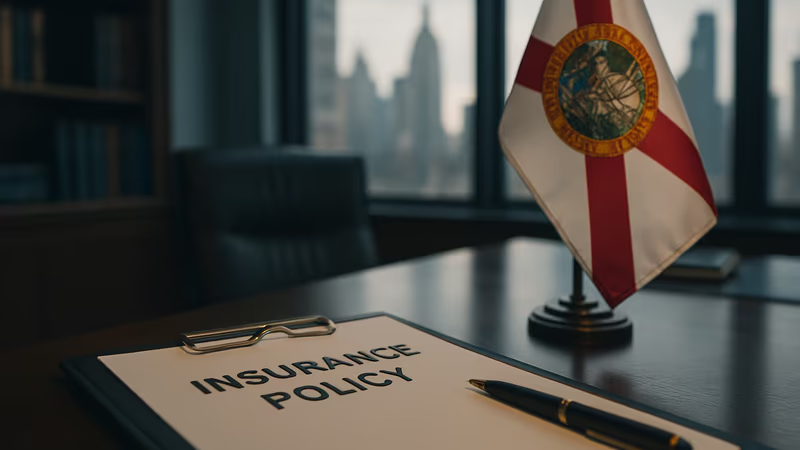
Florida insurance policy rescission requirements under state law - notice to insured and premium return mandates for valid ab initio rescission in New York courts.
This article is part of our ongoing choice of law coverage, with 35 published articles analyzing choice of law issues across New York State. Attorney Jason Tenenbaum brings 24+ years of hands-on experience to this analysis, drawing from his work on more than 1,000 appeals, over 100,000 no-fault cases, and recovery of over $100 million for clients throughout Nassau County, Suffolk County, Queens, Brooklyn, Manhattan, and the Bronx. For personalized legal advice about how these principles apply to your specific situation, contact our Long Island office at (516) 750-0595 for a free consultation.
Choice of law principles in insurance litigation can dramatically affect the substantive rights of parties, particularly when an insurance policy issued in one state becomes the subject of litigation in another jurisdiction. New York courts regularly encounter automobile insurance policies issued under Florida law when Florida-registered vehicles are involved in accidents occurring in New York. The application of Florida insurance law in New York courts requires careful attention to Florida statutory requirements, which may differ significantly from New York’s regulatory framework governing insurance rescission and policy cancellation.
409 permits retroactive rescission of insurance policies under certain circumstances, a remedy that allows insurers to void coverage ab initio as if the policy never existed. This differs from prospective cancellation, which terminates coverage going forward but acknowledges the policy’s validity up to the cancellation date. The distinction is critical because ab initio rescission eliminates the insurer’s obligation to provide coverage for claims arising during the policy period, whereas cancellation leaves intact the insurer’s obligations for pre-cancellation occurrences.
However, Florida law imposes specific procedural requirements on insurers seeking to rescind policies, and failure to comply with these requirements renders the rescission ineffective.
The requirements for valid policy rescission under Florida law serve important consumer protection functions. By mandating notice to the insured and return of all premiums paid, Florida law ensures that policyholders are not left without coverage retroactively while the insurer retains the benefit of premiums received. When New York courts apply Florida law pursuant to choice of law analysis, they enforce these Florida statutory requirements even when litigating in New York forums.
Medical providers seeking first-party no-fault benefits under Florida policies must therefore understand both the substantive grounds for rescission under Florida law and the procedural prerequisites that Florida law imposes.
Case Background
In NR Acupuncture, P.C. v Ocean Harbor Casualty Insurance Company, the plaintiff medical provider sought payment for no-fault benefits under a Florida automobile insurance policy issued to a patient who had been treated following a motor vehicle accident. The defendant insurer moved for summary judgment, arguing that it had properly rescinded the policy ab initio pursuant to Florida Statutes Annotated Section 627.409 based on material misrepresentations in the insurance application.
The insurer’s investigation revealed that when the policyholder applied for automobile insurance, she had provided a Florida address as her residence and stated that the insured vehicle was garaged at that Florida location. Post-accident investigation demonstrated that the policyholder did not actually reside at the Florida address listed on the application and that the vehicle was not garaged at that address. Based on these material misrepresentations, the insurer purported to rescind the policy retroactively, denying coverage for the accident that had already occurred.
The plaintiff medical provider opposed the summary judgment motion, arguing that the insurer had failed to comply with Florida’s statutory requirements for valid rescission. The Appellate Term was required to determine whether the insurer had demonstrated compliance with Florida Statutes Annotated Section 627.728, which governs the procedural requirements for policy rescission.
Jason Tenenbaum’s Analysis
NR Acupuncture, P.C. v Ocean Harbor Cas. Ins. Co., 2019 NY Slip Op 51892(U)(App. Term 2d Dept. 2019)
“It is uncontroverted that the vehicle involved in the accident was insured by defendant under a Florida automobile insurance policy. According to the affidavit submitted by an employee of defendant’s managing agent, an investigation conducted after the accident revealed that, at the time the policyholder applied for automobile insurance, she did not reside at the Florida address listed on her application, and that the insured vehicle was not garaged at that Florida address. Thereafter, defendant purportedly rescinded the policy ab initio, pursuant to [*2]Florida Statutes Annotated § 627.409, which permits the retroactive rescission of an insurance policy.
In order to demonstrate that an automobile insurance policy has been properly rescinded ab initio in accordance with Florida law, an insurer must demonstrate that it gave notice of the rescission to the insured and that it returned, or tendered, all paid premiums within a reasonable time after the discovery of the grounds for avoiding the policy (see Fla Stat Ann § 627.728 ; Leonardo v State Farm Fire and Cas. Co., 675 So 2d 176, 179 ; see also United Auto. Ins. Co. v Salgado, 22 So 3d 594, 600-601 ). Here, defendant’s motion papers failed to demonstrate that it had provided the insured with notice of the rescission, and defendant admitted that it had not returned all of the paid premiums to the insured. “
Legal Significance
The Appellate Term’s decision in NR Acupuncture reinforces the principle that procedural compliance with applicable statutory requirements is essential to effectuating policy rescission, even when substantive grounds for rescission exist. The court’s holding demonstrates that material misrepresentation in an insurance application, while providing grounds for rescission under Florida Statutes Annotated Section 627.409, does not alone suffice to void coverage. The insurer must also satisfy the procedural mandates of Florida Statutes Annotated Section 627.728, including providing notice to the insured and returning all premiums paid.
The decision places a significant evidentiary burden on insurers moving for summary judgment on rescission grounds. It is not sufficient for the insurer to establish that material misrepresentations were made in the application; the insurer must also produce proof that it provided timely notice of rescission to the insured and either returned or tendered return of all premiums within a reasonable time after discovering the grounds for rescission. This burden allocation recognizes that the insurer has superior access to evidence regarding its own actions in providing notice and handling premium refunds.
The court’s strict application of Florida’s procedural requirements serves important policy interests. Requiring actual notice to the insured ensures that policyholders are aware that they lack coverage and can seek alternative insurance. Requiring premium return ensures that insurers do not unjustly enrich themselves by retaining premiums for policies they claim never provided coverage. Together, these requirements create a balanced framework that protects insurers from fraudulent applications while preventing insurers from disclaiming coverage retroactively without making policyholders whole for premiums paid.
Practical Implications
Insurance carriers defending no-fault claims under Florida policies must meticulously document compliance with all procedural requirements when pursuing rescission remedies. This documentation should include proof of mailing or delivery of rescission notices to the insured, the date of such notice, and evidence of premium refund or tender of refund with the timeframe measured from discovery of the misrepresentation. Failure to maintain and produce this documentation will defeat summary judgment motions even when material misrepresentations are clearly established.
Medical providers challenging rescission defenses should scrutinize the insurer’s proof of procedural compliance with Florida law. Even when the underlying grounds for rescission appear strong, lack of proper notice or failure to return premiums renders the rescission ineffective. Discovery demands should specifically seek documents establishing when the insurer first learned of the alleged misrepresentation, when notice was sent to the insured, to what address notice was sent, and when and how premiums were returned.
The decision also highlights the importance of choice of law analysis at the outset of no-fault litigation. When a policy is issued under Florida law, practitioners must research and apply Florida statutory requirements rather than assuming New York law governs. The specific procedural requirements for rescission vary among states, and misapplication of law can result in incorrect legal conclusions regarding coverage validity.
Related Articles
- Understanding Pennsylvania insurance law when applied in New York courts
- How Florida choice of law applies in New York no-fault insurance cases
- A comprehensive primer on Florida insurance law
- Understanding choice of law principles in multi-state personal injury cases
- Interstate insurance law complications in New York personal injury cases
Legal Context
Why This Matters for Your Case
New York law is among the most complex and nuanced in the country, with distinct procedural rules, substantive doctrines, and court systems that differ significantly from other jurisdictions. The Civil Practice Law and Rules (CPLR) governs every stage of civil litigation, from service of process through trial and appeal. The Appellate Division, Appellate Term, and Court of Appeals create a rich and ever-evolving body of case law that practitioners must follow.
Attorney Jason Tenenbaum has practiced across these areas for over 24 years, writing more than 1,000 appellate briefs and publishing over 2,353 legal articles that attorneys and clients rely on for guidance. The analysis in this article reflects real courtroom experience — from motion practice in Civil Court and Supreme Court to oral arguments before the Appellate Division — and a deep understanding of how New York courts actually apply the law in practice.
About This Topic
Choice of Law in New York Insurance & Injury Cases
When an accident or insurance dispute involves multiple states, New York courts must determine which state's law governs the claim. Choice-of-law analysis in New York uses an interest analysis approach for tort claims and a grouping-of-contacts test for contract-based insurance disputes. The choice between New York and another state's law can dramatically affect the outcome — particularly regarding no-fault thresholds, damage caps, and procedural requirements. These articles examine the analytical framework New York courts apply to resolve choice-of-law disputes.
35 published articles in Choice of law
Keep Reading
More Choice of law Analysis

Choice of law?
Court applies New York no-fault law over New Jersey law based on most significant relationship test, despite accident occurring in New Jersey.
Mar 17, 2021
Retroactive rescission
A Florida choice of law analysis leads to successful retroactive rescission, highlighting the importance of understanding different state laws in no-fault insurance cases.
Sep 25, 2020
New Jersey law bars most of Plaintiff's recovery in this PIP subrogation action
New Jersey law significantly limited subrogation recovery in this PIP case involving cross-border accident, workers' compensation, and no-fault benefits under choice of law...
Jun 17, 2011
VA substantive law; NY Procedural law
New York courts apply substantive law from other states but use NY procedural law, as shown in this GEICO case involving Virginia insurance law and mailing requirements.
Jul 21, 2018
AAA is licensed to transact business in NY – and recission not allowed
NY court rules AAA Michigan must follow NY law despite out-of-state status, blocking policy rescission to protect innocent third parties in no-fault claims.
May 3, 2016
Fraudulent prcourement defnese
Pennsylvania insurance policy rescission defense fails against innocent third parties in NY courts. Choice of law typically favors vehicle registration state in cross-border...
Mar 19, 2015Common Questions
Frequently Asked Questions
How do New York courts decide which state's law applies?
New York follows an 'interest analysis' approach to choice-of-law questions, examining which jurisdiction has the greatest interest in having its law applied. In insurance and personal injury cases, relevant factors include where the accident occurred, where the policy was issued, where the insured resides, and where the insurer is domiciled. Choice-of-law issues frequently arise in cross-border accidents and when out-of-state insurance policies cover New York accidents.
Was this article helpful?

About the Author
Jason Tenenbaum, Esq.
Jason Tenenbaum is the founding attorney of the Law Office of Jason Tenenbaum, P.C., headquartered at 326 Walt Whitman Road, Suite C, Huntington Station, New York 11746. With over 24 years of experience since founding the firm in 2002, Jason has written more than 1,000 appeals, handled over 100,000 no-fault insurance cases, and recovered over $100 million for clients across Long Island, Nassau County, Suffolk County, Queens, Brooklyn, Manhattan, the Bronx, and Staten Island. He is one of the few attorneys in the state who both writes his own appellate briefs and tries his own cases.
Jason is admitted to practice in New York, New Jersey, Florida, Texas, Georgia, and Michigan state courts, as well as multiple federal courts. His 2,353+ published legal articles analyzing New York case law, procedural developments, and litigation strategy make him one of the most prolific legal commentators in the state. He earned his Juris Doctor from Syracuse University College of Law.
Disclaimer: This article is published by the Law Office of Jason Tenenbaum, P.C. for informational and educational purposes only. It does not constitute legal advice, and no attorney-client relationship is formed by reading this content. The legal principles discussed may not apply to your specific situation, and the law may have changed since this article was last updated.
New York law varies by jurisdiction — court decisions in one Appellate Division department may not be followed in another, and local court rules in Nassau County Supreme Court differ from those in Suffolk County Supreme Court, Kings County Civil Court, or Queens County Supreme Court. The Appellate Division, Second Department (which covers Long Island, Brooklyn, Queens, and Staten Island) and the Appellate Term (which hears appeals from lower courts) each have distinct procedural requirements and precedents that affect litigation strategy.
If you need legal help with a choice of law matter, contact our office at (516) 750-0595 for a free consultation. We serve clients throughout Long Island (Huntington, Babylon, Islip, Brookhaven, Smithtown, Riverhead, Southampton, East Hampton), Nassau County (Hempstead, Garden City, Mineola, Great Neck, Manhasset, Freeport, Long Beach, Rockville Centre, Valley Stream, Westbury, Hicksville, Massapequa), Suffolk County (Hauppauge, Deer Park, Bay Shore, Central Islip, Patchogue, Brentwood), Queens, Brooklyn, Manhattan, the Bronx, Staten Island, and Westchester County. Prior results do not guarantee a similar outcome.