Why Trust This Analysis
This article is part of our ongoing coverage coverage, with 150 published articles analyzing coverage issues across New York State. Attorney Jason Tenenbaum brings 24+ years of hands-on experience to this analysis, drawing from his work on more than 1,000 appeals, over 100,000 no-fault cases, and recovery of over $100 million for clients throughout Nassau County, Suffolk County, Queens, Brooklyn, Manhattan, and the Bronx. For personalized legal advice about how these principles apply to your specific situation, contact our Long Island office at (516) 750-0595 for a free consultation.
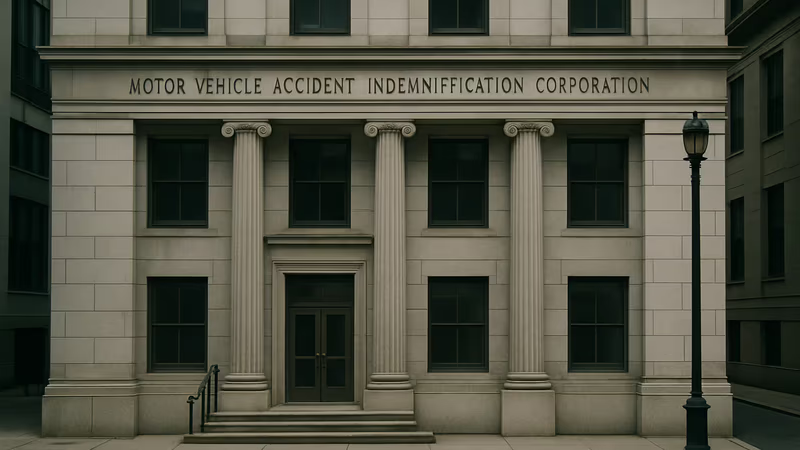
The Motor Vehicle Accident Indemnification Corporation (MVAIC) serves as New York’s safety net for no-fault insurance coverage when traditional insurance isn’t available. However, MVAIC cases often involve complex procedural requirements that can trap unwary practitioners. A recent Appellate Term decision highlights ongoing confusion around the “exhaustion of remedies” requirement — a procedural hurdle that has created a split between different judicial departments.
This jurisdictional divide has significant practical implications for attorneys handling New York No-Fault Insurance Law cases. Understanding which department’s precedent applies can mean the difference between a successful claim and a dismissed case based on procedural grounds.
Jason Tenenbaum’s Analysis:
JJ & R Chiropractic PC v MVAIC, 2019 NY Slip Op 51559(U)(App. Term 1st Dept. 2019)
” efendant MVAIC failed in its burden to establish, prima facie, that plaintiff’s assignor was not a “qualified person” entitled to no-fault coverage (see Socrates Med. Health, P.C. v MVAIC, 29 Misc 3d 129, 2010 NY Slip Op 51780 ). Nor has defendant established that plaintiff was required to “exhaust its remedies” against the vehicle’s owner prior to commencing this action”
Free Consultation · No Fee Unless We Win
Does this apply to your situation?
Every case is different. Get a free, confidential case review from an experienced attorney who can tell you exactly where you stand.
For some reason, I do not find MVAIC issues blog worthy. Perhaps it is because I do not deal with them frequently. But the exhaustion of remedies has caused a department split in the Appellate Terms. I take MVAIC will leave this alone since the majority of their cases take place in the Second Department, which has historically been more receptive to MVAIC’s “coverage” issue analysis.
Legal Significance
The exhaustion of remedies doctrine typically requires plaintiffs to pursue all available remedies against primary sources before seeking recovery from secondary or backup sources. In the MVAIC context, this doctrine would require medical providers to exhaust remedies against vehicle owners or operators before pursuing claims against MVAIC as the insurer of last resort.
The First Department’s rejection of this requirement in JJ & R Chiropractic creates significant practical benefits for providers. Rather than pursuing potentially judgment-proof vehicle owners or uninsured operators—often a futile exercise—providers can proceed directly against MVAIC when the circumstances warrant coverage. This streamlines recovery and prevents the waste of judicial resources on collection efforts against defendants with no ability to pay.
However, the Second Department has taken a different view in other cases, requiring providers to demonstrate exhaustion before MVAIC coverage attaches. This split creates forum shopping opportunities and strategic venue considerations. Cases filed in counties within the First Department’s jurisdiction benefit from the more provider-friendly exhaustion standard, while Second Department cases face stricter exhaustion requirements.
The split also reflects different judicial philosophies about MVAIC’s role. The First Department views MVAIC as a true safety net that should be accessible when insurance is genuinely unavailable, without requiring plaintiffs to jump through exhaustion hoops. The Second Department takes a more restrictive view, treating MVAIC as a last resort that should only be accessed after all other avenues have been pursued and proven fruitless.
Practical Implications
For plaintiff attorneys, this decision creates strategic venue opportunities. When representing medical providers seeking MVAIC coverage, filing in First Department counties avoids exhaustion defenses. This is particularly valuable when the underlying vehicle owner or operator is judgment-proof or cannot be located for service.
For MVAIC defense counsel, the decision limits available defenses in First Department cases. Without the exhaustion requirement, MVAIC must focus on substantive coverage defenses—whether the claimant qualifies as a “qualified person” under the statute, whether proper notice was provided, and whether the accident meets MVAIC coverage criteria.
The decision also affects case valuation and settlement negotiations. In Second Department cases, exhaustion requirements add procedural hurdles that may encourage settlement or create opportunities for dismissal. In First Department cases, the absence of exhaustion requirements means cases proceed more directly to merits determinations, potentially affecting settlement value.
Key Takeaway
The First Department rejected MVAIC’s exhaustion of remedies defense, creating a split with the Second Department’s approach. This jurisdictional divide means attorneys must carefully consider venue selection in MVAIC cases, as different departments apply varying standards to procedural requirements and coverage defenses. The First Department’s provider-friendly approach eliminates the requirement to pursue futile collection efforts against judgment-proof defendants before accessing MVAIC coverage, while the Second Department maintains stricter exhaustion requirements that favor MVAIC’s position as insurer of last resort.
Related Articles
Legal Context
Why This Matters for Your Case
New York law is among the most complex and nuanced in the country, with distinct procedural rules, substantive doctrines, and court systems that differ significantly from other jurisdictions. The Civil Practice Law and Rules (CPLR) governs every stage of civil litigation, from service of process through trial and appeal. The Appellate Division, Appellate Term, and Court of Appeals create a rich and ever-evolving body of case law that practitioners must follow.
Attorney Jason Tenenbaum has practiced across these areas for over 24 years, writing more than 1,000 appellate briefs and publishing over 2,600 legal articles that attorneys and clients rely on for guidance. The analysis in this article reflects real courtroom experience — from motion practice in Civil Court and Supreme Court to oral arguments before the Appellate Division — and a deep understanding of how New York courts actually apply the law in practice.
About This Topic
Insurance Coverage Issues in New York
Coverage disputes determine whether an insurance policy provides benefits for a particular claim. In the no-fault context, coverage questions involve policy inception, named insured status, vehicle registration requirements, priority of coverage among multiple insurers, and the applicability of exclusions. These articles examine how New York courts resolve coverage disputes, the burden of proof on coverage defenses, and the interplay between regulatory requirements and policy language.
150 published articles in Coverage
Keep Reading
More Coverage Analysis

IME no-show is a policy defense triggering the hourly attorney fee provision
Learn how IME no-show defenses trigger hourly attorney fee provisions in NY no-fault insurance. Court rules failure to attend IME is policy defense.
May 22, 2021
Contractual deemer
New York courts examine when out-of-state insurers can avoid no-fault coverage obligations through contractual deemer provisions and policy language analysis.
Apr 24, 2021
Staged accident not proven
Court rules insurance company failed to prove staged accident claims due to inadmissible evidence and lack of personal knowledge in NY no-fault case.
May 10, 2016
Reargument granted and complaint dismissed under PA law
New York court applies Pennsylvania insurance law to dismiss no-fault benefits claim where injured party was complicit in insurance fraud scheme.
Aug 13, 2014
Just a bad decision
Court rules insurer cannot modify no-fault judgment after losing summary judgment motion - defendant's belated policy limit defense fails procedural requirements.
Mar 30, 2011
Affirmed, Reversed, and Modified on Summary Judgment: Key Causation Lessons
Valentin v Pomilla: why unanswered degenerative findings defeated causation proof, with later Perl guidance and the 2026 serious-injury change.
Jan 25, 2009Was this article helpful?
Disclaimer: This article is published by the Law Office of Jason Tenenbaum, P.C. for informational and educational purposes only. It does not constitute legal advice, and no attorney-client relationship is formed by reading this content. The legal principles discussed may not apply to your specific situation, and the law may have changed since this article was last updated.
New York law varies by jurisdiction — court decisions in one Appellate Division department may not be followed in another, and local court rules in Nassau County Supreme Court differ from those in Suffolk County Supreme Court, Kings County Civil Court, or Queens County Supreme Court. The Appellate Division, Second Department (which covers Long Island, Brooklyn, Queens, and Staten Island) and the Appellate Term (which hears appeals from lower courts) each have distinct procedural requirements and precedents that affect litigation strategy.
If you need legal help with a coverage matter, contact our office at (516) 750-0595 for a free consultation. We serve clients throughout Long Island (Huntington, Babylon, Islip, Brookhaven, Smithtown, Riverhead, Southampton, East Hampton), Nassau County (Hempstead, Garden City, Mineola, Great Neck, Manhasset, Freeport, Long Beach, Rockville Centre, Valley Stream, Westbury, Hicksville, Massapequa), Suffolk County (Hauppauge, Deer Park, Bay Shore, Central Islip, Patchogue, Brentwood), Queens, Brooklyn, Manhattan, the Bronx, Staten Island, and Westchester County. Prior results do not guarantee a similar outcome.