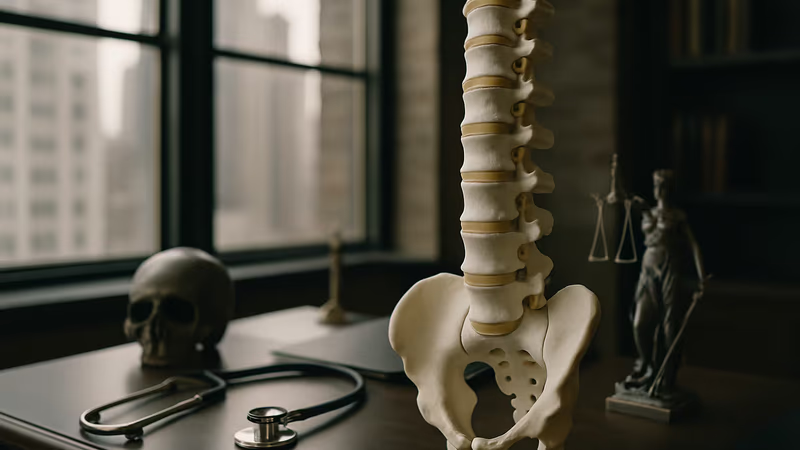
Key Takeaway
Learn how pre-existing conditions affect NY personal injury cases. Expert legal guidance for Long Island accidents. Call 516-750-0595 for free consultation.
This article is part of our ongoing causation coverage, with 51 published articles analyzing causation issues across New York State. Attorney Jason Tenenbaum brings 24+ years of hands-on experience to this analysis, drawing from his work on more than 1,000 appeals, over 100,000 no-fault cases, and recovery of over $100 million for clients throughout Nassau County, Suffolk County, Queens, Brooklyn, Manhattan, and the Bronx. For personalized legal advice about how these principles apply to your specific situation, contact our Long Island office at (516) 750-0595 for a free consultation.
Understanding Pre-Existing Injuries in New York Personal Injury Claims
If you’ve been injured in an accident in New York but had pre-existing medical conditions, you may wonder whether you can still pursue a personal injury claim. The landmark case Dixon v Kone, 2019 NY Slip Op 02041 (1st Dept, 2019) provides crucial insight into how New York courts handle these complex situations.
The Dixon v Kone Case: A Critical Precedent
In Dixon v Kone, the plaintiff had previously undergone fusion surgery in his cervical spine and had significant degenerative disc disease that was documented in MRIs and CT scans performed seven years before the accident. The defendants successfully argued that the plaintiff’s current symptoms were related to these pre-existing conditions rather than the motor vehicle accident.
As the court noted: “Defendants submitted, among other things, plaintiff’s deposition testimony, acknowledging that he previously had fusion surgery in his cervical spine, and reports of their radiologist who, consistent with plaintiff’s own radiologists, found that MRIs and CT scans performed approximately seven years before the accident showed significant degenerative disc disease in his cervical and lumbar spine.”
The Expert Medical Opinion Requirement
The critical failing in the Dixon case was the plaintiff’s expert medical testimony. The court emphasized: “Although the physician acknowledged plaintiff’s prior surgery, preexisting degenerative conditions, and continuing pre-accident treatment, he failed to explain why plaintiff’s alleged injuries were not caused by the preexisting conditions, or to provide any basis for finding an aggravation of those injuries.”
How Pre-Existing Conditions Affect Your New York Personal Injury Case
The “Aggravation” Standard
In New York personal injury law, having a pre-existing condition doesn’t automatically bar you from recovery. However, you must prove that the accident either:
- Caused new, distinct injuries separate from your pre-existing condition
- Significantly aggravated or worsened your pre-existing condition
- Accelerated the progression of your pre-existing condition
This is where proper medical documentation and expert testimony become essential. Your attorney must work with medical experts who can clearly differentiate between your pre-accident condition and any changes caused by the incident.
Common Pre-Existing Conditions in Personal Injury Cases
Some of the most frequently encountered pre-existing conditions in New York personal injury cases include:
- Degenerative disc disease – As seen in Dixon v Kone
- Arthritis and joint problems
- Previous back or neck injuries
- Prior surgical procedures
- Chronic pain conditions
- Mental health conditions like depression or anxiety
Building a Strong Case Despite Pre-Existing Conditions
Essential Medical Evidence
To successfully pursue a personal injury claim with pre-existing conditions, your legal team must gather comprehensive medical evidence, including:
- Pre-accident medical records documenting your baseline condition
- Post-accident medical records showing changes in your condition
- Expert medical testimony explaining the connection between the accident and your current symptoms
- Imaging studies (MRIs, CT scans, X-rays) comparing before and after the incident
The Importance of Immediate Medical Attention
If you’re involved in an accident and have pre-existing conditions, seeking immediate medical attention is crucial. This creates a timeline that can help distinguish between your pre-existing symptoms and any new or worsened conditions caused by the accident.
New York No-Fault Insurance and Pre-Existing Conditions
New York’s no-fault insurance system adds another layer of complexity to cases involving pre-existing conditions. Under New York’s no-fault law, you’re entitled to basic economic benefits regardless of fault, but insurance companies often scrutinize claims involving pre-existing conditions more closely.
Threshold Injury Requirements
To pursue a lawsuit beyond no-fault benefits in New York, you must demonstrate a “serious injury” as defined by Insurance Law § 5102(d). Pre-existing conditions can complicate this determination, as insurance companies and defendants may argue that your limitations are due to your pre-existing condition rather than the accident.
Common Defense Strategies in Pre-Existing Condition Cases
Causation Challenges
Defense attorneys and insurance companies commonly employ several strategies when pre-existing conditions are involved:
- Arguing no new injury – Claiming all symptoms existed before the accident
- Minimizing accident severity – Suggesting the incident wasn’t significant enough to cause injury
- Highlighting gaps in treatment – Using treatment delays to argue against causation
- Emphasizing natural progression – Claiming worsening is due to age or disease progression
Medical Record Scrutiny
Defense teams will thoroughly examine your medical history, looking for evidence that contradicts your claims. This is why having experienced legal representation is essential – your attorney must be prepared to address these challenges proactively.
How an Experienced Personal Injury Attorney Can Help
When dealing with pre-existing conditions in a personal injury case, having skilled legal representation is crucial. An experienced attorney will:
- Work with qualified medical experts who can clearly explain the relationship between your accident and current condition
- Gather comprehensive medical evidence from before and after the accident
- Develop a clear timeline of your symptoms and treatment
- Counter defense arguments effectively with proper documentation and expert testimony
- Navigate no-fault insurance requirements and threshold injury determinations
Frequently Asked Questions
Can I still file a personal injury lawsuit if I have pre-existing conditions?
Yes, having pre-existing conditions doesn’t automatically prevent you from filing a lawsuit. However, you must be able to prove that the accident caused new injuries or significantly aggravated your existing conditions. The key is having proper medical documentation and expert testimony to establish this connection.
What if my pre-existing condition was asymptomatic before the accident?
If you had a pre-existing condition that wasn’t causing symptoms before the accident, you may have a stronger case. For example, if you had degenerative disc disease that wasn’t bothering you, but the accident caused it to become symptomatic, you could potentially recover damages.
How do insurance companies handle claims involving pre-existing conditions?
Insurance companies often scrutinize these claims more closely and may attempt to deny coverage by arguing that your current symptoms are related to your pre-existing condition rather than the accident. Having proper medical documentation and legal representation is essential to counter these arguments.
What’s the difference between aggravation and natural progression of a pre-existing condition?
Aggravation refers to worsening of a condition due to the accident, while natural progression is worsening that would have occurred anyway due to age or disease. Medical experts must be able to distinguish between these two scenarios to establish a valid claim.
How long do I have to file a lawsuit if I have pre-existing conditions?
New York’s statute of limitations for personal injury cases is generally three years from the date of the accident, regardless of whether you have pre-existing conditions. However, there may be exceptions, so it’s important to consult with an attorney promptly.
Taking Action: Next Steps for Your Case
If you’ve been injured in an accident and have pre-existing medical conditions, don’t let this discourage you from seeking the compensation you deserve. The key is working with experienced legal and medical professionals who understand how to build a strong case despite these challenges.
Remember that each case is unique, and what happened in Dixon v Kone doesn’t mean all cases involving pre-existing conditions will fail. With proper preparation, medical evidence, and legal representation, it’s possible to achieve a successful outcome even when dealing with complex medical histories.
The most important step is to act quickly. Medical evidence can deteriorate over time, and New York’s statute of limitations puts a firm deadline on when you can file your lawsuit.
Call 516-750-0595 for a free consultation with our experienced Long Island personal injury attorneys. We’ll review your case, help you understand your rights, and develop a strategy to pursue the compensation you deserve – regardless of any pre-existing conditions you may have.
Legal Update (February 2026): Since this post’s publication in 2019, New York Insurance Law § 5102 and related no-fault insurance provisions may have been amended, particularly regarding serious injury thresholds and medical documentation requirements for pre-existing condition cases. Additionally, appellate decisions subsequent to Dixon v Kone may have further refined the standards for expert medical testimony in cases involving pre-existing injuries. Practitioners should verify current statutory language and recent case law developments when handling similar causation issues.
Related Articles
How New York Pre-Existing Injuries & Causation Law Has Evolved
Verified February 2026This topic has been shaped by appellate rulings over many years. Explore the timeline below.
- Causation: Beware Seeking Trial de Novo After Arbitration
Early causation analysis — the risks of seeking trial de novo after an arbitrator affirms an award on causation grounds.
- Key Causation Lessons on Summary Judgment
Affirmed, reversed, and modified — key lessons from summary judgment rulings on causation in personal injury cases.
- Causation Requirements for Economic Loss Recovery
No-fault insurance causation requirements and economic loss recovery analyzed through Hartman, Jweid, and Overbaugh.
- Causation Defense Rebuffed
Subtle evidentiary failures doom a causation defense — illustrating the precision required to prove lack of causation.
- Defeating a Lack-of-Causation Motion: Knee Injury
Practical guidance on rebutting a lack-of-causation motion, with specific focus on knee injuries and medical evidence.
- Lack of Causation Proven via Biomechanical Study
Biomechanical analysis successfully establishes prima facie lack of causation — a defense tool gaining traction.
- Pre-Existing Injury Proof Not Refuted
Defendant establishes pre-existing injury; plaintiff fails to rebut — illustrating the burden-shifting framework.
- Pre-Existing Injuries: What You Need to Know
Hub article: comprehensive guide to the eggshell plaintiff rule, aggravation claims, and the specific medical evidence required to prove causation when pre-existing conditions are present.
Legal Context
Why This Matters for Your Case
New York law is among the most complex and nuanced in the country, with distinct procedural rules, substantive doctrines, and court systems that differ significantly from other jurisdictions. The Civil Practice Law and Rules (CPLR) governs every stage of civil litigation, from service of process through trial and appeal. The Appellate Division, Appellate Term, and Court of Appeals create a rich and ever-evolving body of case law that practitioners must follow.
Attorney Jason Tenenbaum has practiced across these areas for over 24 years, writing more than 1,000 appellate briefs and publishing over 2,353 legal articles that attorneys and clients rely on for guidance. The analysis in this article reflects real courtroom experience — from motion practice in Civil Court and Supreme Court to oral arguments before the Appellate Division — and a deep understanding of how New York courts actually apply the law in practice.
About This Topic
Causation in New York Personal Injury & No-Fault Law
Causation — proving that the defendant's negligence or the accident caused the plaintiff's injuries — is an essential element of every personal injury and no-fault claim. New York courts distinguish between proximate cause, intervening causes, and pre-existing conditions that may have been aggravated by an accident. The legal standards for establishing causation through medical evidence and the defenses available to challenge causal connection are analyzed in depth across these articles.
51 published articles in Causation
Keep Reading
More Causation Analysis

Collateral Estoppel?
Explore collateral estoppel: why default judgments don't preclude later suits & when courts can depart from other departments' rulings.
Sep 28, 2020
New York Personal Injury Law: Proving Causation in Accident Cases
Learn how to prove causation in NY personal injury cases. Expert analysis of Parisien v Allstate case and causation challenges. Call 516-750-0595.
Aug 10, 2019
Cessation of treatment/Pre-existing injuries/Commentary
NY court ruling on cessation of treatment and pre-existing injuries in personal injury cases. Analysis of burden shifting and causation requirements.
Mar 7, 2018
Contemporaneous medical records sufficient
Court ruling demonstrates how contemporaneous medical records can establish causation between accidents and injuries, with implications for no-fault insurance claims.
Dec 11, 2014
A 2007 causation case – affidavit insufficient
2007 New York case shows how conclusory medical expert affidavits fail to establish causation in personal injury claims, highlighting importance of substantive evidence.
Apr 27, 2011
Understanding Causal Relationship in New York Personal Injury Cases: Legal Guide
Learn how to prove causal relationship in New York personal injury cases. Expert legal guidance on causation challenges, medical evidence, and winning strategies. Call...
Jul 24, 2019Was this article helpful?

About the Author
Jason Tenenbaum, Esq.
Jason Tenenbaum is the founding attorney of the Law Office of Jason Tenenbaum, P.C., headquartered at 326 Walt Whitman Road, Suite C, Huntington Station, New York 11746. With over 24 years of experience since founding the firm in 2002, Jason has written more than 1,000 appeals, handled over 100,000 no-fault insurance cases, and recovered over $100 million for clients across Long Island, Nassau County, Suffolk County, Queens, Brooklyn, Manhattan, the Bronx, and Staten Island. He is one of the few attorneys in the state who both writes his own appellate briefs and tries his own cases.
Jason is admitted to practice in New York, New Jersey, Florida, Texas, Georgia, and Michigan state courts, as well as multiple federal courts. His 2,353+ published legal articles analyzing New York case law, procedural developments, and litigation strategy make him one of the most prolific legal commentators in the state. He earned his Juris Doctor from Syracuse University College of Law.
Disclaimer: This article is published by the Law Office of Jason Tenenbaum, P.C. for informational and educational purposes only. It does not constitute legal advice, and no attorney-client relationship is formed by reading this content. The legal principles discussed may not apply to your specific situation, and the law may have changed since this article was last updated.
New York law varies by jurisdiction — court decisions in one Appellate Division department may not be followed in another, and local court rules in Nassau County Supreme Court differ from those in Suffolk County Supreme Court, Kings County Civil Court, or Queens County Supreme Court. The Appellate Division, Second Department (which covers Long Island, Brooklyn, Queens, and Staten Island) and the Appellate Term (which hears appeals from lower courts) each have distinct procedural requirements and precedents that affect litigation strategy.
If you need legal help with a causation matter, contact our office at (516) 750-0595 for a free consultation. We serve clients throughout Long Island (Huntington, Babylon, Islip, Brookhaven, Smithtown, Riverhead, Southampton, East Hampton), Nassau County (Hempstead, Garden City, Mineola, Great Neck, Manhasset, Freeport, Long Beach, Rockville Centre, Valley Stream, Westbury, Hicksville, Massapequa), Suffolk County (Hauppauge, Deer Park, Bay Shore, Central Islip, Patchogue, Brentwood), Queens, Brooklyn, Manhattan, the Bronx, Staten Island, and Westchester County. Prior results do not guarantee a similar outcome.