Key Takeaway
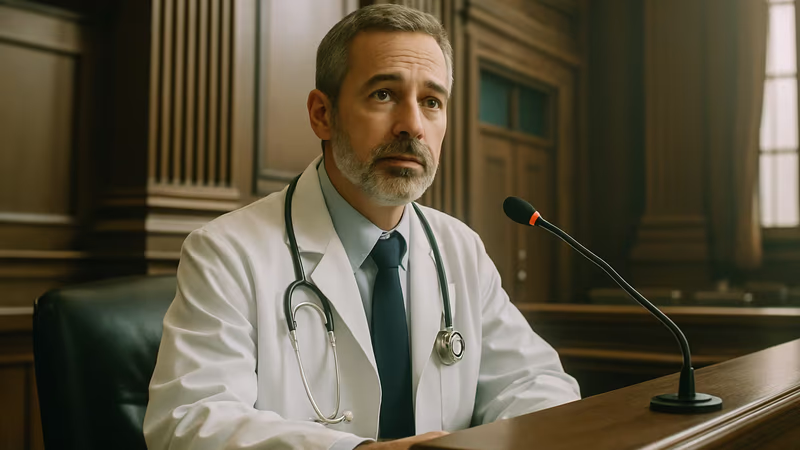
Court ruling clarifies that insurance companies can use different expert witnesses to testify about peer review reports in no-fault cases, expanding defense flexibility.
This article is part of our ongoing experts coverage, with 80 published articles analyzing experts issues across New York State. Attorney Jason Tenenbaum brings 24+ years of hands-on experience to this analysis, drawing from his work on more than 1,000 appeals, over 100,000 no-fault cases, and recovery of over $100 million for clients throughout Nassau County, Suffolk County, Queens, Brooklyn, Manhattan, and the Bronx. For personalized legal advice about how these principles apply to your specific situation, contact our Long Island office at (516) 750-0595 for a free consultation.
In New York’s no-fault insurance litigation, questions frequently arise about which expert witnesses can testify on behalf of insurance companies when defending denials of medical claims. A common scenario involves an insurance company having one doctor prepare a peer review report to deny coverage, but then wanting to use a different expert witness at trial to defend that denial decision.
This practice has generated considerable debate in the courts, with some judges questioning whether the testifying expert must be the same doctor who prepared the original peer review report. The issue touches on fundamental principles of expert witness testimony and the proper foundation required for such evidence. The distinction between the reviewing physician and the testifying physician raises questions about whether courts should require firsthand knowledge of the claim review process or permit experts to offer opinions based on records reviewed by others.
Insurance carriers face practical challenges when the physician who conducted the peer review becomes unavailable for trial due to scheduling conflicts, relocation, or other circumstances. Requiring the original reviewing physician to testify could create significant logistical burdens and potentially delay proceedings. Conversely, permitting substitute experts to testify raises concerns about whether those witnesses possess sufficient knowledge of the specific claim to offer reliable opinions on medical necessity.
The Appellate Term’s decision in Nova Chiropractic Services provides important clarification on this procedural question, addressing the scope of permissible expert testimony and the burden placed on plaintiffs to object when testimony exceeds appropriate boundaries. This ruling has implications for how both sides prepare their cases and handle expert witness disclosures in no-fault litigation.
Case Background
Nova Chiropractic Services brought an action against GEICO General Insurance Company to recover no-fault benefits for healthcare services rendered to an injured patient. GEICO denied the claims based on a peer review report concluding that the services lacked medical necessity. At trial, GEICO sought to present expert testimony supporting its denial, but the proposed expert witness was not the physician who had prepared the original peer review report upon which the denial was based.
The trial court apparently precluded GEICO’s expert from testifying, reasoning that only the physician who conducted the peer review could properly testify about the basis for denial. This ruling prevented GEICO from presenting expert testimony supporting its medical necessity defense, potentially undermining the carrier’s ability to sustain its denial. GEICO appealed to the Appellate Term, arguing that the expert testimony should have been admitted with appropriate limitations.
Jason Tenenbaum’s Analysis
Nova Chiropractic Servs., P.C. v GEICO Gen. Ins. Co., 2018 NY Slip Op 51688(U)(App. Term 2d Dept. 2018)
“Defendant’s expert medical witness, who was not the expert who had prepared the peer review report upon which defendant’s denial of claim form had been based, should have been permitted to testify as to his opinion regarding the lack of medical necessity of the services at issue (see e.g. Park Slope Med. & Surgical Supply, Inc. v Progressive Ins. Co., 34 Misc 3d 154, 2012 NY Slip Op 50349 ). While the expert witness’s testimony should be limited to the basis for the denial as set forth in the peer review report (see id.), it is plaintiff’s burden to make an appropriate objection in the [*2]event the testimony goes beyond the basis for the denial and, if necessary, produce the peer review report”
At the least the judges that were reversed have bee consistent.
Legal Significance
The Appellate Term’s decision establishes that insurance carriers may present expert testimony from physicians other than those who prepared the underlying peer review reports, subject to important limitations. This flexibility recognizes the practical realities of litigation while maintaining appropriate safeguards against unfair surprise or expansion of denial bases. By permitting substitute experts, courts acknowledge that medical opinions can be based on review of records and reports prepared by others, consistent with generally accepted expert testimony principles.
The decision places responsibility on plaintiffs to police the scope of expert testimony through timely objections. Rather than categorically excluding testimony from non-reviewing physicians, courts require plaintiffs to monitor whether experts exceed the boundaries established by the original peer review. This approach balances carriers’ need for witness flexibility with plaintiffs’ rights to know the specific grounds for denial and prepare responsive evidence. The framework requires active participation from both sides during trial proceedings.
Practical Implications
For insurance companies defending medical necessity denials, this ruling provides valuable flexibility in expert witness selection. Carriers need not limit themselves to the specific physician who conducted the peer review, allowing them to utilize experts with superior credentials, availability, or courtroom experience. However, carriers must ensure their testifying experts confine opinions to the grounds articulated in the original peer review reports. Expanding denial theories at trial through expert testimony risks objection and potential preclusion.
Healthcare providers challenging denials must prepare to object when defense experts venture beyond the documented basis for denial. Plaintiffs should obtain peer review reports through discovery and carefully compare those documents to expert testimony at trial. When experts introduce new theories or bases for denial not contained in the peer review, plaintiffs must make specific objections to preserve their rights. Failing to object during trial may waive challenges to expert testimony exceeding proper scope.
Key Takeaway
Insurance companies can use different expert witnesses to testify about peer review reports, even when the testifying expert didn’t prepare the original denial report. However, the testimony must remain within the scope of the original peer review findings. Plaintiffs bear the responsibility to object if the expert testimony strays beyond the documented basis for denial, similar to requirements for establishing proper foundation in other expert testimony contexts.
Related Articles
Legal Context
Why This Matters for Your Case
New York law is among the most complex and nuanced in the country, with distinct procedural rules, substantive doctrines, and court systems that differ significantly from other jurisdictions. The Civil Practice Law and Rules (CPLR) governs every stage of civil litigation, from service of process through trial and appeal. The Appellate Division, Appellate Term, and Court of Appeals create a rich and ever-evolving body of case law that practitioners must follow.
Attorney Jason Tenenbaum has practiced across these areas for over 24 years, writing more than 1,000 appellate briefs and publishing over 2,353 legal articles that attorneys and clients rely on for guidance. The analysis in this article reflects real courtroom experience — from motion practice in Civil Court and Supreme Court to oral arguments before the Appellate Division — and a deep understanding of how New York courts actually apply the law in practice.
About This Topic
Expert Testimony in New York Litigation
Expert testimony is essential in most personal injury and no-fault cases — from medical experts establishing causation and damages to accident reconstructionists and economic experts calculating lost earnings. New York courts apply specific rules governing expert qualifications, the foundation for expert opinions, the use of medical journals and treatises, and the sufficiency of expert evidence on summary judgment. These articles analyze the legal standards for expert testimony and practical strategies for presenting and challenging expert evidence.
80 published articles in Experts
Keep Reading
More Experts Analysis

Expert Witness in Car Accident Lawsuits
Learn how expert witnesses in New York car accident lawsuits help establish fault, causation, and damages through accident reconstruction, medical testimony, and economic analysis.
May 14, 2025
Expert opinion
Court reminds attorneys that expert opinions must address specific assertions with cited evidence, not just conclusory statements, in personal injury litigation.
Mar 22, 2021
It was not proven that the surgery was not medically necessary
New York no-fault medical necessity denial case where insurer's peer review expert failed to consider all medical records, highlighting common arbitration challenges.
Oct 28, 2017
Biomechanical evidence allowed
Court ruling expands use of biomechanical expert testimony in personal injury cases, establishing qualifications needed for engineers to opine on accident causation.
Aug 10, 2015
Another Article 10 case wittles away peer hearsay
Article 10 case limits peer hearsay in expert testimony, impacting no-fault insurance and threshold injury cases in New York courts.
Jun 12, 2011
An interesting 5102(d) case involving a knee surgery
Expert analysis of Gilmonio v Toussaint 5102(d) case involving knee surgery. Learn how incomplete medical history can defeat serious injury threshold claims in NY.
Feb 26, 2010Common Questions
Frequently Asked Questions
How are expert witnesses used in New York personal injury cases?
Expert witnesses provide specialized opinion testimony that helps the court or jury understand complex issues like medical causation, injury severity, future care needs, economic losses, and engineering defects. Under New York law, expert testimony must be based on facts in evidence, the expert's professional knowledge, or a combination of both. The expert must be qualified by training, education, or experience in the relevant field. Expert disclosure requirements under CPLR 3101(d)(1)(i) require parties to identify their experts and provide detailed summaries before trial.
Was this article helpful?

About the Author
Jason Tenenbaum, Esq.
Jason Tenenbaum is the founding attorney of the Law Office of Jason Tenenbaum, P.C., headquartered at 326 Walt Whitman Road, Suite C, Huntington Station, New York 11746. With over 24 years of experience since founding the firm in 2002, Jason has written more than 1,000 appeals, handled over 100,000 no-fault insurance cases, and recovered over $100 million for clients across Long Island, Nassau County, Suffolk County, Queens, Brooklyn, Manhattan, the Bronx, and Staten Island. He is one of the few attorneys in the state who both writes his own appellate briefs and tries his own cases.
Jason is admitted to practice in New York, New Jersey, Florida, Texas, Georgia, and Michigan state courts, as well as multiple federal courts. His 2,353+ published legal articles analyzing New York case law, procedural developments, and litigation strategy make him one of the most prolific legal commentators in the state. He earned his Juris Doctor from Syracuse University College of Law.
Disclaimer: This article is published by the Law Office of Jason Tenenbaum, P.C. for informational and educational purposes only. It does not constitute legal advice, and no attorney-client relationship is formed by reading this content. The legal principles discussed may not apply to your specific situation, and the law may have changed since this article was last updated.
New York law varies by jurisdiction — court decisions in one Appellate Division department may not be followed in another, and local court rules in Nassau County Supreme Court differ from those in Suffolk County Supreme Court, Kings County Civil Court, or Queens County Supreme Court. The Appellate Division, Second Department (which covers Long Island, Brooklyn, Queens, and Staten Island) and the Appellate Term (which hears appeals from lower courts) each have distinct procedural requirements and precedents that affect litigation strategy.
If you need legal help with a experts matter, contact our office at (516) 750-0595 for a free consultation. We serve clients throughout Long Island (Huntington, Babylon, Islip, Brookhaven, Smithtown, Riverhead, Southampton, East Hampton), Nassau County (Hempstead, Garden City, Mineola, Great Neck, Manhasset, Freeport, Long Beach, Rockville Centre, Valley Stream, Westbury, Hicksville, Massapequa), Suffolk County (Hauppauge, Deer Park, Bay Shore, Central Islip, Patchogue, Brentwood), Queens, Brooklyn, Manhattan, the Bronx, Staten Island, and Westchester County. Prior results do not guarantee a similar outcome.