Key Takeaway
People v Donato analysis: Due process violations in NYC Justice Courts. Protect your constitutional rights. Expert defense. Call 516-750-0595 for help.
This article is part of our ongoing no-fault coverage, with 271 published articles analyzing no-fault issues across New York State. Attorney Jason Tenenbaum brings 24+ years of hands-on experience to this analysis, drawing from his work on more than 1,000 appeals, over 100,000 no-fault cases, and recovery of over $100 million for clients throughout Nassau County, Suffolk County, Queens, Brooklyn, Manhattan, and the Bronx. For personalized legal advice about how these principles apply to your specific situation, contact our Long Island office at (516) 750-0595 for a free consultation.
Due Process Violations in New York Justice Courts: A Wake-Up Call for Long Island and NYC Defendants
Due process rights form the foundation of America’s justice system, yet disturbing violations continue to occur in New York’s local Justice Courts. For residents of Long Island and New York City facing traffic violations, misdemeanor charges, and other local court proceedings, understanding these fundamental constitutional protections can mean the difference between a fair trial and a miscarriage of justice. This analysis of a shocking Justice Court case demonstrates why these courts need serious reform. If you’re dealing with a no-fault insurance defense matter, an experienced attorney can help protect your rights.
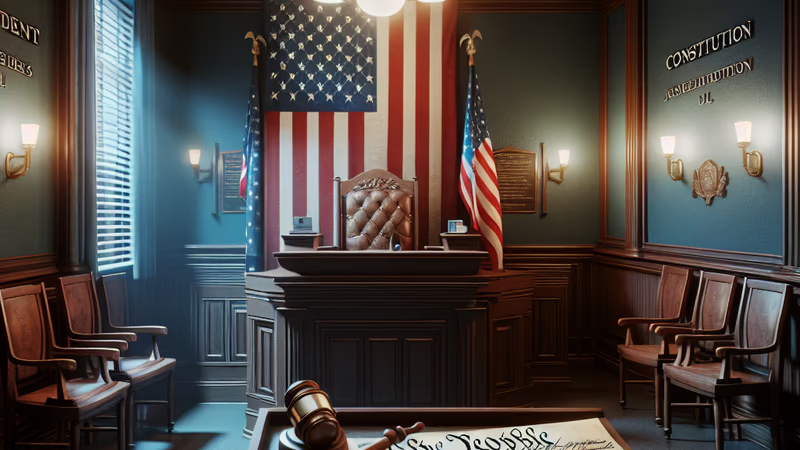
The People v. Donato Decision: A Textbook Due Process Violation
People v Donato (Michael), 2012 NY Slip Op 22018 (App. Term 2d Dept. 2012)
This is why New York needs to abolish the Justice Courts in this state. Third-world justice, to this extent, has no place in the unified court system
“On cross-examination, defendant attempted to elicit testimony from the officer indicating that defendant had “pulled into a driveway in an attempt to back up” and had not actually performed a U-turn. At this juncture, the Justice Court asked defendant, “o if you were to testify, you would say you went into the driveway and turned?” The following exchange ensued:
“Defendant:I pulled into the driveway in an attempt to back up. That’s when the officer pulled up next to me.
The Court:No. I find you guilty then.”
The Justice Court erred when it permitted the officer to proffer his unsworn testimony. In all criminal proceedings, “every witness over 12 years of age may testify only under oath, unless he suffers from a mental disease or defect which renders him unable to understand the nature of an oath” (People v Copeland, 70 AD2d 884, 884 ; see CPL 60.20 ). This “requirement serves two purposes – to alert the witness to the moral duty to testify truthfully and to deter false testimony through the sanction of a perjury prosecution” (People v Copeland, 70 AD2d at 884; see People v Parks, 41 NY2d 36, 45 ). As a result, the Justice Court committed reversible error when it failed to swear in the officer prior to accepting his testimony (People v Copeland, 70 AD2d 884).
Similarly, the Justice Court committed reversible error when it impermissibly prevented defendant from testifying in his own defense. “t is beyond cavil that a criminal defendant has a constitutional right to testify in his own behalf at trial’” (People v Cosby, 82 AD3d 63, 66 , quoting U.S. v Teague, 953 F2d 1525, 1530 ). “he centuries-old right granted an accused to be present and to be heard in person at a … criminal trial may not be denied without violating the accused’s Fifth and Sixth Amendment rights” (U.S. v Bifield, 702 F2d 342, 349 ). In this case, the Justice Court stifled any meaningful opportunity for defendant to testify on his own behalf and offer a full account of the events surrounding the alleged incident. Nor did the Justice Court inquire whether defendant wished to proffer any photographs, maps or relevant legal authority in his own defense.
What This Means for Long Island and NYC Residents
The Donato case represents a systemic problem affecting thousands of defendants throughout Nassau County, Suffolk County, Queens, Brooklyn, Manhattan, and the Bronx. Justice Courts across New York handle hundreds of thousands of cases annually, from traffic violations to misdemeanor criminal charges, yet many of these courts operate with minimal oversight and inadequate training on constitutional protections.
The Scope of the Problem
Long Island residents facing charges in local Justice Courts often encounter situations similar to the Donato case. These courts, typically presided over by part-time judges who may lack formal legal training, handle everything from speeding tickets to DWI charges, yet constitutional violations occur with alarming frequency.
Common due process violations in New York Justice Courts include:
- Failing to administer oaths to witnesses
- Preventing defendants from presenting evidence
- Denying the right to cross-examine witnesses
- Rushing proceedings without adequate time for defense preparation
- Showing obvious bias toward law enforcement testimony
- Failing to explain defendants’ rights
The Constitutional Framework: Your Fundamental Rights
The Fifth and Sixth Amendments to the U.S. Constitution guarantee specific protections that every defendant in Long Island and NYC courts should understand:
Fifth Amendment Protections:
- Right to remain silent
- Protection against self-incrimination
- Due process of law
- Right to grand jury indictment for serious crimes
Sixth Amendment Rights:
- Right to a speedy and public trial
- Right to an impartial jury
- Right to know the charges against you
- Right to confront witnesses
- Right to compel witnesses in your favor
- Right to legal representation
The Oath Requirement: Why It Matters
The requirement that witnesses testify under oath serves two critical purposes that protect defendants throughout Long Island and New York City. First, the oath alerts witnesses to their moral duty to tell the truth. Second, it creates the possibility of perjury prosecution if they lie under oath.
Practical Implications for Your Case
When Justice Courts allow unsworn testimony, as happened in Donato, they create several serious problems:
- Reduced deterrent effect: Without the threat of perjury prosecution, witnesses may be more likely to embellish or fabricate testimony
- Weakened cross-examination: Defense attorneys cannot effectively challenge testimony that wasn’t given under oath
- Appellate review issues: Unsworn testimony creates grounds for appeal and case reversal
- Fundamental unfairness: Defendants face accusations they cannot properly challenge
The Right to Testify: Your Voice in Court
The right to testify in your own defense represents one of the most fundamental protections in American criminal law. Yet the Donato case shows how Justice Courts sometimes trample this basic right, leaving defendants unable to tell their side of the story.
Why This Right Exists
The right to testify serves multiple purposes:
- Allows defendants to provide context and explanation for their actions
- Enables challenges to the prosecution’s version of events
- Provides opportunity to demonstrate credibility and character
- Ensures defendants aren’t convicted based solely on accusations
When Justice Courts Violate This Right
Throughout Long Island and NYC, defendants regularly encounter Justice Court judges who:
- Rush proceedings without allowing adequate testimony time
- Show impatience or hostility toward defendant testimony
- Interrupt or cut off defendants mid-testimony
- Fail to inform defendants of their right to testify
- Create an intimidating atmosphere that discourages testimony
The Justice Court Problem in New York
Jason Tenenbaum’s observation that “New York needs to abolish the Justice Courts” reflects frustration shared by criminal defense attorneys throughout the state. These courts, originally designed for small rural communities, now handle complex legal matters affecting urban and suburban populations across Long Island and the metropolitan area.
Structural Problems with Justice Courts
Several systemic issues contribute to the due process violations we see in cases like Donato:
Inadequate Training: Many Justice Court judges are part-time officials who may lack comprehensive legal education. While they receive some training, it’s often insufficient for the complex constitutional issues they regularly encounter.
High Volume, Low Time: Justice Courts handle enormous caseloads with limited time per case. This rush-to-judgment approach creates pressure to skip important procedural protections.
Limited Oversight: Unlike higher courts with more robust appellate review, Justice Court decisions often receive minimal scrutiny until cases reach the appellate level.
Financial Pressures: Some Justice Courts depend on fines and fees for municipal revenue, creating potential conflicts of interest.
Protecting Your Rights in Long Island and NYC Courts
Before Your Court Date
If you’re facing charges in a Justice Court anywhere in Nassau County, Suffolk County, or the five boroughs, take these steps to protect your constitutional rights:
- Hire experienced counsel: An attorney familiar with local Justice Courts can identify and prevent due process violations
- Document everything: Keep detailed records of all interactions with court personnel
- Understand your rights: Know what constitutional protections you’re entitled to receive
- Prepare your defense: Gather evidence, witness statements, and documentation supporting your case
During Court Proceedings
Watch for these red flags that may indicate due process violations:
- Witnesses testifying without being sworn in
- Being prevented from speaking on your own behalf
- Rushed proceedings that don’t allow adequate time for your defense
- Obvious judicial bias or predetermined outcomes
- Denial of your right to cross-examine witnesses
Frequently Asked Questions
What should I do if a Justice Court violates my due process rights?
Document the violation immediately and contact an experienced criminal defense attorney. Many due process violations provide grounds for appeal or case dismissal, but you need to act quickly to preserve your rights.
Can I represent myself in Justice Court?
While you have the right to self-representation, the Donato case demonstrates the risks of facing Justice Court proceedings without experienced legal counsel. An attorney can spot constitutional violations and protect your rights.
What happens if I’m convicted after a due process violation?
You may have grounds for appeal. The appellate courts take due process violations seriously, as demonstrated by the reversal in Donato. However, appeals have strict time limits and procedural requirements.
Are Justice Courts really that bad throughout Long Island and NYC?
While not all Justice Courts violate due process rights, the systemic problems identified in Donato exist across the state. The quality of justice can vary dramatically from court to court.
How can I find out about the track record of my local Justice Court?
Research court statistics, speak with local attorneys, and review appellate decisions involving your local court. An experienced criminal defense lawyer can provide insights about specific courts and judges.
Get Experienced Legal Representation
The due process violations revealed in People v. Donato demonstrate why you need experienced legal representation when facing charges in any New York Justice Court. Don’t let constitutional violations derail your case or result in wrongful conviction.
At the Law Office of Jason Tenenbaum, we have extensive experience defending clients in Justice Courts throughout Long Island and New York City. We know how to spot due process violations, protect your constitutional rights, and fight for the fair treatment you deserve under law.
Don’t face Justice Court proceedings alone. Call us today at 516-750-0595 for a free consultation about your case and how we can protect your rights.
We serve clients throughout Nassau County, Suffolk County, Queens, Brooklyn, Manhattan, the Bronx, and surrounding areas. With our deep understanding of local court systems and constitutional law, we’re here to ensure your due process rights are respected and your case receives the fair treatment it deserves.
Related Articles
- Understanding default judgment procedures and personal jurisdiction defenses
- Critical timing rules for summary judgment motions under CPLR 3212(a)
- The CPLR 3212(g) paradigm for motion practice
- New York No-Fault Insurance Law
Legal Update (February 2026): Since this 2012 analysis of due process protections in New York Justice Courts, there have been ongoing judicial reforms and procedural updates that may affect the standards and oversight mechanisms discussed in this post. Court rules, appellate guidance on due process requirements, and administrative policies governing Justice Court proceedings may have evolved significantly over the past fourteen years, and practitioners should verify current constitutional protections and procedural safeguards when representing clients in these venues.
Legal Context
Why This Matters for Your Case
New York's no-fault insurance system, established under Insurance Law Article 51, is one of the most complex insurance frameworks in the country. Every motorist must carry Personal Injury Protection coverage that pays medical expenses and lost wages regardless of fault, up to $50,000 per person.
But insurers routinely deny valid claims using peer reviews, EUO scheduling tactics, fee schedule reductions, and coverage defenses. The Law Office of Jason Tenenbaum has handled over 100,000 no-fault cases since 2002 — from initial claim submissions through arbitration before the American Arbitration Association, trials in Civil Court and Supreme Court, and appeals to the Appellate Term and Appellate Division. Jason Tenenbaum is one of the few attorneys in the state who both writes his own appellate briefs and tries his own cases.
His 2,353+ published legal articles on no-fault practice are cited by attorneys throughout New York. Whether you are dealing with a medical necessity denial, an EUO no-show defense, a fee schedule dispute, or a coverage question, this article provides the kind of detailed case-law analysis that helps practitioners and claimants understand exactly where the law stands.
About This Topic
New York No-Fault Insurance Law
New York's no-fault insurance system requires every driver to carry Personal Injury Protection (PIP) coverage that pays medical expenses and lost wages regardless of who caused the accident. But insurers routinely deny, delay, and underpay valid claims — using peer reviews, IME no-shows, and fee schedule defenses to avoid paying providers and injured claimants. Attorney Jason Tenenbaum has litigated thousands of no-fault arbitrations and court cases since 2002.
271 published articles in No-Fault
Keep Reading
More No-Fault Analysis
Priority of Payment Regulation Has No Force in Arbitration: First and Second Departments Agree
Both the First and Second Departments have held that the priority of payment regulation under 11 NYCRR 65-3.15 is of no force or effect in no-fault arbitration proceedings....
Feb 25, 2026
How Insurance Companies Use Colossus Software to Undervalue Your Injury Claim
Insurance companies use Colossus software to lowball your injury claim. Learn how this system works and how a Long Island attorney can fight back. Call 516-750-0595.
Feb 18, 2026
Being an exotic dance is not a prior bad act for impeachment purposes
Fourth Department ruling clarifies that exotic dancing employment cannot be used as prior bad act evidence for cross-examination in criminal trials.
May 10, 2011
Can an insurance carrier sue for “overpaid” PIP attorneys fees?
New Jersey court rules insurance carriers cannot sue attorneys for "overpaid" PIP fees under IFPA when payments were regulatory penalties, not policy benefits.
Jul 30, 2022
“Equitable estoppel” – Domotor light
Florida court affirms equitable estoppel doctrine when insurer wrongly denied PIP coverage then changed tactics after discovering their error in no-fault case.
Jun 22, 2021
What’s the over under on this appeal scheduled for the December term
Jason Tenenbaum analyzes a no-fault insurance case heading to appeal, predicting reversal due to insurer's procedural failures in EUO scheduling and discovery tactics.
Oct 7, 2016Was this article helpful?

About the Author
Jason Tenenbaum, Esq.
Jason Tenenbaum is the founding attorney of the Law Office of Jason Tenenbaum, P.C., headquartered at 326 Walt Whitman Road, Suite C, Huntington Station, New York 11746. With over 24 years of experience since founding the firm in 2002, Jason has written more than 1,000 appeals, handled over 100,000 no-fault insurance cases, and recovered over $100 million for clients across Long Island, Nassau County, Suffolk County, Queens, Brooklyn, Manhattan, the Bronx, and Staten Island. He is one of the few attorneys in the state who both writes his own appellate briefs and tries his own cases.
Jason is admitted to practice in New York, New Jersey, Florida, Texas, Georgia, and Michigan state courts, as well as multiple federal courts. His 2,353+ published legal articles analyzing New York case law, procedural developments, and litigation strategy make him one of the most prolific legal commentators in the state. He earned his Juris Doctor from Syracuse University College of Law.
Disclaimer: This article is published by the Law Office of Jason Tenenbaum, P.C. for informational and educational purposes only. It does not constitute legal advice, and no attorney-client relationship is formed by reading this content. The legal principles discussed may not apply to your specific situation, and the law may have changed since this article was last updated.
New York law varies by jurisdiction — court decisions in one Appellate Division department may not be followed in another, and local court rules in Nassau County Supreme Court differ from those in Suffolk County Supreme Court, Kings County Civil Court, or Queens County Supreme Court. The Appellate Division, Second Department (which covers Long Island, Brooklyn, Queens, and Staten Island) and the Appellate Term (which hears appeals from lower courts) each have distinct procedural requirements and precedents that affect litigation strategy.
If you need legal help with a no-fault matter, contact our office at (516) 750-0595 for a free consultation. We serve clients throughout Long Island (Huntington, Babylon, Islip, Brookhaven, Smithtown, Riverhead, Southampton, East Hampton), Nassau County (Hempstead, Garden City, Mineola, Great Neck, Manhasset, Freeport, Long Beach, Rockville Centre, Valley Stream, Westbury, Hicksville, Massapequa), Suffolk County (Hauppauge, Deer Park, Bay Shore, Central Islip, Patchogue, Brentwood), Queens, Brooklyn, Manhattan, the Bronx, Staten Island, and Westchester County. Prior results do not guarantee a similar outcome.