
Key Takeaway
New York criminal court procedure differences from civil rules - essential knowledge for Long Island and NYC attorneys handling diverse case types.
This article is part of our ongoing no-fault coverage, with 271 published articles analyzing no-fault issues across New York State. Attorney Jason Tenenbaum brings 24+ years of hands-on experience to this analysis, drawing from his work on more than 1,000 appeals, over 100,000 no-fault cases, and recovery of over $100 million for clients throughout Nassau County, Suffolk County, Queens, Brooklyn, Manhattan, and the Bronx. For personalized legal advice about how these principles apply to your specific situation, contact our Long Island office at (516) 750-0595 for a free consultation.
Understanding Criminal Court Procedure: Why Civil Rules Don’t Always Apply
When practicing law in New York, particularly in the complex jurisdictions of Long Island and New York City, attorneys must navigate different procedural rules depending on whether they’re handling civil or criminal matters. A common misconception among practitioners is that civil procedure rules can be universally applied across all types of cases. This assumption can lead to serious procedural errors and dismissed cases. If you’re dealing with a no-fault insurance defense matter, an experienced attorney can help protect your rights.
As a Nassau County attorney who has handled both civil and criminal matters throughout Long Island and the five boroughs, I’ve seen firsthand how this confusion can derail otherwise strong cases. Today, I want to share an important lesson about the boundaries between civil and criminal procedure that every New York attorney should understand.
The Intersection of Civil and Criminal Law in New York Courts
New York’s legal system operates under distinct procedural frameworks for civil and criminal matters. The Civil Practice Law and Rules (CPLR) governs civil proceedings, while the Criminal Procedure Law (CPL) controls criminal cases. This separation exists for good reason – criminal proceedings involve constitutional protections and due process requirements that differ significantly from civil disputes.
However, there are rare instances where these worlds intersect, creating opportunities for procedural confusion. Understanding when and how these rules apply is crucial for effective representation in New York courts, whether you’re practicing in Manhattan Supreme Court, Nassau County District Court, or any of the local justice courts throughout Long Island.
Yes, this is a no fault blog that I maintain, mostly for my own amusement. I take pride in the level of scholarship set forth in this blog. I try to avoid topics that do not apply either directly or tangentially to the arena of PIP issues. This will be a rare exception.
In my daily reading of the App. Term criminal cases, I found an interesting issue that has satisfied my curiosity. Likewise, I find the outcome disturbing.
The case that is interesting is entitled: People v Manupelli (Christine), 2008 NY Slip Op 28520 (App. Term 2d Dept. 9th and 10th Jud. Dis. 2008). It says the following:
In this prosecution based on defendants’ alleged violation of local ordinances requiring landfill permits and barring the diversion of rainwater onto neighboring properties, defendants moved pretrial to dismiss the accusatory instruments pursuant to CPLR 3211 (a) (7). The Justice Court granted the motion, concluding, in essence, that there was a legal impediment to conviction (CPL 170.30 ), finding that defendants’ proof in support of the motion established both their entitlement to an exclusion from the permit requirement and the People’s inability to prove, on the facts, that defendants are legally responsible for the alleged illegal diversion of rainwater onto a neighbor’s property.
Defendants’ motion should have been denied. With rare exceptions (e.g. CPL 60.10), the CPLR is inapplicable to criminal proceedings (CPLR 101; CPL 1.10 ; People v Knobel, 94 NY2d 226, 230 ; People v Crisp, 268 AD2d 247 ; People v Silva, 122 AD2d 750 ; see generally People ex rel. Hirschberg v Orange County Court, 271 NY 151, 155 ). The authority of a criminal court to dismiss an information pursuant to a pretrial motion (see CPL 170.30) does not include a motion for accelerated judgment available to civil court litigants (see CPLR 3211, 3212), and, in any event, the motion should have been denied on the merits.
Key Takeaways for New York Practitioners
The Manupelli decision highlights several critical points that every attorney practicing in New York should understand:
1. Procedural Rules Are Not Interchangeable
The most fundamental lesson from this case is that civil procedure rules cannot be casually imported into criminal proceedings. While this might seem obvious to experienced practitioners, the Justice Court in Manupelli made exactly this mistake by applying CPLR 3211(a)(7) to a criminal case.
2. Criminal Courts Have Limited Dismissal Authority
Unlike civil courts, which have broad authority to grant summary judgment and dismiss cases based on various procedural and substantive grounds, criminal courts operate under more restrictive rules. CPL 170.30 provides specific grounds for dismissing criminal cases, and these cannot be expanded by borrowing from civil procedure.
3. The Importance of Appellate Review
The Appellate Term’s correction of this error demonstrates the importance of appellate review in maintaining procedural integrity. When trial courts make fundamental errors in procedure, appellate courts serve as an essential check on the system.
Practical Applications for Long Island and NYC Attorneys
Whether you’re handling cases in Nassau County District Court, Suffolk County courts, or the various New York City criminal courts, understanding these procedural distinctions is crucial. Here are some practical considerations:
Motion Practice Differences
When preparing motions in criminal cases, always reference the CPL rather than the CPLR. The grounds for dismissal, the timing requirements, and the standards applied are all different. Attempting to use civil procedure in criminal court will likely result in denial of your motion and could damage your credibility with the court.
Client Consultation and Case Strategy
When clients come to you with cases that might have both civil and criminal implications – such as environmental violations, business disputes that could involve criminal charges, or accidents that might result in both civil claims and criminal prosecutions – it’s essential to clearly separate the procedural strategies for each type of proceeding.
Frequently Asked Questions
Can civil and criminal cases involving the same facts be handled simultaneously?
Yes, but they must be handled as separate proceedings with different procedural rules. The strategies and legal standards applied in each case will differ significantly, even when the underlying facts are identical.
Are there any exceptions where CPLR rules apply to criminal proceedings?
Very few. CPL 60.10 is one of the rare exceptions mentioned in the case law, but generally, criminal proceedings are governed exclusively by the CPL.
What should I do if I realize I’ve made a procedural error in a criminal case?
Contact an experienced criminal defense attorney immediately. Procedural errors can often be corrected, but timing is crucial. Don’t attempt to fix complex procedural problems without proper guidance.
How do local courts in Nassau and Suffolk Counties handle these issues?
Local justice courts, district courts, and county courts throughout Long Island all follow the same procedural rules established by state law. However, individual judges may have different approaches to motion practice and case management.
Can a case like Manupelli affect no-fault insurance claims?
While this particular decision deals with criminal procedure, the underlying principle about not mixing civil and criminal procedural rules applies to all areas of practice, including no-fault insurance litigation.
Why This Matters for Your Legal Practice
Understanding the boundaries between civil and criminal procedure isn’t just academic – it has real-world implications for your clients and your practice. Procedural errors can result in:
- Dismissed cases or motions
- Wasted time and resources
- Damaged attorney credibility
- Potential malpractice claims
- Poor outcomes for clients
Whether you’re handling a complex civil litigation matter in Manhattan or a criminal case in Hempstead, always ensure you’re applying the correct procedural rules for the type of case you’re handling.
Need Legal Assistance with Criminal or Civil Matters?
If you’re facing criminal charges or have questions about procedural issues in your case, it’s important to work with an attorney who understands the nuances of New York law. Our firm has extensive experience handling both civil and criminal matters throughout Nassau County, Suffolk County, and New York City.
Don’t let procedural errors derail your case. Contact us today at 516-750-0595 to discuss your legal needs. We provide thorough, knowledgeable representation based on a deep understanding of New York’s complex legal procedures.
The information in this post is provided for educational purposes only and should not be construed as legal advice. Every case is unique, and the outcome of your case will depend on the specific facts and circumstances involved.
Related Articles
- Understanding CPLR 3212(a) timing rules for summary judgment motions
- The CPLR 3212(g) paradigm in New York civil procedure
- Reasonable excuse requirements and personal jurisdiction defaults
- No-fault verification requirements and compliance standards
- New York No-Fault Insurance Law
Legal Update (February 2026): Since this 2008 post, New York’s Civil Practice Law and Rules (CPLR) and Criminal Procedure Law (CPL) have undergone various amendments and updates that may affect the procedural distinctions discussed. Additionally, court rules and local practices in Nassau County and other New York jurisdictions may have evolved. Practitioners should verify current CPLR provisions, particularly any amendments to Section 3211, and consult the most recent versions of both civil and criminal procedure rules when handling cases that may involve intersections between these practice areas.
Legal Context
Why This Matters for Your Case
New York's no-fault insurance system, established under Insurance Law Article 51, is one of the most complex insurance frameworks in the country. Every motorist must carry Personal Injury Protection coverage that pays medical expenses and lost wages regardless of fault, up to $50,000 per person.
But insurers routinely deny valid claims using peer reviews, EUO scheduling tactics, fee schedule reductions, and coverage defenses. The Law Office of Jason Tenenbaum has handled over 100,000 no-fault cases since 2002 — from initial claim submissions through arbitration before the American Arbitration Association, trials in Civil Court and Supreme Court, and appeals to the Appellate Term and Appellate Division. Jason Tenenbaum is one of the few attorneys in the state who both writes his own appellate briefs and tries his own cases.
His 2,353+ published legal articles on no-fault practice are cited by attorneys throughout New York. Whether you are dealing with a medical necessity denial, an EUO no-show defense, a fee schedule dispute, or a coverage question, this article provides the kind of detailed case-law analysis that helps practitioners and claimants understand exactly where the law stands.
About This Topic
New York No-Fault Insurance Law
New York's no-fault insurance system requires every driver to carry Personal Injury Protection (PIP) coverage that pays medical expenses and lost wages regardless of who caused the accident. But insurers routinely deny, delay, and underpay valid claims — using peer reviews, IME no-shows, and fee schedule defenses to avoid paying providers and injured claimants. Attorney Jason Tenenbaum has litigated thousands of no-fault arbitrations and court cases since 2002.
271 published articles in No-Fault
Keep Reading
More No-Fault Analysis
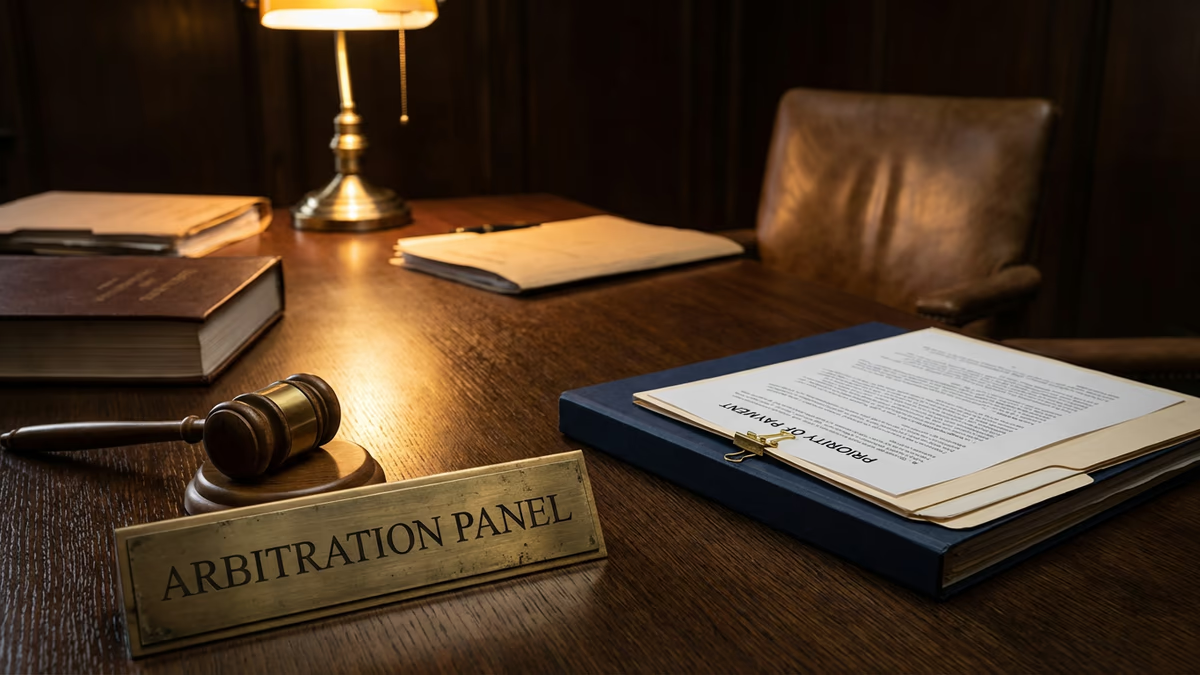
Priority of Payment Regulation Has No Force in Arbitration: First and Second Departments Agree
Both the First and Second Departments have held that the priority of payment regulation under 11 NYCRR 65-3.15 is of no force or effect in no-fault arbitration proceedings....
Feb 25, 2026
How Insurance Companies Use Colossus Software to Undervalue Your Injury Claim
Insurance companies use Colossus software to lowball your injury claim. Learn how this system works and how a Long Island attorney can fight back. Call 516-750-0595.
Feb 18, 2026
More Objective standards?
Learn about objective standards for no-fault insurance examinations under oath on Long Island. Expert legal analysis from Jason Tenenbaum. Call 516-750-0595.
Jun 25, 2023
Time period
Learn about CPLR filing requirements and time periods in New York courts. Expert analysis of Miller v Annucci case on notice of appeal filing deadlines and mailbox rule exceptions.
Sep 14, 2021
Texting your friend who kills someone: Are you liable?
Court rules texting someone who kills in car accident doesn't create liability. Remote senders lack control over drivers unlike passengers in vehicle.
May 4, 2018
Major medical carrier taken to the mat for unscrupulous conduct
Get expert legal analysis on Major medical carrier taken to the mat for unscrupulous conduct from Law Office of Jason Tenenbaum | Personal Injury Lawyers
Mar 24, 2012Was this article helpful?

About the Author
Jason Tenenbaum, Esq.
Jason Tenenbaum is the founding attorney of the Law Office of Jason Tenenbaum, P.C., headquartered at 326 Walt Whitman Road, Suite C, Huntington Station, New York 11746. With over 24 years of experience since founding the firm in 2002, Jason has written more than 1,000 appeals, handled over 100,000 no-fault insurance cases, and recovered over $100 million for clients across Long Island, Nassau County, Suffolk County, Queens, Brooklyn, Manhattan, the Bronx, and Staten Island. He is one of the few attorneys in the state who both writes his own appellate briefs and tries his own cases.
Jason is admitted to practice in New York, New Jersey, Florida, Texas, Georgia, and Michigan state courts, as well as multiple federal courts. His 2,353+ published legal articles analyzing New York case law, procedural developments, and litigation strategy make him one of the most prolific legal commentators in the state. He earned his Juris Doctor from Syracuse University College of Law.
Disclaimer: This article is published by the Law Office of Jason Tenenbaum, P.C. for informational and educational purposes only. It does not constitute legal advice, and no attorney-client relationship is formed by reading this content. The legal principles discussed may not apply to your specific situation, and the law may have changed since this article was last updated.
New York law varies by jurisdiction — court decisions in one Appellate Division department may not be followed in another, and local court rules in Nassau County Supreme Court differ from those in Suffolk County Supreme Court, Kings County Civil Court, or Queens County Supreme Court. The Appellate Division, Second Department (which covers Long Island, Brooklyn, Queens, and Staten Island) and the Appellate Term (which hears appeals from lower courts) each have distinct procedural requirements and precedents that affect litigation strategy.
If you need legal help with a no-fault matter, contact our office at (516) 750-0595 for a free consultation. We serve clients throughout Long Island (Huntington, Babylon, Islip, Brookhaven, Smithtown, Riverhead, Southampton, East Hampton), Nassau County (Hempstead, Garden City, Mineola, Great Neck, Manhasset, Freeport, Long Beach, Rockville Centre, Valley Stream, Westbury, Hicksville, Massapequa), Suffolk County (Hauppauge, Deer Park, Bay Shore, Central Islip, Patchogue, Brentwood), Queens, Brooklyn, Manhattan, the Bronx, Staten Island, and Westchester County. Prior results do not guarantee a similar outcome.