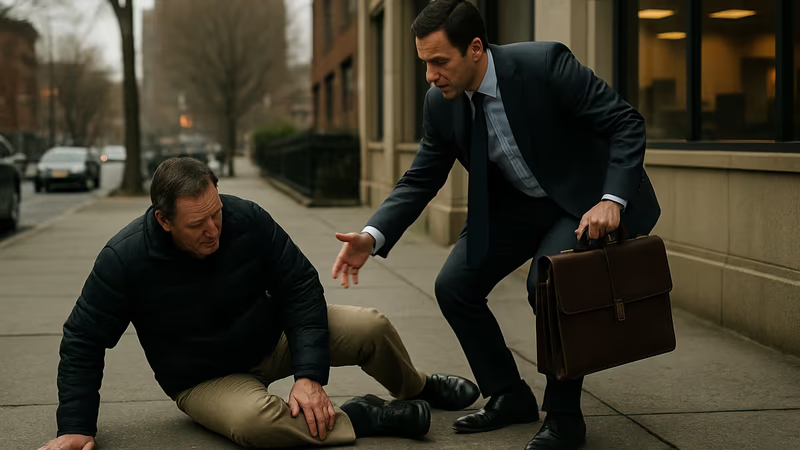
Key Takeaway
Learn why a $650K trip and fall verdict was overturned in Rambarran case. Expert analysis of actionable defects in NY premises liability. Call 516-750-0595.
This article is part of our ongoing premises liability coverage, with 8 published articles analyzing premises liability issues across New York State. Attorney Jason Tenenbaum brings 24+ years of hands-on experience to this analysis, drawing from his work on more than 1,000 appeals, over 100,000 no-fault cases, and recovery of over $100 million for clients throughout Nassau County, Suffolk County, Queens, Brooklyn, Manhattan, and the Bronx. For personalized legal advice about how these principles apply to your specific situation, contact our Long Island office at (516) 750-0595 for a free consultation.
When Trip and Fall Verdicts Get Overturned: Understanding Actionable Defects in New York
Updated March 2026: This analysis of actionable defects in New York trip and fall cases has been reviewed and remains current law. The principles from Rambarran continue to be applied by New York appellate courts.
The case of Rambarran v New York City Transit Authority, 2019 NY Slip Op 00484 (2d Dept. 2019), provides a sobering reminder that not all dangerous conditions are legally actionable in New York trip and fall cases. Despite a $650,000 jury verdict for the plaintiff, the Second Department reversed the decision, highlighting the critical distinction between hazardous conditions and actionable defects.
The court explained: “Here, the plaintiff’s evidence at trial included her own testimony, the testimony of her expert engineer, as well as photographs identified and marked by the plaintiff showing the alleged defect as it existed at the time of the subject accident. Accepting such evidence as true, and affording the plaintiff every favorable inference that may be properly drawn from the facts presented, the alleged defect was not actionable. Considering the appearance and dimensions of the protruding bolt, as well as its location on the sidewall of the staircase, directly underneath a handrail and away from the walking surface of the stairway.”
This decision demonstrates the high burden plaintiffs face in Long Island and New York City slip and fall cases, even when significant damages are involved.
What Makes a Defect “Actionable” in New York Trip and Fall Cases
Under New York premises liability law, property owners and operators have a duty to maintain their premises in a reasonably safe condition. However, not every defect or dangerous condition gives rise to legal liability. The Rambarran case illustrates several key factors courts consider when determining whether a defect is actionable.
Location and Visibility of the Hazard
The Second Department specifically noted that the protruding bolt was located “on the sidewall of the staircase, directly underneath a handrail and away from the walking surface of the stairway.” This location was significant because:
- The defect was not in the normal path of travel
- It was positioned away from the walking surface
- Its location underneath a handrail made it less likely to cause a trip
- Pedestrians would not normally be expected to contact this area
Size and Appearance Requirements
New York courts have established specific standards for what constitutes an actionable defect. The dimensions and appearance of the hazard play a crucial role in determining liability. Factors include:
- Height differential: How much the defect protrudes or creates an elevation change
- Visibility: Whether the condition is readily apparent to a reasonable person
- Contrast: How well the defect stands out from surrounding surfaces
- Lighting conditions: Whether adequate illumination exists to notice the hazard
The Challenge of Expert Testimony in Trip and Fall Cases
The Rambarran case involved expert engineer testimony supporting the plaintiff’s claims, yet the court still found the defect non-actionable. This highlights several important considerations for Nassau and Suffolk County premises liability cases:
Expert Analysis Must Address Legal Standards
While expert testimony can be valuable in establishing the existence and characteristics of a defect, experts must address the legal standards for actionable conditions, not merely whether a hazard exists. Key areas expert witnesses should cover include:
- Industry safety standards and building codes
- Reasonable maintenance practices
- Visibility and notice requirements
- The relationship between the defect’s characteristics and accident causation
Photographic Evidence Standards
The plaintiff in Rambarran provided photographs showing the defect as it existed at the time of the accident. However, effective photographic documentation should include:
- Multiple angles showing the defect’s relationship to the walking surface
- Scale references demonstrating size and height differentials
- Lighting conditions similar to those present during the incident
- Contextual views showing the overall area and normal traffic patterns
Common Types of Non-Actionable Conditions
Based on Rambarran and similar New York appellate decisions, several types of conditions are frequently found to be non-actionable:
Minimal Height Differentials
New York courts have generally held that height differentials of less than one inch are not actionable, though this can vary based on other factors such as visibility and location.
Open and Obvious Hazards
Conditions that are clearly visible and would be apparent to a reasonable person exercising ordinary care may not be actionable, particularly if alternative routes are available.
Code-Compliant Conditions
Features that comply with applicable building codes and industry standards are less likely to be deemed actionable, even if they contribute to accidents.
Natural Accumulations
Weather-related conditions like ice and snow may not create liability during storms or for reasonable periods afterward, depending on the specific circumstances.
Strategic Implications for Plaintiffs and Property Owners
The Rambarran decision has important implications for both injured parties and property owners in New York.
For Accident Victims
Understanding what makes a defect actionable is crucial for evaluating the strength of a potential premises liability claim:
- Document thoroughly: Photograph the scene from multiple angles immediately after the incident
- Measure dimensions: Record the exact size and height of any alleged defects
- Note lighting: Consider whether visibility issues contributed to the accident
- Identify witnesses: Locate people who can testify about the condition’s existence and duration
- Preserve evidence: Ensure the scene remains unchanged until proper documentation is complete
For Property Owners
The decision provides guidance on risk management and potential defenses:
- Regular inspections: Conduct systematic property evaluations to identify and address hazards
- Documentation: Maintain records of maintenance activities and safety improvements
- Code compliance: Ensure all features meet applicable building and safety standards
- Prompt remediation: Address identified hazards quickly and thoroughly
The Role of Notice in Premises Liability
While Rambarran focused on whether the defect was actionable, New York premises liability law also requires that defendants have notice of dangerous conditions. This notice can be either:
Actual Notice
The property owner or operator knew about the specific condition that caused the accident.
Constructive Notice
The condition existed for a sufficient length of time that the property owner should have discovered and remedied it through reasonable inspection practices.
Frequently Asked Questions About Trip and Fall Liability
What should I do immediately after a trip and fall accident?
Seek medical attention first, then document the scene with photographs from multiple angles. Report the incident to the property owner or manager, obtain witness information, and preserve any physical evidence like torn clothing or damaged shoes. Avoid making statements about fault and contact an experienced premises liability attorney promptly.
How do courts determine if a defect is “actionable” in New York?
Courts consider factors including the defect’s dimensions, location, visibility, duration, and relationship to normal foot traffic patterns. The condition must present an unreasonable risk to someone exercising ordinary care. As the Rambarran case shows, even expert testimony supporting a plaintiff’s claims may not overcome a determination that a defect is non-actionable.
Can I still recover damages if the jury awarded money but the verdict was overturned?
Unfortunately, appellate court reversals mean the original jury verdict is void and no damages are awarded. However, depending on the specific grounds for reversal, there may be opportunities to appeal to higher courts or, in some cases, seek a new trial with additional evidence.
What is the statute of limitations for trip and fall cases in New York?
Generally, you have three years from the date of the accident to file a premises liability lawsuit in New York. However, this timeframe can be shorter for claims against government entities like the New York City Transit Authority involved in Rambarran. Prompt legal consultation is essential to protect your rights.
How much does size matter in determining if a defect is actionable?
While there’s no universal rule, New York courts have generally found that height differentials of less than one inch are insufficient to create liability. However, other factors like poor lighting, concealment, or unusual traffic patterns can make smaller defects actionable in certain circumstances.
Lessons from High-Value Reversals
The fact that a $650,000 jury verdict was completely overturned in Rambarran demonstrates several critical points about New York premises liability law:
Jury Sympathy vs. Legal Standards
Juries may be sympathetic to injured plaintiffs and willing to award substantial damages, but appellate courts must apply established legal standards regardless of the human impact. This disconnect highlights the importance of building cases on solid legal foundations from the beginning.
The Importance of Expert Selection
Even qualified experts cannot overcome the fundamental requirement that defects be actionable under New York law. Expert witnesses must understand not only engineering or safety principles but also the specific legal standards applicable to premises liability cases.
Evidence Quality Over Quantity
The plaintiff in Rambarran presented testimony from multiple sources and photographic evidence, yet still lost on appeal. This emphasizes that the quality and relevance of evidence matter more than the volume of materials presented.
Moving Forward: Building Stronger Premises Liability Cases
For attorneys and clients dealing with trip and fall cases on Long Island and in New York City, the Rambarran decision provides valuable guidance on case selection and development:
- Early case evaluation: Assess actionability before investing significant resources in case development
- Comprehensive documentation: Gather evidence that specifically addresses legal standards for defect actionability
- Expert witness preparation: Ensure experts understand and can address the legal requirements for actionable conditions
- Alternative theories: Consider whether other legal theories might apply when defect actionability is questionable
The Rambarran case serves as a reminder that successful premises liability litigation requires more than proving that an accident occurred and damages resulted. Plaintiffs must demonstrate that the condition that caused their injuries meets New York’s specific legal standards for actionable defects.
If you’ve been injured in a trip and fall accident on Long Island or in New York City, contact our experienced premises liability attorneys for a free case evaluation. Call (516) 750-0595 — we understand the complex requirements for building successful cases and can evaluate whether your situation involves an actionable defect. No fees unless we win.
Related Articles
Legal Context
Why This Matters for Your Case
New York law is among the most complex and nuanced in the country, with distinct procedural rules, substantive doctrines, and court systems that differ significantly from other jurisdictions. The Civil Practice Law and Rules (CPLR) governs every stage of civil litigation, from service of process through trial and appeal. The Appellate Division, Appellate Term, and Court of Appeals create a rich and ever-evolving body of case law that practitioners must follow.
Attorney Jason Tenenbaum has practiced across these areas for over 24 years, writing more than 1,000 appellate briefs and publishing over 2,353 legal articles that attorneys and clients rely on for guidance. The analysis in this article reflects real courtroom experience — from motion practice in Civil Court and Supreme Court to oral arguments before the Appellate Division — and a deep understanding of how New York courts actually apply the law in practice.
Keep Reading
More Premises Liability Analysis

What to Do After a Winter Slip and Fall Accident in NYC & Long Island
Injured in a winter slip and fall in NYC or Long Island? Learn what to do, who is liable, and how a personal injury lawyer can help. Call 516-750-0595.
Feb 14, 2026
Averting Premises Liability Traps in New York
Learn essential strategies to avoid costly premises liability traps in New York. Discover legal frameworks, maintenance tips, and prevention methods for property owners.
Aug 28, 2025
Top 5 Common Premises Liability Claims 2025
Discover the 5 most common premises liability claims in NYC. From slip and falls to security issues, learn what property owners must know in 2025.
Jul 9, 2025
Premises Liability: Property Owners’ Hidden Responsibilities
Premises liability laws establish property owners' responsibility to maintain safe conditions or warn of hazards.
Feb 3, 2025
Trip and Fall in NY: What’s Your Case Really Worth?
Learn what trip and fall cases are worth in NY. Real settlement data, factors affecting compensation, and how to evaluate your premises liability claim.
Aug 22, 2025
Long Island Elevator Laws
Nassau and Suffolk County elevator safety laws, inspection requirements, and liability rules for Long Island property owners and injury victims.
Aug 11, 2025Was this article helpful?

About the Author
Jason Tenenbaum, Esq.
Jason Tenenbaum is the founding attorney of the Law Office of Jason Tenenbaum, P.C., headquartered at 326 Walt Whitman Road, Suite C, Huntington Station, New York 11746. With over 24 years of experience since founding the firm in 2002, Jason has written more than 1,000 appeals, handled over 100,000 no-fault insurance cases, and recovered over $100 million for clients across Long Island, Nassau County, Suffolk County, Queens, Brooklyn, Manhattan, the Bronx, and Staten Island. He is one of the few attorneys in the state who both writes his own appellate briefs and tries his own cases.
Jason is admitted to practice in New York, New Jersey, Florida, Texas, Georgia, and Michigan state courts, as well as multiple federal courts. His 2,353+ published legal articles analyzing New York case law, procedural developments, and litigation strategy make him one of the most prolific legal commentators in the state. He earned his Juris Doctor from Syracuse University College of Law.
Disclaimer: This article is published by the Law Office of Jason Tenenbaum, P.C. for informational and educational purposes only. It does not constitute legal advice, and no attorney-client relationship is formed by reading this content. The legal principles discussed may not apply to your specific situation, and the law may have changed since this article was last updated.
New York law varies by jurisdiction — court decisions in one Appellate Division department may not be followed in another, and local court rules in Nassau County Supreme Court differ from those in Suffolk County Supreme Court, Kings County Civil Court, or Queens County Supreme Court. The Appellate Division, Second Department (which covers Long Island, Brooklyn, Queens, and Staten Island) and the Appellate Term (which hears appeals from lower courts) each have distinct procedural requirements and precedents that affect litigation strategy.
If you need legal help with a premises liability matter, contact our office at (516) 750-0595 for a free consultation. We serve clients throughout Long Island (Huntington, Babylon, Islip, Brookhaven, Smithtown, Riverhead, Southampton, East Hampton), Nassau County (Hempstead, Garden City, Mineola, Great Neck, Manhasset, Freeport, Long Beach, Rockville Centre, Valley Stream, Westbury, Hicksville, Massapequa), Suffolk County (Hauppauge, Deer Park, Bay Shore, Central Islip, Patchogue, Brentwood), Queens, Brooklyn, Manhattan, the Bronx, Staten Island, and Westchester County. Prior results do not guarantee a similar outcome.