Key Takeaway
Learn NY expert witness testimony requirements for personal injury cases. Understanding scope of practice limitations. Call 516-750-0595 for consultation.
This article is part of our ongoing no-fault coverage, with 271 published articles analyzing no-fault issues across New York State. Attorney Jason Tenenbaum brings 24+ years of hands-on experience to this analysis, drawing from his work on more than 1,000 appeals, over 100,000 no-fault cases, and recovery of over $100 million for clients throughout Nassau County, Suffolk County, Queens, Brooklyn, Manhattan, and the Bronx. For personalized legal advice about how these principles apply to your specific situation, contact our Long Island office at (516) 750-0595 for a free consultation.
Expert Witness Testimony Requirements in New York Personal Injury Cases: Understanding Scope of Practice
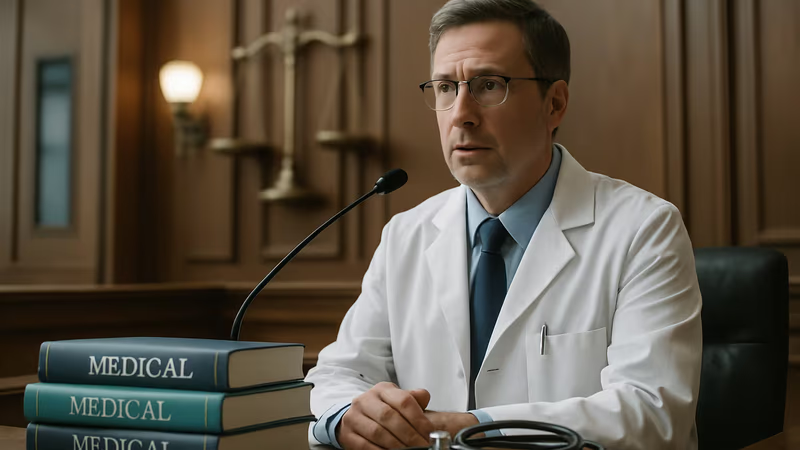
When pursuing a personal injury claim in New York, expert witnesses often play a crucial role in establishing medical malpractice or proving the standard of care. However, a recent Court of Appeals decision in Daniele v Pain Mgt. Ctr. of Long Is. highlights a critical limitation: experts must testify within their area of specialization or establish a proper foundation for their opinions.
The Daniele Case: A Cautionary Tale for Personal Injury Attorneys
In Daniele v Pain Mgt. Ctr. of Long Is., 2019 NY Slip Op 00093 (2d Dept. 2019), the Second Department reversed a trial court decision that allowed two physicians to testify as expert witnesses in emergency medicine outside their areas of specialization.
The case involved plaintiff’s experts Jason Brajer and Paul Edelson, who were permitted to testify about emergency medicine standards despite lacking proper qualifications in that field. The appellate court found this to be reversible error, emphasizing that “here a physician opines outside his or her area of specialization, a foundation must be laid tending to support the reliability of the opinion rendered.”
New York’s Expert Witness Standards for Medical Testimony
The General Rule: Stay Within Your Specialty
New York law requires that medical expert witnesses possess appropriate qualifications in the specific area about which they’re testifying. This rule serves several important purposes:
- Ensures reliability of expert opinions presented to juries
- Maintains professional standards within the medical community
- Protects defendants from unfounded allegations based on inadequate expertise
- Preserves judicial efficiency by preventing appeals based on improper expert testimony
When Experts Can Testify Outside Their Specialty
While the general rule requires experts to testify within their specialization, New York courts do allow some flexibility when proper foundation is established. An expert may testify outside their primary specialty if they can demonstrate:
- Relevant training or experience in the subject area
- Specialized knowledge gained through practice or education
- Sufficient familiarity with applicable standards of care
- Current understanding of practices in the field
The Foundation Requirement: What Courts Look For
Adequate Foundation Elements
When a physician seeks to testify outside their board-certified specialty, courts examine several factors:
Training and Education:
- Formal residency or fellowship training
- Continuing education in the relevant field
- Board certification or eligibility
Practical Experience:
- Regular practice in the area
- Hospital privileges in relevant departments
- Recent experience with similar cases
Knowledge of Standards:
- Familiarity with current practices
- Understanding of applicable guidelines
- Awareness of peer-reviewed literature
Common Foundation Failures
The Daniele case illustrates typical problems with expert qualification:
Dr. Brajer’s Issues:
- Board-certified in anesthesiology and pain management
- No formal training in emergency medicine
- Limited experience being called to emergency rooms
- Failed to adequately explain familiarity with emergency medicine standards
Dr. Edelson’s Issues:
- Pediatrician by training
- Emergency medicine experience limited to moonlighting
- Experience occurred in late 1970s/early 1980s
- Nearly 30-year gap between experience and case incident
- Failed to demonstrate current knowledge of emergency medicine practices
Practical Implications for Long Island and NYC Personal Injury Cases
For Plaintiffs’ Attorneys
When selecting expert witnesses for personal injury cases in Nassau County, Suffolk County, or the five boroughs:
- Choose specialists in the relevant field whenever possible
- Thoroughly vet expert qualifications before retention
- Prepare detailed foundation testimony if using experts outside their primary specialty
- Consider the timing of expert experience relative to the incident date
For Defense Attorneys
The Daniele decision provides ammunition for challenging opposing expert witnesses:
- Scrutinize expert CVs for relevant experience gaps
- Challenge stale experience that’s too remote in time
- File pre-trial motions to exclude unqualified experts
- Preserve objections at trial for appellate review
Impact on Different Types of Personal Injury Cases
Medical Malpractice Claims
In medical malpractice cases, the Daniele ruling particularly affects:
- Emergency room malpractice claims requiring emergency medicine experts
- Surgical complications needing specialist surgeon testimony
- Anesthesia errors requiring anesthesiology expertise
Motor Vehicle Accidents
Car accident and truck accident cases may involve:
- Orthopedic injuries requiring orthopedic specialists
- Neurological damage needing neurology or neurosurgery experts
- Pain management requiring certified pain specialists
Workplace Injuries
Workers’ compensation cases often involve:
- Occupational medicine specialists
- Physical therapy experts for rehabilitation issues
- Vocational rehabilitation specialists for disability assessments
Best Practices for Expert Witness Selection
Due Diligence Steps
- Verify board certifications through official medical boards
- Review recent publications and continuing education
- Confirm current practice in the relevant specialty
- Check disciplinary records with state medical boards
- Assess litigation experience and testimony history
Documentation Requirements
Maintain thorough records of:
- Expert’s curriculum vitae
- Board certification documentation
- Evidence of continuing education
- Practice history in relevant field
- Prior expert witness experience
Recent Trends in Expert Witness Law
Increasing Scrutiny
New York courts are applying more rigorous standards to expert witness qualifications, following trends in federal courts under the Daubert standard. This includes:
- Enhanced pre-trial scrutiny through Frye hearings
- Stricter foundation requirements for out-of-specialty testimony
- Greater emphasis on reliability of expert opinions
Technology and Telemedicine Impact
The rise of telemedicine and remote consultations is creating new challenges for expert witness qualification:
- Defining relevant experience in virtual care settings
- Establishing standards for remote medical consultations
- Addressing scope limitations in telehealth practices
Frequently Asked Questions
Can a family doctor testify about specialist care?
Generally, no. Family physicians cannot testify about specialist standards of care unless they can establish proper foundation through additional training, experience, or certification in the specialty area.
How recent must expert experience be?
While there’s no bright-line rule, the Daniele case suggests that experience from 30+ years ago may be too stale. Courts prefer experts with current or recent experience in the relevant field.
What happens if an expert is deemed unqualified?
If a court finds an expert unqualified, their testimony may be excluded, potentially resulting in:
- Dismissal of claims lacking other proof
- Reduced damages if key opinions are excluded
- Settlement pressure due to weakened case
Can experts refresh their qualifications?
Yes, physicians can strengthen their expert witness qualifications through:
- Continuing education programs
- Clinical observation in relevant specialties
- Literature review and staying current
- Formal training or certification programs
Are there specialty-specific requirements?
Some medical specialties have specific requirements for expert witness testimony, particularly in fields like:
- Emergency medicine requiring board certification
- Radiology needing specific imaging expertise
- Anesthesiology requiring current practice experience
Protecting Your Personal Injury Case
The Daniele decision underscores the importance of careful expert witness selection in New York personal injury litigation. Whether you’re dealing with a slip and fall case, construction accident, or complex medical malpractice claim, having properly qualified experts is essential to success.
At the Law Office of Jason Tenenbaum, we understand the critical role expert witnesses play in personal injury cases. Our experienced team carefully vets all expert witnesses to ensure they meet New York’s strict qualification standards and can withstand appellate scrutiny.
If you’ve been injured due to someone else’s negligence, don’t let procedural issues undermine your case. Contact our experienced Long Island and NYC personal injury attorneys to discuss your claim and ensure you have the qualified expert testimony needed for success.
Call 516-750-0595 for a free consultation with our experienced personal injury legal team.
Legal Context
Why This Matters for Your Case
New York's no-fault insurance system, established under Insurance Law Article 51, is one of the most complex insurance frameworks in the country. Every motorist must carry Personal Injury Protection coverage that pays medical expenses and lost wages regardless of fault, up to $50,000 per person.
But insurers routinely deny valid claims using peer reviews, EUO scheduling tactics, fee schedule reductions, and coverage defenses. The Law Office of Jason Tenenbaum has handled over 100,000 no-fault cases since 2002 — from initial claim submissions through arbitration before the American Arbitration Association, trials in Civil Court and Supreme Court, and appeals to the Appellate Term and Appellate Division. Jason Tenenbaum is one of the few attorneys in the state who both writes his own appellate briefs and tries his own cases.
His 2,353+ published legal articles on no-fault practice are cited by attorneys throughout New York. Whether you are dealing with a medical necessity denial, an EUO no-show defense, a fee schedule dispute, or a coverage question, this article provides the kind of detailed case-law analysis that helps practitioners and claimants understand exactly where the law stands.
About This Topic
New York No-Fault Insurance Law
New York's no-fault insurance system requires every driver to carry Personal Injury Protection (PIP) coverage that pays medical expenses and lost wages regardless of who caused the accident. But insurers routinely deny, delay, and underpay valid claims — using peer reviews, IME no-shows, and fee schedule defenses to avoid paying providers and injured claimants. Attorney Jason Tenenbaum has litigated thousands of no-fault arbitrations and court cases since 2002.
271 published articles in No-Fault
Keep Reading
More No-Fault Analysis
Priority of Payment Regulation Has No Force in Arbitration: First and Second Departments Agree
Both the First and Second Departments have held that the priority of payment regulation under 11 NYCRR 65-3.15 is of no force or effect in no-fault arbitration proceedings....
Feb 25, 2026
How Insurance Companies Use Colossus Software to Undervalue Your Injury Claim
Insurance companies use Colossus software to lowball your injury claim. Learn how this system works and how a Long Island attorney can fight back. Call 516-750-0595.
Feb 18, 2026
Comparative Negligence not found
New York appellate court clarifies that plaintiffs don't need to prove absence of comparative negligence for partial summary judgment on defendant liability in personal injury...
May 14, 2020
Incorrect zipcode is fatal to mailing of the letters
A New York court ruling demonstrates how an incorrect zip code on IME scheduling letters can defeat an insurance company's proof of mailing in no-fault cases.
Dec 23, 2014
Welcome to Tenenbaum Law: Your Personal Injury Attorney for NYC and Long Island
Experienced personal injury attorney serving NYC and Long Island. Get expert legal representation for accidents, injuries, and insurance claims. Call 516-750-0595 for consultation.
Oct 7, 2009
Staged accident fraud
Learn about staged accident fraud in NY no-fault insurance cases. Court analysis of intentional collision factors including policy age, inconsistent testimony, and party...
Mar 7, 2022Was this article helpful?

About the Author
Jason Tenenbaum, Esq.
Jason Tenenbaum is the founding attorney of the Law Office of Jason Tenenbaum, P.C., headquartered at 326 Walt Whitman Road, Suite C, Huntington Station, New York 11746. With over 24 years of experience since founding the firm in 2002, Jason has written more than 1,000 appeals, handled over 100,000 no-fault insurance cases, and recovered over $100 million for clients across Long Island, Nassau County, Suffolk County, Queens, Brooklyn, Manhattan, the Bronx, and Staten Island. He is one of the few attorneys in the state who both writes his own appellate briefs and tries his own cases.
Jason is admitted to practice in New York, New Jersey, Florida, Texas, Georgia, and Michigan state courts, as well as multiple federal courts. His 2,353+ published legal articles analyzing New York case law, procedural developments, and litigation strategy make him one of the most prolific legal commentators in the state. He earned his Juris Doctor from Syracuse University College of Law.
Disclaimer: This article is published by the Law Office of Jason Tenenbaum, P.C. for informational and educational purposes only. It does not constitute legal advice, and no attorney-client relationship is formed by reading this content. The legal principles discussed may not apply to your specific situation, and the law may have changed since this article was last updated.
New York law varies by jurisdiction — court decisions in one Appellate Division department may not be followed in another, and local court rules in Nassau County Supreme Court differ from those in Suffolk County Supreme Court, Kings County Civil Court, or Queens County Supreme Court. The Appellate Division, Second Department (which covers Long Island, Brooklyn, Queens, and Staten Island) and the Appellate Term (which hears appeals from lower courts) each have distinct procedural requirements and precedents that affect litigation strategy.
If you need legal help with a no-fault matter, contact our office at (516) 750-0595 for a free consultation. We serve clients throughout Long Island (Huntington, Babylon, Islip, Brookhaven, Smithtown, Riverhead, Southampton, East Hampton), Nassau County (Hempstead, Garden City, Mineola, Great Neck, Manhasset, Freeport, Long Beach, Rockville Centre, Valley Stream, Westbury, Hicksville, Massapequa), Suffolk County (Hauppauge, Deer Park, Bay Shore, Central Islip, Patchogue, Brentwood), Queens, Brooklyn, Manhattan, the Bronx, Staten Island, and Westchester County. Prior results do not guarantee a similar outcome.