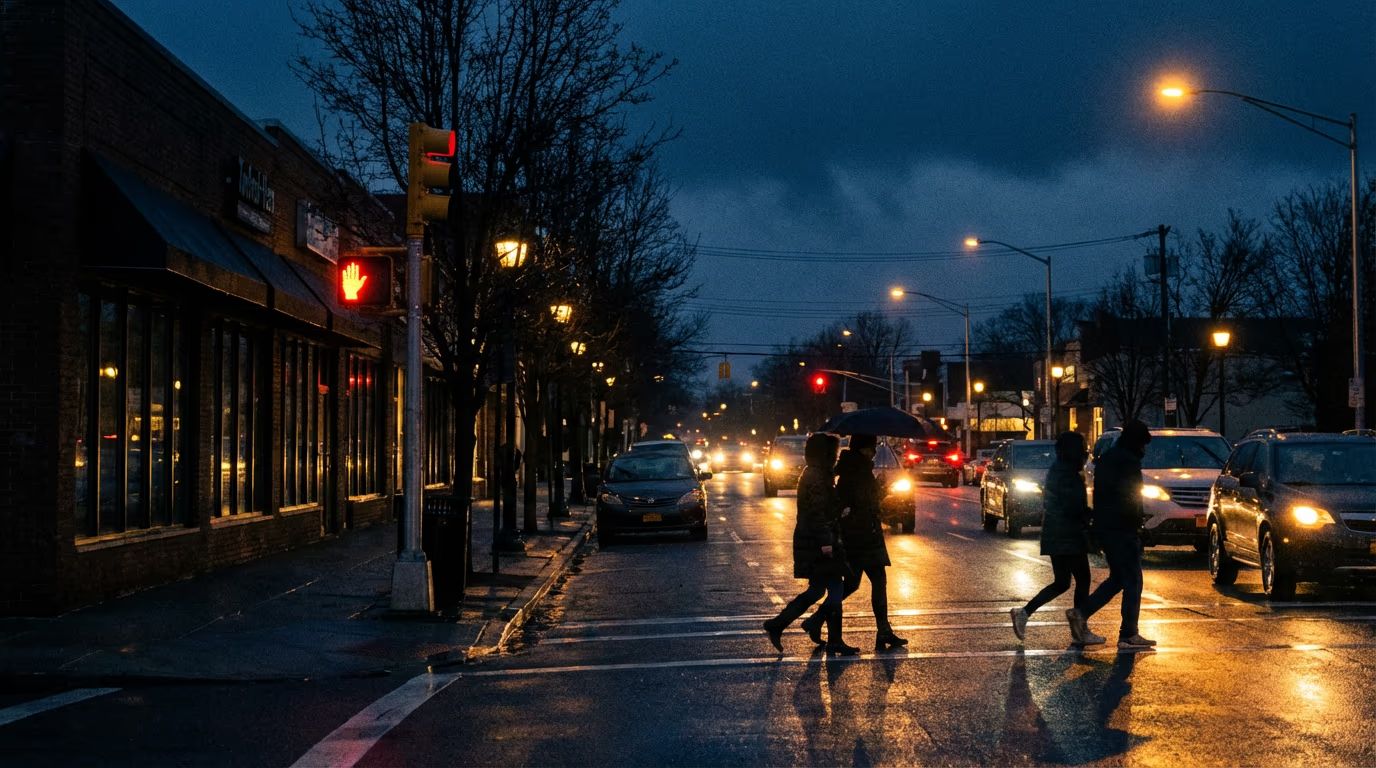
Long Island Pedestrian Accident Attorneys
Long Island Pedestrian
Accident Attorney
Pedestrians have zero protection when struck by a vehicle. If you or a loved one was hit by a car, truck, or bus while walking on Long Island, you have the right to full compensation — and you need an attorney who will fight to get it.
Serving Long Island, Nassau County, Suffolk County & All of NYC
$100M+
Recovered
24+
Years Experience
$0
Upfront Cost
24/7
Available
Quick Answer
Pedestrian accident settlements on Long Island range from $50,000 to over $2,000,000, depending on injury severity and liability. Under New York law (VTL §1146), drivers must exercise due care to avoid striking pedestrians — even if the pedestrian was jaywalking. The statute of limitations is 3 years (CPLR §214), and New York’s comparative negligence law (CPLR §1411) allows you to recover damages even if you were partially at fault.
Last updated: March 2026 · Every case is unique — these ranges reflect general Long Island outcomes and are not guarantees.
Why Choose Our Firm
Why Pedestrian Accident Victims Choose Us
Aggressive Pedestrian Injury Advocacy
Pedestrian accidents produce some of the most devastating injuries in personal injury law. We have extensive experience recovering maximum compensation for pedestrian victims across Nassau and Suffolk Counties.
No Fee Unless We Win
Every pedestrian accident case is handled on contingency. You pay nothing upfront and nothing out of pocket. If we don't recover compensation for you, you owe us nothing — zero risk to you.
We Investigate Every Detail
Accident reconstruction, traffic camera footage, police reports, witness interviews, cell phone records — we leave no stone unturned building your case with evidence that wins.
Deep Knowledge of NY Pedestrian Laws
VTL §1151 right-of-way rules, VTL §1146 due care requirements, crosswalk laws, comparative negligence — we know the statutes that protect pedestrians and how to apply them to your case.
24+ Years of Experience
Jason Tenenbaum has practiced personal injury law on Long Island since 2002, with over 1,000 appeals written, 100K+ no-fault cases handled, and the ability to try his own cases — the attorney who knows your file is the one in front of the judge.
Familiar With Long Island's Dangerous Roads
We know the intersections, the traffic patterns, and the problem areas — from Route 110 to Hempstead Turnpike to Sunrise Highway. Local knowledge strengthens every pedestrian accident claim we handle.
Proven Track Record
Pedestrian Accident Case Recoveries
Pedestrian accidents produce catastrophic injuries. Here is what our advocacy has achieved for victims across Long Island.
$1.8M
Pedestrian Struck in Crosswalk
Nassau County
$1.1M
Pedestrian Hit by Turning Vehicle
Suffolk County
$750K
Pedestrian Struck in Parking Lot
Hempstead
$625K
Pedestrian Hit While Jogging
Huntington
*Past results do not guarantee similar outcomes. Every case is different.
Simple Process
Getting Started Takes 5 Minutes
Call or Click
Reach us 24/7 at (516) 750-0595 or fill out our online form. We respond within minutes.
Free Case Review
We review the accident details, obtain police reports and traffic camera footage, consult with experts, and determine the strength of your claim — at no cost to you.
We Fight. You Heal.
We handle the investigation, negotiations, and trial if needed. You focus on recovery. We don't get paid until you do.
What Are My Legal Rights After Being Hit by a Car on Long Island?
Pedestrian accidents are among the most devastating events in personal injury law. Unlike occupants of a vehicle — who are protected by seatbelts, airbags, and a steel frame — pedestrians have nothing between them and a two-ton vehicle traveling at speed. The injuries are almost always severe, the medical costs are enormous, and the impact on the victim's life is often permanent. New York law recognizes this vulnerability and provides strong protections for pedestrians, but recovering full compensation requires an attorney who understands how to navigate the legal and insurance complexities of these cases.
| Injury Severity | Settlement Range | Typical Timeline |
|---|---|---|
| Minor (sprains, contusions, minor fractures) | $25,000 – $100,000 | 3–6 months |
| Moderate (fractures, herniated discs, concussion) | $100,000 – $750,000 | 6–18 months |
| Severe (TBI, spinal cord, amputation, wrongful death) | $750,000 – $2,000,000+ | 1–3+ years |
Every case is unique. These ranges reflect general Long Island case outcomes and are not guarantees of results.
VTL §1151 — Crosswalk Right of Way
Drivers must yield the right of way to pedestrians in marked crosswalks. A failure to yield is a traffic infraction that establishes negligence per se in a civil lawsuit — meaning the violation alone proves the driver breached their duty of care. This applies to both marked and unmarked crosswalks at every intersection.
Under New York Vehicle and Traffic Law (VTL) §1151, pedestrians have the right of way in marked crosswalks when the traffic signal is in their favor. Drivers must yield to pedestrians who have lawfully entered a crosswalk, and a failure to yield is a traffic infraction that establishes negligence per se in a civil action. VTL §1152 governs pedestrian crossings at locations other than crosswalks — while pedestrians must yield to vehicles in those situations, drivers still have obligations to exercise due care.
VTL §1146 — sometimes referenced alongside Leandra's Law for its emphasis on driver responsibility — imposes a duty on every driver to exercise due care to avoid striking a pedestrian. This statute applies regardless of whether the pedestrian was in a crosswalk, and it creates a powerful tool for establishing liability. A driver who hits a pedestrian can rarely argue they had no duty to avoid the collision.
New York follows a pure comparative negligence rule under CPLR §1411. This rule is critically important in pedestrian accident cases. Insurance companies almost always try to shift blame to the pedestrian — claiming they jaywalked, were distracted by their phone, or wore dark clothing at night. Even if a jury assigns some fault to the pedestrian, the victim can still recover.
For example, a pedestrian found 30% at fault for crossing outside a crosswalk who suffers $1,000,000 in damages would still recover $700,000. Even at 80% fault, the pedestrian recovers 20% of damages. This pure comparative negligence system makes it worth pursuing a claim even when liability is not clear-cut.
The statute of limitations for pedestrian accident claims is generally three years from the date of the accident under CPLR §214. However, if a government entity is involved — a county vehicle, a state-maintained road, or a municipal traffic signal malfunction — you must file a notice of claim within 90 days under General Municipal Law §50-e. No-fault PIP coverage applies to pedestrians struck by motor vehicles, providing up to $50,000 in medical and lost wage benefits through the driver's auto insurance. Filing a no-fault application within 30 days of the accident is essential to preserving these benefits.
Hit by a car while walking on Long Island?
Get a free case evaluation. We'll review what happened, explain your legal options, and tell you what your case may be worth.
Free Case ReviewWhat Are the Most Common Types of Pedestrian Accidents on Long Island?
Long Island's mix of suburban sprawl, high-speed arterials, aging infrastructure, and heavy traffic creates a uniquely dangerous environment for pedestrians. Understanding the common causes of pedestrian accidents helps establish liability and strengthens your claim.
Distracted driving
Texting, scrolling through apps, adjusting GPS navigation, and phone conversations divert a driver's attention from the road during the critical moments when a pedestrian enters their path. A driver looking at their phone for just five seconds at 30 mph covers the length of a football field without seeing the road. VTL §1225-c prohibits the use of handheld electronic devices while driving, and a violation creates a strong presumption of negligence.
Failure to yield at crosswalks and intersections
Drivers who roll through crosswalks, make aggressive turns through pedestrian traffic, or ignore yield-to-pedestrian signs are responsible for a significant portion of pedestrian accidents on Long Island. This is particularly common at busy intersections where drivers are focused on gaps in vehicle traffic rather than watching for people on foot.
Left-turn accidents
Left-turning vehicles are disproportionately involved in pedestrian fatalities nationwide. The driver's attention is focused on oncoming traffic and finding a gap to turn — not on the pedestrian entering the crosswalk from the driver's right. The pedestrian is often in the driver's blind spot, and the impact occurs with the front of the vehicle at near-full turning speed.
Speeding in residential areas and school zones
Speed is the single largest determinant of pedestrian injury severity. A pedestrian struck at 20 mph has a 95% survival rate. At 40 mph, the fatality rate climbs to 85%. Drivers who speed through residential neighborhoods, school zones, and commercial districts dramatically increase the likelihood of striking a pedestrian and the severity of injuries when they do.
Drunk and impaired driving
Alcohol and drug impairment reduces reaction time, impairs judgment, and creates tunnel vision — all of which make it far more likely that a driver will fail to see a pedestrian until it is too late. Impaired driving is a factor in a disproportionate number of fatal pedestrian accidents, particularly during evening and nighttime hours.
Poor visibility
Nighttime, dawn, dusk, and adverse weather conditions significantly increase pedestrian accident risk. Many Long Island roads lack adequate street lighting, and crosswalks are often poorly illuminated. When visibility is reduced, the burden on drivers to operate at safe speeds and remain vigilant increases — but many drivers fail to adjust their behavior to conditions.
Backing vehicles in parking lots and driveways
Pedestrians are struck by backing vehicles in shopping center parking lots, residential driveways, and commercial loading areas with alarming frequency. Children and elderly pedestrians are particularly vulnerable because they may not be visible in the driver's mirrors or rear camera view. Drivers have an absolute duty to ensure the path behind them is clear before reversing.
Running red lights and stop signs
Drivers who blow through red lights and stop signs create some of the most violent pedestrian impact scenarios because the pedestrian has every reason to believe they are safe to cross. These accidents often involve high vehicle speeds and devastating injuries. Red-light camera evidence and intersection surveillance footage are critical in these cases.
What Are the Most Common Pedestrian Accident Injuries?
Because pedestrians have no protective barrier, the injuries sustained in vehicle-pedestrian collisions are typically far more severe than those in vehicle-to-vehicle accidents. The human body simply cannot absorb the force of a moving vehicle without catastrophic consequences.
Traumatic brain injuries
Pedestrians struck by vehicles frequently suffer traumatic brain injuries (TBI) from impact with the vehicle hood, windshield, or pavement. TBIs range from concussions that resolve over weeks to severe brain damage that causes permanent cognitive impairment, personality changes, memory loss, and the inability to live independently. These injuries may not be immediately apparent — symptoms can emerge hours or days after the accident — making immediate medical evaluation essential.
Spinal cord injuries and paralysis
The violent force of a vehicle striking a pedestrian can fracture vertebrae and damage the spinal cord, resulting in partial or complete paralysis. Paraplegia (loss of lower body function) and quadriplegia (loss of function in all four limbs) require lifelong medical care, adaptive equipment, home modifications, and full-time assistance. The lifetime cost of spinal cord injury care can exceed $5 million.
Broken bones and fractures
Pedestrian accidents commonly cause fractures of the pelvis, hips, legs, ankles, arms, and ribs. The pelvis and lower extremities absorb the initial impact from a vehicle's bumper and hood, while arms and wrists fracture as the victim braces for impact or is thrown to the ground. Complex fractures often require surgical repair with plates, screws, and rods, followed by extensive rehabilitation and physical therapy.
Internal organ damage
The blunt force trauma of a vehicle striking a pedestrian's torso can cause internal bleeding, ruptured organs (spleen, liver, kidneys), and damage to the lungs and diaphragm. Internal injuries are life-threatening emergencies that may not produce visible external symptoms. Emergency surgery is often required, and victims may face organ removal, long-term complications, or permanent impairment.
Soft tissue injuries and road rash
When a pedestrian is thrown to the pavement, the resulting road rash can strip away multiple layers of skin, requiring skin grafts and leaving permanent scarring and disfigurement. Deep contusions, torn ligaments, and muscle damage cause chronic pain and limit mobility for months or years. Insurance companies downplay these injuries, but the impact on daily life can be devastating.
Emotional trauma and PTSD
Survivors of pedestrian accidents frequently develop post-traumatic stress disorder (PTSD), anxiety disorders, depression, and a debilitating fear of walking near traffic. These psychological injuries are compensable under New York law and can be as disabling as physical injuries — preventing victims from working, socializing, or leaving their homes without extreme anxiety.
Wrongful death
Tragically, many pedestrian accidents are fatal. When a loved one is killed by a negligent driver, the deceased person's estate can bring a wrongful death action under EPTL §5-4.1, seeking compensation for the family's pecuniary loss — the financial support, services, and guidance the deceased would have provided. The personal representative of the estate may also pursue a survival action for the victim's conscious pain and suffering prior to death.
What Are the Most Dangerous Intersections for Pedestrians on Long Island?
Long Island has some of the most dangerous roads for pedestrians in the New York metropolitan area. High traffic volumes, wide multi-lane arterials, inadequate pedestrian infrastructure, and aggressive driver behavior combine to create corridors where pedestrian accidents cluster.
Route 110 (Walt Whitman Road) — the corridor running through Huntington Station, Melville, and Farmingdale — is one of Suffolk County's most dangerous roads for pedestrians. The combination of commercial traffic, high speeds, and limited crosswalk infrastructure makes crossing Route 110 hazardous, particularly near shopping centers and bus stops where pedestrians are forced to cross multiple lanes of fast-moving traffic.
Hempstead Turnpike, stretching across Nassau County from the Queens border through Hempstead, Levittown, and beyond, consistently ranks among Long Island's most dangerous pedestrian corridors. Its wide lanes, high speeds, and heavy commercial traffic create conditions where drivers frequently fail to yield to pedestrians crossing at intersections and marked crosswalks.
Sunrise Highway pedestrian crossings — particularly in the Bay Shore, Islip, and Patchogue areas — present serious dangers for pedestrians navigating between commercial areas on opposite sides of this major east-west arterial. The highway's design prioritizes vehicle throughput over pedestrian safety, with crosswalk distances that leave pedestrians exposed to traffic for extended periods.
Northern Boulevard in Nassau County, Main Street corridors in Huntington, Farmingdale, and Patchogue, and school zones throughout both counties are additional high-risk areas for pedestrian accidents. New York State Department of Transportation crash data consistently identifies these corridors as pedestrian accident hotspots, and our firm's experience handling cases along these roads gives us a strategic advantage in understanding the specific hazards involved.
What Should I Do After Being Hit by a Car While Walking on Long Island?
The actions you take in the minutes, hours, and days after being struck by a vehicle directly affect the strength of your legal claim and the compensation you can recover. Follow these steps to protect your rights:
Call 911 and seek medical attention
Even if you feel you can walk away, call 911. Adrenaline masks pain and serious injuries — internal bleeding, traumatic brain injuries, and spinal damage — may not produce symptoms for hours or days. A 911 call creates an official record, dispatches EMS, and triggers a police accident report that documents the scene and the driver's information.
Stay at the scene if possible
If your injuries allow it, remain at the scene until police arrive. Leaving before speaking to officers can complicate your claim and make it harder to establish what happened. Your presence ensures the police report includes your account of events.
Get the driver's information
Obtain the driver's name, license number, license plate number, insurance company, and policy number. If the driver has passengers, get their names as well. If the driver attempts to leave, note as much identifying information as possible — plate number, vehicle make and model, color, and direction of travel.
Document everything
Photograph the scene from multiple angles: the crosswalk or intersection, the vehicle (including damage), your injuries, traffic signals, road conditions, skid marks, and any debris. Capture the lighting conditions and the presence or absence of pedestrian signage. Time-stamped photos from your phone create powerful evidence of exactly what the scene looked like.
Get witness names and contact info
Other pedestrians, nearby store employees, and drivers who stopped can provide critical independent testimony about what they saw. Witness statements carry enormous weight, and memories fade quickly — within weeks, details become unreliable. Get names, phone numbers, and email addresses before they leave the scene.
Do NOT give recorded statements to the driver's insurer
The driver's insurance company will contact you quickly — often within days. Their adjusters are trained to ask questions designed to minimize your claim or shift blame to you. Do not give a recorded statement, sign any documents, or accept any payment without first speaking to an attorney.
File a no-fault claim within 30 days
New York's no-fault system provides pedestrians hit by vehicles with PIP benefits (up to $50,000) for medical expenses and lost wages through the driver's auto insurance. You must file a no-fault application within 30 days of the accident. Missing this deadline can result in losing your right to these benefits entirely.
Contact a pedestrian accident attorney immediately
Time is your enemy in pedestrian accident cases. Traffic camera footage is typically overwritten within 30 to 72 hours. Nearby businesses with surveillance cameras may record over their footage. Witnesses disperse and forget. Physical evidence at the scene — skid marks, debris, damaged crosswalk signals — is cleaned up or repaired. The sooner you contact an experienced pedestrian accident attorney, the more evidence we can preserve.
How Does Insurance Work After a Pedestrian Accident in New York?
Insurance companies handle pedestrian accident claims with the same objective they bring to every claim: pay as little as possible, as quickly as possible. Understanding their tactics is essential to protecting the full value of your case.
The most common strategy is blaming the pedestrian. The insurer will argue you were jaywalking, crossing against a signal, distracted by your phone, wearing dark clothing at night, or walking outside the crosswalk. They use comparative fault aggressively because every percentage point of fault they can attribute to you reduces their payout proportionally. Even in cases where the driver ran a red light, the insurance company will look for any argument that shifts partial blame to the pedestrian.
Disputing the severity of injuries is another standard tactic. Insurers will argue that your injuries are not as bad as claimed, that your symptoms are exaggerated, or that pre-existing conditions are responsible for your current medical problems. They request extensive medical records going back years to find any prior complaint that could be used to attribute your injuries to something other than the accident. They send you to their own "independent" medical examiners — doctors who regularly testify on behalf of insurance companies and whose opinions predictably minimize injury severity.
Lowball settlement offers arrive early — often before you have finished medical treatment and before the full extent of your injuries is known. A quick $25,000 offer for what turns out to be a traumatic brain injury requiring years of cognitive rehabilitation and costing hundreds of thousands in future medical care would be a catastrophic mistake to accept. Once you sign a release, you cannot go back for more money. Insurance companies know that injured pedestrians facing mounting medical bills and lost income are under financial pressure, and they exploit that vulnerability.
Surveillance and social media monitoring are increasingly common. Insurers hire investigators to follow you, photograph you at the grocery store or picking up your children, and use that footage to argue your injuries are exaggerated. They also monitor your Facebook, Instagram, and other social media accounts. A single photo of you smiling at a family gathering can be used out of context to undermine your pain and suffering claim.
However, having an experienced attorney changes the negotiation dynamic. Insurance companies know the difference between an unrepresented pedestrian they can pressure and an experienced trial lawyer who will take the case to a jury.
New York Pedestrian Safety Laws
New York has enacted a comprehensive framework of pedestrian safety laws that protect walkers and create liability for drivers who violate them. Understanding these statutes is critical to proving fault in a pedestrian accident case.
VTL §1151 — Pedestrians' right of way in crosswalks. When traffic control signals are not in place or not in operation, the driver of a vehicle must yield the right of way to a pedestrian crossing within a marked crosswalk or within any unmarked crosswalk at an intersection. This is the foundational statute for pedestrian right-of-way claims, and a driver's violation of this section constitutes negligence per se — meaning the violation alone establishes the breach of duty element in a negligence case.
VTL §1152 — Crossing at other than crosswalks. A pedestrian crossing a road at any point other than within a marked or unmarked crosswalk must yield the right of way to all vehicles. However, this does not absolve drivers of their separate duty under VTL §1146. Even when a pedestrian is crossing outside a crosswalk, the driver must still exercise due care to avoid the collision.
VTL §1146 — Drivers to exercise due care. Every driver must exercise due care to avoid colliding with any pedestrian and must give warning by sounding the horn when necessary. This overarching duty applies everywhere — crosswalks, intersections, mid-block crossings, parking lots, and residential streets. It is the statute most frequently cited in pedestrian accident lawsuits because it applies in virtually every scenario.
Right of Way laws and speed regulations provide additional protections. Speed limits of 15 mph in school zones and 25 mph in residential areas reflect the recognized danger that speeding poses to pedestrians. Drivers who exceed posted speed limits in these zones face enhanced liability in civil actions. Hit-and-run drivers face criminal penalties under VTL §600, including felony charges if the pedestrian suffers serious physical injury or death, and the criminal case can provide powerful evidence for the civil claim.
Why Pedestrian Accident Injuries Are Frequently Catastrophic
The physics of a vehicle striking a pedestrian produce injuries that are fundamentally different from — and almost always more severe than — those in vehicle-to-vehicle collisions. Understanding why pedestrian injuries are so devastating strengthens both the medical documentation strategy and the damages presentation in your case.
The numbers are stark. A pedestrian struck by a vehicle traveling at 30 mph faces approximately a 40% chance of death. At 40 mph, the fatality rate climbs to roughly 85%. By contrast, an occupant of a passenger vehicle struck at the same speeds — protected by seatbelts, airbags, crumple zones, and a steel frame — faces a fatality risk of approximately 2% at 30 mph. This disparity exists because a pedestrian absorbs the full kinetic energy of the collision with no intervening protection.
In fact, the human body is simply not designed to withstand the forces a multi-ton vehicle generates at even moderate speeds. Every mile per hour matters. The relationship between vehicle speed and pedestrian injury severity is not linear but exponential — small increases in speed produce dramatically worse outcomes.
The biomechanics of a pedestrian collision follow a predictable and devastating pattern. In a typical front-end impact, the vehicle's bumper strikes the pedestrian's legs at or below knee height, fracturing the tibia, fibula, or both. The impact often shatters the knee joint. The pedestrian's body then rotates onto the vehicle's hood, with the torso and head striking the hood surface or windshield.
This secondary impact frequently causes traumatic brain injuries. The head decelerates violently upon contact with the vehicle, and the brain continues to move inside the skull, tearing blood vessels and bruising neural tissue. Finally, the pedestrian is thrown from the vehicle and strikes the pavement. This third impact can produce additional skull fractures, spinal cord injuries, and severe road rash.
This triple-impact mechanism — legs, torso/head against the vehicle, and full body against the pavement — is why pedestrian accidents produce such a wide range of simultaneous injuries.
The most common injury patterns in pedestrian accidents include traumatic brain injuries (TBI), which occur in a significant percentage of all pedestrian collisions. Even when a pedestrian survives the initial impact, TBI can cause permanent cognitive impairment, memory loss, personality changes, chronic headaches, and seizure disorders. These conditions fundamentally alter every aspect of daily life.
Additionally, spinal cord injuries resulting from the violent forces of impact can cause partial or complete paralysis — paraplegia or quadriplegia. These injuries require lifelong medical care, adaptive equipment, and home modifications costing millions of dollars over a lifetime. Crushed pelvis injuries are also particularly common because the vehicle's bumper strikes at hip height. Pelvic fractures are among the most painful and debilitating orthopedic injuries, often requiring multiple surgeries, extended rehabilitation, and permanent limitations on mobility.
Internal organ damage — ruptured spleen, lacerated liver, punctured lungs, and kidney trauma — results from the blunt force impact to the torso. These injuries may not present symptoms immediately, making prompt emergency medical evaluation essential.
Long Island presents specific pedestrian dangers that contribute to the frequency and severity of these accidents. Many of Long Island's major commercial corridors — Hempstead Turnpike, Route 110, Sunrise Highway, and Northern Boulevard — are wide, multi-lane arterials designed primarily for high-speed vehicle throughput with minimal pedestrian infrastructure. Crosswalk distances across four or six lanes of traffic leave pedestrians exposed for 20 to 30 seconds or more, creating extended windows of vulnerability.
Additionally, inadequate pedestrian signal timing at many intersections means that elderly pedestrians, those with mobility impairments, and parents with young children cannot complete the crossing before the signal changes. LIRR station crossings present a particularly acute danger. Commuters exiting trains at stations across Nassau and Suffolk Counties must cross busy roads during rush hour, often in poor lighting and at locations where drivers are impatient and traveling at speed.
School zone violations remain a persistent problem despite reduced speed limits. Drivers routinely exceed 15 mph limits near schools during arrival and dismissal times.
Proving driver fault in pedestrian accident cases requires specialized investigative techniques that our firm employs in every case. We work with accident reconstructionists who analyze vehicle speed through multiple methodologies: throw distance calculations (how far the pedestrian was propelled), crush depth analysis on the vehicle's hood and bumper, skid mark measurements, and event data recorder (black box) downloads from the vehicle.
Sight-distance calculations determine whether the driver had adequate visibility to see the pedestrian and stop in time. If the driver could see the pedestrian, the failure to stop constitutes powerful evidence of inattention or excessive speed. Signal timing evidence is also critical in intersection cases. We obtain signal timing plans from the municipality and cross-reference them with witness testimony and traffic camera footage to prove whether the pedestrian had the walk signal when they entered the crosswalk.
In cases involving poor visibility — nighttime accidents, dawn and dusk collisions, or accidents in rain and fog — we retain lighting experts. These experts measure ambient illumination at the accident scene and determine whether the pedestrian was visible to a reasonably attentive driver under the actual conditions at the time of the crash.
Pedestrian Rights and Driver Duties Under New York Law
New York's Vehicle and Traffic Law establishes a detailed framework of rights and responsibilities governing the relationship between pedestrians and drivers. Understanding these statutes is essential to proving fault in a pedestrian accident case, because each provision creates specific legal duties whose violation constitutes evidence of negligence — and in some cases, negligence per se.
VTL §1151 requires drivers to yield the right of way to pedestrians lawfully within a crosswalk. This obligation applies to both marked crosswalks — the painted lines at signalized intersections and mid-block crossings — and unmarked crosswalks. Unmarked crosswalks exist by operation of law at every intersection where two roads meet, even if no paint or signage is present. Many drivers on Long Island do not realize that unmarked crosswalks carry the same legal force as marked ones.
As a result, failure to yield at these locations is a frequent cause of pedestrian accidents at uncontrolled intersections throughout Nassau and Suffolk Counties. A violation of §1151 is a traffic infraction. In the civil context, it establishes that the driver breached their duty of care — often the most contested element in a negligence case.
VTL §1152 addresses the converse situation: when a pedestrian crosses a roadway at a point other than within a crosswalk, the pedestrian must yield the right of way to vehicles on the road. Insurance companies seize on this statute to argue that a jaywalking pedestrian was solely responsible for the accident. However, §1152 does not eliminate the driver's independent duty of care under VTL §1146. Even when a pedestrian crosses mid-block, outside any crosswalk, and against traffic signals, every driver retains a statutory obligation to exercise due care to avoid striking that pedestrian.
The two statutes work in tandem. The pedestrian may bear some comparative fault for crossing unlawfully. However, the driver who fails to brake, swerve, or sound the horn when a pedestrian is visible in the roadway has also breached a duty. Both parties' fault percentages are for the jury to determine.
VTL §1146, often called the Vulnerable User Law, imposes a broad and powerful duty on every driver to exercise due care to avoid colliding with pedestrians, cyclists, and other vulnerable road users. Unlike the crosswalk-specific provisions of §1151 and §1152, the due care obligation under §1146 applies everywhere — crosswalks, intersections, mid-block crossings, parking lots, driveways, and residential streets.
Violations of §1146 can support both civil negligence claims and criminal charges. When a driver strikes a pedestrian and receives a §1146 citation, that citation creates a strong evidentiary foundation for the civil lawsuit. It establishes not only that the driver failed to exercise due care but that law enforcement independently confirmed that failure at the scene.
New York's pure comparative negligence rule under CPLR §1411 is critically important in pedestrian cases because insurance companies almost universally attempt to shift blame to the pedestrian. Under §1411, a pedestrian who was jaywalking, crossing against a signal, distracted by a phone, or wearing dark clothing at night can still recover damages. The recovery is simply reduced by the pedestrian's percentage of fault.
For example, if a jury determines that a pedestrian who crossed mid-block was 35% at fault and the speeding driver who failed to brake was 65% at fault, the pedestrian recovers 65% of their total damages. Even at high fault percentages — 70% or 80% — the pedestrian retains the right to compensation for the remaining share.
This pure comparative fault system makes it worth pursuing a claim in situations where other states would bar recovery entirely. It also places enormous strategic importance on how fault is argued and allocated at trial.
Certain categories of pedestrians face heightened vulnerability that both the law and juries recognize. Elderly pedestrians often walk at speeds significantly slower than the pace assumed by traffic signal timing, leaving them stranded in crosswalks when lights change. Their bones are more brittle, their balance less stable, and their ability to take evasive action is dramatically reduced compared to younger adults.
Children present a different set of risks. Their behavior is unpredictable, they are smaller and less visible to drivers, and they lack the cognitive development to accurately judge vehicle speeds and distances. Under New York law, children under four cannot be found contributorily negligent at all. Older children are held only to the standard of care expected of a reasonably prudent child of the same age and experience — a far lower threshold than the adult standard.
Pedestrians with disabilities — wheelchair users, visually impaired persons using white canes or guide dogs, and individuals with mobility impairments — are entitled to additional protections and accommodations. Drivers are expected to recognize and respond to the presence of disabled pedestrians. A failure to do so can support enhanced negligence findings.
Our firm uses specialized investigative techniques to prove driver fault in every pedestrian case we handle. We obtain traffic signal timing data from the municipality to determine whether the pedestrian had the walk signal when they entered the crosswalk and whether the signal provided adequate crossing time for the intersection's width. We analyze intersection design — lane widths, sight lines, the presence or absence of pedestrian refuge islands, turning radii, and the positioning of crosswalks relative to vehicle turning paths — to identify design deficiencies that contributed to the accident.
Vehicle speed at the point of impact is calculated through multiple methodologies including pedestrian throw distance, vehicle crush depth, skid mark analysis, and event data recorder downloads. When combined with testimony from treating physicians documenting the severity and permanence of injuries, this evidence creates a comprehensive case that demonstrates both the driver's fault and the full extent of the harm suffered by our client.
Related practice areas: Car Accident Lawyer • Bicycle Accident • Wrongful Death • Bus Accidents • Personal Injury
Pedestrian Accident Settlement Calculator
Pedestrian injuries are often severe, with settlements reflecting the impact. Estimate your case value for free.
Calculate Your EstimateEducational tool only. Not legal advice.
Common Questions
Pedestrian Accident FAQ
What should I do if I'm hit by a car while walking on Long Island?
Can I sue if I was jaywalking when hit by a car?
How much is my pedestrian accident case worth?
Who pays my medical bills after a pedestrian accident in New York?
What if the driver who hit me fled the scene (hit and run)?
How long do I have to file a pedestrian accident lawsuit in NY?
Can I recover damages if a child was hit by a car?
What if the pedestrian accident was caused by a road defect, not a driver?
Do pedestrians always have the right of way in New York?
How much is a pedestrian accident settlement worth on Long Island?
Locations
Pedestrian Accident Attorneys Serving Long Island & NYC

Reviewed & Verified By
Jason Tenenbaum, Esq.
Jason Tenenbaum is a personal injury attorney serving Long Island, Nassau & Suffolk Counties, and New York City. Admitted to practice in NY, NJ, FL, TX, GA, MI, and Federal courts, Jason is one of the few attorneys who writes his own appeals and tries his own cases. Since 2002, he has authored over 2,353 articles on no-fault insurance law, personal injury, and employment law — a resource other attorneys rely on to stay current on New York appellate decisions.
Don't Wait — Your Rights Have Deadlines
Pedestrians Deserve Justice
Every day that passes, critical evidence disappears. Traffic camera footage is overwritten. Witnesses forget what they saw. Physical evidence at the scene is cleaned up. If you or a loved one was struck by a vehicle while walking on Long Island, contact us now.
No fee unless we win. Available 24/7. Hablamos Español.