Kings County · NYC Outer Borough
Brooklyn Personal Injury Lawyer.
Maximum Compensation.
Serving Park Slope, Williamsburg, Bushwick, Crown Heights, Bedford-Stuyvesant, Bay Ridge, Brighton Beach, and every Brooklyn neighborhood. Free consultation. No fee unless we win.
Litigating in Kings County Supreme Court (360 Adams St) and the EDNY federal courthouse (225 Cadman Plaza E.)
$100M+
Recovered
24+
Years Experience
$0
Upfront Cost
2.7M
Borough Residents
Quick Answer
The Law Office of Jason Tenenbaum, P.C. represents injured Brooklyn residents and accident victims who were hurt anywhere in the borough — the BQE, the Belt Parkway, Atlantic Avenue, Flatbush Avenue, the F/G/L/A/C trains, and every major Brooklyn hospital. New York personal-injury claims have a 3-year statute of limitations under CPLR §214(5); claims against the City, MTA, NYC H+H, or NYC DOE require a 90-day Notice of Claim under General Municipal Law §50-e. Call (516) 750-0595 for a free case review.
Last reviewed: May 23, 2026 · Long Island office, 45 minutes east of Downtown Brooklyn via the BQE.
Key Takeaways
- •New York’s personal-injury statute of limitations is 3 years under CPLR §214(5); claims against the City of New York, the MTA, NYC H+H, or NYC DOE require a 90-day Notice of Claim under General Municipal Law §50-e.
- •Brooklyn is NYC’s most populous borough with roughly 2.7 million residents (about 5.9% of New York State’s population).
- •New York follows pure comparative negligence for most injury claims under CPLR §1411(a) — your award is reduced by your share of fault. In motor vehicle cases commenced on or after May 26, 2026, recovery is barred if your share of fault is greater than the other side’s.
- •Car accidents are subject to the serious-injury threshold under Insurance Law §5102(d) and the no-fault PIP cap under §5102(b).
- •Motorcycles are exempt from no-fault under Insurance Law §5103 — riders can sue directly without meeting the threshold.
- •Brooklyn Civil Court sits at 141 Livingston Street (cases $25K and under); Brooklyn Supreme Court sits at 360 Adams Street (cases over $25K — most PI matters).
- •The Law Office of Jason Tenenbaum, P.C. has recovered $100 million-plus for injured clients since 2002.
- •Free consultation, contingency fee, no fee unless we win — we advance all costs.
Borough-Wide Coverage
Personal Injury Cases We Handle in Brooklyn
From a fender-bender on Atlantic Avenue to a catastrophic construction fall in a Williamsburg high-rise, we cover every type of Brooklyn personal injury matter. Even a low-impact crash with no visible injury at the scene can develop into a real claim — see our no-injury car accident guide for the delayed-onset and diminished-value framework.
Car Accidents
BQE, Belt Parkway, Atlantic Ave, Flatbush Ave, Ocean Parkway, Eastern Parkway crashes
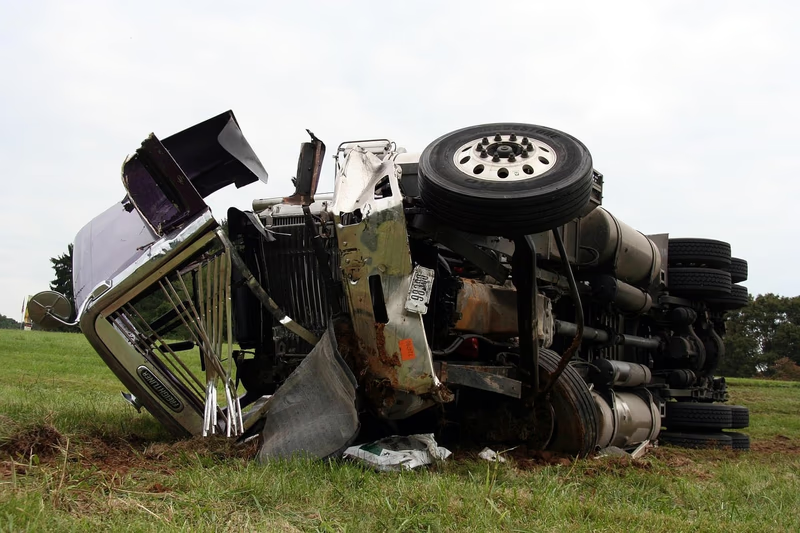
Truck Accidents
Red Hook port traffic, BQE delivery routes, Brooklyn Navy Yard freight
Motorcycle Accidents
No-fault exempt — sue immediately without meeting the §5102(d) threshold
Slip & Fall
NYC §7-210 abutting-owner liability for sidewalk falls in every Brooklyn neighborhood
Pedestrian Accidents
Brooklyn consistently ranks as NYC’s deadliest borough for pedestrians (NYPD data)
Bicycle Accidents
Prospect Park lanes, Bedford Avenue corridor, Brooklyn Bridge cycling crashes
Uber & Lyft Accidents
Rideshare crashes with $1.25M TNC coverage and complex multi-party insurance claims
Medical Malpractice
Maimonides, NYP Brooklyn Methodist, Kings County Hospital, SUNY Downstate cases
Wrongful Death
EPTL §5-4.1 estate claims filed in Kings County Surrogate’s Court
Premises Liability
Apartment building, bodega, subway station, and commercial property injuries
Dog Bites
Strict liability when the owner knows of the dog’s vicious propensity
Catastrophic Injuries
TBI, spinal cord, amputation, severe burns — life-care plans and structured settlements
Construction Accidents
Williamsburg high-rises, Downtown Brooklyn towers, Brooklyn Bridge Park — Labor Law §240
Where Accidents Happen in Brooklyn
Brooklyn’s geography produces a distinct personal-injury crash profile that doesn’t look like Long Island, Queens, or Manhattan. Two highway corridors, dense local-arterial traffic, four East River bridges, an extensive subway network, and the largest active construction pipeline in NYC all generate continuous serious-injury claims.
Highways and Parkways
The Brooklyn-Queens Expressway (I-278) is Brooklyn’s spine, running from the Verrazzano-Narrows Bridge through Bay Ridge, Sunset Park, Red Hook, Downtown Brooklyn, Williamsburg, and Greenpoint into Queens. Its triple-cantilever section under Brooklyn Heights Promenade is one of the most heavily trafficked and structurally constrained stretches of urban highway in the country. The Belt Parkway wraps the southern shoreline through Bay Ridge, Bensonhurst, Coney Island, Sheepshead Bay, Mill Basin, and Canarsie before crossing into Queens. The Prospect Expressway (NY-27) connects the BQE to Ocean Parkway and the south-Brooklyn surface grid. The Gowanus Expressway elevated section through Sunset Park and the Jackie Robinson Parkway (formerly Interboro) along the Brooklyn-Queens border round out the highway network. Each of these corridors has its own pattern of rear-end pile-ups, sideswipes during merging, and tractor-trailer underride crashes.
Major Surface Roads
Brooklyn’s busiest surface arterials cut across every neighborhood. Atlantic Avenue runs east-west from the Brooklyn waterfront through Downtown Brooklyn, Boerum Hill, Bedford-Stuyvesant, Crown Heights, Brownsville, and East New York into Queens — it is the borough’s busiest single arterial and one of NYC’s Vision Zero priority corridors. Flatbush Avenue runs from the Manhattan Bridge through Downtown Brooklyn, Prospect Heights, Flatbush, and Marine Park to Floyd Bennett Field. Ocean Parkway, Coney Island Avenue, Eastern Parkway, Fourth Avenue, Bedford Avenue, and Eighth Avenue through Sunset Park all carry continuous high-density mixed traffic that produces the bulk of borough pedestrian and cyclist injuries.
Bridges and Tunnels
Four East River crossings concentrate Manhattan-bound traffic onto Brooklyn approaches: the Brooklyn Bridge, the Manhattan Bridge, the Williamsburg Bridge, and the Hugh L. Carey (Brooklyn-Battery) Tunnel. The Verrazzano-Narrows Bridge connects Bay Ridge to Staten Island. Bridge and tunnel approaches generate distinctive crash patterns — rear-end collisions at toll plazas, lane-change crashes during merge, and weather-related rollover crashes on the high-elevation Verrazzano roadway.
Subway System
Brooklyn has the densest subway coverage of any NYC outer borough. The F, G, L, N, Q, R, A, C, J, 2, 3, 4, and 5 trains all serve substantial Brooklyn ridership. Subway personal-injury cases include platform-edge falls, third-rail electrocution, train doors closing on passengers, escalator and stair injuries inside stations, and slip-and-fall claims on station floors. All subway claims trigger the MTA’s 90-day Notice of Claim procedure under Public Authorities Law §1212.
Construction Zones
Brooklyn carries the most active construction pipeline of any NYC borough. Williamsburg waterfront high-rise development, Downtown Brooklyn tower construction, Park Slope mid-rise infill, and the Brooklyn Bridge Park expansion all generate constant Labor Law §240 (Scaffold Law) and §241(6) Industrial Code claims for construction workers, plus premises and sidewalk-shed liability claims for pedestrians injured by falling debris or unsafe site perimeters.
Cycling Corridors
Brooklyn has more miles of protected and conventional bike lanes than any other NYC borough. Prospect Park West, Bedford Avenue, Flushing Avenue, the Williamsburg cycling corridor, and the bike paths feeding the Brooklyn Bridge and Manhattan Bridge all produce repeated crash clusters. Dooring incidents, right-hook collisions at intersections, and crashes involving delivery e-bikes and rideshare vehicles dominate the cyclist-injury caseload.
Brooklyn Hospitals We Work With
Brooklyn has the largest single-borough hospital network in NYC. We coordinate medical records, billing, and lien resolution with every major Brooklyn trauma center and community hospital. The public-versus-private distinction directly controls the procedural framework for any medical-malpractice claim.
Private · Borough Park
Maimonides Medical Center
Brooklyn’s largest hospital and a Level I Trauma Center on 10th Avenue.
Private · Park Slope
NewYork-Presbyterian Brooklyn Methodist
Major teaching hospital on Sixth Street serving Park Slope and central Brooklyn.
Public · East Flatbush · H+H
Kings County Hospital Center
Level I Trauma Center on Clarkson Avenue — 90-day Notice of Claim required.
Public · East Flatbush · SUNY
SUNY Downstate Medical Center
Academic medical center; claims fall under Court of Claims jurisdiction.
Private · Fort Greene
Brooklyn Hospital Center
Community teaching hospital on DeKalb Avenue.
Public · Coney Island · H+H
Coney Island Hospital
Serves south Brooklyn coastal neighborhoods — H+H Notice of Claim required.
Public · Bushwick · H+H
Woodhull Medical Center
Serves the Bushwick · Williamsburg border — H+H Notice of Claim required.
Private · Sunset Park
NYU Langone Hospital — Brooklyn
Formerly Lutheran Medical Center; major Sunset Park trauma resource.
Private · Bushwick
Wyckoff Heights Medical Center
Bushwick community hospital on St. Nicholas Avenue.
Private · Brownsville
Brookdale Hospital Medical Center
Major Brownsville · East New York trauma resource on Linden Boulevard.
Public versus private matters. NYC Health + Hospitals facilities — Kings County, Coney Island, and Woodhull — trigger the 90-day Notice of Claim deadline under General Municipal Law §50-e and the shorter 1-year-and-90-day substantive statute of limitations. SUNY Downstate cases proceed in the Court of Claims with different filing requirements. Private hospitals are subject to the standard 2-year-and-6-month medical malpractice SOL under CPLR §214-a. Identifying the correct framework on day one is critical.
Filing a Claim in Brooklyn Civil & Supreme Court
Brooklyn personal injury claims are filed in one of several Kings County forums depending on the amount in controversy, the nature of the defendant, and whether federal jurisdiction applies. Knowing which courthouse, which judge’s part, and which pre-suit procedure controls your case is the difference between a timely-filed claim and a dismissed one.
Kings County Civil Court
141 Livingston Street
Cases with monetary jurisdiction of $25,000 or less. Most low-value rear-end and minor slip-and-fall matters proceed here.
Kings County Supreme Court (Civil)
360 Adams Street
Unlimited jurisdiction — the home of virtually every significant Brooklyn PI lawsuit.
Kings County Surrogate’s Court
2 Johnson Street
Estate administration, letters of appointment for the EPTL §5-4.1 personal representative in wrongful death matters.
EDNY Federal Court
225 Cadman Plaza East
U.S. District Court for the Eastern District of New York — federal-question and diversity-jurisdiction cases.
Claims against the City of New York begin at the NYC Comptroller’s Bureau of Law and Adjustment, which processes Notice of Claim filings under General Municipal Law §50-e and conducts the mandatory 50-h examination before suit. Claims against the MTA Bus Company, NYC Transit, and the MTA Subway follow a parallel framework under Public Authorities Law §1212 with the MTA Office of the General Counsel managing claims. Each agency has its own claims unit, its own forms, and its own 50-h scheduling clerk — misrouting a notice to the wrong entity does not stop the 90-day clock.
Brooklyn-Specific Statute of Limitations Considerations
Brooklyn cases sit at the intersection of New York’s general civil-practice deadlines and the layered municipal-defendant rules that govern any claim touching the City, the MTA, or NYC H+H. For a deadline-by-deadline matrix and the principal exceptions, see our complete New York personal injury statute of limitations guide.
| Claim Type | Deadline | Statute |
|---|---|---|
| General personal injury | 3 years from accident | CPLR §214(5) |
| Medical malpractice (private hospital) | 2 years 6 months | CPLR §214-a |
| Wrongful death | 2 years from death | EPTL §5-4.1 |
| City of NY / MTA / NYC H+H / NYC DOE (NOC) | 90 days from incident | GML §50-e |
| Municipal lawsuit after NOC | 1 year 90 days | GML §50-i |
The 90-day rule is the most common reason Brooklyn cases die. If you were injured by an MTA bus, in an MTA subway station, on a City-owned street defect, on a NYC DOE school property, or while receiving care at a NYC H+H public hospital, you have only 90 days from the incident to file a Notice of Claim. Miss the window and your case is over — even if you would otherwise have three years.
Brooklyn’s Vision Zero Pedestrian Crisis
Brooklyn consistently records the highest number of pedestrian fatalities of any NYC borough per NYPD crash data. The borough’s combination of dense residential neighborhoods, high-speed arterials, and major commercial corridors produces a continuous pedestrian-injury caseload that is structurally larger than any other outer borough.
The Vision Zero Program
Vision Zero was launched by NYC in 2014 with the goal of eliminating traffic fatalities and serious injuries. The program lowered the default citywide speed limit to 25 mph, created 20 mph slow zones around Brooklyn schools, redesigned dozens of priority intersections, expanded protected bike-lane mileage, and deployed automated speed-camera enforcement in school zones across Brooklyn. The NYC Department of Transportation publishes annual Vision Zero View data identifying the borough’s priority corridors and intersections by injury and fatality count.
High-Risk Corridors
Flatbush Avenue, Atlantic Avenue, Eastern Parkway, Fourth Avenue, and Coney Island Avenue repeatedly appear on the Vision Zero priority list. These are the corridors where speeding, failure-to-yield, and red-light running drive the bulk of borough pedestrian deaths and serious injuries. A pedestrian struck on a designated Vision Zero priority corridor enters a case posture where DOT crash data, speed-camera records, and posted-speed-limit history are all admissible to establish foreseeability and notice.
Legal Framework
Brooklyn pedestrian cases sit at the intersection of two doctrines: comparative negligence under CPLR §1411 and the abutting-owner sidewalk-maintenance duty under NYC Administrative Code §7-210. When the pedestrian was crossing inside a marked crosswalk and the driver violated a posted Vision Zero speed limit or ran a red light captured on automated camera, comparative fault on the pedestrian rarely exceeds 10–20%. When the pedestrian was crossing mid-block or outside a crosswalk, comparative-fault exposure is higher; in cases commenced on or after May 26, 2026, a pedestrian found more at fault than the driver recovers nothing under CPLR §1411(b), so the fault allocation decides the case.
When the Defendant Is an MTA Bus
Brooklyn pedestrian cases involving an MTA bus — MTA Bus Company or NYCT bus operations — require a 90-day Notice of Claim under Public Authorities Law §1212 and General Municipal Law §50-e. Bus operators are subject to common-carrier duty, which is the highest duty of care recognized in New York law. The MTA preserves on-board video on most bus routes; preservation letters issued within days of the crash routinely produce footage that decides the case.
What Is a Brooklyn Personal Injury Case Worth?
Brooklyn personal injury case values track New York’s general tort framework, but the borough’s mix of municipal defendants, dense commercial-vehicle exposure, and Vision Zero-priority pedestrian corridors creates meaningful upward pressure on settlements where liability is clear and insurance coverage is adequate.
| Injury Severity | Settlement Range | Typical Timeline |
|---|---|---|
| Minor (soft tissue, sprains) | $15,000 – $75,000 | 3–6 months |
| Moderate (fractures, disc injuries) | $75,000 – $500,000 | 6–18 months |
| Severe (TBI, spinal cord, amputation, wrongful death) | $500,000 – $5,000,000+ | 1–3+ years |
Every case is unique. These ranges reflect general Brooklyn case outcomes and are not guarantees of results.
For typical recovery numbers in the most common Brooklyn case types, see our settlement-value breakdowns: car accident settlement amounts in New York, slip-and-fall settlement amounts in New York, and motorcycle accident settlement amounts in New York. For an interactive estimate based on injury type and severity, use our settlement calculator.
Free Settlement Calculator
Estimate what your personal injury case may be worth using real New York settlement data and proven calculation methods.
Calculate Your EstimateEducational tool only. Not legal advice.
Why Choose Tenenbaum Law for Your Brooklyn Personal Injury Case
Attorney Jason Tenenbaum has been representing injured clients across New York State since 2002. Our office is on Long Island, 45 minutes east of Downtown Brooklyn via the BQE, and we litigate Brooklyn cases regularly in Kings County Supreme Court and the EDNY federal courthouse on Cadman Plaza.
Track Record
$100 Million-Plus Recovered
More than $100 million recovered for injured clients across Brooklyn, Queens, Manhattan, the Bronx, Staten Island, Nassau County, and Suffolk County since the firm opened in 2002.
Experience
24+ Years of New York Practice
Jason Tenenbaum has tried cases and written appellate briefs in front of the same Brooklyn judges and the same Appellate Division, Second Department for more than two decades.
Trial & Appellate
Jason Tries His Own Cases
Jason personally tries cases in Kings County Supreme Court and writes the appeals himself before the Appellate Division, Second Department — which has jurisdiction over all of Brooklyn, Queens, and Staten Island.
Multilingual
5 Languages Spoken
Our multilingual staff serves Brooklyn’s diverse communities in English, Spanish, Italian, Japanese, and Russian — so language is never a barrier to justice.
Brooklyn is one of NYC’s most ethnically and linguistically diverse boroughs. From the Russian-speaking population in Brighton Beach and Sheepshead Bay, to the Latino communities of Sunset Park and Bushwick, to the Caribbean population of Crown Heights and Flatbush, to the Hasidic communities of Borough Park and Williamsburg, no two Brooklyn neighborhoods present the same client profile. Our firm has represented Brooklyn clients of every background and we coordinate translator services for any language not directly spoken in-house.
The firm also handles personal-injury matters in the neighboring outer boroughs — see our parallel guidance for Queens personal injury cases (Queens County Supreme in Jamaica, the LIE / Van Wyck / Grand Central Parkway corridors, and multilingual representation in 9 languages) and Bronx personal injury cases (Bronx County Hall of Justice, NYCHA premises liability, and the Cross Bronx Expressway). Many of our clients live in one borough and are injured in another; we handle every venue in the city.
We accept Brooklyn PI cases on contingency. You pay nothing up front, we advance the costs of investigation and experts, and our fee is paid only if we recover money for you. The initial consultation is free and confidential.
Common Brooklyn Questions
Frequently Asked Questions
Who is the best personal injury lawyer in Brooklyn?
What types of personal injury cases do you handle in Brooklyn?
How long do I have to file a personal injury lawsuit in Brooklyn?
What is the average personal injury settlement in Brooklyn, NY?
Do I need a lawyer if I was injured in a Brooklyn car accident?
What if I was hit by an MTA bus or subway in Brooklyn?
How much does a Brooklyn personal injury lawyer cost?
Can I sue if I was injured at Kings County Hospital or another NYC public hospital?
What if I was injured in a Williamsburg or Park Slope construction zone?
What’s the difference between Brooklyn Civil Court and Brooklyn Supreme Court?
Are there special rules for sidewalk slip-and-fall cases in Brooklyn?
What is Brooklyn’s Vision Zero program and does it affect my case?

Written By
Jason Tenenbaum, Esq.
Jason Tenenbaum is a personal injury attorney serving Long Island, Nassau & Suffolk Counties, and New York City. Admitted to practice in NY, NJ, FL, TX, GA, MI, and Federal courts, Jason is one of the few attorneys who writes his own appeals and tries his own cases. Since 2008, he has authored more than 2,600 articles on no-fault insurance law, personal injury, and employment law — a resource other attorneys rely on to stay current on New York appellate decisions.
Don’t Wait — Brooklyn Cases Have Deadlines
Talk to a Brooklyn Personal Injury Lawyer Today
New York’s 3-year SOL and the 90-day Notice of Claim rule for City, MTA, and H+H cases run fast. The sooner you call, the more options you have. Free consultation. No fee unless we win.
No fee unless we win. Available 24/7. Hablamos Español.