Key Takeaway
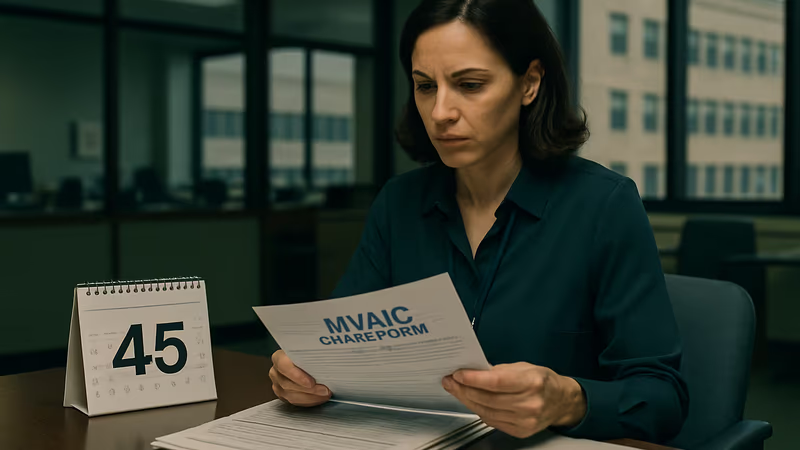
Learn about MVAIC's strict 45-day rule and reasonable excuse standards for late submissions. Expert legal analysis from Long Island attorney Jason Tenenbaum. Call 516-750-0595.
This article is part of our ongoing no-fault coverage, with 271 published articles analyzing no-fault issues across New York State. Attorney Jason Tenenbaum brings 24+ years of hands-on experience to this analysis, drawing from his work on more than 1,000 appeals, over 100,000 no-fault cases, and recovery of over $100 million for clients throughout Nassau County, Suffolk County, Queens, Brooklyn, Manhattan, and the Bronx. For personalized legal advice about how these principles apply to your specific situation, contact our Long Island office at (516) 750-0595 for a free consultation.
Understanding the MVAIC 45-Day Rule and Reasonable Excuse Standards
A critical procedural requirement that affects no-fault insurance claims on Long Island is the 45-day rule for submitting claims to the Motor Vehicle Accident Indemnification Corporation (MVAIC). The Appellate Term’s decision in Good Samaritan Hosp. v MVAIC Ins. Co., 2022 NY Slip Op 51100(U)(App. Term 2d Dept. 2022), illustrates the strict standards courts apply when evaluating whether providers have reasonable excuses for late claim submissions.
What is MVAIC and When Does It Apply?
The Motor Vehicle Accident Indemnification Corporation (MVAIC) is a state-created entity that provides no-fault insurance coverage when:
- No insurance exists: The at-fault vehicle has no insurance coverage
- Unidentified vehicles: Hit-and-run accidents where the responsible party cannot be identified
- Stolen vehicles: Accidents involving stolen cars
- Out-of-state vehicles: Certain situations involving vehicles from states without no-fault laws
MVAIC essentially serves as a safety net, ensuring that innocent accident victims don’t go without basic no-fault benefits when traditional insurance coverage is unavailable. For medical providers treating these patients, MVAIC becomes the source of payment for necessary medical treatment.
The Critical 45-Day Rule
One of the most important requirements when dealing with MVAIC claims is the 45-day submission deadline. Under New York’s no-fault regulations, medical providers must submit their claims to MVAIC within 45 days of providing the service or learning that MVAIC coverage applies.
This deadline is strictly enforced, and late submissions are typically denied unless the provider can demonstrate a “reasonable excuse” for the delay.
The Good Samaritan Hospital Case: A Failed Excuse
The Good Samaritan Hospital case provides a stark example of how courts analyze reasonable excuse claims and the high standards providers must meet to overcome late filings.
What Happened
In this case, Good Samaritan Hospital learned that there was no insurance covering the accident but initially submitted the claim to the patient’s personal health insurer instead of MVAIC. Months later, the hospital finally submitted the claim to MVAIC, well beyond the 45-day deadline.
The hospital attempted to excuse the late filing, but the court found their explanation inadequate on two critical grounds.
The Court’s Analysis
The court identified two fatal flaws in the hospital’s case:
(1) Lack of Reasonable Justification: The court stated: “In opposition, plaintiff failed to raise a triable issue of fact as to whether it provided defendant with a reasonable justification for its untimely submission of the claim, as plaintiff failed to explain why, after learning that there was no insurance covering the accident, it first submitted the claim to the assignor’s personal health insurer instead of MVAIC, and why it took months before it first purportedly sent the claim to MVAIC.”
(2) Insufficient Proof of Mailing: The court found: “To establish this mailing, plaintiff neither presented an affidavit by one with personal knowledge of the mailing nor provided sufficient practices and procedures of mailing, but rather relied on a certificate of mailing, which, under the circumstances presented, was insufficient to fill in the gaps in plaintiff’s proof of mailing.”
Attorney Jason Tenenbaum’s Critical Analysis
Attorney Jason Tenenbaum raises important concerns about the court’s decision, arguing that it improperly converts factual issues into legal ones. His analysis highlights potential problems with how courts handle reasonable excuse determinations:
“To me, the Court is transfixing factual issues into legal ones. Why shouldn’t a trial or evidentiary hearing be held on the reasonable excuse? Also, why isn’t a certificate of mailing, in the least bit, enough to raise an issue of fact? IMHO, poorly decided case.”
This criticism raises fundamental questions about due process and the right to have factual disputes resolved by a jury rather than dismissed as a matter of law.
The Factual vs. Legal Issue Problem
Attorney Tenenbaum’s observation about “transfixing factual issues into legal ones” highlights a significant concern in litigation. When courts decide reasonable excuse questions as matters of law rather than letting juries evaluate the facts, it can deny parties their right to a full hearing on disputed issues.
Reasonable excuse determinations often involve subjective evaluations of a party’s conduct and reasoning. These types of determinations are traditionally considered factual issues that should be resolved by juries, not judges applying legal standards.
The Certificate of Mailing Issue
The court’s dismissal of a certificate of mailing as insufficient proof also raises procedural concerns. While courts require proper foundation for evidence, a certificate of mailing typically creates at least a presumption that mailing occurred, which should raise factual questions about whether the claim was timely submitted.
What This Means for You
If You’re a Medical Provider
The Good Samaritan Hospital case provides crucial lessons for healthcare providers treating patients injured in motor vehicle accidents where MVAIC coverage may apply:
Act Quickly: As soon as you learn that no insurance coverage exists for an accident, immediately submit your claim to MVAIC. Don’t waste time with other potential sources of payment.
Document Everything: Maintain detailed records of when you learned about the lack of insurance coverage and all steps taken to submit claims.
Proper Mailing Procedures: Don’t rely solely on certificates of mailing. Establish proper mailing procedures including:
- Affidavits from employees with personal knowledge of mailing
- Detailed office procedures for handling MVAIC claims
- Certified mail when possible
- Tracking and confirmation procedures
Understand the Timeline: The 45-day clock typically starts when you learn that MVAIC coverage applies, not when you initially treat the patient.
If You’re an Injured Party
Understanding MVAIC procedures is important for patients injured in accidents where traditional insurance isn’t available. Key considerations include:
Inform Your Providers: Make sure your medical providers understand that MVAIC coverage may apply to your case.
Assist with Documentation: Help your providers gather necessary information about the accident and lack of traditional insurance coverage.
Understand Your Rights: You’re entitled to no-fault benefits even when the at-fault party has no insurance, but proper procedures must be followed.
Establishing Reasonable Excuse: Best Practices
While the Good Samaritan Hospital case shows what doesn’t work, providers can learn from this decision to better protect their interests in future MVAIC claims:
Common Reasonable Excuses
Courts have recognized various reasonable excuses for late MVAIC submissions, including:
- Delayed discovery: When providers reasonably didn’t know MVAIC coverage applied
- Misleading information: When patients or others provided incorrect insurance information
- Administrative delays: Properly documented delays in insurance verification
- Reasonable reliance: Justifiable reliance on representations about available coverage
Documenting Your Excuse
To establish a reasonable excuse, providers should:
Create Detailed Records: Document all communications, attempts to verify insurance, and reasons for delays.
Obtain Affidavits: Get sworn statements from employees involved in the claim submission process.
Establish Procedures: Implement and document standard office procedures for handling insurance verification and claim submission.
Act Diligently: Show continuous effort to resolve insurance questions and submit claims promptly once information becomes available.
The Broader Impact on No-Fault Practice
The Good Samaritan Hospital decision reflects broader trends in how courts handle procedural requirements in no-fault cases:
Strict Compliance Standards
Courts increasingly apply strict standards to procedural requirements, offering little flexibility for providers who fail to meet deadlines. This makes proper training and procedures essential for medical practices.
Evidence Standards
The decision also illustrates the importance of proper evidence foundation in no-fault litigation. Simple certificates or documents may not be sufficient without additional supporting evidence.
Due Process Concerns
As Attorney Tenenbaum notes, there are legitimate concerns about whether courts are properly distinguishing between factual and legal issues in these cases, potentially denying parties their right to jury trials on disputed facts.
Frequently Asked Questions About MVAIC and the 45-Day Rule
When does the 45-day deadline start running?
The 45-day deadline typically begins when the provider learns that MVAIC coverage applies, not necessarily when treatment is first provided. However, providers are expected to investigate insurance coverage promptly after treating a patient.
Can I still recover payment if I miss the 45-day deadline?
Yes, but only if you can establish a reasonable excuse for the late submission. As the Good Samaritan Hospital case shows, courts apply strict standards for what constitutes reasonable excuse.
What type of proof do I need to show I submitted a claim on time?
Courts require more than just certificates of mailing. You should have affidavits from employees with personal knowledge of the mailing and documented office procedures for claim submission.
What should I do if I’m unsure whether MVAIC coverage applies?
When in doubt, submit claims to both traditional insurance and MVAIC within the applicable deadlines. This protects your interests while you investigate coverage issues.
Can I appeal an MVAIC denial based on late submission?
Yes, you can challenge MVAIC denials in court, but you’ll need strong evidence of reasonable excuse and proper claim submission. The Good Samaritan Hospital case shows how difficult these challenges can be.
Strategic Considerations for Legal Professionals
The Good Samaritan Hospital decision provides important strategic guidance for attorneys handling MVAIC cases:
Discovery Strategy
When challenging late submission denials, attorneys should pursue comprehensive discovery including:
- All communications about insurance coverage
- Office procedures for handling claims
- Training materials and protocols
- Witness testimony about specific submission practices
Motion Practice
The decision suggests that providers should be prepared for summary judgment motions and have detailed evidence ready to establish factual disputes about reasonable excuse and proper submission.
Appellate Considerations
Attorney Tenenbaum’s criticism raises potential appellate issues about whether courts are properly treating reasonable excuse as a factual question rather than a legal one.
The Bottom Line: Strict Compliance is Essential
The Good Samaritan Hospital case demonstrates that MVAIC applies strict standards to the 45-day rule, and providers cannot rely on weak excuses or inadequate evidence to overcome late submissions.
While Attorney Tenenbaum raises legitimate concerns about whether the court properly handled factual versus legal issues, the practical reality is that providers must be extremely careful about MVAIC submission deadlines and documentation.
At the Law Office of Jason Tenenbaum, we understand the complexities of MVAIC claims and the strict procedural requirements that must be met. We’ve seen how seemingly minor procedural errors can result in the denial of legitimate claims worth thousands of dollars.
Our approach to MVAIC cases includes:
- Careful attention to all procedural deadlines and requirements
- Thorough documentation of reasonable excuse claims when necessary
- Aggressive advocacy to challenge improper denials
- Strategic litigation to protect our clients’ rights
If you’re dealing with MVAIC claim denials or 45-day rule issues on Long Island, don’t let procedural technicalities cost you rightful compensation. Call 516-750-0595 for a free consultation with an experienced attorney who understands MVAIC requirements and will fight to protect your interests.
Related Articles
Legal Context
Why This Matters for Your Case
New York's no-fault insurance system, established under Insurance Law Article 51, is one of the most complex insurance frameworks in the country. Every motorist must carry Personal Injury Protection coverage that pays medical expenses and lost wages regardless of fault, up to $50,000 per person.
But insurers routinely deny valid claims using peer reviews, EUO scheduling tactics, fee schedule reductions, and coverage defenses. The Law Office of Jason Tenenbaum has handled over 100,000 no-fault cases since 2002 — from initial claim submissions through arbitration before the American Arbitration Association, trials in Civil Court and Supreme Court, and appeals to the Appellate Term and Appellate Division. Jason Tenenbaum is one of the few attorneys in the state who both writes his own appellate briefs and tries his own cases.
His 2,353+ published legal articles on no-fault practice are cited by attorneys throughout New York. Whether you are dealing with a medical necessity denial, an EUO no-show defense, a fee schedule dispute, or a coverage question, this article provides the kind of detailed case-law analysis that helps practitioners and claimants understand exactly where the law stands.
About This Topic
New York No-Fault Insurance Law
New York's no-fault insurance system requires every driver to carry Personal Injury Protection (PIP) coverage that pays medical expenses and lost wages regardless of who caused the accident. But insurers routinely deny, delay, and underpay valid claims — using peer reviews, IME no-shows, and fee schedule defenses to avoid paying providers and injured claimants. Attorney Jason Tenenbaum has litigated thousands of no-fault arbitrations and court cases since 2002.
271 published articles in No-Fault
Keep Reading
More No-Fault Analysis
Priority of Payment Regulation Has No Force in Arbitration: First and Second Departments Agree
Both the First and Second Departments have held that the priority of payment regulation under 11 NYCRR 65-3.15 is of no force or effect in no-fault arbitration proceedings....
Feb 25, 2026
How Insurance Companies Use Colossus Software to Undervalue Your Injury Claim
Insurance companies use Colossus software to lowball your injury claim. Learn how this system works and how a Long Island attorney can fight back. Call 516-750-0595.
Feb 18, 2026
Self imposed ROM limitation
Learn how range of motion limitations affect personal injury cases on Long Island. Expert medical evidence standards after Mahler v Lewis. Call 516-750-0595.
Nov 5, 2022
Reasonableness of charges (Fla)
Florida case examining reasonableness of medical charges in auto insurance claims, with implications for New York no-fault and third-party litigation practice.
Aug 21, 2021
Did his veteran status influence this decision?
Court examines whether veteran's PTSD and mental health issues should have triggered inquiry before accepting guilty plea in burglary case.
Nov 11, 2017
Understanding Appellate Jurisdiction: When Court Orders Can and Cannot Be Appealed in New York
Understand appellate jurisdiction in NY courts. Learn when court orders can and cannot be appealed. Expert appellate guidance for Long Island and NYC. Call 516-750-0595.
Feb 3, 2012Was this article helpful?

About the Author
Jason Tenenbaum, Esq.
Jason Tenenbaum is the founding attorney of the Law Office of Jason Tenenbaum, P.C., headquartered at 326 Walt Whitman Road, Suite C, Huntington Station, New York 11746. With over 24 years of experience since founding the firm in 2002, Jason has written more than 1,000 appeals, handled over 100,000 no-fault insurance cases, and recovered over $100 million for clients across Long Island, Nassau County, Suffolk County, Queens, Brooklyn, Manhattan, the Bronx, and Staten Island. He is one of the few attorneys in the state who both writes his own appellate briefs and tries his own cases.
Jason is admitted to practice in New York, New Jersey, Florida, Texas, Georgia, and Michigan state courts, as well as multiple federal courts. His 2,353+ published legal articles analyzing New York case law, procedural developments, and litigation strategy make him one of the most prolific legal commentators in the state. He earned his Juris Doctor from Syracuse University College of Law.
Disclaimer: This article is published by the Law Office of Jason Tenenbaum, P.C. for informational and educational purposes only. It does not constitute legal advice, and no attorney-client relationship is formed by reading this content. The legal principles discussed may not apply to your specific situation, and the law may have changed since this article was last updated.
New York law varies by jurisdiction — court decisions in one Appellate Division department may not be followed in another, and local court rules in Nassau County Supreme Court differ from those in Suffolk County Supreme Court, Kings County Civil Court, or Queens County Supreme Court. The Appellate Division, Second Department (which covers Long Island, Brooklyn, Queens, and Staten Island) and the Appellate Term (which hears appeals from lower courts) each have distinct procedural requirements and precedents that affect litigation strategy.
If you need legal help with a no-fault matter, contact our office at (516) 750-0595 for a free consultation. We serve clients throughout Long Island (Huntington, Babylon, Islip, Brookhaven, Smithtown, Riverhead, Southampton, East Hampton), Nassau County (Hempstead, Garden City, Mineola, Great Neck, Manhasset, Freeport, Long Beach, Rockville Centre, Valley Stream, Westbury, Hicksville, Massapequa), Suffolk County (Hauppauge, Deer Park, Bay Shore, Central Islip, Patchogue, Brentwood), Queens, Brooklyn, Manhattan, the Bronx, Staten Island, and Westchester County. Prior results do not guarantee a similar outcome.