Key Takeaway
Analysis of MRI evidence admissibility in New York no-fault cases, examining Madia v Garcia ruling and challenges with NY's evidentiary system for personal injury practitioners.
This article is part of our ongoing no-fault coverage, with 271 published articles analyzing no-fault issues across New York State. Attorney Jason Tenenbaum brings 24+ years of hands-on experience to this analysis, drawing from his work on more than 1,000 appeals, over 100,000 no-fault cases, and recovery of over $100 million for clients throughout Nassau County, Suffolk County, Queens, Brooklyn, Manhattan, and the Bronx. For personalized legal advice about how these principles apply to your specific situation, contact our Long Island office at (516) 750-0595 for a free consultation.
Most sane practitioners stipulate to medical records and then try the case on its merits. But NY civil practice is the true game of ambush warfare. And this is partly due to 3101(d) disallowing expert witness discovery and the necessity of HIPPA AZ’ for anything. Expert witness discovery on both sides due to actual testimony does away with much of the outrageous evidently shenanigan that we deal with in NY. If you’re dealing with a no-fault insurance defense matter, an experienced attorney can help protect your rights.
Fun fact – other states require the adverse party to challenge a non-party subpeona for medical records otherwise same is waived. Read: 46 CFR 164.512(e)(1). Also, read Fla. R. Civ. Prop 1.351. I submit to you that the Rules in the State should be amended to allow this type of discovery
In New York, both sides can come out of the word work, raise the most baseless evidentiary objections and gum up a trial. This is a problematic quirk in the NY system. The Chief Administrative Judge is more interested in wasting our time with word counts and statements of material facts. Worthless ventures in most cases the non-commercial bar handles. Free tip. Your statement of facts should be a carbon copy of your attorney affirmation.
And I agree that if you can’t ask the 10-15 questions to meet CPLR 4518(a) you should not be trying cases, but the ambush warfare goes beyond that.
I saw this case that really looked interesting, and I am sure the rationale behind it isn’t a newfound understanding to the law on evidence; rather. it represents the fact that former trial judges that now sit on the Appellate Division see the harm that our non-codified common-law “evidentiary” system has placed upon sane practitioners who want a clean trial.
Madia v Garcia, 2021 NY Slip Op 05632 (1st Dept. 2021)
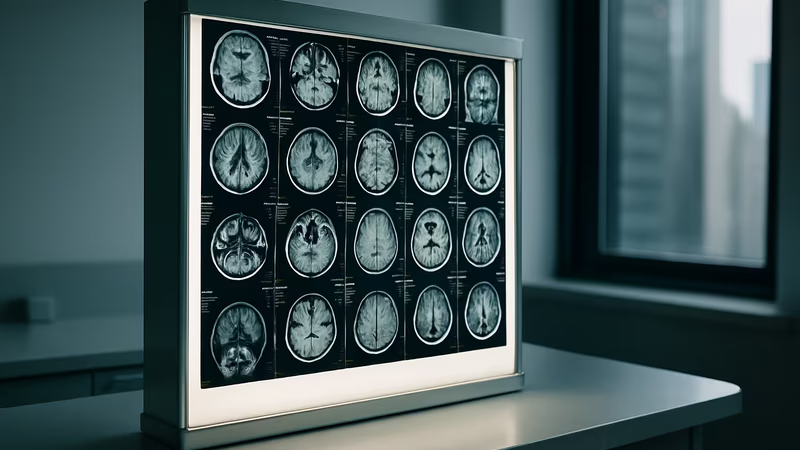
“The MRI films and reports demonstrating those injuries were properly admitted as part of the file of plaintiff’s treating doctor, notwithstanding that they were created at an outside facility (see Freeman v Shtoga_j,_ 174 AD3d 448, 449 ). Plaintiff’s doctor also properly relied on those records in offering his opinions at trial, which were based not only on the MRIs, which he ordered, but also on his own examination and tests (see id. at 449-450).”
If I sat on the rules committee, I would create an evidence code, rework 3101(d), rework the HIPPA rules, create pre-trial motion in limine rules, mandate evidentiary stipulations absent good cause shown, and give the practitioner a real framework of the evidentiary and issue parameters of a trial will be. I think the current system is broken and in need of repair.
Related Articles
Legal Context
Why This Matters for Your Case
New York's no-fault insurance system, established under Insurance Law Article 51, is one of the most complex insurance frameworks in the country. Every motorist must carry Personal Injury Protection coverage that pays medical expenses and lost wages regardless of fault, up to $50,000 per person.
But insurers routinely deny valid claims using peer reviews, EUO scheduling tactics, fee schedule reductions, and coverage defenses. The Law Office of Jason Tenenbaum has handled over 100,000 no-fault cases since 2002 — from initial claim submissions through arbitration before the American Arbitration Association, trials in Civil Court and Supreme Court, and appeals to the Appellate Term and Appellate Division. Jason Tenenbaum is one of the few attorneys in the state who both writes his own appellate briefs and tries his own cases.
His 2,353+ published legal articles on no-fault practice are cited by attorneys throughout New York. Whether you are dealing with a medical necessity denial, an EUO no-show defense, a fee schedule dispute, or a coverage question, this article provides the kind of detailed case-law analysis that helps practitioners and claimants understand exactly where the law stands.
About This Topic
New York No-Fault Insurance Law
New York's no-fault insurance system requires every driver to carry Personal Injury Protection (PIP) coverage that pays medical expenses and lost wages regardless of who caused the accident. But insurers routinely deny, delay, and underpay valid claims — using peer reviews, IME no-shows, and fee schedule defenses to avoid paying providers and injured claimants. Attorney Jason Tenenbaum has litigated thousands of no-fault arbitrations and court cases since 2002.
271 published articles in No-Fault
Keep Reading
More No-Fault Analysis
Priority of Payment Regulation Has No Force in Arbitration: First and Second Departments Agree
Both the First and Second Departments have held that the priority of payment regulation under 11 NYCRR 65-3.15 is of no force or effect in no-fault arbitration proceedings....
Feb 25, 2026
How Insurance Companies Use Colossus Software to Undervalue Your Injury Claim
Insurance companies use Colossus software to lowball your injury claim. Learn how this system works and how a Long Island attorney can fight back. Call 516-750-0595.
Feb 18, 2026
Post EUO demands
State Farm v Burke Physical Therapy case analysis on post-EUO document demands and verification requirements under New York no-fault insurance law.
Jul 7, 2022
The Unreasonable EUO
New York court ruling on unreasonable EUO scheduling practices, mutual rescheduling vs stonewalling, and no-show defenses in no-fault insurance claims.
May 22, 2021
Another Alrof citing
New York appellate court reinforces Alrof precedent requiring personal knowledge proof for EUO non-appearance claims in no-fault insurance litigation.
Oct 6, 2015
No-Fault Legislation – the other type
New York passes no-fault divorce legislation in 2010, allowing divorce based on irretrievable breakdown. Brief analysis of the new law's requirements and provisions.
Jul 4, 2010Common Questions
Frequently Asked Questions
What is New York's no-fault insurance system?
New York's no-fault insurance system, codified in Insurance Law Article 51, requires all drivers to carry Personal Injury Protection (PIP) coverage. This pays for medical expenses, lost wages (up to $2,000/month), and other basic economic loss regardless of who caused the accident, up to $50,000 per person. However, to sue for pain and suffering, you must meet the 'serious injury' threshold under Insurance Law §5102(d).
How do I fight a no-fault insurance claim denial?
When a no-fault claim is denied, you can challenge it through mandatory arbitration under the American Arbitration Association's no-fault rules, or by filing a lawsuit in court. Common defenses to denials include challenging the timeliness of the denial, the adequacy of the peer review report, or the insurer's compliance with regulatory requirements. An experienced no-fault attorney can evaluate which strategy gives you the best chance of overturning the denial.
What is the deadline to file a no-fault claim in New York?
Under 11 NYCRR §65-1.1, you must submit a no-fault application (NF-2 form) within 30 days of the accident. Medical providers must submit claims within 45 days of treatment. Missing these deadlines can result in claim denial, though there are limited exceptions for late notice if the claimant can demonstrate a reasonable justification.
What no-fault benefits am I entitled to after a car accident in New York?
Under Insurance Law §5102(b), no-fault PIP covers necessary medical expenses, 80% of lost earnings up to $2,000/month, up to $25/day for other reasonable expenses, and a $2,000 death benefit. These benefits are available regardless of fault, up to the $50,000 policy limit. Claims are paid by your own insurer — not the at-fault driver's.
Can I choose my own doctor for no-fault treatment in New York?
Yes. Under New York's no-fault regulations, you have the right to choose your own physician, chiropractor, physical therapist, or other licensed healthcare provider. The insurer cannot dictate which providers you see. However, the insurer can request an IME with their chosen doctor and may challenge the medical necessity of your treatment through peer review.
Was this article helpful?

About the Author
Jason Tenenbaum, Esq.
Jason Tenenbaum is the founding attorney of the Law Office of Jason Tenenbaum, P.C., headquartered at 326 Walt Whitman Road, Suite C, Huntington Station, New York 11746. With over 24 years of experience since founding the firm in 2002, Jason has written more than 1,000 appeals, handled over 100,000 no-fault insurance cases, and recovered over $100 million for clients across Long Island, Nassau County, Suffolk County, Queens, Brooklyn, Manhattan, the Bronx, and Staten Island. He is one of the few attorneys in the state who both writes his own appellate briefs and tries his own cases.
Jason is admitted to practice in New York, New Jersey, Florida, Texas, Georgia, and Michigan state courts, as well as multiple federal courts. His 2,353+ published legal articles analyzing New York case law, procedural developments, and litigation strategy make him one of the most prolific legal commentators in the state. He earned his Juris Doctor from Syracuse University College of Law.
Disclaimer: This article is published by the Law Office of Jason Tenenbaum, P.C. for informational and educational purposes only. It does not constitute legal advice, and no attorney-client relationship is formed by reading this content. The legal principles discussed may not apply to your specific situation, and the law may have changed since this article was last updated.
New York law varies by jurisdiction — court decisions in one Appellate Division department may not be followed in another, and local court rules in Nassau County Supreme Court differ from those in Suffolk County Supreme Court, Kings County Civil Court, or Queens County Supreme Court. The Appellate Division, Second Department (which covers Long Island, Brooklyn, Queens, and Staten Island) and the Appellate Term (which hears appeals from lower courts) each have distinct procedural requirements and precedents that affect litigation strategy.
If you need legal help with a no-fault matter, contact our office at (516) 750-0595 for a free consultation. We serve clients throughout Long Island (Huntington, Babylon, Islip, Brookhaven, Smithtown, Riverhead, Southampton, East Hampton), Nassau County (Hempstead, Garden City, Mineola, Great Neck, Manhasset, Freeport, Long Beach, Rockville Centre, Valley Stream, Westbury, Hicksville, Massapequa), Suffolk County (Hauppauge, Deer Park, Bay Shore, Central Islip, Patchogue, Brentwood), Queens, Brooklyn, Manhattan, the Bronx, Staten Island, and Westchester County. Prior results do not guarantee a similar outcome.