Key Takeaway
Navigate complex choice of law issues when Pennsylvania insurance policies meet New York litigation. Learn the innocent third party doctrine. Call 516-750-0595.
This article is part of our ongoing choice of law coverage, with 35 published articles analyzing choice of law issues across New York State. Attorney Jason Tenenbaum brings 24+ years of hands-on experience to this analysis, drawing from his work on more than 1,000 appeals, over 100,000 no-fault cases, and recovery of over $100 million for clients throughout Nassau County, Suffolk County, Queens, Brooklyn, Manhattan, and the Bronx. For personalized legal advice about how these principles apply to your specific situation, contact our Long Island office at (516) 750-0595 for a free consultation.
Choice of Law Complexities: When Pennsylvania Insurance Meets New York Courts
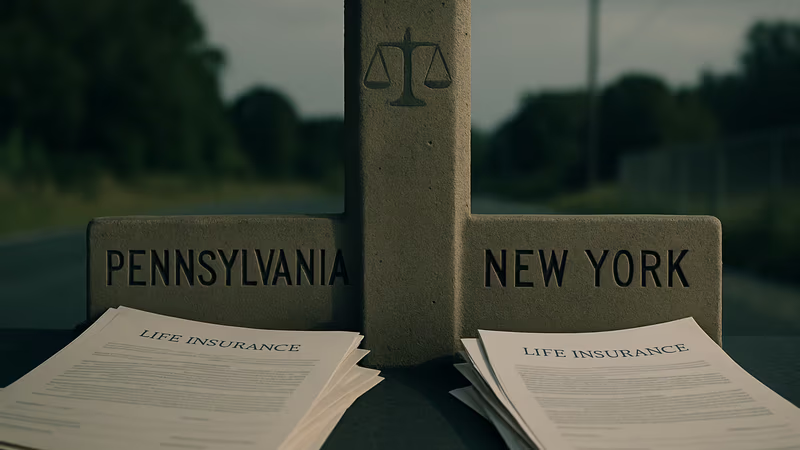
The case of Williams v Janvier, 2019 NY Slip Op 07638 (2d Dept. 2019) provides an excellent illustration of the complex choice of law issues that arise when Pennsylvania insurance policies intersect with New York litigation.
This decision highlights the critical differences between Pennsylvania and New York insurance law. It focuses on the protection of innocent third parties when insurers seek to rescind policies for fraud.
As the original commentary notes, practitioners frequently observe “Pa license plates, Pa policies and the usual EUO showing the EIP did not actually reside in Pa.” This common scenario creates a legal minefield. It requires careful navigation of competing state laws and jurisdictional principles.
The Williams v Janvier Decision: A Choice of Law Primer
The Williams v Janvier case arose when Penn National Insurance tried to rescind a policy. They claimed the insured, Janvier, made material misrepresentations in his application.
The critical question: how would Pennsylvania law apply to protect innocent third parties—the plaintiffs who were injured in an accident involving Janvier?
The Pennsylvania Rule: Erie Insurance Exchange v Lake
The court applied the seminal Pennsylvania case of Erie Ins. Exch. v Lake (543 Pa 363, 671 A2d 681), which established the “innocent third party” doctrine in Pennsylvania insurance law. Under this rule:
- An insurer may rescind a policy retroactively based on fraud or misrepresentation “as to the actual perpetrator of the fraud”
- However, the insurer “may not deny coverage under the policy with respect to claims made by third parties who are innocent of trickery, and injured through no fault of their own”
- The rationale is that “motorists carry insurance not only for their own protection, but also, for the benefit of third parties who may suffer through the negligence of the insured motorist”
This doctrine creates significant protection for injured parties that may not exist under other states’ laws.
Understanding Choice of Law in Insurance Disputes
When insurance policies issued in one state become the subject of litigation in another state, courts must determine which state’s law applies. This choice can dramatically affect the outcome of the case.
Factors Courts Consider in Choice of Law Analysis
New York courts typically apply a “center of gravity” or “grouping of contacts” analysis to determine which state’s law should govern. Key factors include:
- Where the policy was issued: The state where the insurance contract was formed
- Where premiums were paid: The location of financial transactions
- Where the insured resided: The actual residence, not just the stated address
- Where the vehicle was principally garaged: The primary location of the insured vehicle
- Where the accident occurred: The situs of the tort
- Where the injuries were sustained: The location of the harm
The Significance of State Law Differences
The choice between Pennsylvania and New York law can be outcome-determinative because:
- Policy rescission rules: Different standards for when insurers can void coverage
- Third party protection: Varying levels of protection for innocent parties
- No-fault systems: Different approaches to mandatory insurance coverage
- Fraud standards: Differing requirements for proving material misrepresentation
- Statute of limitations: Different time limits for various claims
The Pennsylvania Innocent Third Party Doctrine in Detail
Pennsylvania’s approach to protecting innocent third parties represents a policy choice that prioritizes victim compensation over insurer protection from fraud.
Historical Development of the Doctrine
The Erie Insurance Exchange v Lake decision was groundbreaking in Pennsylvania law because it recognized that:
- Insurance serves a dual purpose: protecting the insured and compensating victims
- Public policy favors ensuring that injured parties have access to compensation
- The burden of insurer due diligence should not fall on innocent accident victims
- Allowing unrestricted rescission would undermine the social purposes of mandatory insurance
Requirements for Innocent Third Party Protection
For the innocent third party doctrine to apply under Pennsylvania law:
- Material misrepresentation: The insurer must prove the insured made material misrepresentations
- Fraud by insured: The misrepresentations must constitute fraud or material omissions
- Innocent third party: The claimant must not have participated in or known of the fraud
- Injury through no fault: The third party must be a victim, not a participant in wrongdoing
- Reasonable discovery period: The fraud must not have been reasonably discoverable within 60 days of policy issuance
Practical Implications for Multi-State Insurance Issues
The Williams v Janvier decision has significant practical implications for attorneys handling cases involving out-of-state insurance policies.
The Pennsylvania License Plate Problem
As noted in the original commentary, it’s common to encounter cases involving:
- Vehicles with Pennsylvania license plates operating in New York
- Insurance policies issued in Pennsylvania to purported Pennsylvania residents
- EUO testimony revealing the “EIP” (Eligible Injured Person) never actually resided in Pennsylvania
- Disputes over which state’s law should apply to coverage questions
Strategic Considerations for Plaintiffs
When representing injured parties in cases involving Pennsylvania policies:
- Investigate actual residency: Determine where the insured actually lived, not just where they claimed to live
- Analyze policy terms: Pennsylvania policies may have different coverage terms than New York policies
- Argue for Pennsylvania law: If beneficial, argue that Pennsylvania law should apply to protect innocent third parties
- Document innocent status: Establish that your client had no knowledge of or involvement in any insurance fraud
- Challenge rescission timing: Examine whether the insurer could have discovered the fraud within the 60-day period
Strategic Considerations for Insurers
Insurance companies facing potential Pennsylvania law application should:
- Investigate thoroughly: Conduct proper underwriting investigations to avoid being bound by Pennsylvania’s protective rules
- Document due diligence: Maintain records showing reasonable efforts to verify applicant information
- Act quickly: If fraud is discovered, act within the 60-day reasonable discovery period when possible
- Argue for other state law: When beneficial, argue that a state with less protective rules should apply
- Consider settlement: Pennsylvania’s innocent third party rule may make litigation risks too high
Comparison with New York Insurance Law
New York’s approach to insurance fraud and policy rescission differs significantly from Pennsylvania’s innocent third party doctrine.
New York’s Traditional Approach
Under New York law:
- Insurers generally have broader rights to rescind policies for material misrepresentation
- The focus is primarily on the contractual relationship between insurer and insured
- Third party protection is less comprehensive than under Pennsylvania law
- Courts may apply equitable principles but not a formal innocent third party doctrine
Policy Considerations Behind the Differences
The different approaches reflect competing policy priorities:
- Pennsylvania emphasis: Victim compensation and public safety through insurance availability
- New York emphasis: Contractual freedom and insurer protection from fraud
- Practical impact: Pennsylvania law may result in more coverage disputes being resolved in favor of injured parties
Jurisdictional and Procedural Complications
Multi-state insurance disputes create additional procedural complexities beyond substantive law differences.
Forum Selection Issues
Parties may face strategic choices about where to litigate:
- Pennsylvania courts: May be more favorable to innocent third party arguments
- New York courts: May apply New York law if contacts favor New York
- Federal court: May apply state law differently than state courts
- Administrative forums: Insurance department proceedings may have different rules
Service of Process and Personal Jurisdiction
Out-of-state insurers may raise jurisdictional challenges:
- Personal jurisdiction over Pennsylvania insurers in New York courts
- Service of process requirements for out-of-state entities
- Long-arm statute application to insurance coverage disputes
- Due process considerations for multi-state litigation
Frequently Asked Questions About Choice of Law in Insurance Cases
How do courts decide which state’s law to apply in insurance disputes?
Courts typically use a “center of gravity” test that examines all contacts between the case and potential forum states, including where the policy was issued, where the insured lives, where the vehicle is garaged, and where the accident occurred. The state with the most significant relationship to the dispute usually provides the governing law.
Can an insurance company avoid Pennsylvania’s innocent third party rule by arguing for different state law?
Yes, if the insurer can show that another state has more significant contacts to the dispute, a court might apply that state’s law instead. However, this requires a thorough choice of law analysis and isn’t guaranteed to succeed.
What evidence is needed to prove someone is an “innocent third party” under Pennsylvania law?
The third party must show they had no knowledge of and didn’t participate in any fraud or misrepresentation made to the insurance company. This typically involves demonstrating they were simply accident victims with no connection to the insured’s application process or policy procurement.
Does the innocent third party doctrine apply to all types of insurance fraud?
Under Pennsylvania law, the doctrine applies when material misrepresentations or fraud could not reasonably have been discovered within the 60-day period following policy issuance. However, courts examine each case individually to determine if the doctrine applies to the specific circumstances.
How can attorneys identify potential choice of law issues in insurance cases?
Key red flags include out-of-state license plates, policies issued in different states from where accidents occur, addresses that don’t match actual residence, and any indications that the insured may have misrepresented their location or other material facts to obtain coverage.
Best Practices for Handling Multi-State Insurance Disputes
Given the complexity of choice of law issues in insurance cases, attorneys should follow certain best practices.
Early Case Assessment
- Identify all state connections: Map out every contact the case has with different states
- Research applicable laws: Understand the substantive differences between potentially applicable state laws
- Evaluate forum options: Consider where the case should be filed for maximum advantage
- Investigate actual facts: Don’t rely on stated addresses or representations without verification
Discovery Strategy
- Focus on residency: Obtain detailed information about where parties actually lived
- Vehicle location: Determine where vehicles were actually garaged and operated
- Insurance application process: Understand how and where the policy was obtained
- Premium payment methods: Follow the money trail to establish state connections
Legal Research and Briefing
- Comprehensive choice of law analysis: Brief all relevant factors, not just favorable ones
- Policy considerations: Explain why one state’s law better serves the relevant policies
- Factual development: Ensure the record supports your choice of law argument
- Alternative arguments: Prepare backup positions in case your primary choice of law argument fails
The Future of Multi-State Insurance Litigation
As our society becomes increasingly mobile, multi-state insurance issues are likely to become more common and complex.
Trends Affecting Choice of Law Analysis
Several developments may influence how courts approach these issues:
- Interstate compacts: Some states are adopting uniform approaches to certain insurance issues
- Federal oversight: Increased federal involvement in insurance regulation may create more uniformity
- Technology impacts: Digital residency and remote work complicate traditional residence concepts
- Policy standardization: Industry-wide policy forms may reduce some state-law differences
Practical Implications for Practitioners
Attorneys should stay current with:
- Changes in state insurance laws that affect choice of law analysis
- New court decisions interpreting multi-state insurance disputes
- Industry practices that might influence residency and coverage determinations
- Technology tools that can help track and verify residency claims
Conclusion
The Williams v Janvier decision illustrates the critical importance of choice of law analysis in multi-state insurance disputes. Pennsylvania’s innocent third party doctrine represents a significant protection for accident victims that may not exist under other states’ laws, making the choice between Pennsylvania and New York law potentially case-determinative.
As the original commentary astutely observed, the frequency of cases involving Pennsylvania license plates and policies, combined with EUO testimony revealing non-Pennsylvania residence, creates a recurring pattern that attorneys must be prepared to address. Understanding both the substantive differences between state laws and the procedural complexities of choice of law analysis is essential for effective representation in these cases.
The intersection of Pennsylvania and New York insurance law demonstrates why thorough investigation, careful legal analysis, and strategic thinking are essential in multi-state insurance disputes.
Whether representing injured parties seeking to invoke Pennsylvania’s protective doctrine or insurers seeking to avoid its application, practitioners must master both the substantive law and the choice of law principles. These principles determine which state’s rules will ultimately govern.
If you’re dealing with a complex insurance coverage dispute involving multiple states or need help navigating choice of law issues, call 516-750-0595 for a free consultation. Our experienced team understands the intricacies of multi-state insurance law and can help develop the strategy that best protects your interests. Don’t let complex jurisdictional issues compromise your case—contact us today for expert guidance.
Related Articles
- Understanding choice of law principles in multi-state personal injury cases
- When New York and New Jersey insurance laws create cross-state claims complications
- Interstate insurance law complications in New York personal injury litigation
- Pennsylvania law policy rescission and assignor proof requirements
- Florida choice of law applications in New York no-fault insurance cases
Legal Context
Why This Matters for Your Case
New York law is among the most complex and nuanced in the country, with distinct procedural rules, substantive doctrines, and court systems that differ significantly from other jurisdictions. The Civil Practice Law and Rules (CPLR) governs every stage of civil litigation, from service of process through trial and appeal. The Appellate Division, Appellate Term, and Court of Appeals create a rich and ever-evolving body of case law that practitioners must follow.
Attorney Jason Tenenbaum has practiced across these areas for over 24 years, writing more than 1,000 appellate briefs and publishing over 2,353 legal articles that attorneys and clients rely on for guidance. The analysis in this article reflects real courtroom experience — from motion practice in Civil Court and Supreme Court to oral arguments before the Appellate Division — and a deep understanding of how New York courts actually apply the law in practice.
About This Topic
Choice of Law in New York Insurance & Injury Cases
When an accident or insurance dispute involves multiple states, New York courts must determine which state's law governs the claim. Choice-of-law analysis in New York uses an interest analysis approach for tort claims and a grouping-of-contacts test for contract-based insurance disputes. The choice between New York and another state's law can dramatically affect the outcome — particularly regarding no-fault thresholds, damage caps, and procedural requirements. These articles examine the analytical framework New York courts apply to resolve choice-of-law disputes.
35 published articles in Choice of law
Keep Reading
More Choice of law Analysis

Choice of law?
Court applies New York no-fault law over New Jersey law based on most significant relationship test, despite accident occurring in New Jersey.
Mar 17, 2021
Retroactive rescission
A Florida choice of law analysis leads to successful retroactive rescission, highlighting the importance of understanding different state laws in no-fault insurance cases.
Sep 25, 2020
Understanding Florida Choice of Law in New York No-Fault Insurance Cases: Long Island Legal Analysis
Understanding how Florida law applies to New York no-fault insurance disputes. Expert legal analysis from Long Island insurance attorneys. Call (516) 750-0595.
Jan 18, 2013
Interstate Insurance Law Complications in New York Personal Injury Cases
Learn how interstate insurance laws affect NY personal injury cases. Expert analysis of multi-state complications. Call 516-750-0595.
May 12, 2019
New Jersey arbitration statute requires an application for Article 75 relief
New Jersey arbitration statute requires application for Article 75 relief to compel arbitration in no-fault insurance disputes, as New York procedural law controls over substantive...
Sep 16, 2016
Embarrassment or hubrus?
Attorney Jason Tenenbaum critiques a case where counsel failed to research applicable Rhode Island law before proceeding to trial, highlighting the importance of thorough legal...
Sep 4, 2015Was this article helpful?

About the Author
Jason Tenenbaum, Esq.
Jason Tenenbaum is the founding attorney of the Law Office of Jason Tenenbaum, P.C., headquartered at 326 Walt Whitman Road, Suite C, Huntington Station, New York 11746. With over 24 years of experience since founding the firm in 2002, Jason has written more than 1,000 appeals, handled over 100,000 no-fault insurance cases, and recovered over $100 million for clients across Long Island, Nassau County, Suffolk County, Queens, Brooklyn, Manhattan, the Bronx, and Staten Island. He is one of the few attorneys in the state who both writes his own appellate briefs and tries his own cases.
Jason is admitted to practice in New York, New Jersey, Florida, Texas, Georgia, and Michigan state courts, as well as multiple federal courts. His 2,353+ published legal articles analyzing New York case law, procedural developments, and litigation strategy make him one of the most prolific legal commentators in the state. He earned his Juris Doctor from Syracuse University College of Law.
Disclaimer: This article is published by the Law Office of Jason Tenenbaum, P.C. for informational and educational purposes only. It does not constitute legal advice, and no attorney-client relationship is formed by reading this content. The legal principles discussed may not apply to your specific situation, and the law may have changed since this article was last updated.
New York law varies by jurisdiction — court decisions in one Appellate Division department may not be followed in another, and local court rules in Nassau County Supreme Court differ from those in Suffolk County Supreme Court, Kings County Civil Court, or Queens County Supreme Court. The Appellate Division, Second Department (which covers Long Island, Brooklyn, Queens, and Staten Island) and the Appellate Term (which hears appeals from lower courts) each have distinct procedural requirements and precedents that affect litigation strategy.
If you need legal help with a choice of law matter, contact our office at (516) 750-0595 for a free consultation. We serve clients throughout Long Island (Huntington, Babylon, Islip, Brookhaven, Smithtown, Riverhead, Southampton, East Hampton), Nassau County (Hempstead, Garden City, Mineola, Great Neck, Manhasset, Freeport, Long Beach, Rockville Centre, Valley Stream, Westbury, Hicksville, Massapequa), Suffolk County (Hauppauge, Deer Park, Bay Shore, Central Islip, Patchogue, Brentwood), Queens, Brooklyn, Manhattan, the Bronx, Staten Island, and Westchester County. Prior results do not guarantee a similar outcome.