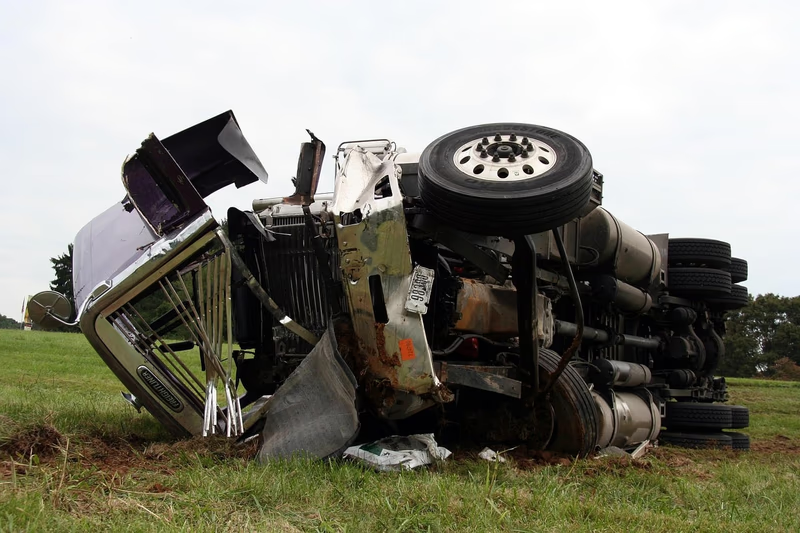
Hit by a Truck?
Size Matters in Court.
Commercial trucks cause 45% more severe injuries. We know the federal regulations trucking companies violate — and how to prove it. No fee unless we win.
Serving Long Island, Nassau County, Suffolk County & All of NYC
$100M+
Recovered
24+
Years Experience
$0
Upfront Cost
24/7
Available
Quick Answer
Truck accident settlements on Long Island range from $200,000 to over $5,000,000, depending on injury severity and the degree of regulatory violations. Trucking companies must carry $750,000 to $5,000,000 in minimum insurance under federal law (49 CFR §387.9), providing significantly more coverage than standard auto policies. The statute of limitations is 3 years (CPLR §214), but critical black box data can be overwritten in as little as 30 days.
Last updated: March 2026 · Every case is unique — these ranges reflect general Long Island outcomes and are not guarantees.
Truck Accident Cases We Handle
What Type of Truck Accident?
Tractor-Trailer Crashes
Delivery Truck Accidents
Jackknife Accidents
Rear-End Collisions
Wide Turn Accidents
Cargo Spill Accidents
Underride Accidents
Bus & Commercial Vehicle
Proven Track Record
Truck Accident Results That Speak
Trucking companies carry $1M–$5M policies. We know how to access every dollar.
$2.5M
Tractor-Trailer Collision
Driver fatigue violation on the LIE — hours-of-service logbook proved falsified
$1.8M
18-Wheeler Rear-End
Brake failure on Route 110; ECM data showed overdue maintenance
$1.2M
Delivery Truck Accident
Motorcyclist struck by Amazon van — insurer offered $20K, we got 60x more
$950K
Jackknife Accident
Tractor-trailer jackknifed on Northern State Parkway during rain
$800K
Cargo Spill Injuries
Unsecured load shifted on Southern State, causing multi-vehicle pileup
$600K
Wide Turn Accident
Box truck failed to check mirror turning off Jericho Turnpike
Past results do not guarantee a similar outcome. Each case is unique.
Simple Process
Getting Started Takes 5 Minutes
Call or Click
Reach us 24/7 at (516) 750-0595 or fill out our online form. We respond within minutes.
Free Accident Investigation
We issue immediate evidence preservation demands, obtain the truck's black box data, and review driver logbooks and FMCSA compliance records.
We Fight. You Heal.
We handle the trucking company, their insurers, and their corporate defense team. You focus on recovery. We don't get paid until you do.
Why Tenenbaum Law for Truck Accidents
Built to Beat Trucking Companies
Trucking companies deploy rapid-response teams within hours of a crash. You need a firm that moves just as fast. Jason Tenenbaum has spent 24 years fighting commercial carriers and their corporate insurers across Nassau and Suffolk County courts.
FMCSA Regulation Expertise
We know federal hours-of-service rules, CDL requirements, and drug-testing mandates — and exactly how to prove violations that caused your crash.
Black Box Data Recovery
We issue immediate spoliation letters to preserve Electronic Control Module data — speed, braking, and hours of operation — before it's overwritten.
Multi-Party Liability Experience
Truck crashes often involve the driver, trucking company, vehicle manufacturer, and cargo loader. We pursue every liable party for maximum recovery.
Local Road Knowledge
LIE (I-495), Southern State Parkway, Northern State, Route 110 — we know where truck accidents cluster and how local conditions factor into liability.
"A delivery truck ran a red light and hit my car broadside. The trucking company denied everything. Jason got the truck's black box data, proved the driver had been on the road for 14 hours straight, and won us a settlement that covered everything."
Michael R.
Delivery Truck Collision — Suffolk County
Legal Analysis
Why Are Truck Accident Cases Different from Car Accidents on Long Island?
Truck accident litigation is fundamentally different from a standard car accident claim. When a passenger vehicle collides with another passenger vehicle, the legal analysis is relatively straightforward: one driver was negligent, their insurance pays. But when a commercial truck is involved, the legal landscape shifts dramatically.
Federal regulatory frameworks come into play, multiple corporate entities may share liability, and the evidence that proves fault is often stored in electronic systems controlled by the very companies you are suing. Understanding these differences is essential for anyone injured in a truck accident on Long Island. Hiring an attorney with specific truck accident experience can mean the difference between a fair recovery and a fraction of what your case is worth.
| Injury Severity | Settlement Range | Typical Timeline |
|---|---|---|
| Minor (soft tissue, whiplash) | $50,000 – $200,000 | 3–6 months |
| Moderate (fractures, herniated discs) | $200,000 – $1,500,000 | 6–18 months |
| Severe (TBI, spinal cord, amputation, death) | $1,500,000 – $5,000,000+ | 1–3+ years |
Every case is unique. These ranges reflect general Long Island case outcomes and are not guarantees of results.
What Federal Trucking Regulations Apply to My Truck Accident Case?
Trucks operating in interstate commerce are governed by the Federal Motor Carrier Safety Administration (FMCSA) regulations — a comprehensive body of federal law codified in Title 49 of the Code of Federal Regulations. These regulations impose safety requirements that do not apply to ordinary passenger vehicle accidents. The FMCSA regulates virtually every aspect of commercial trucking: hours of service, vehicle maintenance, cargo securement, driver qualifications, and drug and alcohol testing.
When a trucking company or its driver violates any of these regulations and that violation contributes to a crash, the violation constitutes negligence per se in New York courts. The plaintiff does not need to independently prove that the defendant's conduct fell below a reasonable standard of care. The regulatory violation itself establishes negligence as a matter of law.
The hours-of-service regulations are among the most commonly violated and most frequently litigated provisions. Under 49 CFR Part 395, a commercial truck driver is limited to 11 hours of driving within a 14-hour on-duty window, and only after taking 10 consecutive hours off duty. Drivers must also take a mandatory 30-minute break after 8 cumulative hours of driving. Over a rolling seven-day period, a driver cannot exceed 60 hours on duty, or 70 hours over eight days.
These rules exist because driver fatigue is one of the leading causes of fatal truck accidents in the United States. According to the FMCSA's own Large Truck Crash Causation Study, fatigue was a factor in approximately 13 percent of all large truck crashes. Despite these rules, violations are rampant. Trucking companies face economic pressure to deliver loads on tight schedules, and drivers — many of whom are paid by the mile rather than by the hour — have financial incentives to keep driving past their legal limits.
Beyond hours-of-service requirements, the FMCSA mandates rigorous vehicle maintenance and inspection protocols. Drivers must perform pre-trip inspections before each shift and document their findings on Driver Vehicle Inspection Report (DVIR) forms. Trucking companies must conduct periodic inspections and maintain detailed maintenance records.
Cargo securement standards under 49 CFR Part 393 dictate how loads must be secured — specifying proper loading methods, weight distribution, tie-down requirements, and the minimum number and strength of securing devices based on cargo weight. Violations of these standards cause cargo spills, rollovers, and shifted-load accidents that can be catastrophic on highways like the Long Island Expressway.
The FMCSA also requires pre-employment drug and alcohol testing, random testing throughout employment, and post-accident testing when crashes meet certain thresholds. Our firm obtains and meticulously analyzes FMCSA compliance records, driver qualification files, electronic logging device (ELD) data, and maintenance logs to identify every regulatory violation that contributed to your crash.
Who Can I Sue After a Truck Accident on Long Island?
Unlike a typical car accident where there is usually one at-fault driver carrying a standard personal auto insurance policy, truck accidents frequently involve multiple liable parties — each of which may carry separate insurance coverage. This multiplicity of defendants is one of the primary reasons truck accident settlements and verdicts tend to be significantly higher than car accident recoveries. Identifying and pursuing every responsible party requires an understanding of the trucking industry's corporate structure, contractual relationships, and the regulatory framework that assigns legal responsibility.
The truck driver is the most obvious potential defendant. Drivers may be liable for negligent operation — speeding, following too closely, making unsafe lane changes — as well as for driving while fatigued, distracted, or under the influence.
However, the trucking company itself is frequently the more important defendant. Under the doctrine of respondeat superior, an employer is vicariously liable for the negligent acts of its employees committed within the scope of employment. Beyond vicarious liability, trucking companies face direct negligence claims for negligent hiring, inadequate training, failure to enforce hours-of-service compliance, and failure to maintain vehicles in safe operating condition.
The chain of liability often extends further. Cargo loading companies can be held liable when improper loading causes rollovers, cargo spills, or shifting loads that affect the truck's stability and handling. Truck and parts manufacturers may be strictly liable under products liability theories when defective brakes, tires, steering systems, or coupling mechanisms fail and contribute to a crash. Maintenance contractors who perform negligent repairs — failing to properly service brakes, overlooking worn tires, or improperly reconnecting safety systems — may also share liability.
The federal "motor carrier" designation under 49 CFR Part 387 determines which entities are legally responsible for the safe operation of commercial vehicles, and this designation can impose liability on entities that might otherwise try to distance themselves from the crash by characterizing the driver as an independent contractor.
Key Legal Point: FMCSA Insurance Minimums Mean More Coverage
Under 49 CFR §387.9, trucking companies must carry minimum liability insurance ranging from $750,000 to $5 million depending on the type of cargo — far more than the $25,000 to $100,000 typically available under a personal auto policy. Many large carriers carry excess or umbrella policies that push available coverage even higher. This multiplicity of defendants and larger policies is a primary reason truck accident recoveries significantly exceed car accident cases.
Importantly, this multiplicity of defendants means higher total insurance coverage is available to compensate victims. Trucking companies are required to carry minimum liability coverage ranging from $750,000 to $5 million depending on the type of cargo, and many carry policies well in excess of these minimums — far more than the $25,000 to $100,000 typically available under a personal auto policy.
What Evidence Is Critical in a Truck Accident Case?
Modern commercial trucks are equipped with Electronic Control Modules (ECMs) — essentially the truck's "black box." These devices continuously record vehicle speed, engine RPMs, throttle position, brake application, and cruise control usage for the moments before, during, and after a crash.
Some ECMs record data in a continuous loop, meaning older data is overwritten as new data is recorded. If not preserved quickly — often within 30 days or less — this critical evidence can be permanently lost.
In addition to ECM data, electronic logging devices (ELDs) mandated by the FMCSA since December 2017 automatically record driving time and hours-of-service compliance. These devices replaced the paper logbooks that drivers could easily falsify.
Our firm sends immediate spoliation letters to the trucking company, its insurer, and any other relevant party demanding preservation of all potentially relevant evidence: ECM data, ELD records, driver logs, GPS tracking data, dashcam footage, dispatch records, maintenance logs, the driver's qualification file, and drug and alcohol testing records.
Speed is critical because trucking companies and their insurers have their own rapid-response protocols. Major carriers often deploy accident response teams — including investigators, adjusters, and defense attorneys — to the scene of a serious crash within hours. These teams document the scene from the company's perspective and begin building a narrative that minimizes liability.
They interview witnesses before victims have consulted an attorney. They photograph the scene selectively. They may take steps to repair or move the truck before an independent investigation can occur.
Victims of truck accidents need equally aggressive legal representation from the very beginning. When our firm is retained, we move immediately to preserve evidence, retain accident reconstruction experts, and challenge the trucking company's version of events. The first 48 to 72 hours after a truck accident are often the most consequential for the outcome of the entire case.
Local Knowledge
What Are the Most Dangerous Roads for Truck Accidents on Long Island?
Long Island's roadway infrastructure was largely designed for passenger vehicle traffic, yet the region's commercial corridors now carry enormous volumes of heavy truck traffic daily. This mismatch creates dangerous conditions that contribute to a disproportionate number of serious and fatal truck accidents.
Our firm has handled truck accident cases across Long Island's most hazardous corridors. Our familiarity with these specific roads — their design deficiencies, traffic patterns, and crash histories — gives our clients a meaningful advantage in proving liability.
The Long Island Expressway (I-495) is consistently the most dangerous road on Long Island for truck accidents. Stretching from the Queens Midtown Tunnel to Riverhead, the LIE carries dense commercial traffic alongside commuter vehicles, creating constant merge conflicts, sudden slowdowns, and rear-end collisions. The interchange where the LIE meets the Cross Island Parkway is particularly notorious — the complex weaving patterns required by merging traffic create conditions where trucks cannot react quickly enough to stop.
High-crash zones cluster around the exits serving major commercial areas in Melville, Hauppauge, and Commack, where trucks entering and exiting the expressway interact with passenger vehicles at differential speeds.
Sunrise Highway (NY Route 27) presents a different but equally dangerous profile. As a surface road functioning as a commercial artery, it mixes heavy truck traffic with passenger vehicles, pedestrians, and cyclists — particularly through Lindenhurst, West Babylon, and Bay Shore. The mix of traffic signals, turning movements, and loading zones creates a steady stream of truck-involved collisions.
The Northern State Parkway presents a unique hazard: low overpasses that commercial trucks are prohibited from entering. Despite this, trucks illegally enter the parkway with alarming regularity.
When an over-height truck strikes a low bridge on the Northern State, the results are often catastrophic — for the truck driver, for vehicles behind the truck, and for vehicles on the road beneath the overpass. These bridge-strike accidents are entirely preventable. Liability typically rests on the driver and trucking company for ignoring posted restrictions.
The Route 110 corridor, running through Melville, Farmingdale, and Huntington Station, is one of the most congested commercial corridors on Long Island. Home to corporate headquarters, industrial parks, and retail centers, Route 110 carries a particularly heavy concentration of delivery trucks, tractor-trailers, and commercial vehicles. The combination of high truck volume, frequent turning movements, and heavy congestion during business hours makes this corridor a persistent source of truck accident claims.
Long Island's industrial areas — particularly the Hauppauge Industrial Park and the Bohemia Industrial Park — generate additional risks in the form of truck-pedestrian and truck-cyclist conflicts at loading docks, warehouse access roads, and the intersections surrounding these industrial zones, where trucks make wide turns, back across sidewalks, and operate in areas with limited visibility.
Related practice areas: Car Accident Lawyer • Catastrophic Injury • Wrongful Death • Pain & Suffering • Personal Injury
Understanding Your Injuries
What Are the Most Common Truck Accident Injuries?
The physics of a truck accident make catastrophic injuries far more likely than in a typical car crash. A fully loaded tractor-trailer can weigh up to 80,000 pounds — more than 20 times the weight of an average passenger car. When these vehicles collide, the force differential is devastating.
The lighter vehicle absorbs the overwhelming majority of the crash energy, and its occupants bear the consequences. This is why truck accidents produce a disproportionately high rate of serious injuries and fatalities.
Traumatic brain injuries (TBI) are among the most devastating consequences of truck accidents. Even when occupants are wearing seatbelts, the violent deceleration forces generated by a truck collision can cause the brain to impact the inside of the skull, resulting in concussions, contusions, diffuse axonal injuries, and intracranial hemorrhages. Mild TBI may produce persistent headaches, cognitive difficulties, mood changes, and memory problems that interfere with work and daily life for months or years. Severe TBI can result in permanent cognitive impairment, personality changes, seizure disorders, and the need for lifelong assisted care.
Spinal cord injuries are equally common in truck accidents. The tremendous forces involved can cause herniated discs, compression fractures, and in the worst cases, partial or complete paralysis. Cervical spine injuries may result in quadriplegia, while thoracic and lumbar injuries can cause paraplegia.
Even "lesser" spinal injuries such as multiple herniated discs can require surgical intervention — including discectomy, laminectomy, or spinal fusion. These injuries may result in chronic pain and permanent limitations on mobility.
Crush injuries occur when the passenger compartment collapses under the weight and force of a truck impact. These injuries can affect limbs, the pelvis, and the torso, often requiring extensive surgical intervention including internal fixation, skin grafting, and in severe cases, amputation.
Burns are a particularly horrifying consequence of truck accidents, especially in underride collisions or accidents involving fuel tank ruptures. Diesel fuel fires burn at extreme temperatures and can cause third-degree burns requiring years of reconstructive surgery.
Traumatic amputations — the loss of limbs at the scene of the accident or through subsequent surgical necessity — occur with disproportionate frequency in truck accidents, particularly in side-impact and underride crashes where the structural integrity of the passenger vehicle is completely compromised. Wrongful death is tragically common: truck accidents carry a significantly higher fatality rate than passenger vehicle collisions, and families who lose loved ones face not only immeasurable grief but also the financial devastation of losing a provider.
Under New York law, each of these injury categories can meet the "serious injury" threshold defined by Insurance Law §5102(d) — the statutory gateway that permits victims to pursue full compensation for pain and suffering, beyond the no-fault benefits that cover only basic medical expenses and lost wages.
Maximizing Your Recovery
What Compensation Can I Get After a Truck Accident on Long Island?
Truck accident settlements and verdicts are typically substantially higher than those in ordinary car accident cases, and several structural reasons explain this. First, truck accident injuries tend to be far more severe — the force differentials produce catastrophic injuries that require extensive treatment and frequently result in permanent disability.
Second, the insurance coverage available is dramatically greater. While a typical New York personal auto policy carries liability limits of $25,000 to $100,000, federal regulations require interstate trucking companies to carry minimum liability insurance of $750,000 — with limits increasing to $5 million for certain cargo under 49 CFR §387.9.
Third, the culpability of trucking company defendants — particularly when regulatory violations, falsified logs, or deferred maintenance are proven — tends to produce larger jury verdicts and more favorable settlement negotiations.
Economic damages in truck accident cases can be staggering. A single trip to a Level I trauma center can generate hundreds of thousands of dollars in medical bills. Catastrophic injuries requiring intensive care, multiple surgeries, and extended rehabilitation can easily produce costs exceeding one million dollars.
For spinal cord injuries resulting in paralysis, lifetime medical care costs can reach several million dollars. Traumatic brain injuries requiring cognitive rehabilitation and long-term neurological care produce similar projections.
Lost earning capacity represents another major component. When a truck accident leaves a prime-age worker unable to return to their occupation, the lost future earnings over 20 to 30 years can amount to millions of dollars. Expert economists retained by our firm calculate these losses using accepted methodologies.
Non-economic damages — compensation for pain and suffering, loss of enjoyment of life, emotional distress, and loss of consortium — are often the largest component of a truck accident recovery. New York does not cap non-economic damages in personal injury cases. The severity of truck accident injuries typically supports substantial pain-and-suffering awards.
Victims who endure chronic pain, permanent disfigurement, or traumatic brain injuries experience a diminished quality of life that juries recognize and compensate. Post-traumatic stress disorder (PTSD) is also common among truck accident survivors, leaving many with persistent anxiety, flashbacks, and an inability to drive without extreme distress.
Punitive damages, while not available in every case, are recoverable when the defendant's conduct rises to the level of gross negligence or willful disregard for safety. Punitive damages may be warranted when a trucking company knowingly allowed a fatigued driver to operate a vehicle, permitted a driver with a known substance abuse problem to continue driving, or falsified maintenance records. These damages punish the defendant and deter similar conduct.
In wrongful death cases arising from truck accidents, the decedent's estate may bring a claim under EPTL §5-4.1 to recover pecuniary losses suffered by surviving family members — including lost financial support, the value of lost parental guidance, funeral expenses, and the conscious pain and suffering experienced before death.
Finally, New York's comparative negligence statute, CPLR §1411, allows plaintiffs to recover damages even when they bear some percentage of fault — though the recovery is reduced proportionally. Trucking companies invariably attempt to shift blame to the passenger vehicle driver. Our firm aggressively challenges these comparative fault arguments using accident reconstruction evidence, black box data, and witness testimony.
Our Investigation Process
How Does a Truck Accident Lawyer Investigate Your Case?
The first hours after a truck accident are the most critical for your case. The steps an attorney takes during that narrow window can determine whether decisive evidence is preserved or permanently lost.
Trucking companies understand this better than anyone. Major carriers deploy accident investigation teams — including adjusters, defense attorneys, and private investigators — to the scene within hours. These teams photograph the scene from the carrier's perspective, interview witnesses, and begin constructing a narrative that minimizes liability. Victims need equally aggressive legal representation from the very start.
The moment we are retained, we send immediate spoliation letters to the trucking company, its insurer, the driver, and any other party that may possess relevant evidence. These letters demand preservation of all potentially relevant materials — ELD data, ECM recordings, dashcam footage, GPS records, dispatch communications, driver logbooks, the qualification file, drug testing records, and maintenance logs.
Spoliation letters serve a dual purpose: they create a legal obligation to preserve evidence, and they establish a basis for sanctions if evidence is destroyed. ECM data is particularly time-sensitive because many systems record on a continuous loop. If not captured within 30 days or less, critical data from the moments before the crash may be permanently erased.
Beyond evidence preservation, our investigation involves requesting the driver's complete qualification file from the motor carrier. Federal regulations require trucking companies to maintain detailed records on every driver — including CDL history, medical certificates, road test results, employment applications, and records of prior accidents or violations.
This file can reveal that the carrier hired a driver with a history of safety violations or overlooked disqualifying red flags. We also obtain the truck's complete maintenance history, which frequently reveals that required preventive maintenance was deferred or that inspection reports were fabricated.
Our firm retains accident reconstruction experts who specialize in commercial vehicle crashes. These experts use physical evidence — skid marks, gouge marks, debris fields, and vehicle damage patterns — combined with ECM data and witness statements to reconstruct the collision sequence. Their analysis establishes vehicle speeds, braking distances, and the precise point of impact with scientific certainty.
We also work with federal motor carrier safety consultants who identify every regulatory violation that contributed to the crash. These consultants review the carrier's safety rating, inspection history, and compliance record through the FMCSA's SAFER system and the CSA program, identifying patterns of non-compliance that demonstrate systemic disregard for safety.
We coordinate closely with law enforcement to obtain the police crash report, witness statements, and any criminal investigation files. In serious truck accidents, the New York State Police or local departments may conduct their own investigation, including toxicology testing and mechanical analysis. These records provide independent corroboration of our findings.
When the crash involves a fatality or criminal charges, we monitor the criminal proceedings and use the evidence developed by prosecutors to strengthen our civil case. The bottom line is straightforward: trucking companies will spend whatever it takes to minimize their exposure. Victims need a firm that matches that intensity from the first phone call.
Legal Framework
Federal & NY Trucking Law on Your Side
FMCSA Hours-of-Service
Federal law limits truck drivers to 11 hours of driving within a 14-hour window after 10 consecutive hours off. Violations are rampant — and provable through logbook analysis and ECM data. When a fatigued driver causes a crash on the LIE or Southern State Parkway, these violations become powerful evidence of negligence.
NY Vehicle & Traffic Law
New York requires commercial fleet operators to maintain vehicles in safe working condition. Defective brakes, worn tires, and faulty lighting are common findings in our truck accident investigations across Nassau and Suffolk County highways, including Route 110 and the Northern State Parkway.
Electronic Control Module Data
A truck's "black box" records speed, braking patterns, engine hours, and GPS location. This data can be overwritten in as little as 30 days. We issue immediate preservation demands and work with forensic analysts to extract and interpret this critical evidence.
3-Year Statute of Limitations
Under CPLR §214, you generally have three years from the date of the truck accident to file a personal injury lawsuit in New York. Claims against government entities require a Notice of Claim within 90 days. Wrongful death actions carry a two-year deadline.
Comparative Negligence (CPLR §1411)
New York's pure comparative negligence rule means you can recover damages even if you were partially at fault. Your award is reduced by your percentage of responsibility — but never eliminated. Trucking companies routinely try to shift blame; we fight to minimize any fault attributed to you.
Long Island Accident Corridors
The LIE (I-495), Southern State Parkway, Northern State Parkway, and Route 110 are among Long Island's most dangerous roads for truck collisions. Our firm has handled cases across these corridors. Preparing for court? See our guides on what to wear to court and how to talk to a judge.
Truck Accident Questions
Answers You Need Right Now
What should I do immediately after a truck accident on Long Island?
How long do I have to file a truck accident lawsuit in New York?
Can I sue the trucking company, not just the driver?
How much is my truck accident case worth?
What if I was partially at fault for the truck accident?
What evidence is critical in a truck accident case?
Do truck accidents result in higher settlements than car accidents?
How much does a truck accident lawyer cost?
Estimate Your Truck Accident Settlement
Truck accident settlements in NY average 45% higher than standard car accidents. See what your case may be worth.
Calculate Your EstimateEducational tool only. Not legal advice.

Reviewed & Verified By
Jason Tenenbaum, Esq.
Jason Tenenbaum is a personal injury attorney serving Long Island, Nassau & Suffolk Counties, and New York City. Admitted to practice in NY, NJ, FL, TX, GA, MI, and Federal courts, Jason is one of the few attorneys who writes his own appeals and tries his own cases. Since 2002, he has authored over 2,353 articles on no-fault insurance law, personal injury, and employment law — a resource other attorneys rely on to stay current on New York appellate decisions.
Don't Wait — Evidence Disappears Fast
Black Box Data Gets Erased. Logbooks Disappear. Act Now.
Trucking companies send cleanup crews within hours. ECM data can be overwritten in 30 days. Driver logs get "lost." The longer you wait, the harder it is to prove what happened. We're ready to preserve the evidence today.
No fee unless we win. Available 24/7. Hablamos Español.