
Injured on Someone Else's Property?
They Owed You a Safe Space.
Property owners have a legal duty to maintain safe conditions. When they fail, you deserve compensation. No fee unless we win.
Serving Long Island, Nassau County, Suffolk County & All of NYC
$100M+
Recovered
24+
Years Experience
$0
Upfront Cost
24/7
Available
Quick Answer
Long Island premises liability settlements typically range from $25,000 to $1,500,000+ depending on injury severity and the property owner’s degree of negligence. Under CPLR §214, you have 3 years from the date of injury to file a lawsuit, but claims involving government-owned property require a Notice of Claim within 90 days. New York law requires injured persons to prove the property owner had actual or constructive notice of the dangerous condition — meaning they either knew about the hazard or should have known about it through reasonable inspection.
Last updated: March 2026 · Every case is unique — these ranges reflect general Long Island outcomes and are not guarantees.
Property Injuries We Handle
What Happened to You?
Slip & Fall
Wet floors, icy walkways, spills
Trip & Fall
Uneven surfaces, torn carpet, debris
Stairway Falls
Broken handrails, poor lighting, rot
Elevator & Escalator
Malfunctions, sudden stops, entrapment
Inadequate Security
Assaults, robberies, missing lighting
Swimming Pool
Missing fences, broken drains, no lifeguard
Parking Lot Accidents
Potholes, poor lighting, no barriers
Construction Site Falls
Scaffolding, open pits, falling objects
Proven Track Record
Real Premises Liability Results
Property owners and their insurers fight hard to avoid paying. We fight harder.
$1.5M
Grocery Store Slip & Fall
Broken hip from unmarked wet floor in produce aisle
$1.2M
Stairway Collapse
Rotted staircase in apartment building — landlord ignored repairs for years
$900K
Parking Lot Assault
Inadequate security at commercial lot led to violent attack
$750K
Elevator Malfunction
Sudden drop between floors caused spinal injuries
$500K
Restaurant Wet Floor
No warning signs — fractured wrist and torn rotator cuff
$350K
Sidewalk Trip & Fall
Raised concrete slab in front of commercial property
Past results do not guarantee a similar outcome. Each case is unique.
Simple Process
Getting Started Takes 5 Minutes
Call or Click
Reach us 24/7 at (516) 750-0595 or fill out our online form. We respond within minutes.
Free Property Injury Review
We analyze the hazardous condition, review maintenance records, and identify every liable party. No jargon, no pressure, no cost.
We Fight. You Heal.
We handle insurers, property owners, and their lawyers. You focus on recovery. We don't get paid until you do.
Why Tenenbaum Law
Built for Property Injury Cases
Premises liability cases demand more than legal knowledge — they require fast evidence preservation, technical expertise in building codes, and experience with government claims. Jason Tenenbaum has spent 24 years handling property injury cases across Nassau and Suffolk County courts.
Property Code Expertise
Deep knowledge of New York building codes, Huntington town ordinances, and maintenance requirements that prove property owner negligence.
Surveillance Footage Recovery
Security camera evidence gets overwritten in days. We send spoliation letters immediately to preserve the footage that proves your case.
Government Claims Experience
Injuries on public property require a 90-day Notice of Claim under GML §50-e. We handle the strict procedural requirements that trip up other firms.
Expert Witness Network
Engineers, building inspectors, and safety consultants who testify about code violations, structural defects, and hazardous conditions.
"I slipped in a grocery store and the insurance company offered me $15,000. Jason's team got me $1.5 million. They found surveillance footage the store tried to hide and brought in an engineer who proved the floor violated safety codes."
Maria G.
$1.5M Slip & Fall Settlement
Know Your Rights
How Does Premises Liability Law Work in New York?
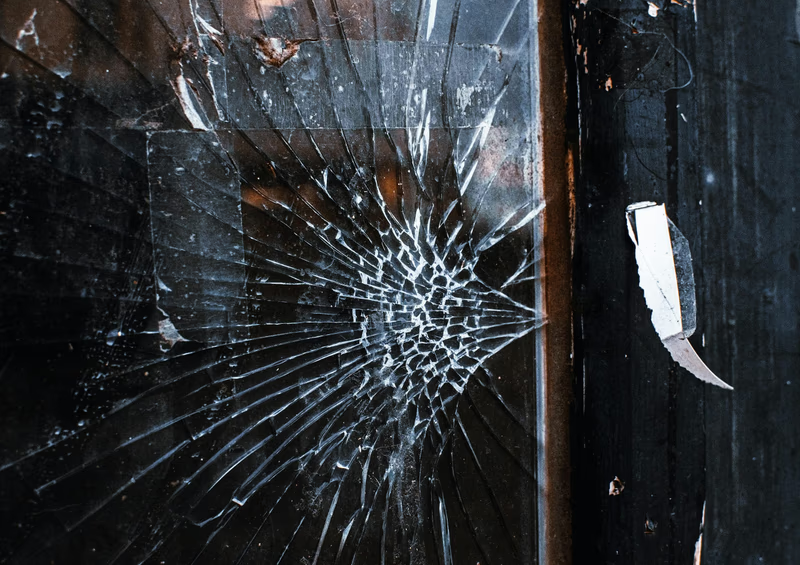
Under New York law, property owners owe different levels of care depending on the visitor's status. CPLR §214 establishes a 3-year statute of limitations for premises liability claims in New York. Miss this deadline and your right to compensation is permanently extinguished. However, some deadlines are far shorter — injuries on government property require a Notice of Claim within 90 days under General Municipal Law §50-e.
Long Island presents unique premises liability challenges, from the shopping centers along Route 110 to the residential complexes in Deer Park and Commack. Property owners who cut corners on maintenance create dangerous conditions. Our firm holds them accountable.
Duty of Care by Visitor Status
The foundation of every premises liability case in New York is the duty of care that the property owner owed to the injured person at the time of the accident. New York courts classify visitors into three categories, each carrying a different standard of responsibility for the property owner. Understanding which category applies to your situation is essential because it determines what the owner was legally required to do — and whether their failure to act constitutes negligence.
Invitees receive the highest duty of care. An invitee enters the property for the mutual benefit of both parties or at the express or implied invitation of the owner. This includes customers shopping at Walt Whitman Mall in Huntington Station, diners at restaurants along Jericho Turnpike, tenants in apartment buildings throughout Hicksville and Farmingdale, and patients visiting medical offices.
Property owners owe invitees an affirmative duty to inspect the premises for hidden or non-obvious hazards, repair dangerous conditions within a reasonable time, and warn of any known dangers not yet corrected. A grocery store, for example, cannot simply wait for a customer to report a spill in the produce aisle. The store must have regular inspection procedures to discover and clean up spills before they injure someone.
When a shopper slips on an unmarked wet floor and fractures a hip, the store's failure to maintain an adequate inspection schedule is powerful evidence of negligence.
Licensees, such as social guests invited to a friend's home, receive a somewhat lower duty of care. The property owner is not required to inspect for unknown hazards on behalf of a licensee, but they must warn the guest of any dangerous conditions they actually know about. If a homeowner knows that the third step on their back porch is rotted and could collapse, they are obligated to tell their dinner guest about it. Failure to provide that warning — resulting in the guest falling through the step and sustaining a knee injury — gives rise to a valid premises liability claim.
Trespassers occupy the lowest rung of protection: property owners generally owe them no duty of care beyond refraining from willful or wanton conduct, such as setting traps. However, New York recognizes an important exception for child trespassers under the attractive nuisance doctrine.
If a property owner maintains a condition likely to attract children — an unfenced swimming pool, an abandoned construction site, or unlocked heavy equipment — and a child is injured while trespassing, the owner can be held liable. This doctrine applies broadly across Long Island, where backyard pools are common in residential neighborhoods throughout Dix Hills, Smithtown, and Babylon.
Proving Notice — Actual vs. Constructive
Actual vs. Constructive Notice
To win a premises liability case, you must prove the property owner had notice of the hazard — either actual notice (direct knowledge) or constructive notice (the condition was visible and existed long enough that the owner should have discovered it). The landmark case Gordon v. American Museum of Natural History, 67 N.Y.2d 836 (1986), established New York's constructive notice standard.
In most premises liability cases, proving that a hazardous condition existed is only half the battle. The injured plaintiff must also demonstrate that the property owner had notice of the dangerous condition — either actual notice or constructive notice.
Actual notice means the property owner had direct, specific knowledge of the hazard. You can prove this through maintenance logs showing a prior report, written complaints from tenants or customers, internal memos discussing the condition, or testimony from employees who observed the hazard. For example, if a busboy told a restaurant manager that water was leaking from a ceiling pipe onto the dining room floor, and the manager failed to address it before a patron slipped and fell, the restaurant had actual notice.
Constructive notice is more common and more difficult to establish. It applies when the hazardous condition was visible and apparent and existed long enough that the property owner, exercising reasonable care, should have discovered and corrected it.
The landmark New York case on constructive notice is Gordon v. American Museum of Natural History, 67 N.Y.2d 836 (1986). In that decision, the Court of Appeals held that the plaintiff must show the defect was visible and apparent. The defect must also have existed for a sufficient length of time prior to the accident to permit the defendant's employees to discover and remedy it.
Courts examine several factors: how long the hazard existed before the injury, whether the property owner had regular inspection procedures, whether anyone previously complained about similar conditions, and the property's general maintenance practices.
For example, a puddle of water that formed five minutes before a slip-and-fall may not support constructive notice. However, a puddle that sat in a supermarket aisle for two hours — with dirty footprints tracking through it — strongly suggests the store had ample opportunity to discover and clean it up. Our firm works with accident reconstruction experts and subpoenas store inspection records to establish the timeline that proves constructive notice.
Comparative Negligence and Open/Obvious Hazards
One of the most frequent defenses property owners raise is that the hazardous condition was "open and obvious" — meaning the injured person should have seen and avoided it. In many states, this defense can completely bar recovery. New York takes a critically different approach.
Under CPLR §1411, New York follows a pure comparative negligence system. The open and obvious nature of a hazard does not eliminate the property owner's duty to maintain safe conditions — it merely becomes a factor in assessing comparative fault. A property owner cannot leave a gaping hole in a stairwell and claim immunity simply because the hole was visible. The owner still had a duty to repair the hazard. The jury will then apportion fault between the owner and the injured party based on the specific facts of the case.
This distinction matters because insurance companies routinely exploit the open-and-obvious defense to pressure injured victims into accepting lowball settlements. An adjuster may tell you, "You should have seen that broken step — we're not responsible." In New York, that argument does not hold up.
Even if a jury determines you bore some responsibility for not noticing the hazard, your recovery is merely reduced by your percentage of fault — not eliminated. If your total damages are $800,000 and the jury assigns you 25% fault, you still recover $600,000.
Insurance companies understand this, which is why having an experienced premises liability attorney who can counter their comparative negligence arguments is essential to maximizing your recovery. Our firm has handled hundreds of cases where the insurer initially denied the claim based on open-and-obvious arguments. Those insurers paid substantial settlements once we demonstrated the property owner's negligence through expert testimony and documentary evidence.
Government Property and the 90-Day Notice of Claim
Injuries on government-owned property — a cracked sidewalk maintained by the Town of Huntington, a pothole in a Nassau County parking lot, a defective handrail in a New York City subway station, a broken bench in Heckscher State Park — follow an entirely different set of procedural rules. These rules create traps for the unwary.
Under General Municipal Law §50-e, anyone injured on property owned or maintained by a municipality, county, state agency, or public authority must file a Notice of Claim within 90 days of the date of injury. This is not a suggestion — it is a jurisdictional requirement. Failing to file within the 90-day window will almost certainly result in permanent dismissal of your case, regardless of how strong your evidence of negligence may be.
Beyond the Notice of Claim, many municipalities on Long Island have enacted prior written notice laws that impose an additional burden on the injured plaintiff. Under these local ordinances, a municipality cannot be held liable for a defective sidewalk, roadway, or other property condition unless it received prior written notice of the specific defect. This typically means a written complaint filed with the town clerk, highway department, or relevant municipal agency.
As a result, even if a Town of Babylon sidewalk had been cracked and raised for years, the town may argue it bears no liability unless someone previously reported that exact defect in writing.
There are exceptions — if the municipality created the defect through its own affirmative actions, or if it received written notice and failed to act — but these cases require meticulous research into municipal records. This is one of the most technically demanding areas of premises liability law, and hiring an attorney with specific experience in government claims is essential. Our firm regularly handles claims against the Town of Huntington, Town of Islip, Nassau County, Suffolk County, and New York City, and we understand the procedural requirements that must be satisfied to pursue these cases successfully.
If you were injured on someone else's property, explore our legal blog for in-depth case law analysis, or learn about related claims on our slip and fall and personal injury pages.
Dangerous Conditions
What Are the Most Common Premises Liability Hazards on Long Island?
Premises liability injuries on Long Island arise from a wide range of hazardous conditions. The type of hazard often determines the complexity of the case and which parties can be held responsible. Slip-and-fall hazards remain the most common category. These include wet floors in grocery stores and restaurants — particularly near produce sections, beverage aisles, and restroom entrances where spills are foreseeable — as well as icy parking lots and sidewalks during Long Island's harsh winters.
Property owners have a duty to salt, sand, and shovel walkways within a reasonable time after a storm ends. Yet every winter, our firm handles cases where apartment complexes, strip malls, and office parks fail to perform even basic snow and ice removal.
Additionally, broken or deteriorating staircases in older apartment buildings throughout Hempstead, Freeport, and Central Islip are a persistent source of injuries. Torn or bunched carpeting in commercial buildings, loose floor tiles, and recently mopped surfaces without warning signs also lead to serious falls.
Inadequate security cases arise when property owners fail to provide reasonable safety measures and a visitor is assaulted, robbed, or otherwise harmed by a third party's criminal conduct. These claims are common in poorly lit parking garages at shopping centers, apartment building lobbies without working locks or security cameras, hotel rooms with broken deadbolts, and nightclub or bar parking lots with a history of violent incidents.
To prevail in an inadequate security case, we must prove the criminal act was foreseeable — typically by demonstrating a pattern of prior criminal activity at the location. We must also show the property owner failed to take reasonable precautions such as installing lighting, maintaining locks, hiring security personnel, or installing surveillance cameras.
Swimming pool accidents are a grave concern across Long Island's suburban communities, where thousands of residential and commercial pools exist. Residential pools without code-compliant fencing, self-closing gates, or pool alarms create drowning and near-drowning risks for children. Hotel and community pools that operate without lifeguards, fail to maintain proper drain covers, or lack adequate depth markings also expose guests to serious harm.
Elevator and escalator injuries occur in high-rise buildings, malls, and commercial properties when equipment malfunctions. Common causes include sudden drops, door closures on passengers, escalator entrapment, and leveling failures that create trip hazards between the elevator car and the floor. These cases typically involve claims against both the building owner and the elevator maintenance company.
Construction site hazards deserve special mention because New York provides some of the strongest worker protections in the country through Labor Law §240 (the "Scaffold Law") and Labor Law §241(6). Workers injured by falling objects, scaffold collapses, or falls from heights may have strict liability claims against property owners and general contractors — regardless of the worker's own negligence.
Even non-workers can pursue premises liability claims. Pedestrians struck by falling debris from scaffolding above a sidewalk, or those who fall into unbarricaded open trenches, can hold the property owner and responsible contractor liable.
Toxic exposure in residential and commercial buildings represents a growing area of premises liability litigation on Long Island. Tenants in older apartment buildings may be exposed to lead paint — particularly dangerous for young children — while water damage left unaddressed leads to toxic mold growth. Asbestos exposure remains a risk during renovations of pre-1980 buildings, and landlords who fail to follow proper abatement procedures can be held liable for the resulting health consequences.
Understanding the Differences
How Is Commercial Premises Liability Different from Residential in New York?
Not all premises liability cases are created equal. The legal standards, the duties owed by property owners, and the insurance dynamics differ significantly depending on whether the injury occurred on a commercial property or a residential property. Understanding these distinctions is essential to evaluating the strength of your claim and the compensation you can realistically recover.
Commercial property owners owe the highest standard of care to visitors because their premises are open to the public and maintained for business purposes. Stores, restaurants, shopping malls, office buildings, hotels, and entertainment venues must regularly inspect their premises for hazardous conditions, maintain reasonably safe conditions, and promptly warn visitors of any known dangers not yet corrected.
This duty is not passive — commercial property owners cannot simply wait for someone to report a hazard. They must implement regular inspection protocols. A supermarket, for example, must perform documented sweep-and-inspection routines at regular intervals throughout the day. When a customer slips on a spill that sat on the floor for an hour, the absence of documented inspections during that period is powerful evidence of negligence.
Commercial properties must also comply with building codes and ADA accessibility requirements that impose specific safety standards. The New York State Uniform Fire Prevention and Building Code establishes minimum standards for stairways, handrails, lighting, floor surfaces, exits, and structural integrity. The Americans with Disabilities Act requires commercial properties to provide accessible entrances, ramps, handrails, and restroom facilities.
A violation of any of these codes that contributes to an injury creates a strong presumption of negligence. Our firm works with building inspectors and safety engineers who identify code violations the property owner may have ignored for years — violations that directly caused or contributed to your injury.
Residential property owners operate under a different framework that depends largely on whether the property is a rental or owner-occupied, and whether it is a single-family home or a multi-family dwelling. Landlords of rental properties owe their tenants a duty of care defined in significant part by Real Property Law §235-b. This statute imposes an implied warranty of habitability on every residential lease in New York.
The warranty requires the landlord to maintain the premises in a condition fit for human habitation, free from conditions that are dangerous, hazardous, or detrimental to life, health, or safety. A tenant injured because of a landlord's failure to maintain the property — a broken staircase, a missing handrail, defective electrical wiring, water damage creating slip hazards — can bring a premises liability claim based on the landlord's breach of this warranty.
Residential landlords also face specific obligations regarding lead paint disclosure under Real Property Law §467. Properties built before 1978 are presumed to contain lead-based paint. Landlords of these properties must disclose the known presence of lead paint to tenants, provide informational pamphlets, and take specific steps to remediate lead hazards.
Lead paint exposure is particularly dangerous for young children. It can cause irreversible neurological damage, developmental delays, and learning disabilities. A landlord who fails to address lead paint hazards in a building with young children can be held liable for the resulting injuries — and these cases can produce significant damages given the lifelong impact of lead poisoning.
The rules differ further for multi-family dwellings versus single-family homes. Owners of multi-family buildings — apartment complexes, duplexes, and triplexes — have a heightened duty to maintain common areas such as hallways, stairwells, lobbies, laundry rooms, parking lots, and shared outdoor spaces. These common areas remain under the landlord's control even when individual apartments are leased to tenants.
As a result, the landlord is directly responsible for their condition. A tenant who trips on torn carpeting in a building hallway or slips on an icy walkway outside the building entrance has a strong claim against the landlord.
Single-family homeowners, by contrast, generally owe a more limited duty that applies primarily to conditions they actually know about. A homeowner aware that a porch step is rotted must warn guests about the hazard. However, they are not required to conduct regular inspections the way a commercial property owner would be.
The insurance dynamics in commercial versus residential premises liability cases also differ in ways that directly affect your potential recovery. Commercial properties are typically covered by commercial general liability (CGL) insurance policies with coverage limits ranging from $1 million to $10 million or more, depending on the size and nature of the business.
Large commercial enterprises — shopping malls, hotel chains, restaurant franchises — may carry umbrella policies that provide additional layers of coverage above the primary CGL limits. As a result, in cases involving serious injuries on commercial property, substantial insurance coverage is often available to satisfy a judgment or settlement.
Residential properties, by contrast, are typically covered by homeowner's insurance policies with far lower liability limits — commonly $100,000 to $500,000. While landlords of multi-family rental properties often carry landlord liability policies with higher limits, a premises liability claim against a single-family homeowner may be constrained by relatively modest policy limits. Understanding the available insurance coverage early in the case is critical to setting realistic expectations and developing an appropriate litigation strategy. Our firm investigates coverage as part of our initial case evaluation so that you understand from the outset what insurance resources are available to compensate your injuries.
Financial Recovery
What Compensation Can I Get for a Premises Liability Injury on Long Island?
| Injury Severity | Settlement Range | Typical Timeline |
|---|---|---|
| Minor (sprains, bruises) | $25,000 – $100,000 | 3–6 months |
| Moderate (fractures, torn ligaments) | $100,000 – $500,000 | 6–18 months |
| Severe / Catastrophic (TBI, spinal cord, hip fracture) | $500,000 – $1,500,000+ | 1–3+ years |
Every case is unique. These ranges reflect general Long Island case outcomes and are not guarantees of results.
A successful premises liability claim entitles you to both economic damages and non-economic damages. Economic damages compensate you for the tangible financial losses caused by the injury. These include all past and future medical expenses — emergency room treatment, hospitalization, surgery, prescription medications, physical therapy, chiropractic care, and long-term rehabilitation.
If your injury required or will require assistive devices such as a wheelchair, crutches, or a hospital bed at home, those costs are recoverable. Lost wages from time missed at work are also included. Additionally, you can recover for the loss of future earning capacity if the injury has permanently diminished your ability to work or forced you into a lower-paying position.
In catastrophic injury cases — spinal cord damage, traumatic brain injuries, severe fractures requiring multiple surgeries — economic damages may also include the cost of home modifications such as wheelchair ramps, widened doorways, and accessible bathrooms, as well as ongoing home health aides or nursing care.
Non-economic damages compensate you for pain and suffering, emotional distress, loss of enjoyment of life, and the diminished quality of your daily existence following the injury. Unlike motor vehicle accident cases — where recovery for pain and suffering is limited to injuries meeting the "serious injury" threshold under Insurance Law §5102(d) — premises liability claims carry no such threshold.
You can recover non-economic damages for any injury caused by a property owner's negligence, regardless of severity. This makes premises liability claims particularly valuable in cases involving chronic pain, permanent scarring, anxiety about returning to the location of the injury, and depression resulting from prolonged disability.
The value of a premises liability case varies significantly depending on the county where the case is tried. Long Island juries in Nassau County, sitting in the courthouse in Mineola, and Suffolk County, sitting in the courthouse in Riverhead, tend to award substantial damages in premises liability cases. This is especially true where evidence shows the property owner knew about the hazardous condition and deliberately chose not to fix it.
Juries respond to evidence of corporate indifference: internal emails showing ignored maintenance requests, inspection logs with gaps, and testimony from former employees describing a culture of cutting corners. Our firm builds these narratives from the ground up. We use discovery tools to extract the documentary evidence that transforms a routine premises liability claim into a case that commands maximum value at trial or in settlement negotiations.
Protect Your Case
What Should I Do After a Slip and Fall or Property Injury on Long Island?
What you do in the hours and days immediately following a premises liability injury can make or break your case. The single most important step is to report the incident to the property owner or manager and insist that they create a written incident report. Ask for a copy before you leave — many businesses will claim they never received a report if you do not obtain your own copy.
While still at the scene, use your phone to photograph the hazardous condition from multiple angles. Capture wide shots showing the surrounding area, close-ups of the specific defect that caused your injury, and photos of any warning signs — or the absence of warning signs. If weather conditions contributed to your injury, photograph the ice, snow, or standing water. Also take photos of your injuries, including any bruising, swelling, cuts, or torn clothing.
Seek medical attention immediately, even if your injuries seem minor at the time. Many premises liability injuries — concussions, soft tissue damage, hairline fractures, internal bleeding — do not manifest full symptoms for hours or days. A gap between your accident date and your first medical visit gives the insurance company ammunition to argue your injuries were not caused by the fall or are not as severe as you claim. Go to the emergency room, urgent care, or your primary care physician on the same day.
Additionally, identify any witnesses who saw the accident and collect their names and phone numbers. If the property has security cameras, make a mental note of their locations. This evidence is critical because surveillance footage is routinely overwritten within 24 to 72 hours.
Equally important is what you should not do after a premises liability injury. Do not give a recorded statement to the property owner's insurance company without first consulting an attorney. Adjusters ask questions designed to elicit admissions that can be used against you — "Were you looking where you were walking?" or "Did you notice the condition before you fell?" are not innocent questions.
Also, preserve the clothing and footwear you were wearing at the time of the injury. The defense may argue that your shoes were inappropriate for the conditions. Having the actual shoes available for inspection defeats that argument.
Contact an experienced premises liability attorney before the property owner's insurance company contacts you. Our firm offers free consultations and can begin preserving evidence — including sending spoliation letters to prevent the destruction of surveillance footage and maintenance records — within hours of your call to (516) 750-0595.
Related practice areas: Slip & Fall • Catastrophic Injury • Wrongful Death • Pool Accidents • Personal Injury
Common Questions
Premises Liability FAQ
What is premises liability in New York?
How long do I have to file a premises liability lawsuit?
Can I sue if I slipped on ice in New York?
What if I was partially at fault for my injury?
Do I need to report the incident to the property owner?
Can I sue a government entity for a premises liability injury?
What compensation can I recover in a premises liability case?
How much does a premises liability lawyer cost?
Slip & Fall Settlement Calculator
Estimate the value of your premises liability case using real New York settlement data and the multiplier method.
Calculate Your EstimateEducational tool only. Not legal advice.

Reviewed & Verified By
Jason Tenenbaum, Esq.
Jason Tenenbaum is a personal injury attorney serving Long Island, Nassau & Suffolk Counties, and New York City. Admitted to practice in NY, NJ, FL, TX, GA, MI, and Federal courts, Jason is one of the few attorneys who writes his own appeals and tries his own cases. Since 2002, he has authored over 2,353 articles on no-fault insurance law, personal injury, and employment law — a resource other attorneys rely on to stay current on New York appellate decisions.
Evidence Disappears Fast
Surveillance Footage Gets Deleted. Witnesses Forget. Property Gets Repaired. Act Now.
The property owner is already calling their insurer and repairing the hazard that hurt you. Every day you wait, critical evidence vanishes. We preserve it before it's gone.
No fee unless we win. Available 24/7. Hablamos Español.