Key Takeaway
Learn how range of motion limitations affect personal injury cases on Long Island. Expert medical evidence standards after Mahler v Lewis. Call 516-750-0595.
This article is part of our ongoing no-fault coverage, with 271 published articles analyzing no-fault issues across New York State. Attorney Jason Tenenbaum brings 24+ years of hands-on experience to this analysis, drawing from his work on more than 1,000 appeals, over 100,000 no-fault cases, and recovery of over $100 million for clients throughout Nassau County, Suffolk County, Queens, Brooklyn, Manhattan, and the Bronx. For personalized legal advice about how these principles apply to your specific situation, contact our Long Island office at (516) 750-0595 for a free consultation.
Range of Motion Limitations in Personal Injury Cases: Expert Medical Evidence Standards
When you are injured in an accident on Long Island, one of the most critical aspects of your personal injury claim involves proving the extent of your physical limitations.
A recent appellate court decision, Mahler v Lewis, 2022 NY Slip Op 06123 (2d Dept. 2022), provides crucial guidance on this topic. It addresses how medical experts must support their opinions about range of motion (ROM) limitations, and what happens when they fail to do so properly.
In this case, the Second Department made it clear: “One of the defendant’s experts found significant limitations in the range of motion of the cervical and lumbar regions of the injured plaintiff’s spine, and failed to adequately explain and substantiate, with competent medical evidence, his belief that the limitations were self-imposed.”
This ruling has significant implications for personal injury cases across New York, particularly for plaintiffs seeking compensation for spinal injuries and movement restrictions.
Understanding Range of Motion in Personal Injury Cases
What is Range of Motion?
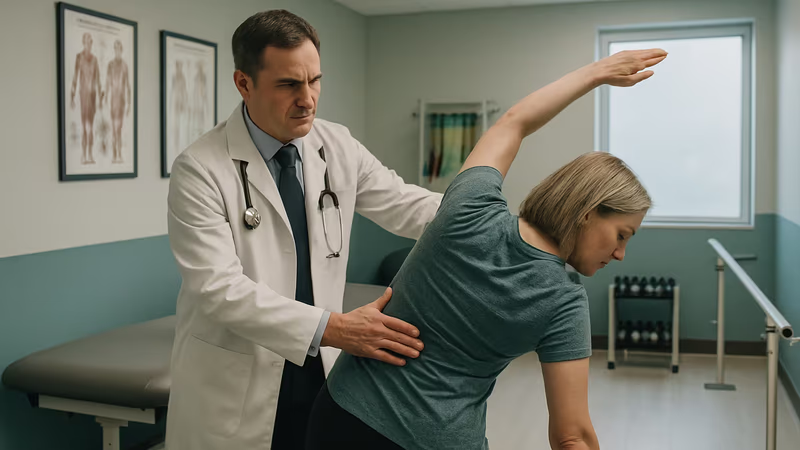
Range of motion refers to the extent of movement possible at a joint or series of joints. In personal injury cases, ROM measurements are crucial because they:
- Document objective physical limitations following an accident
- Provide measurable evidence of injury severity
- Help establish the extent of disability for compensation purposes
- Track recovery progress during treatment
- Support claims for future medical care and lost earning capacity
Common ROM Limitations After Accidents
Motor vehicle accidents, slip and falls, and other traumatic events frequently cause restrictions in:
Cervical Spine (Neck):
- Reduced ability to turn head left/right (rotation)
- Limited forward/backward neck movement (flexion/extension)
- Restricted side-to-side bending (lateral flexion)
Lumbar Spine (Lower Back):
- Difficulty bending forward (flexion)
- Limited backward extension
- Reduced side bending
- Impaired twisting motions
Extremities:
- Shoulder, elbow, wrist limitations
- Hip, knee, ankle restrictions
- Finger and toe movement impairments
The Problem with “Self-Imposed” Limitation Claims
Defense Strategy Exposed
Insurance companies and defense attorneys often try to minimize injury claims by arguing that physical limitations are “self-imposed.” They claim the injured person is restricting their own movement, either consciously or unconsciously. In their view, the person is not physically unable to move normally—they are choosing not to.
This defense strategy attempts to:
- Reduce settlement values by questioning injury legitimacy
- Avoid full compensation for legitimate limitations
- Shift blame to the plaintiff for their own restrictions
- Create doubt about objective findings through subjective interpretations
The Legal Standard for Expert Opinions
The Mahler decision reinforces critical requirements for medical expert testimony:
1. Adequate Explanation Required
Medical experts cannot simply state conclusions without proper reasoning. They must explain the basis for their opinions in detail.
2. Competent Medical Evidence Needed
Opinions must be supported by objective medical evidence, not just subjective observations or assumptions.
3. Scientific Foundation Essential
Expert conclusions must be grounded in accepted medical principles and practices.
4. Detailed Documentation Required
Experts must provide sufficient detail to allow courts to evaluate the reliability of their conclusions.
What This Means For You
If You are an Injured Party
Your Rights Are Protected: This decision strengthens your position when insurance companies try to claim your limitations are not real. Defense experts cannot simply wave their hands and declare your restrictions “self-imposed” without substantial medical evidence.
Document Everything: Work with your treating physicians to ensure:
- All ROM limitations are properly measured and documented
- Your symptoms are recorded consistently across visits
- Objective testing supports subjective complaints
- Treatment records reflect genuine attempts to improve
Do Not Let Defense Tactics Intimidate You: Insurance companies may pressure you to accept lower settlements by questioning your injuries. This decision shows courts will scrutinize unsupported defense expert opinions.
If You are a Medical Provider
Thorough Documentation is Critical: When treating patients with ROM limitations, ensure your records include:
- Specific degree measurements for all restricted movements
- Comparison to normal ranges for the patient’s age/condition
- Objective findings supporting subjective complaints
- Consistent measurements across multiple visits
- Response to various treatment modalities
Expert Testimony Standards: If called to testify, remember that opinions must be:
- Based on thorough examination and review
- Supported by objective medical evidence
- Explained in detail with scientific reasoning
- Consistent with accepted medical standards
Strategic Implications for Personal Injury Cases
Strengthening Plaintiff Cases
The Mahler decision provides several tactical advantages:
1. Challenge Weak Defense Experts
Demand detailed explanations and medical support for any claims that limitations are “self-imposed.”
2. Focus on Objective Evidence
Emphasize ROM measurements, imaging studies, and other objective findings that support your client’s limitations.
3. Expose Defense Bias
Highlight when defense experts rely on speculation rather than medical evidence.
Building Stronger Medical Records
Work with treating physicians to create comprehensive documentation:
- Initial post-accident ROM measurements
- Periodic reassessments showing consistent limitations
- Correlation with other objective findings
- Documentation of genuine treatment efforts
- Expert opinions based on thorough examination
Understanding the Broader Legal Context
New York State Approach to Medical Expert Evidence
New York courts have consistently required that medical expert opinions be:
- Scientifically reliable and based on accepted medical principles
- Adequately supported by the evidence in the record
- Properly explained with sufficient detail for judicial review
- Consistent with objective findings rather than mere speculation
Impact on Settlement Negotiations
This decision affects settlement discussions by:
- Strengthening plaintiff negotiating positions when ROM limitations are documented
- Weakening defense arguments based on unsupported “self-imposed” theories
- Encouraging more thorough medical documentation from all parties
- Raising the bar for defense expert qualifications and testimony
Frequently Asked Questions
Q: What should I do if a defense expert claims my limitations are “self-imposed”?
A: Work with your attorney to demand detailed medical support for this opinion. The Mahler decision requires experts to provide competent medical evidence, not just speculation. Your legal team can challenge unsupported conclusions and highlight the lack of proper medical foundation.
Q: How can I prove my ROM limitations are genuine and not psychological?
A: Focus on objective evidence: consistent measurements by multiple healthcare providers, imaging studies showing structural damage, unsuccessful attempts at improvement through physical therapy, and correlation between your limitations and documented injuries. Multiple independent examinations showing similar restrictions are particularly valuable.
Q: Can old injuries affect my current ROM limitations after an accident?
A: Yes, but your attorney can argue that the accident either caused new limitations or aggravated pre-existing conditions. The key is distinguishing between your pre-accident baseline and current restrictions. Medical records before and after the accident help establish this distinction.
Q: What types of medical evidence best support ROM limitation claims?
A: The strongest evidence includes: formal ROM measurements by qualified healthcare providers, repeated measurements showing consistency, imaging studies correlating with clinical findings, physical therapy notes documenting genuine efforts to improve, and expert opinions based on thorough examination and objective evidence.
Q: How do courts typically handle conflicting expert opinions about ROM limitations?
A: Courts evaluate the quality of evidence supporting each opinion. The Mahler decision shows courts will scrutinize whether experts provide adequate explanations and competent medical evidence. Well-supported opinions based on objective findings typically carry more weight than conclusions based on speculation or inadequate examination.
Moving Forward After the Mahler Decision
This ruling is an important victory for injured parties throughout New York. Insurance companies and their experts cannot simply dismiss legitimate physical limitations.
They must provide proper medical evidence and detailed explanations to support their conclusions.
For personal injury practitioners on Long Island and throughout New York, this decision provides powerful ammunition to challenge weak defense expert testimony and protect clients’ rights to fair compensation for genuine physical limitations.
The message is clear: medical experts must do more than simply state conclusions—they must support their opinions with competent medical evidence and adequate explanations that meet rigorous legal standards.
Get Expert Legal Help for Your ROM Limitation Case
If you have suffered range of motion limitations following an accident on Long Island, do not let insurance companies minimize your injuries with unsupported claims that your limitations are “self-imposed.” The Law Office of Jason Tenenbaum understands the medical and legal complexities of ROM cases and will fight to ensure your limitations are properly documented and fairly compensated.
Our experienced team knows how to:
- Work with medical experts who provide thorough, well-supported opinions
- Challenge defense experts who rely on speculation rather than evidence
- Build comprehensive medical records that document your genuine limitations
- Negotiate settlements that reflect the true extent of your injuries
- Litigate cases when insurance companies refuse to offer fair compensation
Do not settle for less than you deserve. Call 516-750-0595 for a free consultation and learn how we can help protect your rights and secure the compensation you need for your range of motion limitations.
The Law Office of Jason Tenenbaum is located on Long Island and serves clients throughout New York in personal injury, no-fault insurance, and medical malpractice cases. Learn more about our personal injury services, no-fault insurance practice, and motor vehicle accident representation.
Related Articles
Legal Context
Why This Matters for Your Case
New York's no-fault insurance system, established under Insurance Law Article 51, is one of the most complex insurance frameworks in the country. Every motorist must carry Personal Injury Protection coverage that pays medical expenses and lost wages regardless of fault, up to $50,000 per person.
But insurers routinely deny valid claims using peer reviews, EUO scheduling tactics, fee schedule reductions, and coverage defenses. The Law Office of Jason Tenenbaum has handled over 100,000 no-fault cases since 2002 — from initial claim submissions through arbitration before the American Arbitration Association, trials in Civil Court and Supreme Court, and appeals to the Appellate Term and Appellate Division. Jason Tenenbaum is one of the few attorneys in the state who both writes his own appellate briefs and tries his own cases.
His 2,353+ published legal articles on no-fault practice are cited by attorneys throughout New York. Whether you are dealing with a medical necessity denial, an EUO no-show defense, a fee schedule dispute, or a coverage question, this article provides the kind of detailed case-law analysis that helps practitioners and claimants understand exactly where the law stands.
About This Topic
New York No-Fault Insurance Law
New York's no-fault insurance system requires every driver to carry Personal Injury Protection (PIP) coverage that pays medical expenses and lost wages regardless of who caused the accident. But insurers routinely deny, delay, and underpay valid claims — using peer reviews, IME no-shows, and fee schedule defenses to avoid paying providers and injured claimants. Attorney Jason Tenenbaum has litigated thousands of no-fault arbitrations and court cases since 2002.
271 published articles in No-Fault
Keep Reading
More No-Fault Analysis

Priority of Payment Regulation Has No Force in Arbitration: First and Second Departments Agree
Both the First and Second Departments have held that the priority of payment regulation under 11 NYCRR 65-3.15 is of no force or effect in no-fault arbitration proceedings....
Feb 25, 2026
How Insurance Companies Use Colossus Software to Undervalue Your Injury Claim
Insurance companies use Colossus software to lowball your injury claim. Learn how this system works and how a Long Island attorney can fight back. Call 516-750-0595.
Feb 18, 2026
Injunction scored on the Yan Moshe, the biggest No-Fault Player out there
Yan Moshe faces GEICO lawsuit over fraudulent medical billing practices in New Jersey facilities and violations.
Jul 20, 2020
Third-party vendor troubles
New York no-fault insurance carriers risk costly legal defeats when third-party mailing vendors fail to prove proper delivery procedures for claim denials.
Apr 7, 2015
Untimely Summary Judgment Motions: Nearly Identical Grounds Rule – Long Island & NYC
Second Department ruling allows untimely summary judgment motions on nearly identical grounds. Strategic insights for Long Island and NYC litigation practice.
Jan 23, 2010
Yet Another Verification?
Nassau County court finds no-fault insurance verification demands unclear, denies carrier's summary judgment motion for disclaimer validity in State Farm v Burke Physical Therapy...
Mar 19, 2022Was this article helpful?

About the Author
Jason Tenenbaum, Esq.
Jason Tenenbaum is the founding attorney of the Law Office of Jason Tenenbaum, P.C., headquartered at 326 Walt Whitman Road, Suite C, Huntington Station, New York 11746. With over 24 years of experience since founding the firm in 2002, Jason has written more than 1,000 appeals, handled over 100,000 no-fault insurance cases, and recovered over $100 million for clients across Long Island, Nassau County, Suffolk County, Queens, Brooklyn, Manhattan, the Bronx, and Staten Island. He is one of the few attorneys in the state who both writes his own appellate briefs and tries his own cases.
Jason is admitted to practice in New York, New Jersey, Florida, Texas, Georgia, and Michigan state courts, as well as multiple federal courts. His 2,353+ published legal articles analyzing New York case law, procedural developments, and litigation strategy make him one of the most prolific legal commentators in the state. He earned his Juris Doctor from Syracuse University College of Law.
Disclaimer: This article is published by the Law Office of Jason Tenenbaum, P.C. for informational and educational purposes only. It does not constitute legal advice, and no attorney-client relationship is formed by reading this content. The legal principles discussed may not apply to your specific situation, and the law may have changed since this article was last updated.
New York law varies by jurisdiction — court decisions in one Appellate Division department may not be followed in another, and local court rules in Nassau County Supreme Court differ from those in Suffolk County Supreme Court, Kings County Civil Court, or Queens County Supreme Court. The Appellate Division, Second Department (which covers Long Island, Brooklyn, Queens, and Staten Island) and the Appellate Term (which hears appeals from lower courts) each have distinct procedural requirements and precedents that affect litigation strategy.
If you need legal help with a no-fault matter, contact our office at (516) 750-0595 for a free consultation. We serve clients throughout Long Island (Huntington, Babylon, Islip, Brookhaven, Smithtown, Riverhead, Southampton, East Hampton), Nassau County (Hempstead, Garden City, Mineola, Great Neck, Manhasset, Freeport, Long Beach, Rockville Centre, Valley Stream, Westbury, Hicksville, Massapequa), Suffolk County (Hauppauge, Deer Park, Bay Shore, Central Islip, Patchogue, Brentwood), Queens, Brooklyn, Manhattan, the Bronx, Staten Island, and Westchester County. Prior results do not guarantee a similar outcome.