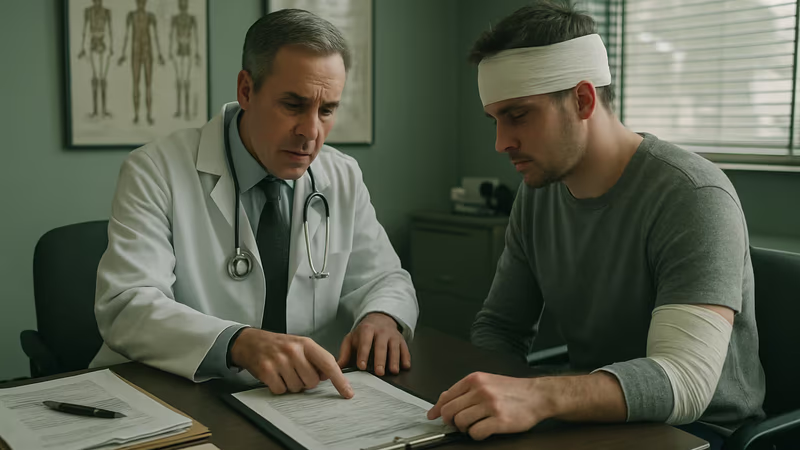
Key Takeaway
Second Department follows First Department precedent, making gaps in medical treatment a viable defense against personal injury threshold claims again.
This article is part of our ongoing 5102(d) issues coverage, with 89 published articles analyzing 5102(d) issues issues across New York State. Attorney Jason Tenenbaum brings 24+ years of hands-on experience to this analysis, drawing from his work on more than 1,000 appeals, over 100,000 no-fault cases, and recovery of over $100 million for clients throughout Nassau County, Suffolk County, Queens, Brooklyn, Manhattan, and the Bronx. For personalized legal advice about how these principles apply to your specific situation, contact our Long Island office at (516) 750-0595 for a free consultation.
The landscape of personal injury litigation in New York continues to evolve, particularly regarding how courts handle gaps in medical treatment when determining whether a plaintiff meets the serious injury threshold under Insurance Law § 5102(d). For years, plaintiffs’ attorneys have grappled with defendants who argue that interruptions in treatment demonstrate that injuries weren’t truly serious or disabling.
The Second Department’s approach to treatment gaps has historically differed from the First Department’s more plaintiff-friendly stance. This divergence created strategic challenges for attorneys practicing in different appellate divisions, as the same set of facts might yield different outcomes depending on the court’s jurisdiction.
Recent developments suggest the Second Department is aligning more closely with First Department precedent, potentially making it more difficult for plaintiffs to succeed in personal injury cases involving soft tissue injuries where treatment gaps exist.
Jason Tenenbaum’s Analysis:
Chiu Yuan Hu v Frenzel, 2018 NY Slip Op 05445 (1st Dept. 2018)
“In opposition to the defendant’s prima facie showing, the plaintiff raised triable issues of fact as to whether she sustained serious injuries to the cervical and thoracolumbar regions of her spine (see Perl v Meher, 18 NY3d 208, 215-218). Further, contrary to the determination of the Supreme Court, we find that the plaintiff adequately explained the gap in her treatment by submitting an affirmed medical report of her treating physician (see Pommells v Perez, 4 NY3d 566, 577; Jean-Baptiste v Tobias, 88 AD3d 962; Park v He Jung Lee, 84 AD3d 904, 905).”
It got harder as a Plaintiff to make a living on soft tissue cases today in the Second Department. I was waiting for the Second Department to follow the First Department. It has somewhat happened. Gap in treatment is back.
Key Takeaway
This decision signals a concerning trend for plaintiffs’ attorneys handling soft tissue injury cases in the Second Department. The court’s renewed emphasis on treatment gaps as grounds for dismissal aligns with First Department precedent, making it increasingly challenging to pursue successful threshold motions in cases where clients have interrupted their medical care, regardless of the underlying reasons for such gaps.
Legal Update (February 2026): Since this 2018 analysis, New York appellate courts may have issued additional precedential decisions regarding treatment gaps and serious injury threshold determinations under Insurance Law § 5102(d). The evolving jurisprudence in both the First and Second Departments on this issue requires practitioners to verify current case law and any potential harmonization of standards across appellate divisions.
Related Articles
Legal Context
Why This Matters for Your Case
New York law is among the most complex and nuanced in the country, with distinct procedural rules, substantive doctrines, and court systems that differ significantly from other jurisdictions. The Civil Practice Law and Rules (CPLR) governs every stage of civil litigation, from service of process through trial and appeal. The Appellate Division, Appellate Term, and Court of Appeals create a rich and ever-evolving body of case law that practitioners must follow.
Attorney Jason Tenenbaum has practiced across these areas for over 24 years, writing more than 1,000 appellate briefs and publishing over 2,353 legal articles that attorneys and clients rely on for guidance. The analysis in this article reflects real courtroom experience — from motion practice in Civil Court and Supreme Court to oral arguments before the Appellate Division — and a deep understanding of how New York courts actually apply the law in practice.
Keep Reading
More 5102(d) issues Analysis

Significant limitation v. permanent consequential, again
New York court ruling creates apparent contradiction in no-fault threshold requirements for significant limitation vs. permanent consequential limitation cases.
May 22, 2021
NY Serious Injury Threshold: When Suboptimal Effort Derails Personal Injury Cases
Learn how NY's serious injury threshold works and why suboptimal effort can destroy your personal injury case. Expert Long Island attorney guidance. Call 516-750-0595.
Nov 25, 2019
A Plaintiff's own hospital records defeated his own threshold summary judgment motion
Court examines how plaintiff's own hospital records contradicted expert testimony in no-fault threshold case, creating triable issues of fact.
Jun 5, 2010
Causation on a degeneration
Court ruling shows how plaintiffs can overcome preexisting condition defenses in personal injury cases by proving conditions were asymptomatic before the accident.
Oct 10, 2018
5102(d) baseline under an aggravation and exacervbation
How defendants can defeat 5102(d) serious injury threshold claims under aggravation and exacerbation theories - Boroszko v Zylinski case analysis
Jun 21, 2016
The jury could not find under a reasonable view of the evidence that plaintiff failed to sustain a serious injury under 5102(d)
Court overturns jury verdict finding no serious injury under Insurance Law 5102(d) when plaintiff proved rotator cuff tear with significant range of motion loss.
Jun 20, 2013Common Questions
Frequently Asked Questions
What is the serious injury threshold under Insurance Law §5102(d)?
New York Insurance Law §5102(d) defines 'serious injury' as a personal injury that results in death, dismemberment, significant disfigurement, a fracture, loss of a fetus, permanent loss of use of a body organ, member, function or system, permanent consequential limitation of use of a body organ or member, significant limitation of use of a body function or system, or a medically determined injury that prevents the person from performing substantially all of their daily activities for at least 90 of the first 180 days following the accident.
Why does the serious injury threshold matter?
In New York, you cannot sue for pain and suffering damages in a motor vehicle accident case unless your injuries meet the serious injury threshold. This is a critical hurdle in every car accident lawsuit. Insurance companies aggressively challenge whether plaintiffs meet this threshold, often relying on IME doctors who find no objective limitations. Successfully establishing a serious injury requires detailed medical evidence, including quantified range-of-motion findings and correlation to the accident.
Was this article helpful?

About the Author
Jason Tenenbaum, Esq.
Jason Tenenbaum is the founding attorney of the Law Office of Jason Tenenbaum, P.C., headquartered at 326 Walt Whitman Road, Suite C, Huntington Station, New York 11746. With over 24 years of experience since founding the firm in 2002, Jason has written more than 1,000 appeals, handled over 100,000 no-fault insurance cases, and recovered over $100 million for clients across Long Island, Nassau County, Suffolk County, Queens, Brooklyn, Manhattan, the Bronx, and Staten Island. He is one of the few attorneys in the state who both writes his own appellate briefs and tries his own cases.
Jason is admitted to practice in New York, New Jersey, Florida, Texas, Georgia, and Michigan state courts, as well as multiple federal courts. His 2,353+ published legal articles analyzing New York case law, procedural developments, and litigation strategy make him one of the most prolific legal commentators in the state. He earned his Juris Doctor from Syracuse University College of Law.
Disclaimer: This article is published by the Law Office of Jason Tenenbaum, P.C. for informational and educational purposes only. It does not constitute legal advice, and no attorney-client relationship is formed by reading this content. The legal principles discussed may not apply to your specific situation, and the law may have changed since this article was last updated.
New York law varies by jurisdiction — court decisions in one Appellate Division department may not be followed in another, and local court rules in Nassau County Supreme Court differ from those in Suffolk County Supreme Court, Kings County Civil Court, or Queens County Supreme Court. The Appellate Division, Second Department (which covers Long Island, Brooklyn, Queens, and Staten Island) and the Appellate Term (which hears appeals from lower courts) each have distinct procedural requirements and precedents that affect litigation strategy.
If you need legal help with a 5102(d) issues matter, contact our office at (516) 750-0595 for a free consultation. We serve clients throughout Long Island (Huntington, Babylon, Islip, Brookhaven, Smithtown, Riverhead, Southampton, East Hampton), Nassau County (Hempstead, Garden City, Mineola, Great Neck, Manhasset, Freeport, Long Beach, Rockville Centre, Valley Stream, Westbury, Hicksville, Massapequa), Suffolk County (Hauppauge, Deer Park, Bay Shore, Central Islip, Patchogue, Brentwood), Queens, Brooklyn, Manhattan, the Bronx, Staten Island, and Westchester County. Prior results do not guarantee a similar outcome.
![Peer report is sufficient to prima facie prove lack of serious injury (Ins Law Sec. 5102[d])](https://cdn.jtnylaw.com/blog/peer-report-is-sufficient-to-prima-facie-prove-lack-of-serious-injury-ins-law-sec-5102d.avif)