Key Takeaway
Learn about NY civil court evidence rules including CPLR 3101(d) demands and peer review report foundations. Expert legal analysis from Long Island personal injury attorney.
This article is part of our ongoing business records coverage, with 180 published articles analyzing business records issues across New York State. Attorney Jason Tenenbaum brings 24+ years of hands-on experience to this analysis, drawing from his work on more than 1,000 appeals, over 100,000 no-fault cases, and recovery of over $100 million for clients throughout Nassau County, Suffolk County, Queens, Brooklyn, Manhattan, and the Bronx. For personalized legal advice about how these principles apply to your specific situation, contact our Long Island office at (516) 750-0595 for a free consultation.
Understanding Civil Court Evidence Rules in New York Personal Injury Cases
When it comes to no-fault insurance litigation and personal injury cases in New York, particularly on Long Island and throughout the NYC metropolitan area, understanding the nuances of civil court evidence rules can make the difference between a successful case and a dismissed claim. The IAV Med. Supply, Inc. v Progressive Ins. Co., 2010 NY Slip Op 50433(U)(Civ. Ct. Richmond Co. 2010) decision provides valuable insights into two critical aspects of New York civil procedure that every personal injury attorney and medical provider should understand.
The Case Background: A Well-Reasoned Decision from Civil Court Richmond
IAV Med. Supply, Inc. v Progressive Ins. Co., 2010 NY Slip Op 50433(U)(Civ. Ct. Richmond Co. 2010)
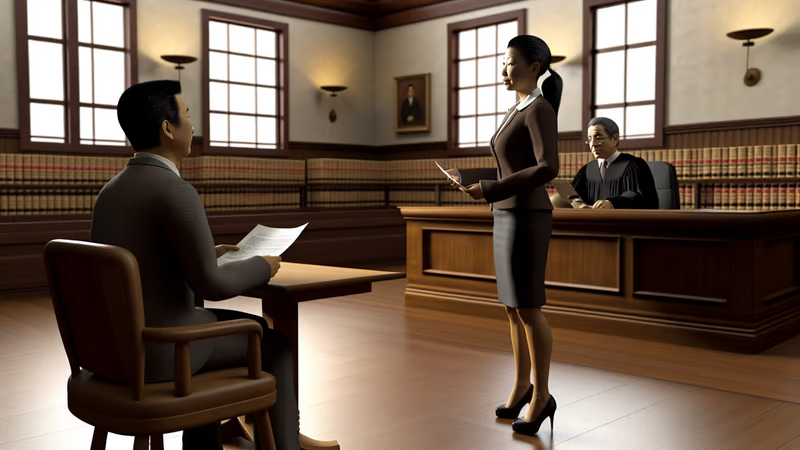
Here is a civil court decision from Judge Dollard in Civil Richmond, which is well written and correct in all respects on the law. First, she found that a 3101(d) demand, although tardy, was proper since plaintiff was not in any way prejudiced. Second, she found that a claims representative could not lay a foundation for entry into evidence of the report of a a non-testifying peer review doctor. Why someone would go down this road, especially with Pine Hollow being reversed, boggles my mind. Moreover, I also tend to think that the admission of a peer report into evidence is tantamount to improper bolstering, since the report memorializes what the doctor – or his substitute – will testify about. It is similar to a police officer telling a jury that the complainant identified the defendant, after the complainant herself identified the defendant to the jury. Those of you who have a criminal practice know that this is improper. People v Trowbridge, 305 NY 471 (1953).
As to whether the doctor, through his testimony satisfied his burden of persuasion, I have no idea; and for purposes of this discussion, it is irrelevant. What is relevant, however, is the path this court took to reach its decision. And this was “on the mark”.
Understanding CPLR 3101(d) Demands in New York Personal Injury Practice
The first significant ruling in this case dealt with a CPLR 3101(d) demand that was submitted in a tardy manner. For personal injury attorneys practicing in Nassau County, Suffolk County, Queens, Brooklyn, Manhattan, and throughout the New York metropolitan area, understanding the timing and propriety of discovery demands is crucial to building a strong case.
CPLR 3101(d) governs the disclosure of expert witness information in New York civil litigation. When a party intends to call an expert witness at trial, they must provide certain information about that expert, including their qualifications, the subject matter of their expected testimony, and the substance of the facts and opinions about which the expert is expected to testify.
Judge Dollard’s ruling that the tardy 3101(d) demand was still proper because the plaintiff suffered no prejudice demonstrates the court’s balanced approach to procedural requirements. This principle is particularly relevant in no-fault insurance disputes and personal injury cases where medical experts play a crucial role in establishing causation, the extent of injuries, and the necessity of treatment.
The Evidentiary Problems with Peer Review Reports
The second major issue addressed in this decision involves the foundational requirements for introducing peer review reports into evidence. This is a recurring challenge in New York no-fault insurance litigation, where insurance companies routinely use peer review examinations to challenge the medical necessity of treatment provided to injured parties.
Judge Dollard correctly ruled that a claims representative cannot lay the proper foundation for entering a peer review report from a non-testifying doctor into evidence. This ruling aligns with fundamental principles of evidence law and the confrontation rights that are essential to fair litigation.
The Pine Hollow Precedent and Its Impact
The decision’s reference to “Pine Hollow being reversed” highlights the evolving nature of New York appellate law regarding peer review evidence. For practitioners handling no-fault insurance disputes across Long Island, Queens, Manhattan, Brooklyn, and the Bronx, staying current with these appellate developments is essential for effective advocacy.
The Problem of Improper Bolstering
One of the most insightful aspects of this analysis is the recognition that admitting peer review reports into evidence may constitute improper bolstering. When a peer review report essentially memorializes what a doctor will testify about, it can provide unfair emphasis to that testimony before the witness even takes the stand.
The analogy to criminal practice, specifically referencing People v Trowbridge, 305 NY 471 (1953), illustrates this point effectively. Just as it would be improper for a police officer to tell a jury that a complainant identified the defendant after the complainant has already made that identification, allowing a peer review report to preview a doctor’s testimony can create unfair prejudice.
Implications for Personal Injury Practice in New York
This decision has significant implications for personal injury attorneys and medical providers throughout the New York metropolitan area. Whether you’re handling cases in Nassau County Supreme Court, Suffolk County District Court, or the various civil courts throughout NYC, understanding these evidentiary principles can strengthen your litigation strategy.
For Plaintiffs’ Attorneys
When representing injured parties in no-fault insurance disputes or personal injury cases, this decision provides valuable ammunition for challenging improperly introduced peer review evidence. Ensuring that insurance companies comply with proper foundational requirements can help level the playing field in these often contentious matters.
For Defense Counsel
Insurance defense attorneys must ensure they have the proper foundation for introducing peer review reports. This typically means having the reviewing physician available to testify and establish the necessary foundation for their report’s admission into evidence.
Frequently Asked Questions About New York Evidence Rules
What is a CPLR 3101(d) demand?
A CPLR 3101(d) demand is a discovery request that requires disclosure of expert witness information, including the expert’s qualifications, the subject matter of their testimony, and the substance of their expected opinions.
Can a tardy expert witness disclosure be cured?
Yes, as this case demonstrates, a tardy CPLR 3101(d) demand may still be acceptable if the opposing party cannot demonstrate actual prejudice from the delay.
Who can lay the foundation for a peer review report?
Generally, only the physician who conducted the peer review can lay the proper foundation for admitting their report into evidence. Claims representatives typically lack the necessary expertise and personal knowledge.
What constitutes improper bolstering in evidence?
Improper bolstering occurs when evidence is introduced that essentially repeats or emphasizes testimony that will be or has been presented, without adding new substantive information, potentially creating unfair prejudice.
Choosing the Right Personal Injury Attorney
When you’re facing a personal injury case or no-fault insurance dispute in New York, whether in Nassau County, Suffolk County, Queens, Brooklyn, Manhattan, or anywhere throughout Long Island and NYC, having an experienced attorney who understands these complex evidentiary issues is crucial to your success.
At the Law Office of Jason Tenenbaum, we have extensive experience handling personal injury cases, no-fault insurance disputes, and complex civil litigation throughout the New York metropolitan area. Our deep understanding of New York evidence law and civil procedure helps us build stronger cases for our clients and achieve better outcomes.
If you’ve been injured in an accident or are dealing with insurance company disputes over medical treatment, don’t address these complex legal waters alone. Contact us today at 516-750-0595 for a free consultation to discuss your case and learn how we can help protect your rights and pursue the compensation you deserve.
Related Articles
- The destruction of peer hearsay: It is not hearsay – and much more
- Understanding Article 10 Evidentiary Issues: Expert Witness Testimony and Hearsay Rules in New York Courts
- Civil Court Decisions in No-Fault Insurance: When Legal Reasoning Goes Wrong
- Another Article 10 case wittles away peer hearsay
- New York No-Fault Insurance Law
Legal Update (February 2026): Since this 2010 analysis of CPLR 3101(d) discovery demands and peer review report admissibility, New York courts have issued numerous decisions refining these evidentiary standards, particularly regarding foundation requirements for medical records and expert testimony in no-fault cases. The procedural landscape for discovery demands and the admissibility of peer review materials may have evolved through subsequent appellate decisions and rule amendments. Practitioners should verify current provisions of CPLR 3101(d) and recent case law regarding peer review report authentication before relying on the standards discussed in this older analysis.
Legal Context
Why This Matters for Your Case
New York law is among the most complex and nuanced in the country, with distinct procedural rules, substantive doctrines, and court systems that differ significantly from other jurisdictions. The Civil Practice Law and Rules (CPLR) governs every stage of civil litigation, from service of process through trial and appeal. The Appellate Division, Appellate Term, and Court of Appeals create a rich and ever-evolving body of case law that practitioners must follow.
Attorney Jason Tenenbaum has practiced across these areas for over 24 years, writing more than 1,000 appellate briefs and publishing over 2,353 legal articles that attorneys and clients rely on for guidance. The analysis in this article reflects real courtroom experience — from motion practice in Civil Court and Supreme Court to oral arguments before the Appellate Division — and a deep understanding of how New York courts actually apply the law in practice.
About This Topic
Business Records & Documentary Evidence in New York
The business records exception to the hearsay rule is one of the most important evidentiary foundations in New York litigation. Establishing that a document qualifies as a business record under CPLR 4518 requires showing it was made in the regular course of business, at or near the time of the event, and that it was the regular practice to create such records. In no-fault and personal injury cases, disputes over business records arise constantly — from claim files and medical records to billing documents and mailing logs.
180 published articles in Business records
Keep Reading
More Business records Analysis

CPLR § 2106 Amendment Eliminates Affidavit Notarization Requirement: What This Means for New York Litigation
NY CPLR 2106 amendment eliminates notarized affidavits and certificates of conformity. Learn how this changes litigation practice. Call 516-750-0595.
Feb 18, 2026
Expert Witness in Car Accident Lawsuits
Learn how expert witnesses in New York car accident lawsuits help establish fault, causation, and damages through accident reconstruction, medical testimony, and economic analysis.
May 14, 2025
The learned treatise exception to the hearsay rule
New York courts allow learned treatises as evidence when experts recognize publications as standards of care, even without using "authoritative" language.
Jul 31, 2015
Present Sense Impression, Refreshing Recollection, and Inconsistent Statements in New York
Second Department reversal on present sense impression, refreshing recollection, and prior inconsistent statement rulings in a New York slip-and-fall case.
Jul 3, 2011
Assignor Admissions in New York No-Fault: When Your Client’s Own Words Work Against Them
Learn how assignor admissions can impact New York no-fault litigation. Expert analysis of Ortho Pro Labs decision and strategic guidance for Long Island and NYC attorneys.
Jan 14, 2010
Hearsay – business records
People v Jones court decision on business records hearsay exception - printout evidence admission requirements and foundational standards under CPLR 4518.
Feb 5, 2018Was this article helpful?

About the Author
Jason Tenenbaum, Esq.
Jason Tenenbaum is the founding attorney of the Law Office of Jason Tenenbaum, P.C., headquartered at 326 Walt Whitman Road, Suite C, Huntington Station, New York 11746. With over 24 years of experience since founding the firm in 2002, Jason has written more than 1,000 appeals, handled over 100,000 no-fault insurance cases, and recovered over $100 million for clients across Long Island, Nassau County, Suffolk County, Queens, Brooklyn, Manhattan, the Bronx, and Staten Island. He is one of the few attorneys in the state who both writes his own appellate briefs and tries his own cases.
Jason is admitted to practice in New York, New Jersey, Florida, Texas, Georgia, and Michigan state courts, as well as multiple federal courts. His 2,353+ published legal articles analyzing New York case law, procedural developments, and litigation strategy make him one of the most prolific legal commentators in the state. He earned his Juris Doctor from Syracuse University College of Law.
Disclaimer: This article is published by the Law Office of Jason Tenenbaum, P.C. for informational and educational purposes only. It does not constitute legal advice, and no attorney-client relationship is formed by reading this content. The legal principles discussed may not apply to your specific situation, and the law may have changed since this article was last updated.
New York law varies by jurisdiction — court decisions in one Appellate Division department may not be followed in another, and local court rules in Nassau County Supreme Court differ from those in Suffolk County Supreme Court, Kings County Civil Court, or Queens County Supreme Court. The Appellate Division, Second Department (which covers Long Island, Brooklyn, Queens, and Staten Island) and the Appellate Term (which hears appeals from lower courts) each have distinct procedural requirements and precedents that affect litigation strategy.
If you need legal help with a business records matter, contact our office at (516) 750-0595 for a free consultation. We serve clients throughout Long Island (Huntington, Babylon, Islip, Brookhaven, Smithtown, Riverhead, Southampton, East Hampton), Nassau County (Hempstead, Garden City, Mineola, Great Neck, Manhasset, Freeport, Long Beach, Rockville Centre, Valley Stream, Westbury, Hicksville, Massapequa), Suffolk County (Hauppauge, Deer Park, Bay Shore, Central Islip, Patchogue, Brentwood), Queens, Brooklyn, Manhattan, the Bronx, Staten Island, and Westchester County. Prior results do not guarantee a similar outcome.