Key Takeaway
Sig Sauer P320 owners: after an $11 million verdict for a pistol firing without trigger pull, learn if you qualify for a product liability lawsuit. Free case review from Long Island attorneys.
This article is part of our ongoing legal news coverage, with 115 published articles analyzing legal news issues across New York State. Attorney Jason Tenenbaum brings 24+ years of hands-on experience to this analysis, drawing from his work on more than 1,000 appeals, over 100,000 no-fault cases, and recovery of over $100 million for clients throughout Nassau County, Suffolk County, Queens, Brooklyn, Manhattan, and the Bronx. For personalized legal advice about how these principles apply to your specific situation, contact our Long Island office at (516) 750-0595 for a free consultation.
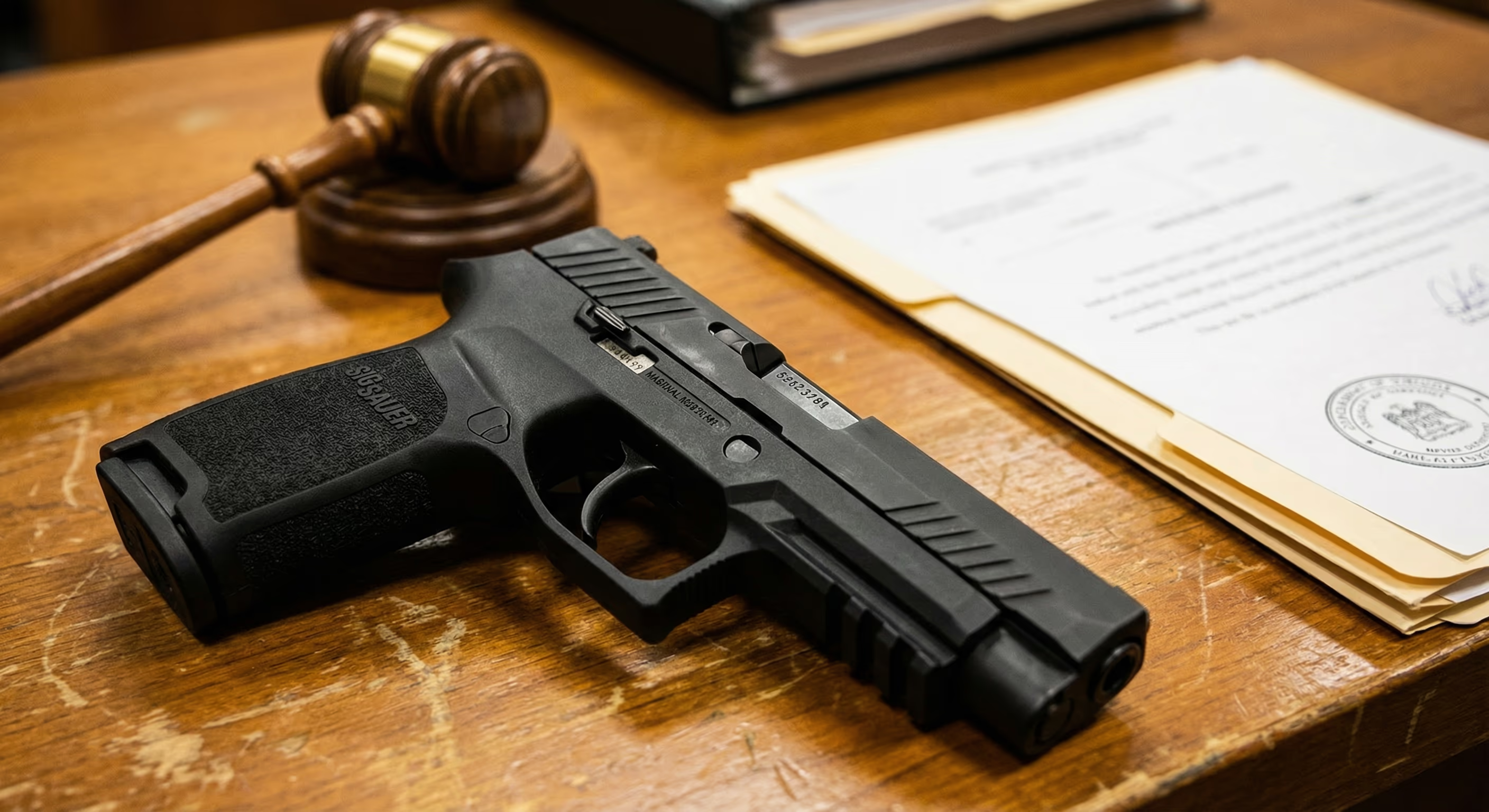
If you own a Sig Sauer P320, you may be entitled to compensation. A Philadelphia jury awarded $11 million to a U.S. Army veteran whose holstered P320 fired without the trigger being pulled — and over 120 similar lawsuits are pending nationwide. If you’ve been injured by a firearm that discharged on its own, here’s what you need to know about your legal rights.
P320 Misfire Defect: When Safety Mechanisms Fail
Firearms should protect and empower people who use them. But sometimes a trusted gun like the Sig Sauer P320 fires without warning. That happened to U.S. Army veteran George Abrahams. A jury in Philadelphia just handed him $11 million after his holstered pistol shot through his thigh, leaving permanent damage. It’s a harsh lesson in how small manufacturing slips can wreck lives. According to an AP report, the suit alleged the gun fired without the trigger being pulled.
This verdict follows a $2.35 million award in Georgia earlier this year — a verdict that a federal judge upheld on appeal in February 2025, denying Sig Sauer’s request for a new trial. Both cases spotlight problems with Sig Sauer’s popular handgun. Plaintiffs say it discharges accidentally, even though the company insists on tough safety tests. And these aren’t isolated events – they highlight key ideas in product liability. Defects or weak safeguards put users at risk. People often need sharp lawyers to fight back and win justice.
The Law Office of Jason Tenenbaum, P.C. handles tough personal injury and product liability cases like these. The firm holds manufacturers responsible. Call (516) 750-0595 to talk about what happened to you.
What makes a case like this so compelling? It shows how everyday items can turn deadly. Abrahams thought his gun was safe. Then it wasn’t.
P320 Fires Without Trigger: What Really Happened
Picture this: George Abrahams heads down some stairs. His Sig Sauer P320 sits holstered in his athletic pants pocket. Suddenly, the gun fires on its own. The bullet rips through his right thigh and comes out above the knee.
Court records paint a grim picture. This random shot caused lasting harm. A simple walk turned into a nightmare, exposing what critics call design flaws in the pistol.
Misfires aren’t like other gun problems – no jams or stuck casings here. This means the gun goes off without anyone pulling the trigger on purpose. Movement or pressure might set it off. That’s different from mistakes users make. The issue of potential accidental discharge has been a point of contention for the Sig Sauer P320.
Sig Sauer fights back hard. Company reps call the P320 one of the most dependable handguns out there. They pointed fingers at Abrahams’ handling. But the jury didn’t buy it. They ruled Sig Sauer sold a faulty product and holster, plain and simple.
Details on any settlement beyond the verdict? Scarce so far. Yet this case echoes more than 120 similar complaints across the country. People demand recalls and fixes. Sig Sauer plans to appeal, of course.
It’s frustrating, isn’t it? A company stands by its product, but juries keep siding with victims. Makes you wonder about trust in big manufacturers.
One short note: These incidents often start small. A bump, a twist – and boom. Life changes forever.
Injured by a firearm that discharged without a trigger pull? You may have a defective product claim. The Law Office of Jason Tenenbaum, P.C. fights for victims of dangerous firearms and other defective products. Call (516) 750-0595 for a free consultation.
Can You Sue Sig Sauer? Product Liability Basics
Product liability laws protect consumers. They make manufacturers pay when defective goods hurt people. In many places, strict liability applies. That means victims just prove the product was dangerously flawed and caused the injury. No need to dig into the company’s mistakes or intentions.
Three main ways to claim liability stand out. First, manufacturing defects – that’s when a product comes off the line wrong, not matching the plans. Second, design defects. Here, the blueprint itself has problems, making the item unsafe no matter how well it’s built.
Third? Failure to warn. Companies skip proper labels or instructions about risks they know about.
Firearms get tricky. Courts see them as inherently risky – you can’t make a gun completely safe. Still, laws apply. Judges look closely at safety features. Take the P320: Military versions have external safeties. Civilian ones don’t. That gap raises questions about preventing accidents.
Plaintiffs carry the proof load. They show the defect was there from the factory and directly led to the harm. With guns, defendants might argue users knew the risks. Assumption of risk comes up a lot.
But here’s a twist – even with that defense, strong evidence wins out. Experts help a ton. They dissect designs, test failures, and explain to juries why something went wrong.
Think about it: Why do some guns have more safeties than others? Cost-cutting? Oversight? Cases like Abrahams’ force answers.
Expanding on this, let’s consider how these laws play out in real life. Say someone buys a car with bad brakes. The maker knew but didn’t fix it. Liability kicks in. Same with guns. If a design invites accidents, courts step up.
And product recalls? They happen when patterns emerge. The Sig Sauer issues have sparked talks of one. But companies drag their feet. Victims push through lawsuits to force change.
A quick aside (because it’s worth noting): Not every defect is obvious. Some hide in plain sight, like a trigger too sensitive to jostling.
Sig Sauer Settlement Amounts and Compensation
Shifting gears a bit – what about compensation? Verdicts like $11 million cover medical bills, lost wages, pain. But they also send messages. Manufacturers notice big payouts. They rethink designs.
Of course, not all cases win. Juries weigh evidence carefully. Plaintiffs need solid stories, backed by facts. Weak links break chains.
Still, progress happens. Laws evolve with technology. New gun designs incorporate better tech – think biometric locks or smarter triggers. But until then, incidents like this remind everyone to stay vigilant.
One more thing: States differ on these laws. Some lean strict, others require more proof of negligence. Know your local rules. It matters.
Wrapping back to Abrahams – his win builds on others. It pressures Sig Sauer. More suits could follow, each chipping away at denials.
Deeper Dive into Firearm Liability
Firearms aren’t just any product. Their dangers demand extra care from makers. Yet slip-ups occur. The P320 saga illustrates that.
Critics point to the lack of a manual safety in civilian models. Soldiers get one; why not everyone? Sig Sauer says the gun’s internal mechanisms suffice. Juries disagree.
Expert witnesses play key roles. They test guns, recreate scenarios. In Abrahams’ trial, they likely showed how a holstered pistol could fire from impact or movement.
And the holster? Sig Sauer sold it too. If it didn’t secure the gun properly, that’s another defect layer.
Broader picture: Over 120 lawsuits allege similar misfires. Some settled quietly. Others head to court. Patterns like this often lead to class actions or mass torts.
What drives these claims? Partly, the P320’s popularity. Law enforcement uses it widely. When issues hit pros, civilians take note.
Sig Sauer upgraded the design in 2017, adding a trigger pull upgrade program. Voluntary, though. Not everyone participated. Questions linger: Was it enough?
A mild contradiction here – the company touts safety, yet pays out millions. Actions speak louder.
For gun owners, this raises practical tips. Inspect gear regularly. Choose holsters that fit snugly. Train properly. But even then, defects lurk.
Legal side: File claims quickly. Statutes of limitations apply. Evidence fades.
The Law Office of Jason Tenenbaum, P.C. guides clients through this maze. The firm gathers experts, builds cases, fights for fair outcomes. Reach out at (516) 750-0595.
Timeline: The Sig Sauer P320 Crisis
The P320’s problems didn’t start overnight. Here is a comprehensive timeline of incidents, lawsuits, and responses stretching back nearly a decade.
January 2014
P320 Enters the Market
Sig Sauer launches the P320, a modular striker-fired pistol with no external manual safety. It is marketed to civilians, law enforcement, and military worldwide.
January 2017
U.S. Army Awards $580M MHS Contract
The U.S. Army selects the P320-based M17/M18 as its Modular Handgun System, replacing the Beretta M9. The military version includes an external thumb safety not found on civilian models.
August 2017
Drop-Test Failures Go Viral
Independent testers post video of a brand-new P320 discharging twice in three drops when landed on its beavertail at a 30-degree angle. Sig Sauer's own internal testing of 11 models confirms the weakness. Dallas Police suspends P320 duty carry. Sig announces a "Voluntary Upgrade Program" adding six new trigger group components from the M17 design.
2018
First Class-Action Lawsuit Filed
David Hartley files a class-action suit in Missouri alleging the P320 can fire when the slide and barrel are misaligned. The case settles by 2020 with no admission of fault.
2019
Virginia Deputy Sues for $10 Million
Deputy Marcie Vadnais sues Sig Sauer after her holstered P320 allegedly fires into her leg without a trigger pull. The case settles for an undisclosed amount.
January - July 2020
Milwaukee PD: 8 Discharges in 7 Months
Milwaukee Police Department documents eight P320 accidental discharges among officers. In July, an officer's holstered P320 fires and strikes his partner in the knee.
June 2020
George Abrahams Injured in Philadelphia
U.S. Army veteran George Abrahams is walking down stairs when his holstered P320, sitting in his pants pocket, fires. The bullet rips through his right thigh and exits above his knee, causing permanent damage.
November 2020
Canadian Special Forces Soldier Wounded
A Joint Task Force 2 operator in Canada is wounded during range training when a P320 (designated C22) fires unexpectedly. An investigation concludes it was an "unpredictable accident."
2023
100+ Lawsuits Filed Nationwide
More than 100 civilians and law enforcement officers have sued Sig Sauer. At least 80 people wounded between 2016 and 2023. The Philadelphia firm Saltz Mongeluzzi & Bendesky alone represents approximately 100 plaintiffs.
June 2024
Georgia Jury Awards $2.35 Million
Robert Bryan Lang wins a $2.35 million verdict after his holstered P320 fires into his body. First significant jury verdict against Sig Sauer in a P320 case.
July 2024
U.S. Air Force Airman Killed
A security airman dies from an accidental P320 discharge at a Wyoming base. The Air Force temporarily suspends use of the weapon.
November 2024
$11 Million Verdict: Abrahams v. Sig Sauer
A Philadelphia jury awards $11 million ($10M punitive, $1M compensatory), finding Sig Sauer negligent and reckless. Evidence reveals Sig abandoned a safer trigger mechanism and ignored its own safety policy requiring external safeties on pre-cocked pistols.
February 2025
Georgia $2.35M Verdict Upheld on Appeal
A federal judge denies Sig Sauer's motion for a new trial, upholding the $2.35 million verdict in the Robert Bryan Lang case. The court rejects arguments to exclude gunsmith testimony, reinforcing the strength of design-defect claims against the P320.
June 2025
Texas Law Enforcement Claims Consolidated
A federal court denies Sig Sauer's motion to sever and transfer claims from Texas law enforcement officers, keeping those cases consolidated in New Hampshire federal court — a procedural win for plaintiffs.
July 2025
Missouri Class Action Certified — A Landmark
In Glasscock v. Sig Sauer, Inc. (Case 6:22-cv-03095-MDH), U.S. District Judge Douglas Harpool certifies the first statewide consumer class action against Sig Sauer. The class covers all Missouri purchasers of P320s without external thumb safety from September 2017 to present.
August 2025
Air Force Reinstates M18 After Inspection
Air Force Global Strike Command clears the M18 for duty after a month-long inspection of its 7,970-handgun inventory following the July 2024 airman death. The military continues to invest in the P320 platform.
September 2025
Canadian Police Offer Gun Swaps
After a Charlottetown police officer's holstered P320 discharges near a detention centre, the department offers all 72 officers the option to swap back to Beretta Storm sidearms.
November 2025
Washington State Class Action Filed
Schreiber v. Sig Sauer Inc. is filed in Washington State with similar design-defect allegations, opening yet another class action front against Sig Sauer over the P320.
November 2025
U.S. Army Approves M17/M18 Modular Accessories
The U.S. Army approves a general forces configuration with modular accessories for M17/M18. The military continues investing in the P320 platform despite mounting civilian lawsuits.
2025
22+ New Federal Lawsuits Across 16 States
Twenty-two additional victims file new federal court lawsuits alleging the P320 is dangerously defective. 18 new injuries reported in 2025 alone, including 3 ICE agents wounded by their duty P320s. Police departments continue to restrict P320 use. Sig Sauer appeals the Abrahams verdict and maintains the pistol is safe.
February 2026
The Trace / Bloomberg Investigation Reveals Insider Allegations
A joint investigation by The Trace and Bloomberg Businessweek reveals insider allegations that production pressure led to shoddy manufacturing practices at Sig Sauer dating to at least 2010. Quality control failures were documented even on the P226 DAK during internal testing. Updated count: 150+ people have now alleged unintentional P320 discharge. A Pennsylvania father was killed by an alleged unintentional P320 discharge.
By The Numbers
120+
Lawsuits Filed
150+
Alleged Unintentional Discharges
$13.35M
In Jury Verdicts
Were you or a loved one injured by a Sig Sauer P320 or any firearm that discharged without a trigger pull? The clock is ticking. The Law Office of Jason Tenenbaum, P.C. handles product liability and defective firearm claims across Long Island and New York. Call (516) 750-0595 for a free case evaluation.
2025-2026: The Legal Walls Close In
The P320 litigation landscape shifted dramatically in 2025 and early 2026. What started as individual injury claims has evolved into a multi-front legal assault — with class actions, consolidated proceedings, and investigative bombshells piling pressure on Sig Sauer.
Missouri Makes History: First Certified P320 Class Action
On July 28, 2025, U.S. District Judge Douglas Harpool certified the first statewide consumer class action against Sig Sauer in Glasscock v. Sig Sauer, Inc. (Case 6:22-cv-03095-MDH). The certified class includes all Missouri purchasers of P320 pistols without an external thumb safety from September 2017 to the present.
This is a landmark. Until now, P320 claims were fought one by one. Class certification means Sig Sauer faces a single proceeding representing potentially thousands of Missouri gun owners — and the ruling could serve as a blueprint for class actions in other states.
Washington State followed in November 2025 when Schreiber v. Sig Sauer Inc. was filed with similar design-defect allegations, opening another class action front.
Meanwhile, in June 2025, a federal court denied Sig Sauer’s motion to sever and transfer claims from Texas law enforcement officers — keeping those cases consolidated in New Hampshire federal court. Sig Sauer wanted to scatter the cases across different jurisdictions. The court said no.
What This Means for P320 Owners
If you purchased a Sig Sauer P320 without an external thumb safety — particularly in Missouri or Washington — you may have legal options under these class action proceedings. Even if you haven’t experienced an unintentional discharge, certified class actions can cover economic losses like diminished value of a defectively designed product.
Owners in other states should watch closely. The Missouri certification creates legal precedent that plaintiffs’ attorneys in other jurisdictions will cite. More class actions are likely.
If you’re a P320 owner who has experienced an unintentional discharge or are concerned about your rights, consult with a personal injury attorney who handles product liability claims. The Law Office of Jason Tenenbaum, P.C. can help you understand your options — contact us or call (516) 750-0595.
The Georgia Verdict Survives Appeal
In February 2025, a federal judge upheld the $2.35 million verdict in the Robert Bryan Lang case, denying Sig Sauer’s request for a new trial. Sig Sauer had argued that gunsmith testimony should have been excluded. The court disagreed.
This matters because it signals that P320 design-defect claims can survive not just trial but post-trial challenges. For plaintiffs in pending cases, it reinforces that juries’ findings against Sig Sauer will hold up under appellate scrutiny.
The Trace Investigation: What Insiders Say About Sig Sauer
A February 2026 joint investigation by The Trace and Bloomberg Businessweek pulled back the curtain on Sig Sauer’s manufacturing culture. Insiders alleged that pressure to increase production led to shoddy manufacturing practices dating back to at least 2010 — years before the P320 even launched.
The investigation documented quality control failures even on the P226 DAK during internal testing. The reporting painted a picture of a company where speed and volume were prioritized over precision.
The numbers continue to climb. As of the investigation’s publication, over 150 people have alleged unintentional P320 discharge — up significantly from previously reported figures. In 2025 alone, 18 additional injuries were reported, including three ICE agents wounded by their duty-issued P320s. A Pennsylvania father was killed by an alleged unintentional P320 discharge.
These insider revelations could prove devastating in ongoing litigation. Evidence that a manufacturer knew about systemic quality problems — across multiple product lines — and continued pushing production is exactly the kind of evidence that supports punitive damages.
Military Developments: The M17/M18 Paradox
The military’s relationship with the P320 platform remains complicated. After the July 2024 death of an airman at a Wyoming base, Air Force Global Strike Command suspended M18 use and inspected its entire 7,970-handgun inventory. In August 2025, the Air Force cleared the M18 and reinstated it for duty.
Then in November 2025, the U.S. Army approved a general forces configuration with modular accessories for the M17/M18, signaling continued institutional investment in the platform.
The paradox is hard to miss: the military keeps doubling down on the P320 while civilian courts keep finding it defective. The difference? Military M17/M18 variants include an external thumb safety that civilian P320s lack — the very feature at the heart of most lawsuits.
Lessons from the Case
This verdict isn’t just about one man. It spotlights systemic issues in product safety.
Manufacturers must prioritize users over profits. When they don’t, courts intervene.
For victims, hope exists. Skilled representation turns tragedies into triumphs.
But prevention beats cure. Push for better standards. Demand accountability.
In the end, cases like Abrahams’ reshape industries. They save lives down the line.
One final thought: Guns empower, but flaws endanger. Stay informed, stay safe.
Frequently Asked Questions
Can I sue Sig Sauer for a P320 misfire?
Yes. If your Sig Sauer P320 discharged without a trigger pull and you were injured, you may have a product liability claim against Sig Sauer. Over 120 lawsuits have been filed alleging the P320 is defectively designed. A Philadelphia jury awarded $11 million to a veteran whose holstered P320 fired on its own, and a Georgia jury awarded $2.35 million in a similar case. Both verdicts have survived post-trial challenges. The Law Office of Jason Tenenbaum, P.C. can evaluate your case — call (516) 750-0595 for a free consultation.
How much are Sig Sauer P320 lawsuits worth?
Jury verdicts in P320 cases have ranged from $2.35 million (Georgia, 2024) to $11 million (Philadelphia, 2024, including $10 million in punitive damages). Settlement amounts in other cases remain confidential. The value of your claim depends on the severity of your injuries, medical costs, lost wages, and permanent disability. Cases involving punitive damages — where the manufacturer acted recklessly — tend to result in higher awards.
Is there a Sig Sauer P320 recall?
Sig Sauer has not issued a formal recall. In August 2017, after independent testing showed the P320 could discharge when dropped, Sig Sauer offered a “Voluntary Upgrade Program” that replaced six trigger components. However, plaintiffs allege the upgrade did not fix the core design defect. Participation was voluntary, and many owners never completed the upgrade. As of 2026, more than 150 people have alleged unintentional P320 discharges.
What is the deadline to file a Sig Sauer lawsuit?
Statutes of limitations vary by state. In New York, personal injury lawsuits must be filed within three years of the injury under CPLR §214. Other states have different deadlines — some as short as one year. Product liability claims also have discovery rules that may affect when the clock starts. Do not wait: evidence degrades, witnesses become unavailable, and missing the deadline permanently bars your claim regardless of its strength.
Does the P320 voluntary upgrade fix the problem?
Plaintiffs’ attorneys and firearms experts argue the 2017 Voluntary Upgrade Program did not fully address the P320’s design defect. The upgrade replaced trigger group components but did not add an external manual safety — the feature present on military M17/M18 variants that is absent from civilian P320s. Lawsuits filed after 2017 include both pre-upgrade and post-upgrade pistols, and accidental discharges have been reported with upgraded models.
Injured by a Defective Firearm? Get Help Now.
If you or a loved one has been hurt by a Sig Sauer P320 or any firearm that discharged without a trigger pull, you don’t have to fight the manufacturer alone. The Law Office of Jason Tenenbaum, P.C. has the experience to take on major manufacturers and hold them accountable for defective products that cause serious injuries.
Statutes of limitations apply — the sooner you act, the stronger your case. Evidence can degrade and deadlines pass quickly.
Get your free case evaluation today. Call the Law Office of Jason Tenenbaum, P.C. at (516) 750-0595 or contact us online to discuss your defective firearm injury claim. We serve clients across Long Island and New York.
Legal Context
Why This Matters for Your Case
Personal injury law in New York is governed by a complex web of statutes, case law, and procedural rules that differ from most other states. The statute of limitations for most personal injury claims is three years under CPLR 214(5), but claims against municipalities require a Notice of Claim within 90 days. Motor vehicle accident victims must meet the serious injury threshold under Insurance Law §5102(d) before they can recover pain and suffering damages.
The Law Office of Jason Tenenbaum has recovered over $100 million for injured clients across Long Island, Nassau County, Suffolk County, Queens, Brooklyn, Manhattan, and the Bronx. With 24+ years of trial and appellate experience, more than 1,000 appeals written, and 2,353+ published legal articles, Jason Tenenbaum provides the authoritative legal analysis that practitioners and injury victims need to understand their rights.
This article reflects real courtroom experience and a deep understanding of how New York courts actually evaluate personal injury claims — from the initial filing through discovery, summary judgment, trial, and appeal.
Keep Reading
More Legal News Analysis
Pain and Suffering After a Car Accident in New York: How It's Calculated and What It's Worth
Pain and suffering is often the largest component of a New York car accident settlement. Learn how insurers and courts calculate non-economic damages, what the serious injury...
Apr 4, 2026Soft Tissue Injury After a Car Accident in New York: What's Your Claim Worth?
Soft tissue injuries from car accidents — sprains, strains, and whiplash — are common but often disputed by insurers in New York. Learn how to prove your injury, meet the serious...
Apr 4, 2026Intersection Accident Settlement in New York: What Your Case Is Worth
Injured at a Long Island intersection? Learn what your case is worth, how right-of-way violations affect fault, and what evidence wins these cases. Free consultation with an...
Apr 4, 2026
The EEOC's War on DEI: A Complete Timeline of Reverse Discrimination Enforcement (2024-2026)
The EEOC just settled its first major reverse discrimination case against Planned Parenthood. Here's the complete timeline of how federal enforcement turned against corporate DEI...
Mar 20, 2026
How to Choose a Car Accident Attorney
Expert guide on selecting the right car accident attorney on Long Island. Learn key factors, avoid common mistakes, and find skilled legal representation.
May 5, 2025
Distracted Driving: When a Glance Becomes a Claim
Discover legal rights after a distracted driving accident. Learn evidence needed, common challenges, and how to build a strong injury claim.
Jan 22, 2025Was this article helpful?

About the Author
Jason Tenenbaum, Esq.
Jason Tenenbaum is the founding attorney of the Law Office of Jason Tenenbaum, P.C., headquartered at 326 Walt Whitman Road, Suite C, Huntington Station, New York 11746. With over 24 years of experience since founding the firm in 2002, Jason has written more than 1,000 appeals, handled over 100,000 no-fault insurance cases, and recovered over $100 million for clients across Long Island, Nassau County, Suffolk County, Queens, Brooklyn, Manhattan, the Bronx, and Staten Island. He is one of the few attorneys in the state who both writes his own appellate briefs and tries his own cases.
Jason is admitted to practice in New York, New Jersey, Florida, Texas, Georgia, and Michigan state courts, as well as multiple federal courts. His 2,353+ published legal articles analyzing New York case law, procedural developments, and litigation strategy make him one of the most prolific legal commentators in the state. He earned his Juris Doctor from Syracuse University College of Law.
Disclaimer: This article is published by the Law Office of Jason Tenenbaum, P.C. for informational and educational purposes only. It does not constitute legal advice, and no attorney-client relationship is formed by reading this content. The legal principles discussed may not apply to your specific situation, and the law may have changed since this article was last updated.
New York law varies by jurisdiction — court decisions in one Appellate Division department may not be followed in another, and local court rules in Nassau County Supreme Court differ from those in Suffolk County Supreme Court, Kings County Civil Court, or Queens County Supreme Court. The Appellate Division, Second Department (which covers Long Island, Brooklyn, Queens, and Staten Island) and the Appellate Term (which hears appeals from lower courts) each have distinct procedural requirements and precedents that affect litigation strategy.
If you need legal help with a legal news matter, contact our office at (516) 750-0595 for a free consultation. We serve clients throughout Long Island (Huntington, Babylon, Islip, Brookhaven, Smithtown, Riverhead, Southampton, East Hampton), Nassau County (Hempstead, Garden City, Mineola, Great Neck, Manhasset, Freeport, Long Beach, Rockville Centre, Valley Stream, Westbury, Hicksville, Massapequa), Suffolk County (Hauppauge, Deer Park, Bay Shore, Central Islip, Patchogue, Brentwood), Queens, Brooklyn, Manhattan, the Bronx, Staten Island, and Westchester County. Prior results do not guarantee a similar outcome.