Key Takeaway
Master no-fault billing deadlines with expert strategies to avoid claim denials, compliance issues, and costly delays in New York insurance cases.
This article is part of our ongoing no-fault coverage, with 271 published articles analyzing no-fault issues across New York State. Attorney Jason Tenenbaum brings 24+ years of hands-on experience to this analysis, drawing from his work on more than 1,000 appeals, over 100,000 no-fault cases, and recovery of over $100 million for clients throughout Nassau County, Suffolk County, Queens, Brooklyn, Manhattan, and the Bronx. For personalized legal advice about how these principles apply to your specific situation, contact our Long Island office at (516) 750-0595 for a free consultation.

In the high-stakes world of no-fault billing, deadlines aren’t just dates on a calendar. They’re landmines waiting to detonate your case. After reviewing thousands of submissions at The Law Office of Jason Tenenbaum, P.C., it becomes clear how minor delays can unravel even the strongest claims. The objective here? Transform that ticking clock from enemy to ally.
Understanding the Beast: What No-Fault Billing Really Means
No-fault billing operates on a simple premise: insurers pay legitimate claims regardless of who caused the accident. Sounds straightforward, right? Yet the sheer volume of regulations governing these submissions – from state-specific timelines to documentation protocols – creates a minefield. At its core, this system promises efficient compensation for victims. But that efficiency hinges entirely on precision and punctuality.
One case stands out where perfectly valid treatment claims got denied because someone misfiled a CPT code. The insurer didn’t question the medical necessity – they torpedoed it over clerical errors. That’s the reality practitioners face.
When the Law Comes Knocking: Compliance Isn’t Optional
The legal framework here demands serious attention. The False Claims Act (FCA) turns billing errors into potential federal cases. Consider United States ex rel. Miller v. Weston Educ., Inc. – a cautionary tale where delayed submissions snowballed into allegations of fraudulent concealment. Here’s the kicker: under the FCA, even unintentional paperwork delays can trigger treble damages if they’re deemed “material to payment decisions.” You can read more about the False Claims Act on the Department of Justice website.
Contractual duties compound this challenge. Insurers embed submission windows in policy language like tripwires. Miss one? That’s breach of contract territory. Organizational counsel must treat these deadlines like constitutional amendments – non-negotiable and vigorously enforced.
The Timeliness Tightrope
Why does “on time” matter so much? Three brutal truths:
- Statutes of limitations evaporate while gathering documents
- Evidence degrades (witness memories fade, documents get lost)
- Insurers leverage delays to allege bad faith
Common pitfalls appear frequently:
- Paralegals drowning in unstructured document flows
- Physicians delaying narratives because “it’s just a form”
- Fax confirmations mistaken for delivery receipts (yes, faxes still matter)
But here’s a counterintuitive insight from practice: sometimes rushing causes more errors than deliberate pacing. Ever seen a bill submitted early with wrong diagnostic codes? Denied. The sweet spot lies in systematic urgency. One way to ensure accuracy is through proper medical coding.
Case Spotlight: How a $200k Submission Got Salvaged
A recent client faced denied coverage after a multi-car pileup. Their initial submission missed New York’s 45-day window for specialist reports. The insurer pounced, calling it “patterned disregard.” The approach?
First, the team invoked regulatory nuance – proving the clock started at discharge, not treatment date. Then they reconstructed the paper trail showing attempted electronic submissions caught in spam filters. Finally, they demonstrated how contemporaneous nurse notes corroborated all treatments. The kicker? They beat the appeal deadline by 12 hours.
This case taught a valuable lesson: deadlines are fluid until they’re weaponized. Documentation must anticipate that shift.
Practical Strategies for Pitfall Avoidance
- Tech with Teeth: Use calendaring systems that auto-flag state-specific deadlines. But remember – tech fails. Assign human cross-checks.
- The Pre-Submission Autopsy: Review packets for the “deadly trio” – unsigned forms, undated narratives, and uncoded treatments.
- Communication Channels Matter: Fax? Portal? Certified mail? Map each insurer’s preferred (and legally acknowledged) method.
- Train Beyond Compliance: Staff should understand why deadlines exist, not just when they occur.
Frankly, the most effective tool observed is humility: build in a 72-hour buffer for “life happens” moments. Because it always does.
Different approaches work for different practices. Some firms swear by morning deadline huddles. Others prefer automated reminder systems. The key lies in finding what fits your team’s rhythm while maintaining iron-clad accountability. Understanding state regulations, like those in New York, is also essential.
Documentation trails prove crucial here. Every submission should include proof of delivery, confirmation numbers, and backup methods. When insurers challenge timing, this paper trail becomes your shield.
The Finish Line
Timely submissions aren’t about bureaucratic box-ticking. They’re the oxygen keeping no-fault claims alive. Every delayed document whispers “fraud” to insurers. Every missed deadline invites FCA scrutiny.
At The Law Office of Jason Tenenbaum, P.C. (516-750-0595), deadlines serve as narrative tools – they force the cohesive story your case deserves. Master this rhythm, and you transform from deadline victim to deadline strategist. Because in no-fault billing, time isn’t money. It’s everything.
What’s your biggest deadline challenge? Chances are good it’s been encountered before. The solution starts with treating time like the precious, perishable resource it is. Success depends on building systems that work under pressure while maintaining accuracy.
The stakes couldn’t be higher. Miss a deadline, lose a case. Hit every deadline with precision, and you’ve mastered half the battle. The other half? That’s where strategic legal thinking meets practical execution.
Related Articles
Legal Context
Why This Matters for Your Case
New York's no-fault insurance system, established under Insurance Law Article 51, is one of the most complex insurance frameworks in the country. Every motorist must carry Personal Injury Protection coverage that pays medical expenses and lost wages regardless of fault, up to $50,000 per person.
But insurers routinely deny valid claims using peer reviews, EUO scheduling tactics, fee schedule reductions, and coverage defenses. The Law Office of Jason Tenenbaum has handled over 100,000 no-fault cases since 2002 — from initial claim submissions through arbitration before the American Arbitration Association, trials in Civil Court and Supreme Court, and appeals to the Appellate Term and Appellate Division. Jason Tenenbaum is one of the few attorneys in the state who both writes his own appellate briefs and tries his own cases.
His 2,353+ published legal articles on no-fault practice are cited by attorneys throughout New York. Whether you are dealing with a medical necessity denial, an EUO no-show defense, a fee schedule dispute, or a coverage question, this article provides the kind of detailed case-law analysis that helps practitioners and claimants understand exactly where the law stands.
About This Topic
New York No-Fault Insurance Law
New York's no-fault insurance system requires every driver to carry Personal Injury Protection (PIP) coverage that pays medical expenses and lost wages regardless of who caused the accident. But insurers routinely deny, delay, and underpay valid claims — using peer reviews, IME no-shows, and fee schedule defenses to avoid paying providers and injured claimants. Attorney Jason Tenenbaum has litigated thousands of no-fault arbitrations and court cases since 2002.
271 published articles in No-Fault
Keep Reading
More No-Fault Analysis
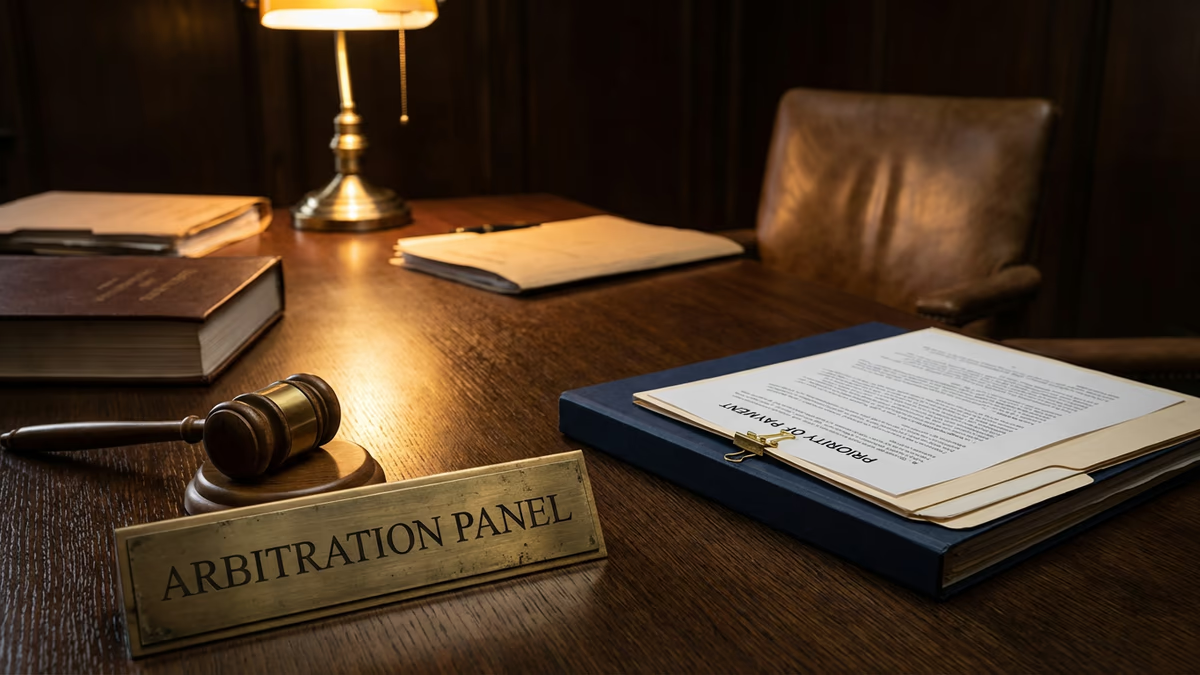
Priority of Payment Regulation Has No Force in Arbitration: First and Second Departments Agree
Both the First and Second Departments have held that the priority of payment regulation under 11 NYCRR 65-3.15 is of no force or effect in no-fault arbitration proceedings....
Feb 25, 2026
How Insurance Companies Use Colossus Software to Undervalue Your Injury Claim
Insurance companies use Colossus software to lowball your injury claim. Learn how this system works and how a Long Island attorney can fight back. Call 516-750-0595.
Feb 18, 2026
Understanding CPLR 3212(a): Critical Timing Rules for Summary Judgment Motions in New York
Master CPLR 3212(a) timing rules for summary judgment motions in NY. Learn the 120-day deadline, service requirements & good cause exceptions. Call 516-750-0595.
Oct 22, 2019
From the Department of Financial Services today
New York Department of Financial Services announces criminal charges against 18 healthcare providers for no-fault insurance fraud, highlighting ongoing enforcement efforts.
Oct 31, 2013
No-Fault Claims and Workers Comp
Learn how no-fault insurance and workers compensation interact in workplace injury cases. Understand legal complexities, employer tactics, and your rights.
Jul 14, 2025
Licensure
New York no-fault insurance licensure requirements for healthcare providers under 11 NYCRR 65-3.16(a)(12) - compliance issues and billing eligibility analysis.
Dec 18, 2021Common Questions
Frequently Asked Questions
What is New York's no-fault insurance system?
New York's no-fault insurance system, codified in Insurance Law Article 51, requires all drivers to carry Personal Injury Protection (PIP) coverage. This pays for medical expenses, lost wages (up to $2,000/month), and other basic economic loss regardless of who caused the accident, up to $50,000 per person. However, to sue for pain and suffering, you must meet the 'serious injury' threshold under Insurance Law §5102(d).
How do I fight a no-fault insurance claim denial?
When a no-fault claim is denied, you can challenge it through mandatory arbitration under the American Arbitration Association's no-fault rules, or by filing a lawsuit in court. Common defenses to denials include challenging the timeliness of the denial, the adequacy of the peer review report, or the insurer's compliance with regulatory requirements. An experienced no-fault attorney can evaluate which strategy gives you the best chance of overturning the denial.
What is the deadline to file a no-fault claim in New York?
Under 11 NYCRR §65-1.1, you must submit a no-fault application (NF-2 form) within 30 days of the accident. Medical providers must submit claims within 45 days of treatment. Missing these deadlines can result in claim denial, though there are limited exceptions for late notice if the claimant can demonstrate a reasonable justification.
What no-fault benefits am I entitled to after a car accident in New York?
Under Insurance Law §5102(b), no-fault PIP covers necessary medical expenses, 80% of lost earnings up to $2,000/month, up to $25/day for other reasonable expenses, and a $2,000 death benefit. These benefits are available regardless of fault, up to the $50,000 policy limit. Claims are paid by your own insurer — not the at-fault driver's.
Can I choose my own doctor for no-fault treatment in New York?
Yes. Under New York's no-fault regulations, you have the right to choose your own physician, chiropractor, physical therapist, or other licensed healthcare provider. The insurer cannot dictate which providers you see. However, the insurer can request an IME with their chosen doctor and may challenge the medical necessity of your treatment through peer review.
Was this article helpful?

About the Author
Jason Tenenbaum, Esq.
Jason Tenenbaum is the founding attorney of the Law Office of Jason Tenenbaum, P.C., headquartered at 326 Walt Whitman Road, Suite C, Huntington Station, New York 11746. With over 24 years of experience since founding the firm in 2002, Jason has written more than 1,000 appeals, handled over 100,000 no-fault insurance cases, and recovered over $100 million for clients across Long Island, Nassau County, Suffolk County, Queens, Brooklyn, Manhattan, the Bronx, and Staten Island. He is one of the few attorneys in the state who both writes his own appellate briefs and tries his own cases.
Jason is admitted to practice in New York, New Jersey, Florida, Texas, Georgia, and Michigan state courts, as well as multiple federal courts. His 2,353+ published legal articles analyzing New York case law, procedural developments, and litigation strategy make him one of the most prolific legal commentators in the state. He earned his Juris Doctor from Syracuse University College of Law.
Disclaimer: This article is published by the Law Office of Jason Tenenbaum, P.C. for informational and educational purposes only. It does not constitute legal advice, and no attorney-client relationship is formed by reading this content. The legal principles discussed may not apply to your specific situation, and the law may have changed since this article was last updated.
New York law varies by jurisdiction — court decisions in one Appellate Division department may not be followed in another, and local court rules in Nassau County Supreme Court differ from those in Suffolk County Supreme Court, Kings County Civil Court, or Queens County Supreme Court. The Appellate Division, Second Department (which covers Long Island, Brooklyn, Queens, and Staten Island) and the Appellate Term (which hears appeals from lower courts) each have distinct procedural requirements and precedents that affect litigation strategy.
If you need legal help with a no-fault matter, contact our office at (516) 750-0595 for a free consultation. We serve clients throughout Long Island (Huntington, Babylon, Islip, Brookhaven, Smithtown, Riverhead, Southampton, East Hampton), Nassau County (Hempstead, Garden City, Mineola, Great Neck, Manhasset, Freeport, Long Beach, Rockville Centre, Valley Stream, Westbury, Hicksville, Massapequa), Suffolk County (Hauppauge, Deer Park, Bay Shore, Central Islip, Patchogue, Brentwood), Queens, Brooklyn, Manhattan, the Bronx, Staten Island, and Westchester County. Prior results do not guarantee a similar outcome.