Key Takeaway
Understanding loaner vehicle insurance coverage in NY. Expert legal analysis of who pays for injuries. Call 516-750-0595 for free consultation.
This article is part of our ongoing no-fault coverage, with 271 published articles analyzing no-fault issues across New York State. Attorney Jason Tenenbaum brings 24+ years of hands-on experience to this analysis, drawing from his work on more than 1,000 appeals, over 100,000 no-fault cases, and recovery of over $100 million for clients throughout Nassau County, Suffolk County, Queens, Brooklyn, Manhattan, and the Bronx. For personalized legal advice about how these principles apply to your specific situation, contact our Long Island office at (516) 750-0595 for a free consultation.
Understanding Loaner Vehicle Insurance Coverage: A Critical Legal Analysis
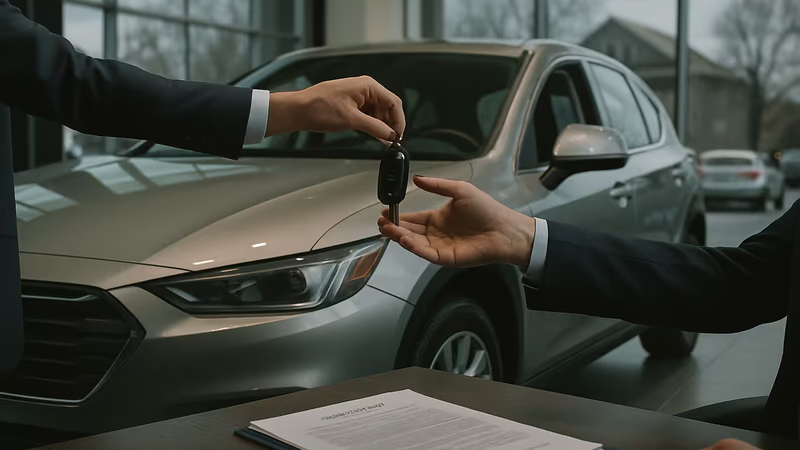
When your personal vehicle is being repaired after an accident, many people assume their insurance coverage automatically follows them to a loaner vehicle. However, recent New York court decisions reveal that this assumption can lead to costly surprises and coverage gaps. Understanding who pays for what when you’re driving a loaner vehicle is crucial for protecting yourself financially.
Key Legal Precedents: GEICO v. Wesco Insurance Cases
Matter of GEICO Gen. Ins. Co. v Wesco Ins. Co., 2022 NY Slip Op 06926 (2d Dept. 2023)
“The arbitrator’s interpretation of the rental agreement between Saha and New Country as relieving Wesco of its obligation to provide mandatory personal injury protection (hereinafter PIP) coverage was contrary to 11 NYCRR part 65, which provides, in effect, that all motor vehicle insurance policies must contain a mandatory PIP endorsement; expressly sets forth the language of the PIP endorsement; permits deviations from the prescribed language only upon prior approval; and prohibits any release, express or implied, from mandatory or optional PIP benefits (see 11 NYCRR 65-1.1, 65-1.7, 65-3.18).”
Matter of GEICO Gen. Ins. Co. v Wesco Ins. Co., 2022 NY Slip Op 06927 (2d Dept. 2023)
“In March 2017, nonparty Linotte Dhaiti was injured when she was involved in a motor vehicle collision while operating a loaner vehicle owned by nonparty New Rochelle Hyundai, LLC, and insured by Wesco Insurance Company (hereinafter Wesco). GEICO Indemnity Company (hereinafter GEICO) paid no-fault benefits to Dhaiti for her injuries pursuant to an automobile liability policy issued to her. GEICO thereafter sought to recover the benefits paid to Dhaiti from Wesco in a compulsory arbitration proceeding. In an arbitration award dated May 23, 2019, the arbitrator determined that Wesco, as insurer of the loaner vehicle operated by Dhaiti, was liable for the benefits paid to Dhaiti.”
Affirmed.
The Legal Complexity Behind These Rulings
This case is particularly interesting because if you research the coverage issue on loaner cars, you will learn that the insurance carrier of the one who “rented” this vehicle is actually primary on the third-party indemnity and defense side. I do not recall the Appellate Division case but I did write a coverage opinion letter on the issue.
The argument is therefore Elrac v. Ward does not apply to this fact pattern. And as you see, that is just not the case.
What This Means For You: Practical Implications
These court decisions have significant real-world implications for anyone who drives a loaner vehicle. Here’s what you need to understand:
No-Fault Coverage Follows the Vehicle, Not Always the Driver
In New York’s no-fault insurance system, Personal Injury Protection (PIP) coverage is mandatory for all registered vehicles. The court’s ruling reinforces that this coverage cannot be waived or excluded through rental agreements, even for loaner vehicles provided by dealerships.
This means that when you’re injured while driving a loaner vehicle, the loaner vehicle’s insurance policy is primarily responsible for your no-fault benefits, including:
- Medical expenses up to $50,000
- Lost wages (up to $2,000 per month for three years)
- Other reasonable and necessary expenses
- Death benefits
Third-Party Liability Coverage: A Different Story
While the no-fault coverage follows the loaner vehicle, third-party liability coverage (for damage you cause to others) can be more complex. In many cases, your personal auto insurance policy may be primary for third-party claims when you’re driving a loaner vehicle.
Common Scenarios and Coverage Issues
Dealership Loaner Vehicles
When your car is being serviced at a dealership and they provide a loaner vehicle, the dealership’s insurance policy typically provides the mandatory no-fault coverage. However, you should always verify this before accepting the loaner.
Rental Car Companies
Traditional rental car companies operate differently from dealership loaners. They typically offer various insurance options, and understanding what coverage you already have versus what you need is crucial.
Insurance Company-Arranged Rentals
When your insurance company arranges a rental car after an accident, they typically ensure proper coverage is in place. However, you should still confirm the details of your coverage.
Protecting Yourself: Essential Steps to Take
Before Accepting Any Loaner Vehicle
- Verify Insurance Coverage: Ask for written confirmation of what insurance coverage applies to the loaner vehicle.
- Check Your Policy: Review your personal auto insurance policy to understand what coverage, if any, extends to loaner vehicles.
- Document Everything: Keep all paperwork related to the loaner vehicle arrangement.
- Understand Your Deductible: Know whether your personal policy deductible applies or if the loaner vehicle has different deductible requirements.
If You’re Injured While Driving a Loaner Vehicle
If you’re injured in an accident while driving a loaner vehicle, you need experienced legal representation to address the complex insurance coverage issues. The interplay between your personal insurance, the loaner vehicle’s insurance, and potentially other parties’ insurance requires careful analysis.
Why Professional Legal Help Is Essential
The GEICO v. Wesco cases highlight how complex insurance coverage disputes can become. What seems straightforward – who pays when you’re injured in a loaner vehicle – can involve multiple insurance companies, complex regulatory requirements, and sophisticated legal arguments.
Common Challenges We See
- Coverage Denials: Insurance companies may wrongly deny claims based on misinterpretations of loaner vehicle coverage.
- Delayed Payments: Disputes between insurance companies can delay your access to necessary medical treatment and wage replacement.
- Inadequate Settlements: Without proper legal representation, you may accept insufficient compensation for your injuries.
- Statute of Limitations Issues: Delays in resolving coverage issues can put your legal claims at risk.
Frequently Asked Questions
Does my personal auto insurance cover me when driving a loaner vehicle?
It depends on your specific policy and the type of loaner vehicle. Generally, your liability coverage may extend to loaner vehicles, but the loaner vehicle’s policy provides primary no-fault coverage. You should review your policy and consult with an attorney to understand your specific situation.
What if the dealership says their insurance doesn’t cover loaner vehicles?
Based on the GEICO v. Wesco decisions, dealerships cannot exclude mandatory PIP coverage from loaner vehicles through rental agreements. If you encounter this situation, you need immediate legal assistance to protect your rights.
Can I be held responsible for damage to a loaner vehicle?
Yes, you can be held responsible for damage to a loaner vehicle depending on the terms of your agreement and your insurance coverage. This is why it’s crucial to understand all coverage implications before accepting a loaner vehicle.
What should I do immediately after an accident in a loaner vehicle?
Follow standard accident procedures: ensure everyone’s safety, call police if necessary, document the scene, and seek medical attention. Additionally, immediately contact both your insurance company and notify the entity that provided the loaner vehicle. Then, consult with an experienced personal injury attorney.
How long do I have to file a claim for injuries sustained in a loaner vehicle accident?
In New York, you generally have three years from the date of the accident to file a personal injury lawsuit. However, no-fault benefits claims have much shorter deadlines – typically 30 days to submit your application. Don’t delay in seeking legal help.
The Importance of Experienced Legal Representation
Loaner vehicle accidents involve multiple layers of insurance coverage that can be difficult to navigate without professional help. At the Law Office of Jason Tenenbaum, we have extensive experience handling complex no-fault insurance cases and understand how to hold insurance companies accountable for their coverage obligations.
Our no-fault insurance attorneys have successfully resolved numerous cases involving loaner vehicle coverage disputes. We understand the regulatory requirements that insurance companies must follow and know how to build strong cases for maximum compensation.
Whether you’re dealing with a coverage denial, delayed payments, or need help understanding your rights after a loaner vehicle accident, our experienced personal injury team is here to help.
Don’t let insurance companies take advantage of your unfamiliarity with complex coverage rules. If you’ve been injured while driving a loaner vehicle, or if you’re facing coverage disputes related to a loaner vehicle accident, contact the Law Office of Jason Tenenbaum today.
Related Articles
- New York No-Fault Insurance Law: What You Need to Know
- What to Do When Your Insurance Claim Is Denied
- Find a Personal Injury Lawyer Near You
Call 516-750-0595 for a free consultation to discuss your case and learn how we can help you get the compensation you deserve. We work on a contingency fee basis, so you don’t pay unless we win your case.
Legal Context
Why This Matters for Your Case
New York's no-fault insurance system, established under Insurance Law Article 51, is one of the most complex insurance frameworks in the country. Every motorist must carry Personal Injury Protection coverage that pays medical expenses and lost wages regardless of fault, up to $50,000 per person.
But insurers routinely deny valid claims using peer reviews, EUO scheduling tactics, fee schedule reductions, and coverage defenses. The Law Office of Jason Tenenbaum has handled over 100,000 no-fault cases since 2002 — from initial claim submissions through arbitration before the American Arbitration Association, trials in Civil Court and Supreme Court, and appeals to the Appellate Term and Appellate Division. Jason Tenenbaum is one of the few attorneys in the state who both writes his own appellate briefs and tries his own cases.
His 2,353+ published legal articles on no-fault practice are cited by attorneys throughout New York. Whether you are dealing with a medical necessity denial, an EUO no-show defense, a fee schedule dispute, or a coverage question, this article provides the kind of detailed case-law analysis that helps practitioners and claimants understand exactly where the law stands.
About This Topic
New York No-Fault Insurance Law
New York's no-fault insurance system requires every driver to carry Personal Injury Protection (PIP) coverage that pays medical expenses and lost wages regardless of who caused the accident. But insurers routinely deny, delay, and underpay valid claims — using peer reviews, IME no-shows, and fee schedule defenses to avoid paying providers and injured claimants. Attorney Jason Tenenbaum has litigated thousands of no-fault arbitrations and court cases since 2002.
271 published articles in No-Fault
Keep Reading
More No-Fault Analysis
Priority of Payment Regulation Has No Force in Arbitration: First and Second Departments Agree
Both the First and Second Departments have held that the priority of payment regulation under 11 NYCRR 65-3.15 is of no force or effect in no-fault arbitration proceedings....
Feb 25, 2026
How Insurance Companies Use Colossus Software to Undervalue Your Injury Claim
Insurance companies use Colossus software to lowball your injury claim. Learn how this system works and how a Long Island attorney can fight back. Call 516-750-0595.
Feb 18, 2026
Lost wages and first party: to arbitrate or to litigate
New York no-fault lost wages cases: when to arbitrate vs litigate for first-party claims. Expert analysis of NF-6 workers, evidentiary issues, and medical complications.
Jul 27, 2021
DMV license suspensions upheld – Deference
NY Court of Appeals upholds DMV license suspension regulations despite conflicts with Vehicle Traffic Law, with implications for insurance department regulatory authority.
May 11, 2017
CPLR 5520 in action
CPLR 5520 case analysis: attorney served wrong party in no-fault appeal, court grants extension and stay despite procedural error in medical necessity dispute.
Jul 21, 2011
The Declaratory Judgment Order v. The Civil Court order
Court rules that timing matters in no-fault litigation when declaratory judgment orders conflict with civil court proceedings - first in time, first in right principle applies.
Sep 25, 2022Was this article helpful?

About the Author
Jason Tenenbaum, Esq.
Jason Tenenbaum is the founding attorney of the Law Office of Jason Tenenbaum, P.C., headquartered at 326 Walt Whitman Road, Suite C, Huntington Station, New York 11746. With over 24 years of experience since founding the firm in 2002, Jason has written more than 1,000 appeals, handled over 100,000 no-fault insurance cases, and recovered over $100 million for clients across Long Island, Nassau County, Suffolk County, Queens, Brooklyn, Manhattan, the Bronx, and Staten Island. He is one of the few attorneys in the state who both writes his own appellate briefs and tries his own cases.
Jason is admitted to practice in New York, New Jersey, Florida, Texas, Georgia, and Michigan state courts, as well as multiple federal courts. His 2,353+ published legal articles analyzing New York case law, procedural developments, and litigation strategy make him one of the most prolific legal commentators in the state. He earned his Juris Doctor from Syracuse University College of Law.
Disclaimer: This article is published by the Law Office of Jason Tenenbaum, P.C. for informational and educational purposes only. It does not constitute legal advice, and no attorney-client relationship is formed by reading this content. The legal principles discussed may not apply to your specific situation, and the law may have changed since this article was last updated.
New York law varies by jurisdiction — court decisions in one Appellate Division department may not be followed in another, and local court rules in Nassau County Supreme Court differ from those in Suffolk County Supreme Court, Kings County Civil Court, or Queens County Supreme Court. The Appellate Division, Second Department (which covers Long Island, Brooklyn, Queens, and Staten Island) and the Appellate Term (which hears appeals from lower courts) each have distinct procedural requirements and precedents that affect litigation strategy.
If you need legal help with a no-fault matter, contact our office at (516) 750-0595 for a free consultation. We serve clients throughout Long Island (Huntington, Babylon, Islip, Brookhaven, Smithtown, Riverhead, Southampton, East Hampton), Nassau County (Hempstead, Garden City, Mineola, Great Neck, Manhasset, Freeport, Long Beach, Rockville Centre, Valley Stream, Westbury, Hicksville, Massapequa), Suffolk County (Hauppauge, Deer Park, Bay Shore, Central Islip, Patchogue, Brentwood), Queens, Brooklyn, Manhattan, the Bronx, Staten Island, and Westchester County. Prior results do not guarantee a similar outcome.